
Auro-Abacavir/Lamivudine Tablets
PDF Leaflet Revision Date: 02 October 2023
Clinical Summary
Quick overview from the medicine insert
Indication
Treatment of HIV in adults and adolescents from 12 years.
Dosage (summary)
One tablet once daily.
Special Populations
- Renal impairment
- Hepatic impairment
Pregnancy & Breastfeeding
Contraindicated in pregnancy and breastfeeding.
Key Drug Interactions
- Trimethoprim increases lamivudine exposure
- Methadone may require dose adjustment
Contraindications
- Hypersensitivity to abacavir or lamivudine
- Moderate to severe hepatic impairment
- Weight < 40 kg
- Children < 12 years
Common side effects
- Hypersensitivity reactions
- Nausea
- Diarrhoea
- Fatigue
- Rash
Counselling Points
- Inform about hypersensitivity risks
- Do not restart after hypersensitivity
- Regular monitoring of liver function
Serious warnings
- Risk of fatal hypersensitivity reactions
- Lactic acidosis
- Pancreatitis
Important Disclaimer
The Auro-Abacavir/Lamivudine Tablets professional information leaflet below is the property of Aurobindo Pharma and is provided on Medinsert exactly as issued, with no.. alterations or editorial changes. We make every effort to keep content current by updating documents as soon as new versions become available. Medinsert serves as a trusted access point for healthcare professionals, but does not replace official sources or clinical judgement. For more details, please read our full disclaimer. read more>>
 Healthcare Professionals Only
This content is for registered healthcare professionals
Sign in or create a free account to read the full package insert.
Free for HPCSA-registered professionals. Powered by Medinsert.
Clinical Particulars
Section 4 of the official insert — extracted exactly as issued, no alterations
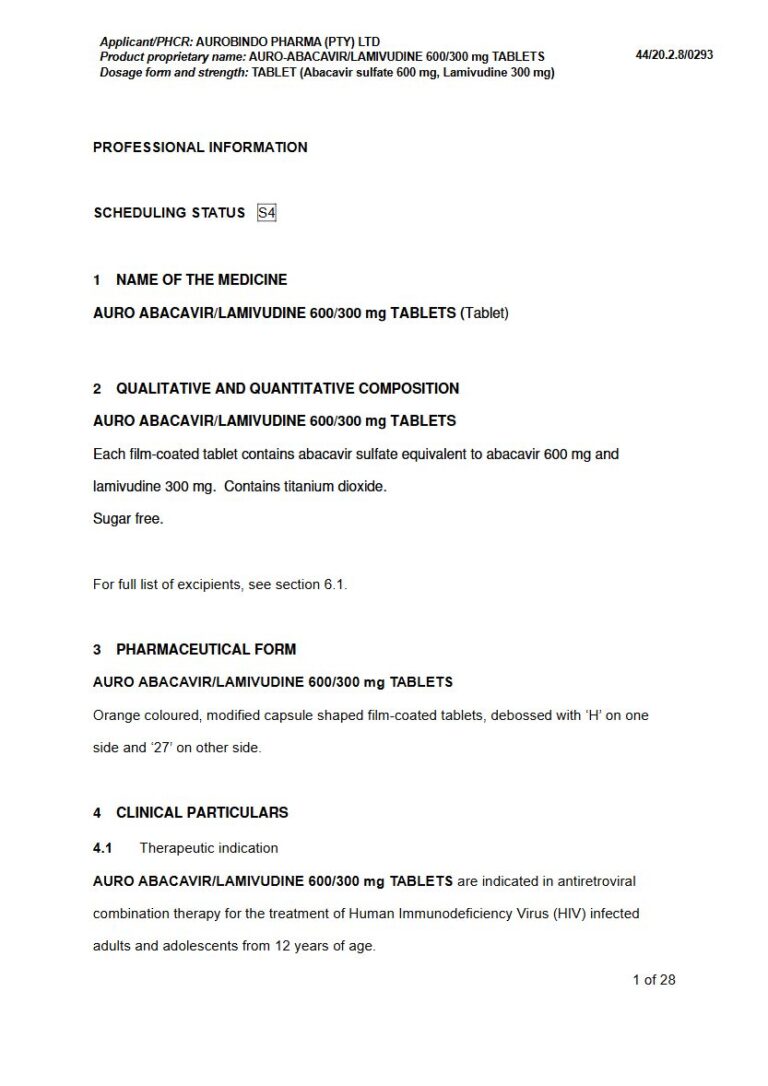
4.1 Therapeutic indication
AURO ABACAVIR/LAMIVUDINE 600/300 mg TABLETS are indicated in antiretroviral combination therapy for the treatment of Human Immunodeficiency Virus (HIV) infected adults and adolescents from 12 years of age.
4.2 Posology and method of administration
Posology Patients should be stabilised on individual medicines before being switched over to AURO ABACAVIR/ LAMIVUDINE 600/300 mg TABLETS. AURO ABACAVIR/ LAMIVUDINE 600/300 mg TABLETS. Therapy should be initiated by a medical practitioner experienced in the management of HIV infection. AURO ABACAVIR/ LAMIVUDINE 600/300 mg TABLETS should not be administered to adults or adolescents who weigh less than 40 kg because it is a fixed-dose tablet that cannot be dose reduced. AURO ABACAVIR/LAMIVUDINE 600/300 mg TABLETS can be taken with or without food. AURO ABACAVIR/LAMIVUDINE 600/300 mg TABLETS is a fixed-dose tablets and should not be prescribed for patients requiring dosage adjustments, such as those with mild hepatic impairment or those with a renal clearance less than 50 mL/min. Separate preparations of abacavir or lamivudine should be administered in cases where discontinuation of dose adjustment is indicated. In these cases the medical practitioner should refer to the individual product information for those medicines. Adults and adolescents: The recommended dosage is one tablet once daily. Special populations Renal Impairment: Whilst no dosage adjustment of abacavir is necessary for patients with renal dysfunction, a dose reduction of lamivudine is required due to decreased clearance. AURO ABACAVIR/LAMIVUDINE 600/300 mg TABLETS is not recommended for use in patients with a creatinine clearance < 50 mL/min (see section 5.2 and 4.3). Hepatic Impairment: A dose reduction of abacavir is likely to be required for patients with mild hepatic impairment, as dose reduction is not possible with AURO ABACAVIR/LAMIVUDINE 600/300 mg TABLETS the separate preparations should be used when judged necessary. AURO ABACAVIR/LAMIVUDINE 600/300 mg TABLETS must not be used on patients with moderate to severe hepatic impairment (see section 5.2). Paediatric population AURO ABACAVIR/LAMIVUDINE 600/300 mg TABLETS is not recommended for the treatment of children as the necessary dose adjustment cannot be made. Medical practitioners should refer to the individual package insert for lamivudine and abacavir. Method of administration To be taken orally.
4.3 Contraindications
AURO ABACAVIR/LAMIVUDINE 600/300 mg TABLETS are contra-indicated in patients:
- with known hypersensitivity to abacavir or lamivudine or any ingredient of AURO ABACAVIR/LAMIVUDINE 600/300 mg TABLETS (see section 6.1).
- with moderate to severe liver function impairment
- who are pregnant and breastfeeding their babies.
- Patients with moderate to severe renal impairment (creatinine clearance < 50mL/min),
- Patients who weigh less than 40 kg,
- Children younger than 12 years old.
4.4 Special warnings and precautions for use
WARNING: Hypersensitivity: In clinical studies, approximately 5 % of subjects receiving abacavir, contained in AURO ABACAVIR/LAMIVUDINE 600/300 mg TABLETS, developed a hypersensitivity reaction which in some cases proved fatal. Risk Factors: studies have shown that carriage of the HLA-B*5701 allele is associated with a significantly increased risk of a hypersensitivity reaction to abacavir. In a prospective study, use of pre-therapy screening for the HLA-B*5701 allele and subsequently avoiding abacavir in patients with this allele reduced the incidence of clinically suspected abacavir hypersensitivity reactions from 7,8 % (66 of 847) to 3,4 % (27 of 803) (p < 0,0001) and the incidence of hypersensitivity reactions confirmed by skin patch testing from 2,7 % (23 of 842) to 0,0 % (0 of 802) (p < 0,0001). Based on this study, it is estimated that 48 % to 61 % of patients with HLA-B*5701 allele will develop a hypersensitivity reaction during the course of abacavir treatment compared with 0 % to 4 % of patients who do not have the HLA-B*5701 allele. Screening for carriage of the HLA-B*5701 allele is recommended in any HIV-infected patient without prior exposure to abacavir. Screening is recommended prior to re-initiation of abacavir in patients of HLA-B*5701 status who have previously tolerated abacavir (see u201cSpecial considerations following interruption of AURO ABACAVIR/LAMIVUDINE 600/300 mg TABLETSu201d). In any patient treated with abacavir, the clinical diagnosis of suspected hypersensitivity reaction must remain the basis of clinical decision-making. Even in the absence of the HLA-B*5701 allele, it is important to permanently discontinue abacavir and not rechallenge with abacavir if a hypersensitivity reaction cannot be ruled out on clinical grounds, due to the potential for a severe or even fatal reaction. Clinical Description: The hypersensitivity reaction is characterised by the appearance of symptoms indicating multi-organ/body-system involvement. The majority of patients have fever and/or rash as part of the syndrome. The symptoms of this hypersensitivity reaction can occur at any time during treatment with AURO ABACAVIR/LAMIVUDINE 600/300 mg TABLETS, but usually appear within the first 6 weeks of initiation of treatment with AURO ABACAVIR/LAMIVUDINE 600/300 mg TABLETS (median time to onset 11 days), and most often include fever, gastrointestinal symptoms (nausea, vomiting, diarrhoea and abdominal pain), rash and fatigue or malaise. Other symptoms may include myalgia, arthralgia, oedema, paraesthesia and respiratory symptoms such as dyspnoea, sore throat or cough. The symptoms worsen with continued therapy and can be life-threatening. These symptoms usually resolve upon discontinuation of abacavir such as in AURO ABACAVIR/LAMIVUDINE 600/300 mg TABLETS. Clinical Management: Patients developing signs or symptoms of hypersensitivity MUST contact their doctor immediately for advice. If a hypersensitivity reaction is diagnosed, AURO ABACAVIR/LAMIVUDINE 600/300 mg TABLETS MUST be discontinued immediately. AURO ABACAVIR/LAMIVUDINE 600/300 mg TABLETS, or any other medicine containing abacavir, MUST NEVER be restarted following a hypersensitivity reaction, as more severe symptoms will recur within hours and may include life-threatening hypotension and death. To avoid a delay in diagnosis and minimise the risk of a life-threatening hypersensitivity reaction, AURO ABACAVIR/LAMIVUDINE 600/300 mg TABLETS should be permanently discontinued if hypersensitivity cannot be ruled out, even when other diagnoses are possible (respiratory diseases, flu-like illness, gastroenteritis or reactions to other medicines). AURO ABACAVIR/LAMIVUDINE 600/300 mg TABLETS or any other medicine containing abacavir should not be re-started even if a recurrence of symptoms occurs following rechallenge with alternative medicines. An Alert Card with information for the patient about the hypersensitivity reaction is included in the AURO ABACAVIR/LAMIVUDINE 600/300 mg TABLETS. Special considerations following an interruption of AURO ABACAVIR/LAMIVUDINE 600/300 mg TABLETS therapy: If therapy with AURO ABACAVIR/LAMIVUDINE 600/300 mg TABLETS has been discontinued and restarting therapy is under consideration, the reason for discontinuation should be evaluated to ensure that the patient did not have symptoms of a hypersensitivity reaction. Patients who have stopped AURO ABACAVIR/LAMIVUDINE 600/300 mg TABLETS due to possible adverse reactions or illness should be advised to contact their doctor before restarting. If hypersensitivity cannot be ruled out AURO ABACAVIR/LAMIVUDINE 600/300 mg TABLETS should not be restarted. There have been infrequent reports of hypersensitivity reactions following reintroduction of abacavir such as in AURO ABACAVIR/LAMIVUDINE 600/300 mg TABLETS, where the interruption was preceded by a single key symptom (e.g. rash, fever, respiratory or gastrointestinal symptoms). If a decision is made to restart AURO ABACAVIR/LAMIVUDINE 600/300 mg TABLETS in these patients this should be done only under direct medical supervision. Hypersensitivity reactions have been reported in patients who have re-started therapy, and who had no apparent preceding symptoms of a hypersensitivity reaction. If a decision is made to re-start AURO ABACAVIR/LAMIVUDINE 600/300 mg TABLETS this must be done only if medical care can be accessed readily by the patient or others. Screening for carriage of HLA-B*5701 allele is recommended prior to re-initiation of AURO ABACAVIR/LAMIVUDINE 600/300 mg TABLETS in patients of unknown HLA-B*5701 status who have previously tolerated AURO ABACAVIR/LAMIVUDINE 600/300 mg TABLETS. Re-initiation of AURO ABACAVIR/LAMIVUDINE 600/300 mg TABLETS in such patients who test positive for the HLA-B*5701 allele is not recommended. Essential patient information: Prescribers must ensure that patients are fully informed regarding the following hypersensitivity reaction:
- Patients must be made aware of the possibility of a hypersensitivity reaction to abacavir that may result in a life-threatening reaction or death.
- Patients developing signs or symptoms possibly linked with a hypersensitivity reaction MUST CONTACT their doctor IMMEDIATELY.
- Patients who are hypersensitive to abacavir should be reminded that they must never take AURO ABACAVIR/LAMIVUDINE 600/300 mg TABLETS or any abacavir containing medicine again regardless of their HLA-B*5701 status.
- In order to avoid restarting AURO ABACAVIR/LAMIVUDINE 600/300 mg TABLETS, patients who have experienced a hypersensitivity reaction should be asked to return the remaining AURO ABACAVIR/LAMIVUDINE 600/300 mg TABLETS to the pharmacy.
- Patients who have stopped AURO ABACAVIR/LAMIVUDINE 600/300 mg TABLETS for any reason, and particularly due to adverse reactions or illness, must be advised to contact their doctor before restarting.
- Each patient should be reminded to read the package insert included in the AURO ABACAVIR/LAMIVUDINE 600/300 mg TABLETS pack.
- They should be reminded of the importance of removing the Alert Card included in the pack and keeping it with them at all times.
4.5 Interaction with other medicines and other forms of interaction
Interactions relevant to lamivudine: Zalcitabine: Lamivudine may inhibit the intracellular phosphorylation of zalcitabine when the two medicines are used together. AURO ABACAVIR/LAMIVUDINE 600/300 mg TABLETS is therefore not recommended to be used in combination with zalcitabine. Trimethoprim: Administration of trimethoprim/sulfamethoxazole 160 mg/800 mg (co-trimoxazole) results in a 40 % increase in lamivudine exposure, because of the trimethoprim/component. However, unless the patient has renal impairment, no dose adjustment of lamivudine is necessary (see section 4.2). Lamivudine has no effect on the pharmacokinetics of trimethoprim or sulfamethoxazole. The effect of co-administration of lamivudine with higher doses of co-trimoxazole used for the treatment of Pneumocystis carinii pneumonia and toxoplamosis has not been studied. The likelihood of metabolic interactions with lamivudine is low due to limited metabolism and plasma protein binding, and almost complete renal clearance. Lamivudine is predominately eliminated by active organic cationic secretion. The possibility of interactions with other medicinal products administered concurrently should be considered, particularly when the main route of elimination is renal. Interactions listed herein should not be considered exhaustive, but are representative of the classes of medicinal products where caution should be exercised. Interactions relevant to abacavir: Methadone In a pharmacokinetic study, co-administration of 600 mg abacavir twice daily with methadone showed a 35 % reduction in abacavir C max and a one hour delay in t max, but AUC was unchanged. These changes in abacavir pharmacokinetics are not considered clinically relevant. In this study, abacavir increased the mean methadone systemic clearance by 22 %. This change is not considered clinically relevant for the majority of patients, however occasionally methadone dose re-titration may be required. Ethanol: The metabolism of abacavir is altered by concomitant consumption of ethanol resulting in increase in AUC if abacavir of about 41 %. Given the safety profile of abacavir, these findings are not considered clinically significant. Abacavir has no effect on the metabolism of ethanol. Retinoids: Isotretinoin Retinoid compounds are eliminated via alcohol dehydrogenase. Interaction with abacavir is possible but has not been studied. AURO ABACAVIR/LAMIVUDINE 600/300 mg TABLETS contains abacavir and lamivudine therefore any interactions for those individually relate to AURO ABACAVIR/ LAMIVUDINE 600/300 mg TABLETS. Clinical studies have shown that there are no clinically significant interactions between abacavir and lamivudine. Abacavir and lamivudine are not significantly metabolised by cytochrome P 450 enzymes (such as CYP 3A4, CYP 2C9 or CYP 206) nor do they induce or inhibit this enzyme system. Therefore, there is little potential for interactions with antiretroviral protease inhibitors, non-nucleosides and other medicinal products metabolised by major P450 enzymes.
4.6 Fertility, pregnancy and lactation
Women of childbearing potential / Contraception in males and females No information available. Pregnancy AURO ABACAVIR/ LAMIVUDINE 600/300 mg TABLETS are contra-indicated in pregnancy. Teratogenicity has been observed with AURO ABACAVIR/LAMIVUDINE 600/300 mg TABLETS. Breastfeeding AURO ABACAVIR/ LAMIVUDINE 600/300 mg TABLETS are contra-indicated in lactation. Lamivudine is excreted and abacavir may be secreted, in human milk. Fertility No fertility data available.
4.7 Effects on ability to drive and use machines
The clinical status of the patient and the adverse reaction profile of AURO ABACAVIR/LAMIVUDINE 600/300 mg TABLETS must be taken into account when considering the patientu2019s ability to drive and operate machines.
4.8 Undesirable effects
a) Summary of the safety profile AURO ABACAVIR/LAMIVUDINE 600/300 mg TABLETS contains abacavir and lamivudine, therefore the adverse effects associated with the medicines may be expected. b) Tabulated list of adverse reactions
- Frequency not known- cannot be estimated from the available data. Lamivudine: System Organ Class Adverse effect Frequency Blood and the lymphatic system disorders: Lymphopenia, leukopenia. Frequent Neutropenia, anaemia, thrombocytopenia, pure red cell aplasia. Less Frequent Metabolism and nutrition disorders: Hyperlactataemia Frequent Lactic acidosis, redistribution/accumulation of body fat. Less Frequent Nervous system disorders: Headache, insomnia Frequent Peripheral neuropathy (or paraesthesia) Less Frequent Respiratory, thoracic and mediastinal disorders: Cough, nasal symptoms Frequent Gastrointestinal disorders: Adult respiratory distress syndrome, respiratory failure. Frequency not known: Diarrhoea, abdominal pain, nausea, vomiting Frequent Rises in serum amylase, pancreatitis Less Frequent Hepato-biliary disorders: Transient rises in liver enzymes (AST, ALT), hepatitis Less Frequent: Skin and subcutaneous tissue disorders: Rash (usually maculopapular or urticarial), alopecia Frequent Arthralgia, muscle disorders Frequent: System Organ Class Adverse effect Frequency Musculoskeletal, connective tissue and bone disorders: Rhabdomyolysis Elevated creatine phosphokinase, myalgia, myolysis. Less Frequent Renal and urinary disorders: Elevated creatinine, renal failure Frequent General disorders and administration site conditions: Fatigue, fever, malaise. Frequent Abacavir: System Organ Class Adverse effect Frequency Immune system disorders Hypersensitivity, fever, rash (usually maculopapular or urticarial) Frequent Metabolism and nutrition disorders: Anorexia, hyperlactataemia Frequent Lactic acidosis, redistribution/accumulation of body fat. Less frequent Nervous system disorders Headache Frequent Gastrointestinal disorders Nausea, vomiting, diarrhoea, abdominal pain, mouth ulceration Frequent Pancreatitis Less frequent Skin and subcutaneous tissue disorders Rash (without systemic symptoms) Frequent Erythema multiforme, stevens-johnson syndrome and toxic epidermal necrolysis Less frequent General disorders and administration site conditions: Fever, lethargy, fatigue Frequent
4.9 Overdose
Symptoms: See section 4.8. Treatment: If overdosage occurs the patient should be monitored for evidence of toxicity, and standard symptomatic and supportive treatment applied as necessary. It is not known whether abacavir can be removed by peritoneal dialysis or haemodialysis. Lamivudine is dialysable. Additional information on special populations Not applicable. Paediatric population Not applicable.
