
Akeega FC Tablets
PDF Leaflet Revision Date: 26 August 2025
Clinical Summary
Quick overview from the medicine insert
Indication
Treatment for male adults with metastatic castration-resistant prostate cancer (mCRPC) with BRCA gene alterations.
Dosage (summary)
200 mg niraparib/1000 mg abiraterone acetate daily on an empty stomach.
Special Populations
- Elderly
- Hepatic impairment
- Renal impairment
Pregnancy & Breastfeeding
Not for use in women; potential for fetal harm; handle with gloves.
Key Drug Interactions
- Strong CYP3A4 inducers
- CYP2D6 substrates
- CYP2C8 substrates
Contraindications
- Hypersensitivity to components
- Moderate to severe hepatic impairment
- Women
Common side effects
- Anaemia
- Hypertension
- Thrombocytopenia
- Nausea
- Fatigue
Counselling Points
- Take on an empty stomach
- Monitor blood pressure
- Report signs of infection
Serious warnings
- Haematologic adverse reactions
- Hepatotoxicity
- Cardiovascular events
Important Disclaimer
The Akeega FC Tablets professional information leaflet below is the property of Janssen Pharmaceutica and is provided on Medinsert exactly as issued, with no.. alterations or editorial changes. We make every effort to keep content current by updating documents as soon as new versions become available. Medinsert serves as a trusted access point for healthcare professionals, but does not replace official sources or clinical judgement. For more details, please read our full disclaimer. read more>>
 Healthcare Professionals Only
This content is for registered healthcare professionals
Sign in or create a free account to read the full package insert.
Free for HPCSA-registered professionals. Powered by Medinsert.
Clinical Particulars
Section 4 of the official insert — extracted exactly as issued, no alterations
4.1 Therapeutic indications
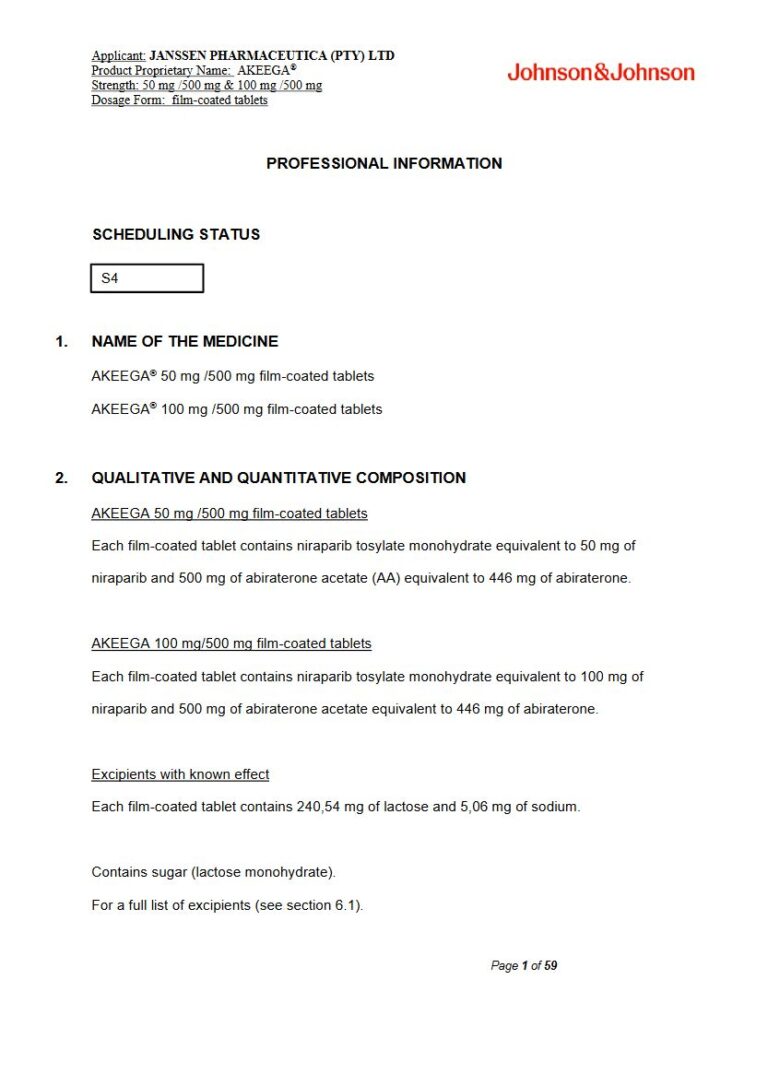
AKEEGA, the combination of niraparib and abiraterone acetate with prednisone or prednisolone, is indicated as treatment for male adults with metastatic castration-resistant prostate cancer (mCRPC) who are positive for BReast CAncer (BRCA) gene alterations (germline and/or somatic), as detected by a validated test in whom chemotherapy is not clinically indicated.
4.2 Posology and method of administration
This medicine should be prescribed and supervised by a medical practitioner experienced in the medical treatment of prostate cancer. AKEEGA is a dual action combination of niraparib, a poly [ADP-ribose] polymerase (PARP) inhibitor, and abiraterone acetate, a CYP17 inhibitor.
When considering the use of AKEEGA, positive BRCA status must be established using a validated test method (see section 5.1 - Clinical studies).
Posology
The recommended dosage of AKEEGA is 200 mg niraparib/1 000 mg abiraterone acetate (two 100 mg/500 mg tablets), as a single daily dose at approximately the same time every day. AKEEGA must be taken on an empty stomach. AKEEGA must be taken at least two hours after eating and food must not be eaten for at least one hour after taking AKEEGA. The tablets must be swallowed whole with water (see section 5.2 u2013 Absorption).
Medical castration with a gonadotropin-releasing hormone (GnRH) analogue should be continued during treatment in patients not surgically castrated.
Dosage of prednisone or prednisolone
AKEEGA is used with 10 mg prednisone or prednisolone daily.
Missed dose(s)
If a dose of either AKEEGA, prednisone or prednisolone is missed, it should be taken as soon as possible on the same day with a return to the normal schedule the following day. Extra tablets must not be taken to make up for the missed dose.
Treatment withdrawal
Treatment should be continued until disease progression or unacceptable toxicity.
Dose adjustments for adverse reactions
Non-haematologic adverse reactions
For patients who develop Grade u2265 3 non-haematologic adverse reactions, treatment should be interrupted, and appropriate medical management should be instituted (see section 4.4). Treatment with AKEEGA should not be reinitiated until symptoms of the toxicity have resolved to Grade 1 or baseline.
Haematologic adverse reactions
For patients who develop a u2265 Grade 3 or intolerable haematological toxicity, dosing with AKEEGA should be interrupted rather than discontinued, and supportive management considered. Permanently discontinue AKEEGA if haematological toxicity has not returned to acceptable levels within 28 days of the dose interruption period. The dose adjustment recommendations for thrombocytopenia and neutropenia are listed in Table 1.
4.3 Contraindications
- Hypersensitivity to abiraterone acetate, niraparib tosylate monohydrate or to any of the excipients listed in section 6.1.
- Women
- Moderate or severe hepatic impairment (Child-Pugh Class B or C) (see sections 4.2, 4.4 and 5.2)
- AKEEGA with prednisone or prednisolone is contraindicated in combination with Ra-223.
4.4 Special warnings and precautions for use
Haematologic adverse reactions (thrombocytopenia, anaemia and neutropenia) have been reported in patients treated with niraparib (see section 4.2). Testing complete blood counts weekly for the first month, every two weeks for the next two months, followed by monthly monitoring for the first year and then every other month for the remainder of treatment is recommended to monitor for clinically significant changes in any haematologic parameter while on treatment (see section 4.2). Based on individual laboratory values, weekly monitoring for the second month may be warranted. If a patient develops severe persistent haematologic toxicity including pancytopenia that does not resolve within 28 days following interruption, AKEEGA should be discontinued. Due to the risk of thrombocytopenia, other medicinal products known to reduce platelet counts should be used with caution in patients taking AKEEGA (see section 4.8).
Hypertension
AKEEGA may cause hypertension and pre-existing hypertension should be adequately controlled before starting AKEEGA treatment. Blood pressure should be monitored at least weekly for two months, monthly afterwards for the first year and every other month thereafter during treatment with AKEEGA.
Hypokalaemia, fluid retention and cardiovascular adverse reactions due to mineralocorticoid excess
AKEEGA may cause hypokalaemia and fluid retention (see section 4.8) as a consequence of increased mineralocorticoid levels resulting from CYP17 inhibition (see section 5.1). Co-administration of a corticosteroid suppresses adrenocorticotropic hormone (ACTH) drive, resulting in a reduction in incidence and severity of these adverse reactions. Caution is required in treating patients whose underlying medical conditions might be compromised by hypokalaemia (e.g., those on cardiac glycosides) or fluid retention (e.g., those with heart failure, severe or unstable angina pectoris, recent myocardial infarction, or ventricular dysrhythmia and those with severe renal impairment). QT prolongation has been observed in patients experiencing hypokalaemia in association with AKEEGA treatment. Hypokalaemia and fluid retention should be corrected and controlled. Before treating patients with a significant risk for congestive heart failure (e.g., a history of cardiac failure, or cardiac events such as ischaemic heart disease), cardiac failure should be treated, and cardiac function optimised. Fluid retention (weight gain, peripheral oedema) and other signs and symptoms of congestive heart failure should be monitored every two weeks for three months, then monthly thereafter, and abnormalities corrected.
Infections
In MAGNITUDE, severe infections including COVID-19 infections with fatal outcome occurred more frequently in patients treated with AKEEGA. Patients should be monitored for signs and symptoms of infection. Severe infections may occur in absence of neutropenia and/or leukopenia.
Pulmonary embolism (PE)
Metastatic malignant disease is a known risk factor for PE. In MAGNITUDE, PE was reported with a higher frequency in patients treated with AKEEGA compared to control. Patients with a prior history of PE or venous thrombosis may be more at risk of a further occurrence. Monitor patients for clinical signs and symptoms of PE. If clinical features of PE occur, patients should be evaluated promptly, followed by appropriate treatment.
Posterior reversible encephalopathy syndrome (PRES)
Posterior Reversible Encephalopathy Syndrome (PRES) is a rare, reversible, neurological disorder which can present with rapidly evolving symptoms including seizures, headache, altered mental status, visual disturbance, or cortical blindness, with or without associated hypertension. A diagnosis of PRES requires confirmation by brain imaging, preferably magnetic resonance imaging (MRI). There have been reports of PRES in patients receiving 300 mg niraparib (a component of AKEEGA) as a monotherapy in the ovarian cancer population. In the MAGNITUDE study, among prostate cancer patients treated with 200 mg of niraparib and 1 000 mg of abiraterone acetate plus prednisone or prednisolone, there were no PRES cases reported. In case of PRES, treatment with AKEEGA should be permanently discontinued and appropriate medical management should be instituted.
Hepatotoxicity and hepatic impairment
Marked increases in liver enzymes leading to treatment interruption or discontinuation occurred in clinical studies, although these were uncommon (see section 4.8). Serum aminotransferase and total bilirubin levels should be measured prior to starting treatment, every two weeks for the first three months of treatment, and monthly thereafter for the first year and then every other month for the duration of treatment. If clinical symptoms or signs suggestive of hepatotoxicity develop, serum aminotransferases should be measured immediately. If at any time the ALT or AST rises above 5 times the upper limit of normal (ULN) or total bilirubin rises above 3 times the ULN, treatment with AKEEGA should be interrupted and liver function closely monitored. Permanently discontinue AKEEGA for patients who develop a concurrent elevation of ALT greater than 3 times the ULN and total bilirubin greater than 2 times the ULN in the absence of biliary obstruction or other causes responsible for the concurrent elevation (see section 4.4).
4.5 Interactions with other medicines
Food effect studies with AKEEGA have not been performed; however, such studies have been conducted with the individual active substances (niraparib and abiraterone acetate). Although food does not impact exposures of niraparib, administration of food significantly increases the absorption of abiraterone acetate. AKEEGA must be taken at least two hours after eating and food must not be eaten for at least one hour after taking AKEEGA (see sections 4.2 and 5.2 u2013Absorption).
Pharmacokinetic interactions
No clinical trial evaluating drug interactions has been performed using AKEEGA. Interactions that have been identified in studies with individual components of AKEEGA (niraparib or abiraterone acetate) determine the interactions that may occur with AKEEGA.
Niraparib
No formal drug interaction studies have been performed with niraparib. In Vitro Studies Niraparib is a substrate of carboxylesterases (CEs) and UDP-glucuronosyltransferases (UGTs) in vivo. Inhibition of CYPs: Neither niraparib nor the major primary metabolite M1 is an inhibitor of CYP1A1/2, CYP2B6, CYP2C8, CYP2C9, CYP2C19, CYP2D6, and CYP3A4. The potential to inhibit CYP3A4 at the intestinal level has not been established at relevant niraparib concentrations. Therefore, caution is recommended when AKEEGA is combined with active substances, the metabolism of which is CYP3A4-dependent and, notably, those having a narrow therapeutic range (e.g., cyclosporin, tacrolimus, alfentanil, ergotamine, pimozide, quetiapine, and halofantrine), because of the niraparib component.
Induction of CYPs: Neither niraparib nor M1 is a CYP3A4 inducer in vitro. Niraparib weakly induces CYP1A2 in vitro. Therefore, caution is recommended when AKEEGA is combined with active substances, the metabolism of which is CYP1A2-dependent and, notably, those having a narrow therapeutic range (e.g., clozapine, theophylline, and ropinirole), because of the niraparib component.
Inhibition of UGTs: Niraparib did not exhibit inhibitory effect against the UGT isoforms (UGT1A1, UGT 1A4, UGT1A9, and UGT2B7) up to 200 u03bcm in vitro. Therefore, the potential for a clinically relevant inhibition of UGTs by niraparib is minimal.
Inhibition of transporter systems: Niraparib is a weak inhibitor of Breast Cancer Resistance Protein (BCRP) and P-glycoprotein (P-gp) with an IC50 = 5, 8 u03bcM and 161 u03bcM, respectively, but does not inhibit bile salt export pump (BSEP). The M1 metabolite is not an inhibitor of P-gp, BCRP, BSEP, MRP2, or Multidrug And Toxin Extrusion (MATE)-1 or 2. Neither niraparib nor M1 is an inhibitor of organic anion transport polypeptide 1B1 (OATP1B1), 1B3 (OATP1B3), or organic anion transporter 1 (OAT1), 3 (OAT3), or organic cation transporter 2 (OCT2). Caution is recommended when AKEEGA is combined with substrates of BCRP (irinotecan, rosuvastatin, simvastatin, atorvastatin, and methotrexate), because of the niraparib component.
4.6 Fertility, pregnancy and lactation
Contraception in males and females
It is not known whether components of AKEEGA or their metabolites are present in semen. During treatment and for four months after the last dose of AKEEGA:
- A condom is required if the patient is engaged in sexual activity with a pregnant woman
- A condom is required along with another effective contraceptive method if the patient is engaged in sexual activity with a woman of childbearing potential.
Studies in animals have shown reproductive toxicity (see section 5.3 u2013 Reproductive Toxicology).
Pregnancy
AKEEGA is not for use in women (see section 5.2). There are no data from the use of AKEEGA in pregnant women. AKEEGA has the potential to cause foetal harm based on the mechanism of action of both components and findings from animal studies with abiraterone acetate. Animal developmental and reproductive toxicology studies were not conducted with niraparib (see section 5.3 u2013 Reproductive Toxicology). To avoid inadvertent exposure, women who are pregnant or women who may be pregnant, should handle AKEEGA tablets with protection, e.g., gloves.
Breastfeeding
AKEEGA is not for use in women.
Fertility
There are no clinical data on fertility with AKEEGA. In animal studies, male fertility was reduced with niraparib or abiraterone acetate but these effects were reversible following treatment cessation (see section 5.3 u2013 Reproductive Toxicology).
4.7 Effects on ability to drive and use machines
Patients who take AKEEGA may experience asthenia, fatigue, dizziness or difficulties concentrating. AKEEGA may influence the ability to drive or use machines. Patients should use caution when driving or using machines.
4.8 Undesirable effects
Summary of the safety profile
The following adverse reactions have been reported with the individual components of AKEEGA but were not observed in MAGNITUDE Cohort 1: myopathy, rhabdomyolysis, adrenal insufficiency and allergic alveolitis, pancytopenia, febrile neutropenia, anaphylactic reaction, PRES, hypertensive crisis, AML/myelodysplastic syndrome. The overall safety profile of AKEEGA is based on data from a Phase 3, randomised, double-blind, placebo-controlled study, MAGNITUDE cohort 1 (BRCA positive subjects; N=113). The most common adverse reactions (AR) of all grades, occurring in > 10 % of the 113 patients in the niraparib plus abiraterone acetate plus placebo (AAP) arm were anaemia (47 %), constipation (34 %), hypertension (33 %), nausea (33 %), fatigue (25 %), thrombocytopenia (23 %), asthenia (20 %), back pain (19 %), decreased appetite (15 %), vomiting (15 %), neutropenia (14 %), arthralgia (14 %), lymphopenia (12 %), urinary tract infection (12 %), insomnia (12 %), headache (12 %), dyspnoea (12 %), cough (12 %), abdominal pain (12 %), peripheral oedema (12 %), hypokalaemia (11 %), and dizziness (11 %). The most frequently observed Grade 3 -4 adverse reactions were anaemia (28 %), hypertension (13 %), thrombocytopenia (8 %), neutropenia (7 %), blood alkaline phosphatase increased (6 %), and lymphopenia (5 %).
4.9 Overdose
There is no specific treatment in the event of AKEEGA overdose. In the event of an overdose, physicians should follow general supportive measures and treat patients symptomatically.
