
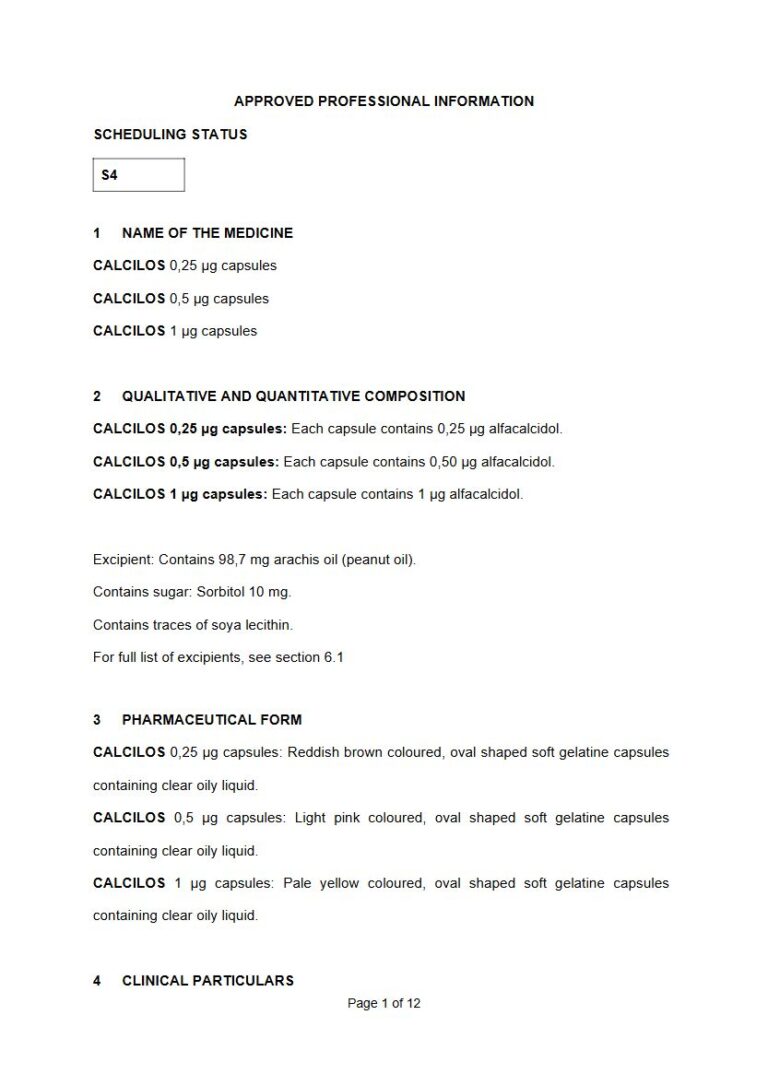
Calcilos 0,25μg/0,5 μg/1 μg Capsules
PDF Leaflet Revision Date: 7 November 2024
Clinical Summary
Quick overview from the medicine insert
Indication
Management of renal osteodystrophy and related conditions.
Dosage (summary)
Adults: 1 u03bcg daily; Elderly: 0.5 u03bcg daily; Adjust based on response.
Onset of Action / Duration
Onset: 6 hours, Duration: Varies.
Special Populations
- Renal impairment
- Elderly
Pregnancy & Breastfeeding
Contraindicated in pregnancy and breastfeeding.
Key Drug Interactions
- Thiazide diuretics
- Anticonvulsants
- Calcium preparations
Contraindications
- Hypersensitivity to ingredients
- Hypercalcaemia
- Vitamin D intoxication
Common side effects
- Hypercalcaemia
- Pruritus
- Abdominal pain
Counselling Points
- Avoid in pregnancy and breastfeeding
- Monitor calcium levels
- Report symptoms of hypercalcaemia
Serious warnings
- Risk of hypercalcaemia
- Monitor plasma calcium regularly
Important Disclaimer
The Calcilos 0,25μg/0,5 μg/1 μg Capsules professional information leaflet below is the property of Strides Pharma Sa and is provided on Medinsert exactly as issued, with no.. alterations or editorial changes. We make every effort to keep content current by updating documents as soon as new versions become available. Medinsert serves as a trusted access point for healthcare professionals, but does not replace official sources or clinical judgement. For more details, please read our full disclaimer. read more>>
 Healthcare Professionals Only
This content is for registered healthcare professionals
Sign in or create a free account to read the full package insert.
Free for HPCSA-registered professionals. Powered by Medinsert.
Clinical Particulars
Section 4 of the official insert — extracted exactly as issued, no alterations
4.1 Therapeutic indications
a) Renal osteodystrophy
b) Hypoparathyroidism
c) Hyperparathyroidism (with bone disease)
d) Hypophosphataemic vitamin D resistant rickets and osteomalacia
e) Pseudo-deficiency (vitamin D-dependent) rickets
f) Nutritional and malabsorptive rickets and osteomalacia
4.2 Posology and method of administration
Posology
Initial dose for all indications
Adults: 1 u03bcg daily
Children 20 kg body weight and above: 1 u03bcg daily
Children less than 20 kg body weight: 0,05 u03bcg/kg daily
Elderly: 0,5 u03bcg daily
It is important to adjust dosage thereafter according to the biochemical responses and to avoid hypercalcaemia.
Indices of response include levels of plasma calcium, alkaline phosphatase, parathyroid hormone, urinary calcium excretion as well as radiographic and histological investigations. Correct plasma levels should initially be measured at weekly intervals. The daily dose of Alfacalcidol may be increased by increments of 0,25 u2013 0, 5 u03bcg.
When the dose is established, plasma levels of calcium, phosphorous and creatinine should be taken every 2 - 4 weeks. Patients with marked bone disease may tolerate a higher dose without developing hypercalcaemia. However, failure of the plasma calcium to rise promptly in osteomalacic patients does not necessarily mean that a higher dose is required, since calcium from increased intestinal calcium absorption may be incorporated into demineralised bone. Most patients respond to doses between 1 to 3 u03bcg daily.
The dose requirements generally decrease in bone disorders at a time when there is biochemical or radiographic evidence of bone healing and in hypoparathyroid patients after normal plasma calcium levels have been attained. Maintenance doses are generally in the range of 0,25 to 1 u03bcg daily.
Paediatric population
For neonatal hypocalcaemia the normal starting dose of 1 u03b1 -OHD 3 is 0,05 to 0,1 u03bcg/kg/day. Adjustment of the dose thereafter is by careful titration. Whilst ionised serum calcium levels may provide a guide to response; measurement of plasma alkaline phosphatase activity may be more useful. Levels of plasma alkaline phosphatase may be markedly raised in the pre-term low birthweight infant. Whilst level of 5 times the normal adult laboratory value may be usual in this group, alkaline phosphatase levels above 7,5 times the adult range indicate active disease.
4.3 Contraindications
- Hypersensitivity to Alfacalcidol, arachis oil (peanut oil), soya or to any of the excipients (see section 6.1)
- Hypercalcaemia or evidence of vitamin D intoxication.
- Pregnancy and lactation.
4.4 Special warnings and precautions for use
1 u03b1 -OHD 3 should be given with care to patients with impaired renal function. If hypercalcaemia is induced by 1 u03b1 -OHD 3 it can be rapidly corrected by stopping treatment Throughout treatment, regular plasma calcium determinations are essential. Facilities for monitoring regular corrected plasma calcium and other appropriate biochemical parameters should be available when 1 u03b1 -OHD 3 is used.
Early symptoms include polyuria, polydipsia, weakness, headache, nausea, constipation, dry mouth, muscle and bone pain, metallic taste. If hypercalcaemia occurs, 1 u03b1 -OHD 3 should be stopped until the plasma calcium returns to normal (about one week) and then restarted at half the last dose used.
The risk of hypercalcaemia depends on such factors as the degree of any mineralisation defect, renal function, and the dose of 1 u03b1 -OHD 3 that is used. Thus, hypercalcaemia is less likely in osteomalacia and more likely in renal failure. Hypercalcaemia will occur when there is biochemical evidence of bone healing (e.g. a return towards normal in the level of plasma alkaline phosphatase) and the dose of 1 u03b1 -OHD 3 is not reduced appropriately. Prolonged hypercalcaemia should be avoided, particularly in chronic renal failure. Plasma calcium levels should be measured at weekly to monthly intervals depending on the progress of the patient. Frequent estimations are necessary in the early stages of treatment and later when there is evidence of bone healing. Plasma calcium levels should also be estimated regularly during the initial treatment of disorders without significant bone involvement, e.g. hypoparathyroidism.
Hypercalcaemia in conjunction with hyperphosphataemia increases the risk of metastatic calcifications. In diseases where hyperphosphataemia may occur, e.g. reduced kidney function, phosphate binding medicines should be used.
Patients concurrently taking barbiturates and other anticonvulsant medicines may require larger doses of 1 u03b1 -OHD 3 to produce the desired effect, as these substances may induce the hepatic metabolising enzymes.
1 u03b1 -OHD 3 should only be used during pregnancy and lactation if considered essential by the doctor. CALCILOS contains arachis oil (peanut oil) and lecithin (soya lecithin). It you are allergic to peanut or soya, do not use this medicine. Patients with rare hereditary problems of fructose intolerance should not take CALCILOS. CALCILOS contains 1 mg of alcohol (ethanol) in each dosage unit which is equivalent to 1 % v/v. The small amount of alcohol in [PRODCUT NAME] will not have any noticeable effects.
4.5 Interaction with other medicines and other forms of interaction
Thiazide diuretics and calcium containing preparations: Concurrent use of thiazide diuretics or calcium containing preparations may enhance the risk of hypercalcaemia. Calcium levels should be monitored.
Other vitamin D containing preparations: Concurrent use of other vitamin D containing preparations may enhance the risk of hypercalcaemia. Use of multiple vitamin D analogues should be avoided.
Anticonvulsants: Anticonvulsants (e.g. barbiturates, phenytoin, carbamazepine or primidone) have enzyme-inducing effects resulting in an increased metabolism of alfacalcidol. Patients taking anticonvulsants may require larger doses of CALCILOS.
Magnesium-containing antacids and laxatives: Absorption of magnesium-containing antacids may be enhanced by CALCILOS , increasing the risk of hypermagnesaemia.
Aluminium-containing preparations: CALCILOS may increase the serum concentration of aluminium. Patients taking aluminium-containing preparations (e.g. aluminium hydroxide, sucralfate) should be monitored for signs of aluminium related toxicities.
Bile acid sequestrants: Concomitant oral administration of bile acid sequestrants such as cholestyramine may impair the intestinal absorption of CALCILOS . CALCILOS should be administered at least 1 hour before, or 4 to 6 hours after the intake of the bile acid sequestrant in order to minimise the potential risk of interaction.
Alfacalcidol should be used with caution for: a) Patients concomitantly treated with digoxin as hypercalcaemia may lead to dysrhythmia in such patients. b) Patients with nephrolithiasis
4.6 Fertility, pregnancy and lactation
Pregnancy
CALCILOS should not be used in pregnancy. CALCILOS should not be used in the first trimester of pregnancy. Hypercalcaemia may produce congenital disorders. There are no adequate data from the use of CALCILOS in pregnant women. Studies in animals have shown reproductive toxicity. The potential risks for humans are unknown.
Breastfeeding
Women using CALCILOS should not breastfeed their babies. CALCILOS is suspected to be excreted into breast milk. Hypercalcaemia in the infant cannot be excluded. Because of inadequate data, breastfeeding is advised against during treatment with CALCILOS.
Fertility
There are no clinical studies on the effect of CALCILOS on fertility. A pre-clinical study did not show an effect on fertility in rats.
4.7 Effects on ability to drive and use machines
CALCILOS has no or negligible influence on the ability to drive or use machines.
4.8 Undesirable effects
a. Summary of the safety profile
The most frequently reported undesirable effects are hypercalcaemia and various skin reactions such as pruritus and rash, gastrointestinal pain/discomfort and hyperphosphataemia.
b. Tabulated summary of adverse reactions
MedDRA system organ class Frequency Adverse reactions
Metabolism and nutrition disorders Frequent Hypercalcaemia, hyperphosphataemia
Psychiatric disorders Frequency unknown Confusional state
Nervous system disorders Less frequent Headache, dizziness
Gastrointestinal disorders Frequent Abdominal pain and discomfort
Less frequent Diarrhoea, vomiting, constipation, nausea
Skin and subcutaneous tissue disorders Frequent Pruritus, rash*
* Various types of rash such as erythematous, maculo-papular and pustular rash have been reported.
Frequency unknown Urticaria
Musculoskeletal and connective tissue disorders Less frequent Myalgia
Renal and urinary disorders Frequent Hypercalciuria
Less frequent Nephrolithiasis/Nephrocalcinosis
Frequency unknown Renal impairment
General disorders and administration site conditions Less frequent Fatigue, asthenia, malaise, calcinosis
4.9 Overdose
The initial signs and symptoms of vitamin D intoxication associated with hypercalcaemia include weakness, fatigue, somnolence, headache, anorexia, nausea, vomiting, diarrhoea, and pruritus. If hypercalcaemia is allowed to persist, the following may also develop: conjunctivitis, a shortened Q-T interval and cardiac dysrhythmias, manifestations of impaired renal function consisting of polyuria, polydipsia, nocturia, hyposthenuria, dehydration and mild proteinuria. Agitation, apprehension, pain in the extremities, paralytic ileus, abdominal pain and, rarely, overt psychosis. Some mild elevations in AST and ALT have been reported in a small percentage of patients treated with CALCILOS.
Treatment of hypercalcaemia and overdosage in patients on haemodialysis: General treatment of hypercalcaemia (greater than 0,25 mmol/l above the upper limit of the normal range) consists of immediate discontinuation of CALCILOS therapy, institution of a low calcium diet and withdrawal of calcium supplements.
General supportive measures: Keep the patient well hydrated by IV infusion of 0.9 % sodium chloride (forced diuresis), measure electrolytes, calcium and renal function indices; assess electrocardiographic abnormalities, especially in patients on digoxin.
Specific treatment: Glucocorticosteroids, loop diuretics, bisphosphonates, calcitonin and eventually haemodialysis with low calcium content dialysis fluid. Serum calcium levels should be determined daily until normocalcaemia ensues. Hypercalcaemia frequently resolves in two to seven days. When serum calcium levels have returned to within normal limits, therapy may be reinstituted at a dose of 0,25 u03bcg/day less than prior therapy. Serum calcium levels should be obtained at least twice weekly after all dosage changes and subsequent dosage titration. Persistent or markedly elevated serum calcium levels may be corrected by dialysis against a calcium-free dialysate.
