
Rapifen 0.5mg / 2ml Injection
PDF Leaflet Revision Date: 12 May 2023
Clinical Summary
Quick overview from the medicine insert
Indication
Narcotic analgesic for general anaesthesia.
Dosage (summary)
Initial IV bolus of 7-15 u03bcg/kg for short procedures; adjust for age and condition.
Onset of Action / Duration
Onset: 1 min, Duration: 11-17 mins
Special Populations
- Elderly
- Hepatic impairment
- Renal impairment
Pregnancy & Breastfeeding
Not established safe in pregnancy; avoid during childbirth; may enter breast milk.
Key Drug Interactions
- MAO inhibitors
- CYP3A4 inhibitors
- Other CNS depressants
Contraindications
- Intolerance to opioids
- Respiratory depression risk
- Myasthenia gravis
Common side effects
- Respiratory depression
- Bradycardia
- Nausea
- Muscle rigidity
Counselling Points
- Ensure monitoring equipment available
- Have naloxone ready
- Avoid driving for 6-24 hours post-dose
Serious warnings
- Risk of bradycardia and cardiac arrest
- Monitor heart rate
- Avoid rapid bolus injections
Important Disclaimer
The Rapifen 0.5mg / 2ml Injection professional information leaflet below is the property of Piramal Critical Care and is provided on Medinsert exactly as issued, with no.. alterations or editorial changes. We make every effort to keep content current by updating documents as soon as new versions become available. Medinsert serves as a trusted access point for healthcare professionals, but does not replace official sources or clinical judgement. For more details, please read our full disclaimer. read more>>
 Healthcare Professionals Only
This content is for registered healthcare professionals
Sign in or create a free account to read the full package insert.
Free for HPCSA-registered professionals. Powered by Medinsert.
Clinical Particulars
Section 4 of the official insert — extracted exactly as issued, no alterations
4.1 Indications
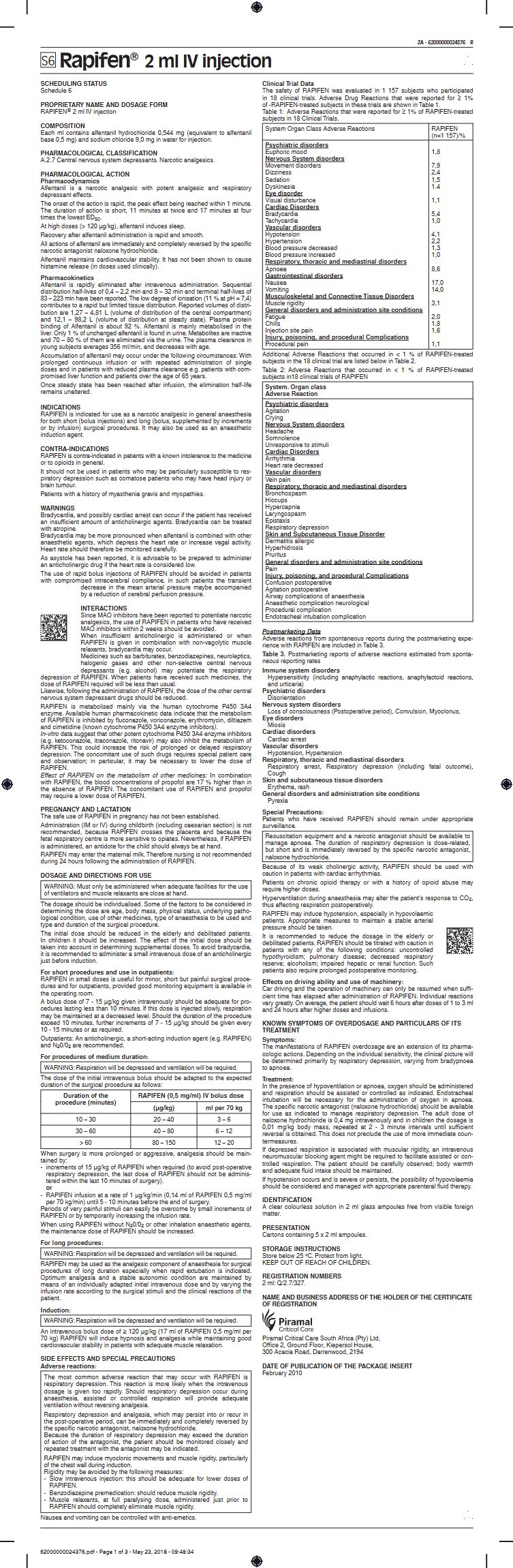
RAPIFEN is indicated for use as a narcotic analgesic in general anaesthesia for both short (bolus injections) and long (bolus, supplemented by increments or by infusion) surgical procedures. It may also be used as an anaesthetic induction agent.
4.2 Posology and method of administration
WARNING: Must only be administered when adequate facilities for the use of ventilators and muscle relaxants are close at hand. The dosage should be individualised. Some of the factors to be considered in determining the dose are age, body mass, physical status, underlying pathological condition, use of other medicines, type of anaesthesia to be used and type and duration of the surgical procedure. The initial dose should be reduced in the elderly and debilitated patients. In children it should be increased. The effect of the initial dose should be taken into account in determining supplemental doses. To avoid bradycardia, it is recommended to administer a small intravenous dose of an anticholinergic just before induction.
For short procedures and use in outpatients: RAPIFEN in small doses is useful for minor, short but painful surgical procedures and for outpatients, provided good monitoring equipment is available in the operating room. A bolus dose of 7 - 15 u03bcg/kg given intravenously should be adequate for procedures lasting less than 10 minutes. If this dose is injected slowly, respiration may be maintained at a decreased level. Should the duration of the procedure exceed 10 minutes, further increments of 7 - 15 u03bcg/kg should be given every 10 - 15 minutes or as required. Outpatients: An anticholinergic, a short-acting induction agent (e.g. RAPIFEN) and N2O/O2 are recommended.
For procedures of medium duration: WARNING: Respiration will be depressed and ventilation will be required. The dose of the initial intravenous bolus should be adapted to the expected duration of the surgical procedure as follows:
- Duration of the procedure (minutes) RAPIFEN (0,5 mg/ml) IV bolus dose (u03bcg/kg) ml per 70 kg
- 10 u2013 30 20 u2013 40 3 u2013 6
- 30 u2013 60 40 u2013 80 6 u2013 12
- > 60 80 u2013 150 12 u2013 20
When surgery is more prolonged or aggressive, analgesia should be maintained by:
- increments of 15 u03bcg/kg of RAPIFEN when required (to avoid post-operative respiratory depression, the last dose of RAPIFEN should not be administered within the last 10 minutes of surgery).
- or RAPIFEN infusion at a rate of 1 u03bcg/kg/min (0,14 ml of RAPIFEN 0,5 mg/ml per 70 kg/min) until 5 - 10 minutes before the end of surgery. Periods of very painful stimuli can easily be overcome by small increments of RAPIFEN or by temporarily increasing the infusion rate. When using RAPIFEN without N2O/O2 or other inhalation anaesthetic agents, the maintenance dose of RAPIFEN should be increased.
For long procedures: WARNING: Respiration will be depressed and ventilation will be required. RAPIFEN may be used as the analgesic component of anaesthesia for surgical procedures of long duration especially when rapid extubation is indicated. Optimum analgesia and a stable autonomic condition are maintained by means of an individually adapted initial intravenous dose and by varying the infusion rate according to the surgical stimuli and the clinical reactions of the patient.
Induction: WARNING: Respiration will be depressed and ventilation will be required. An intravenous bolus dose of u2265 120 u03bcg/kg (17 ml of RAPIFEN 0,5 mg/ml per 70 kg) RAPIFEN will induce hypnosis and analgesia while maintaining good cardiovascular stability in patients with adequate muscle relaxation.
4.3 Contraindications
RAPIFEN is contra-indicated in patients with a known intolerance to the medicine or to opioids in general. It should not be used in patients who may be particularly susceptible to respiratory depression such as comatose patients who may have head injury or brain tumour. Patients with a history of myasthenia gravis and myopathies.
4.4 Special warnings and precautions for use
Bradycardia, and possibly cardiac arrest can occur if the patient has received an insufficient amount of anticholinergic agents. Bradycardia can be treated with atropine. Bradycardia may be more pronounced when alfentanil is combined with other anaesthetic agents, which depress the heart rate or increase vagal activity. Heart rate should therefore be monitored carefully. As asystole has been reported, it is advisable to be prepared to administer an anticholinergic drug if the heart rate is considered low. The use of rapid bolus injections of RAPIFEN should be avoided in patients with compromised intracerebral compliance, in such patients the transient decrease in the mean arterial pressure may be accompanied by a reduction of cerebral perfusion pressure.
4.5 Interactions with other medicines
Since MAO inhibitors have been reported to potentiate narcotic analgesics, the use of RAPIFEN in patients who have received MAO inhibitors within 2 weeks should be avoided. When insufficient anticholinergic is administered or when RAPIFEN is given in combination with non-vagolytic muscle relaxants, bradycardia may occur. Medicines such as barbiturates, benzodiazepines, neuroleptics, halogenic gases and other non-selective central nervous depressants (e.g. alcohol) may potentiate the respiratory depression of RAPIFEN. When patients have received such medicines, the dose of RAPIFEN required will be less than usual. Likewise, following the administration of RAPIFEN, the dose of the other central nervous system depressant drugs should be reduced. RAPIFEN is metabolised mainly via the human cytochrome P450 3A4 enzyme. Available human pharmacokinetic data indicate that the metabolism of RAPIFEN is inhibited by fluconazole, voriconazole, erythromycin, diltiazem and cimetidine (known cytochrome P450 3A4 enzyme inhibitors). In-vitro data suggest that other potent cytochrome P450 3A4 enzyme inhibitors (e.g. ketoconazole, itraconazole, ritonavir) may also inhibit the metabolism of RAPIFEN. This could increase the risk of prolonged or delayed respiratory depression. The concomitant use of such drugs requires special patient care and observation; in particular, it may be necessary to lower the dose of RAPIFEN.
Effect of RAPIFEN on the metabolism of other medicines: In combination with RAPIFEN, the blood concentrations of propofol are 17 % higher than in the absence of RAPIFEN. The concomitant use of RAPIFEN and propofol may require a lower dose of RAPIFEN.
4.6 Fertility, pregnancy and lactation
The safe use of RAPIFEN in pregnancy has not been established. Administration (IM or IV) during childbirth (including caesarian section) is not recommended, because RAPIFEN crosses the placenta and because the fetal respiratory centre is more sensitive to opiates. Nevertheless, if RAPIFEN is administered, an antidote for the child should always be at hand. RAPIFEN may enter the maternal milk. Therefore nursing is not recommended during 24 hours following the administration of RAPIFEN.
4.7 Effects on ability to drive and use machines
Car driving and the operation of machinery can only be resumed when sufficient time has elapsed after administration of RAPIFEN. Individual reactions vary greatly. On average, the patient should wait 6 hours after doses of 1 to 3 ml and 24 hours after higher doses and infusions.
4.8 Undesirable effects
The most common adverse reaction that may occur with RAPIFEN is respiratory depression. This reaction is more likely when the intravenous dosage is given too rapidly. Should respiratory depression occur during anaesthesia, assisted or controlled respiration will provide adequate ventilation without reversing analgesia. Respiratory depression and analgesia, which may persist into or recur in the post-operative period, can be immediately and completely reversed by the specific narcotic antagonist, naloxone hydrochloride. Because the duration of respiratory depression may exceed the duration of action of the antagonist, the patient should be monitored closely and repeated treatment with the antagonist may be indicated. RAPIFEN may induce myoclonic movements and muscle rigidity, particularly of the chest wall during induction. Rigidity may be avoided by the following measures:
- Slow intravenous injection: this should be adequate for lower doses of RAPIFEN.
- Benzodiazepine premedication: should reduce muscle rigidity.
- Muscle relaxants, at full paralysing dose, administered just prior to RAPIFEN should completely eliminate muscle rigidity.
Nausea and vomiting can be controlled with anti-emetics.
4.9 Overdose
The manifestations of RAPIFEN overdosage are an extension of its pharmacologic actions. Depending on the individual sensitivity, the clinical picture will be determined primarily by respiratory depression, varying from bradypnoea to apnoea.
Treatment: In the presence of hypoventilation or apnoea, oxygen should be administered and respiration should be assisted or controlled as indicated. Endotracheal intubation will be necessary for the administration of oxygen in apnoea. The specific narcotic antagonist (naloxone hydrochloride) should be available for use as indicated to manage respiratory depression. The adult dose of naloxone hydrochloride is 0,4 mg intravenously and in children the dosage is 0,01 mg/kg body mass, repeated at 2 - 3 minute intervals until sufficient reversal is obtained. This does not preclude the use of more immediate countermeasures. If depressed respiration is associated with muscular rigidity, an intravenous neuromuscular blocking agent might be required to facilitate assisted or controlled respiration. The patient should be carefully observed; body warmth and adequate fluid intake should be maintained. If hypotension occurs and is severe or persists, the possibility of hypovolaemia should be considered and managed with appropriate parenteral fluid therapy.
