
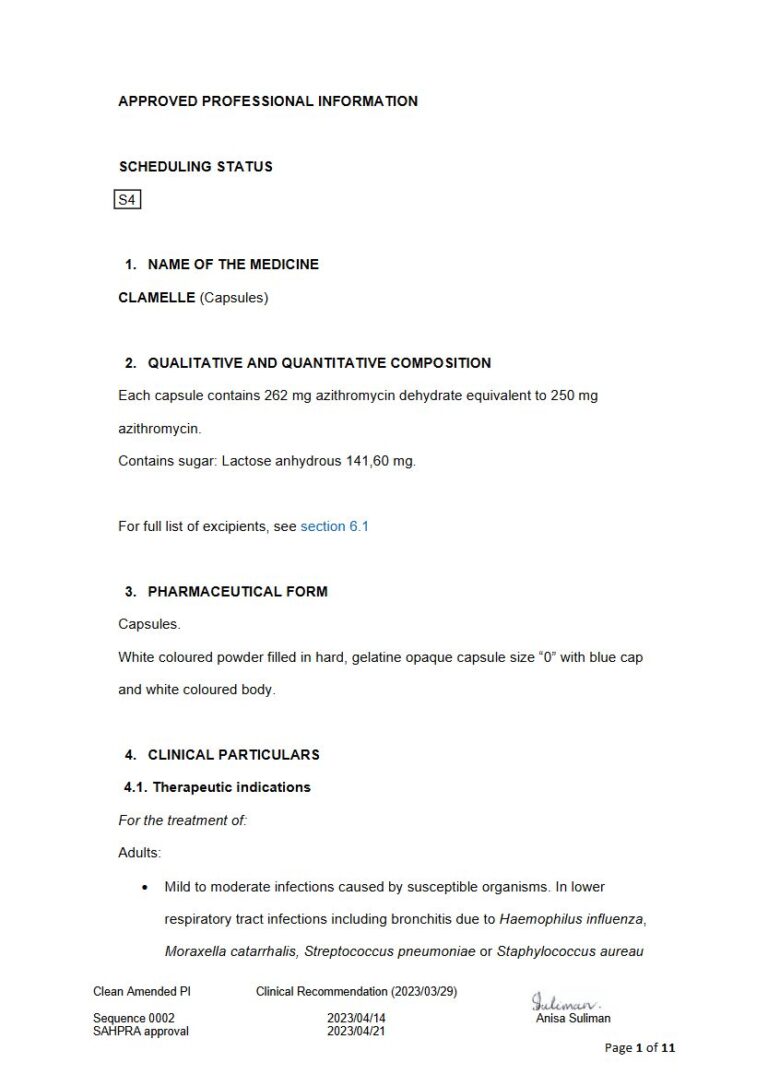
Clamelle 250 mg Capsules.
PDF Leaflet Revision Date: 21 April 2023
Clinical Summary
Quick overview from the medicine insert
Indication
Treatment of mild to moderate infections caused by susceptible organisms.
Dosage (summary)
Adults: 500 mg on day 1, then 250 mg daily for 4 days or 1.5 g total over 3 days.
Special Populations
- Elderly
- Renal impairment
- Hepatic impairment
Pregnancy & Breastfeeding
Contraindicated in pregnancy and lactation; safety not established.
Key Drug Interactions
- Antacids
- Ergot alkaloids
- Digoxin
- Warfarin
Contraindications
- Hypersensitivity to azithromycin
- Co-administration with ergot alkaloids
- Hepatic impairment
Common side effects
- Nausea
- Diarrhoea
- Headache
- Dizziness
- Fatigue
Counselling Points
- Take at least 1 hour before or 2 hours after meals
- Monitor for allergic reactions
- Avoid driving until effects are known
Serious warnings
- Anaphylaxis
- Pseudomembranous colitis
- Super-infection risk
Important Disclaimer
The Clamelle 250 mg Capsules. professional information leaflet below is the property of Strides Pharma Sa and is provided on Medinsert exactly as issued, with no.. alterations or editorial changes. We make every effort to keep content current by updating documents as soon as new versions become available. Medinsert serves as a trusted access point for healthcare professionals, but does not replace official sources or clinical judgement. For more details, please read our full disclaimer. read more>>
 Healthcare Professionals Only
This content is for registered healthcare professionals
Sign in or create a free account to read the full package insert.
Free for HPCSA-registered professionals. Powered by Medinsert.
Clinical Particulars
Section 4 of the official insert — extracted exactly as issued, no alterations
4.1. Therapeutic indications
For the treatment of:
Adults:
- Mild to moderate infections caused by susceptible organisms. In lower respiratory tract infections including bronchitis due to Haemophilus influenza, Moraxella catarrhalis, Streptococcus pneumoniae or Staphylococcus aureau and pneumoniae due to Streptococcus pneumoniae or Haemophilus influenza.
- Uncomplicated skin and soft tissue infection.
- Sinusitis due to Haemophilus influenza, Streptococcus pneumoniae or Staphylococcus aereus.
- Uncomplicated genital infections due to Chlamydia trachomatis in men and women with sexually transmitted diseases.
Children (5 years of age and over):
- Acute otitis media and pharyngitis/tonsillitis caused by susceptible organisms in children.
4.2. Posology and method of administration
Posology
Take the recommended dose at least 1 hour before, or 2 hours after a meal.
For sexually transmitted diseases caused by Chlamydia trachomatis:
- A single dose of 1 g azithromycin.
Other infections:
- Adults and children, 16 years and over: A total dose of 1,5 g which should be given as 500 mg daily for 3 days or alternatively an initial single oral dose of 500 mg on day 1, then 250 mg as a single daily dose for 4 days.
Special populations
- Elderly persons: The normal adult dosage is recommended.
- Paediatric population: Children, 45 kg and over: Dose as for adults.
Method of administration
For oral administration.
4.3. Contraindications
- Hypersensitivity to azithromycin, erythromycin, or any of the macrolide antibiotics.
- Co-administration with ergot alkaloids.
- Hepatic impairment - since biliary excretion is the major route of elimination.
- Pregnancy and lactation: the safety in pregnancy and lactation has not been established (see section 4.6).
4.4. Special warnings and precautions for use
- Serious allergic reactions such as anaphylaxis angioedema, fever, eosinophilia, and skin eruptions have rarely been reported. Despite discontinuation of CLAMELLE and successful symptomatic treatment of the allergic reactions, allergic symptoms have recurred in some patients when the symptomatic therapy was discontinued. These patients may require prolonged periods of observation and symptomatic treatment.
- Pseudomembranous colitis has been reported and may range in severity from mild to life threatening. It is important to consider the possibility of pseudomembranous colitis in patients that develop diarrhoea subsequent to the administration of azithromycin.
- Signs of super-infection of non-susceptible organisms should be observed.
- Caution should be used when CLAMELLE is prescribed for patients with renal impairment, as no data regarding the use of azithromycin in these patients is available.
- Ergotism is theoretically possible therefore CLAMELLE should not be administered with ergot derivates.
- CLAMELLE contains lactose (as lactose anhydrous). Patients with the rare hereditary problems of galactose intolerance, total lactase deficiency or glucose-galactose malabsorption should not take CLAMELLE.
4.5. Interaction with other medicines and other forms of interaction
Antacids: As the concurrent use of aluminium and magnesium-containing antacids decrease the peak serum concentration of azithromycin, it is advisable that azithromycin be administered at least 1 hour before or 2 hours after taking the antacids.
Cimetidine: No effect on the pharmacokinetics of azithromycin was observed after the administration of a single dose of cimetidine two hours prior to the administration of CLAMELLE capsules.
Methylprednisolone: No significant evidence of any interaction was observed, when administered with azithromycin.
Zidovudine: No significant effects on the pharmacokinetic parameters of zidovudine and its glucuronide metabolite were found in the preliminary studies of HIV-positive patients. A shortening in the time to reach maximal concentration when the first and the last day levels were compared, was found in the pharmacokinetics of azithromycin.
Ergot alkaloids: Ergot alkaloids has been associated with acute ergot toxicity characterised by severe peripheral vasospasm and dysesthesia. Co-administration of CLAMELLE and ergot alkaloids is not recommended (see section 4.3).
General: Azithromycin may potentiate the effects of astemizole, carbamazepine, corticosteroids, cyclosporine, digoxin (may increase serum digoxin concentrations, therefore monitoring of digoxin serum concentrations is recommended), terfenadine (may increase serum concentration of terfenadine, therefore monitoring of serum levels of terfenadine is recommended), theophylline (the area under the plasma concentrationu2013time curve may be increased, therefore monitoring of theophylline serum concentrations is recommended), triazolam, valproate and warfarin (prothrombin time should be monitored) by the possible interference with cytochrome P450-mediated metabolism of these medicines.
4.6. Fertility, pregnancy and lactation
Pregnancy and lactation: the safety in pregnancy and lactation has not been established. CLAMELLE is contra-indicated during pregnancy and breastfeeding (see section 4.3).
Fertility: No data on fertility is available.
4.7. Effects on ability to drive and use machines
No data are available regarding the influence of CLAMELLE on a patient's ability to drive or operate machinery. However, the possibility of undesirable effects like dizziness, somnolence, fatigue, and convulsions should be considered when performing these activities (see section 4.8). Patients are therefore advised not to drive or use machinery or engage in other activities requiring mental alertness and coordination until they have established how CLAMELLE affects them.
4.8. Undesirable effects
a. Summary of the safety profile
Use of CLAMELLE may cause an overgrowth of non-susceptible organisms. Appropriate measures should be taken to prevent or treat such superinfection.
b. Tabulated summary of adverse reactions
The adverse reactions are listed below according to system organ class.
MedDRA system organ class
Frequency
Adverse reactions
Infections and infestations
Frequency unknown
Vaginitis.
Blood and lymphatic system disorders
Frequent
Neutropoenia.
Immune system disorders
Less frequent
1 Anaphylaxis and angioedema.
Nervous system disorders
Frequent
Headache, dizziness, tinnitus, hearing loss, convulsions, somnolence, vertigo, fatigue, asthenia, paraesthesia.
Ear and labyrinth disorders
Frequency unknown
2 Transient auditory impairment.
Cardiac disorders
Less Frequent
Palpitations, arrhythmias including ventricular tachycardia, chest pain.
Gastrointestinal disorders
Frequent
Nausea, anorexia, vomiting, abdominal pain, flatulence, diarrhoea, loose stools, constipation, dyspepsia, melaena, taste changes.
Less frequent
Pseudomembranous colitis (abdominal cramps or pain, tenderness, severe, watery diarrhoea which may also be bloody, fever).
Skin and subcutaneous tissue disorders
Less frequent
Erythema multiforme, Stevenu2019s-Johnson syndrome, toxic epidermal necrolysis.
Frequency unknown
Photosensitivity.
Hepatobiliary disorders
Less frequent
Cholestatic jaundice, hepatitis, transient elevations in liver enzymes (elevated liver transaminases and bilirubin values).
Renal and urinary disorders
Less frequent
Acute interstitial nephritis: fever, skin rash and painful joints.
c. Description of selected adverse reaction
1 Serious allergic reactions such as anaphylaxis and angioedema have rarely been reported. These patients may require prolonged periods of observation and symptomatic treatment.
2 Transient auditory impairment is a potential complication when higher doses of azithromycin are used for prolonged periods of time.
Reporting of suspected adverse reactions
Reporting suspected adverse reactions after authorisation of the medicine is important. It allows continued monitoring of the benefit/risk balance of the medicine. Health care providers are asked to report any suspected adverse reactions to SAHPRA via the u201c6.04 Adverse Drug Reactions Reporting Formu201d, found online under SAHPRAu2019s publications: https://www.sahpra.org.za/Publications/Index/8
4.9. Overdose
There is no data on overdosage with azithromycin. Typical symptoms may include nausea, vomiting and diarrhoea. Transient hearing loss may occur. Gastric lavage is indicated. Treatment is symptomatic and supportive.
