
Austell Azithromycin 200 mg/5 ml Suspension
PDF Leaflet Revision Date: 15 January 2025
Clinical Summary
Quick overview from the medicine insert
Indication
Treatment of mild to moderate infections caused by susceptible organisms.
Dosage (summary)
Adults: 500 mg once daily for 3 days. Children: 10 mg/kg once daily for 3 days.
Special Populations
- Hepatic impairment
- Renal impairment
- Myasthenia gravis
Pregnancy & Breastfeeding
Safety in pregnancy and lactation not established; present in breast milk.
Key Drug Interactions
- Antacids
- Digoxin
- Hydroxychloroquine
- Chloroquine
Contraindications
- Hypersensitivity to azithromycin
- Hepatic disease
- Co-administration with ergot derivatives
Common side effects
- Diarrhea
- Nausea
- Dizziness
- Headache
Counselling Points
- Take with food
- Monitor for signs of liver dysfunction
- Avoid co-administration with ergot derivatives
Serious warnings
- Serious allergic reactions
- Hepatotoxicity
- QT prolongation
Important Disclaimer
The Austell Azithromycin 200 mg/5 ml Suspension professional information leaflet below is the property of Austell Pharmaceuticals and is provided on Medinsert exactly as issued, with no.. alterations or editorial changes. We make every effort to keep content current by updating documents as soon as new versions become available. Medinsert serves as a trusted access point for healthcare professionals, but does not replace official sources or clinical judgement. For more details, please read our full disclaimer. read more>>
 Healthcare Professionals Only
This content is for registered healthcare professionals
Sign in or create a free account to read the full package insert.
Free for HPCSA-registered professionals. Powered by Medinsert.
Clinical Particulars
Section 4 of the official insert — extracted exactly as issued, no alterations
4.1 Therapeutic indications
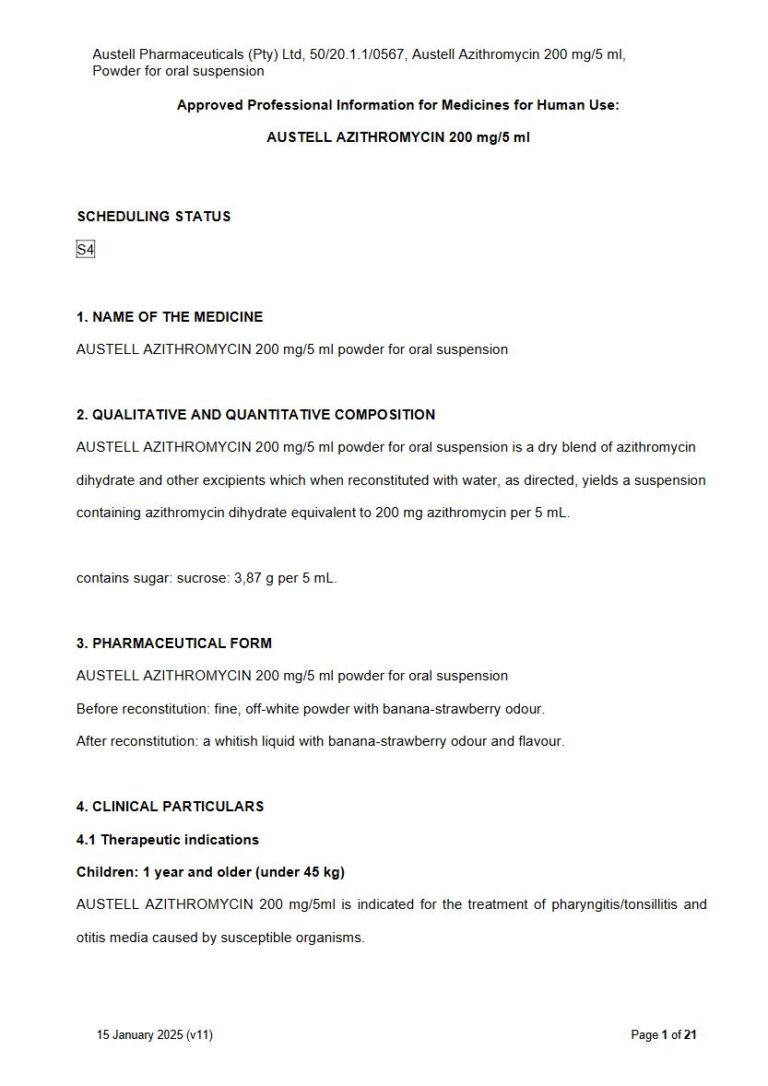
Children: 1 year and older (under 45 kg) AUSTELL AZITHROMYCIN 200 mg/5m l is indicated for the treatment of pharyngitis / tonsillitis and otitis media caused by susceptible organisms.
Adults and children over 45 kg AUSTELL AZITHROMYCIN 200 mg/5m l is indicated for mild to moderate infections caused by susceptible organisms; in lower respiratory tract infections including bronchitis due to Haemophilus influenzae, Moraxella catarrhalis, Streptococcus pneumoniae or Staphylococcus aureus and pneumonia due to Streptococcus pneumoniae or Haemophilus influenzae; uncomplicated skin and soft tissue infections; sinusitis due to Haemophilus influenzae, Streptococcus pneumoniae or Staphylococcus aureus; and as an alternative to first line therapy of pharyngitis/tonsillitis.
4.2 Posology and method of administration
Posology AUSTELL AZITHROMYCIN 200 mg/5 m l powder for oral suspension should be administered as a single daily dose. AUSTELL AZITHROMYCIN 200 mg/5 m l suspension should be administered to children using the 5 mL oral dosing syringe or the spoon provided. AUSTELL AZITHROMYCIN 200 mg/5 m l suspension can be taken with food.
Paediatric population Use in children: 1 year and older The total dose in children is 30 mg/kg which should be given as a single daily dose of 10 mg/kg for 3 days according to the following guidance:
- Weight Dosage
- < 15 kg 10 mg/kg once daily on days 1 - 3
- 15 - 25 kg 200 mg (5 mL) once daily on days 1 - 3
- 26 u2013 35 kg 300 mg (7.5 mL) once daily on days 1 - 3
- 36 u2013 45 kg > 45 kg: 400 mg (10 mL) once daily on days 1 u2013 3
Method of administration AUSTELL AZITHROMYCIN 200 mg/5 m l is for oral administration only. See reconstitution of suspension in section 6.6.
4.3 Contraindications
- Hypersensitivity to azithromycin, erythromycin, or to any of the macrolide antibiotics or to any of the excipients listed in section 6.1.
- Because of the theoretical possibility of ergotism, AUSTELL AZITHROMYCIN 200 mg/5 m l and ergot derivatives should not be co-administered.
- Use in hepatic impairment: As the liver is the principal route of excretion of AUSTELL AZITHROMYCIN 200 mg/5 m l, it should not be used in patients with hepatic disease.
- Use during pregnancy and lactation: The safety and efficacy of AUSTELL AZITHROMYCIN 200 mg/5 m l in pregnancy and lactation have not been established.
4.4 Special warnings and precautions for use
Hypersensitivity As with erythromycin and other macrolides, serious allergic reactions including angioedema and anaphylaxis (rarely fatal), Acute Generalized Exanthematous Pustulosis (AGEP) and Drug Reaction with Eosinophilia and Systemic Symptoms (DRESS) have been reported. Some of these reactions with azithromycin have resulted in recurrent symptoms and required a longer period of observation and treatment.
Hepatotoxicity Cases of fulminant hepatitis potentially leading to life-threatening liver with azithromycin (see section 4.8). In case of signs and symptoms of liver dysfunction, such as rapid developing asthenia associated with jaundice, dark urine, bleeding tendency or hepatic encephalopathy, liver function tests/investigations should be performed immediately. Azithromycin administration should be stopped if liver dysfunction has emerged.
Infantile hypertrophic pyloric stenosis (IHPS) Following the use of azithromycin in neonates (treatment up to 42 days of life), infantile hypertrophic pyloric stenosis (IHPS) has been reported. Parents and caregivers should be informed to contact their medical practitioners if vomiting or irritability with feeding occurs.
Ergot derivatives In patients receiving ergot derivatives, ergotism has been precipitated by co-administration of some macrolide antibiotics. There are no data concerning the possibility of an interaction between ergot and azithromycin. However, because of the theoretical possibility of ergotism, azithromycin and ergot derivatives should not be co-administered.
Prolongation of the QT interval Prolonged cardiac repolarisation and QT interval, imparting a risk of developing cardiac dysrhythmia and torsades de pointes, have been seen in treatment with other macrolides. A similar effect with azithromycin cannot be completely ruled out in patients at increased risk for prolonged cardiac repolarisation (see section 4.8); therefore, caution is required when treating patients:
- with congenital or documented QT prolongation
- currently receiving treatment with other active substances known to prolong the QT interval such as antiarrhythmics of Classes Ia and III, cisapride and terfenadine
- with electrolyte disturbance, particularly in case of hypokalemia and hypomagnesemia,
- with clinically relevant bradycardia, cardiac arrhythmia or severe cardiac insufficiency.
Superinfection Observation for signs of superinfection with non-susceptible organisms including fungi is recommended.
Clostridium difficile associated diarrhoea Clostridium difficile associated diarrhoea (CDAD) has been reported with the use of nearly all antibacterial medicine, including azithromycin, and may range in severity from mild diarrhoea to fatal colitis. Strains of C.difficile producing hypertoxin A and B contribute to the development of CDAD. Hypertoxin producing strains of C.difficile cause increased morbidity and mortality, as these infections can be refractory to antimicrobial therapy and may require colectomy. Therefore, CDAD must be considered in patients who present with diarrhoea during or subsequent to the administration of any antibiotics. Careful medical history is necessary since CDAD has been reported to occur over 2 months after the administration of antibacterial medicines. Discontinuation of therapy with azithromycin and the administration of specific treatment for C.difficile should be considered.
Streptococcal infections Penicillin is usually the first choice for treatment of pharyngitis/tonsilitis due to Streptococcus pyogenes and also for prophylaxis of acute rheumatic fever. Azithromycin is in general effective against streptococcus in the oropharynx, but no data are available that demonstrate the efficacy of azithromycin in preventing acute rheumatic fever.
Renal impairment In patients with severe renal impairment (GFR u02c2 10 mL/min), 33 % increase in the systemic exposure to azithromycin was observed (see section 5.2).
Myasthenia gravis Exacerbations of the symptoms of myasthenia gravis and new onset of myasthenia syndrome have been reported in patients receiving azithromycin therapy (see section 4.8).
Hydroxychloroquine or chloroquine Carefully consider the balance of benefits and risks before prescribing azithromycin for any patients taking hydroxychloroquine or chloroquine, because of the potential for an increased risk of cardiovascular events and cardiovascular mortality (see section 4.5).
Diabetes Caution in diabetic patients: 5 mL of reconstituted suspension contains 3.87 g of sucrose.
Paediatric population Safety and efficacy in children under 1 year of age have not been established. Following the use of azithromycin, such as AUSTELL AZITHROMYCIN 200 mg/5 m l, in neonates (treatment up to 42 days of life), infantile hypertrophic pyloric stenosis (IHPS) has been reported. Parents and caregivers should be instructed to contact their doctor if vomiting or irritability with feeding occurs.
Excipient sucrose This medicine contains sucrose: patients with rare hereditary problems of fructose intolerance, glucose-galactose malabsorption or sucrose-isomaltase insufficiency should not take this medicine.
4.5 Interaction with other medicines and other forms of interaction
Antacids AUSTELL AZITHROMYCIN 200 mg/5 ml should be taken at least 1 hour before or 2 hours after the antacid. In a pharmacokinetic study investigation the effects of simultaneous administration of antacid with azithromycin, no effect on overall bioavailability was seen, although peak serum concentrations were reduced. In patients receiving both azithromycin and antacids, the medicines should not be taken simultaneously.
Cetirizine In healthy volunteer, co-administration of a 5-day regimen of azithromycin with 20 mg cetirizine at steady-state resulted in no pharmacokinetic interaction and no significant changes in the QT interval.
Didanosine (Dideoxyinosine) Co-administration of 1 200 mg/day azithromycin with 400 mg/day didanosine in six HIV-positive subjects did not appear to affect the steady-state pharmacokinetics of didanosine as compared to placebo.
Digoxin and colchicine Concomitant administration of macrolide antibiotics, including azithromycin, with P-glycoprotein substrates such as digoxin and colchicine, has been reported to result in increased serum levels of the P-glycoprotein substrate. Therefore, if azithromycin and P-glycoprotein substrates such as digoxin are administered concomitantly, the possibility of elevated serum digoxin concentrations should be considered. Clinical monitoring, and possibly serum digoxin levels, during treatment with azithromycin and after its discontinuation are necessary.
Zidovudine Single 1 000 mg doses and multiple 1 200 mg or 600 mg doses of azithromycin had little effect on the plasma pharmacokinetics or urinary excretion of zidovudine or its glucuronide metabolite. However, administration of azithromycin increased the concentrations of phosphorylated zidovudine, the clinically active metabolite, in peripheral blood mononuclear cells. The clinical significance of this finding is unclear, but it may be of benefit to patients.
Azithromycin does not interact significantly with the hepatic cytochrome P450 system. It is not believed to undergo the pharmacokinetic medicine interactions as seen with erythromycin and other macrolides. Hepatic cytochrome P450 induction or inactivation via cytochrome-metabolite complex does not occur with azithromycin.
Ergot derivatives Due to the theoretical possibility of ergotism, the concurrent use of azithromycin with ergot derivative is not recommended (see section 4.4).
Pharmacokinetic studies have been conducted between azithromycin and the following medicines known to undergo significant cytochrome P450 mediated metabolism:
- Atorvastatin Co-administration of atorvastatin (10 mg daily) and azithromycin (500 mg daily) did not alter the plasma concentrations of atorvastatin (based on a HMG CoA-reductase inhibition assay). However, there has been cases of rhabdomyolysis in patients receiving AUSTELL AZITHROMYCIN.
- Carbamazepine In a pharmacokinetic interaction study in healthy volunteers, no significant effect was observed on the plasma levels of carbamazepine or its active metabolite in patients receiving concomitant azithromycin.
- Cimetidine In a pharmacokinetic study investigating the effects of a single dose of cimetidine, given 2 hours before azithromycin, on the pharmacokinetics of azithromycin, no alteration of azithromycin pharmacokinetics was seen.
- Coumarin-type oral anticoagulants In a pharmacokinetic interaction study, azithromycin did not alter the anticoagulant effect of a single dose of 15 mg warfarin administered to healthy volunteers. There have been reports received in the post-marketing period of potentiated anticoagulation subsequent to co-administration of azithromycin and coumarin-type oral anticoagulants. Although a causal relationship has not been established, consideration should be given to the frequency of monitoring prothrombin time when azithromycin is used in patients receiving coumarin-type oral anticoagulants.
- Ciclosporin In a pharmacokinetic study with healthy volunteers who were administered a 500 mg/day oral dose of azithromycin for 3 days and were then administered a single 10 mg/kg oral dose of ciclosporin, the resulting ciclosporin C max and AUC 0 - u221e were found to be significantly elevated, however no significant changes were seen in AUC 0 - u221e. Consequently, caution should be exercised before considering concurrent administration of these medicines. If co-administration of these medicines is necessary, ciclosporin levels should be monitored and the dose adjusted accordingly.
- Efavirenz Co-administration of a single dose of 600 mg azithromycin and 400 mg efavirenz daily for 7 days did not result in any clinically significant pharmacokinetic interactions.
- Fluconazole Co-administration of a single dose of 1 200 mg azithromycin did not alter the pharmacokinetics of a single dose of 800 mg fluconazole. Total exposure and half-life of azithromycin were unchanged by the co-administration of fluconazole, however, a clinically insignificant decrease in C max of azithromycin was observed.
- Indinavir Co-administration of a single dose of 1 200 mg azithromycin had no statistically significant effect on the pharmacokinetics of indinavir administered as 800 mg three times daily for 5 days.
- Methylprednisolone In a pharmacokinetic interaction study in healthy volunteers, azithromycin had no significant effect on the pharmacokinetics of methylprednisolone.
- Midazolam In healthy volunteers, co-administration of 500 mg/day azithromycin for 3 days did not cause clinically significant changes in the pharmacokinetics and pharmacodynamics of a single dose of 15 mg midazolam.
- Nelfinavir Co-administration of azithromycin (1200 mg) and nelfinavir at steady state (750 mg three times daily) resulted in increased azithromycin concentrations. No clinically significant adverse effects were observed and no dose adjustment was required.
- Rifabutin Co-administration of azithromycin and rifabutin did not affect the serum concentrations of either medicine. Neutropenia was observed in subjects receiving concomitant treatment of azithromycin and rifabutin. Although neutropenia has been associated with the use of rifabutin, a causal relationship to combination with azithromycin has not been established (see section 4.8).
- Sildenafil In normal healthy male volunteers, there was no evidence of an effect of azithromycin (500 mg daily for 3 days) on the AUC and Cmax, of sildenafil or its major circulating metabolite.
- Terfenadine Pharmacokinetic studies have reported no evidence of an interaction between azithromycin and terfenadine. There have been rare cases reported where the possibility of such an interaction could not be entirely excluded; however there was no specific evidence that such an interaction had occurred.
- Theophylline There is no evidence of a clinically significant pharmacokinetic interaction when azithromycin and theophylline are co-administered to healthy volunteers.
- Triazolam In healthy volunteers, co-administration of 500 mg azithromycin on Day 1 and 250 mg on Day 2 with 0, 125 mg triazolam on Day 2 had no significant effect on any of the pharmacokinetic variables for triazolam compared to triazolam and placebo.
- Trimethoprim/sulfamethoxazole Co-administration of trimethoprim/sulfamethoxazole DS (160 mg/800 mg) for 7 days with 1 200 mg azithromycin on Day 7 had no significant effect on peak concentrations, total exposure or urinary excretion of either trimethoprim or sulfamethoxazole. Azithromycin serum concentrations were similar to those seen in other studies.
Hydroxychloroquine or chloroquine Observational data have shown that co-administration of azithromycin with hydroxychloroquine in patients with rheumatoid arthritis is associated with an increased risk of cardiovascular events and cardiovascular mortality. Carefully consider the balance of benefits and risks before prescribing azithromycin for any patients taking hydroxychloroquine. Similar careful consideration of the balance of benefits and risk should also be undertaken before prescribing azithromycin for any patients taking chloroquine, because of the potential for a similar risk with chloroquine.
4.6 Fertility, pregnancy and lactation
Safety and efficacy in pregnancy and lactation has not been established.
Pregnancy Animal reproduction studies have been performed at doses up to moderately maternally toxic dose concentrations. In these studies, no evidence of harm to the foetus due to azithromycin was found. There are, however, no adequate and well-controlled studies in pregnant women.
Breast-feeding Limited information available from published literature indicates that azithromycin is present in human milk at an estimated highest median daily dose of 0.1 to 0.7 mg/kg/day. No serious adverse effects of azithromycin on the breast-fed infants were observed. A decision must be made whether to discontinue breast-feeding or to discontinue/abstain from azithromycin therapy.
4.7 Effects on ability to drive and use machines
Side effects dizziness, visual impairment, deafness have been reported with uses of AUSTELL AZITHROMYCIN 200 mg/5 ml. These side effects may affect a patientu2019s ability to drive or operate machinery.
4.8 Undesirable effects
AUSTELL AZITHROMYCIN 200 mg/5 m l is well tolerated with a low incidence of side effects. The table below shows all adverse drug reactions (ADRs) observed during reported clinical trials and post-market spontaneous reports with Azithromycin dihydrate. Adverse reactions identified from post-marketing experience are included in italics.
System Organ Class Frequency Frequent Less Frequent Not known Infections and infestations Candidiasis, oral candidiasis, vaginal infection. Pseudomembranous colitis (see section 4.4) Blood and lymphatic system disorders Neutropenia, leukopenia. Thrombocytopenia, haemolytic anaemia Immune system disorders Angioedema, hypersensitivity. Anaphylactic reaction (see section 4.4) Metabolism and nutrition disorders Anorexia.
Psychiatric disorders Nervousness, agitation. Aggression, anxiety Nervous system disorders Dizziness, headache, paraesthesia, dysgeusia. Hypoaesthesia, insomnia, somnolence Syncope, convulsion, psychomotor hyperactivity, anosmia, ageusia, parosmia, Myasthenia gravis (see section 4.4) Eye disorders Visual impairment. Ear and labyrinth disorders Deafness. Impaired hearing, tinnitus, vertigo. Cardiac disorders Palpitations Torsades de pointes (see section 4.4), dysrhythmia (see section 4.4) including ventricular tachycardia. Vascular disorders Hypotension.
Gastrointestinal disorders Diarrhoea, abdominal pain, nausea, flatulence, vomiting, dyspepsia Gastritis, constipation, Pancreatitis, tongue discoloration Hepatobiliary disorders Hepatitis, hepatic function abnormal Hepatic failure (see section 4.4) which has rarely resulted in death, hepatitis fulminant, hepatic necrosis, jaundice cholestatic Skin and subcutaneous tissue disorders Pruritus, rash. Stevens Johnson syndrome (SJS), photosensitivity reaction, urticaria, acute generalized exanthematous pustulosis (AGEP), drug reaction with eosinophilia and systemic symptoms (DRESS). Toxic epidermal necrolysis (TEN), erythema multiforme.
Musculoskeletal and connective tissue disorders Arthralgia. Renal and urinary disorders Renal failure acute, nephritis interstitial General disorders and administration site conditions Fatigue. Chest pain, oedema, malaise, asthenia. Investigations Lymphocyte count decreased, eosinophil count increased, blood bicarbonate decreased. Aspartate aminotransferase increased, alanine aminotransferase increased, blood bilirubin increased, blood urea increased, blood creatinine increased, blood potassium abnormal Electrocardiogram QT prolonged (see section 4.4)
4.9 Overdose
Signs and symptoms Symptoms: Adverse events experienced in higher than recommended doses were similar to those seen at normal doses. The typical symptoms of an overdose with macrolide antibiotics include reversible loss of hearing, severe nausea, vomiting and diarrhoea.
Treatment In the event of overdose, the administration of medical charcoal and general symptomatic treatment and supportive measures are indicated as required.
