
Benzathine Benzylpenicillin 1.2 & 2.4 Mu Ando Injection
PDF Leaflet Revision Date: 27 July 2022
Clinical Summary
Quick overview from the medicine insert
Indication
Treatment of infections caused by penicillin-sensitive organisms.
Dosage (summary)
Adults: 1.2 MU for streptococcal pharyngitis; 2.4 MU for syphilis. Administer IM once monthly.
Special Populations
- Renal impairment
- Hepatic impairment
Pregnancy & Breastfeeding
Crosses placenta; safety in pregnancy and breastfeeding not established.
Key Drug Interactions
- Probenecid
- Methotrexate
- Anticoagulants
Contraindications
- Allergy to penicillin or cephalosporins
- Neonates with maternal penicillin allergy
Common side effects
- Candidiasis
- Diarrhoea
- Nausea
Counselling Points
- Report allergic reactions
- Avoid IV administration
- Monitor for superinfections
Serious warnings
- Risk of anaphylactic shock
- Jarisch-Herxheimer reaction
Important Disclaimer
The Benzathine Benzylpenicillin 1.2 & 2.4 Mu Ando Injection professional information leaflet below is the property of Ando Pharma and is provided on Medinsert exactly as issued, with no.. alterations or editorial changes. We make every effort to keep content current by updating documents as soon as new versions become available. Medinsert serves as a trusted access point for healthcare professionals, but does not replace official sources or clinical judgement. For more details, please read our full disclaimer. read more>>
 Healthcare Professionals Only
This content is for registered healthcare professionals
Sign in or create a free account to read the full package insert.
Free for HPCSA-registered professionals. Powered by Medinsert.
Clinical Particulars
Section 4 of the official insert — extracted exactly as issued, no alterations
4.1 Therapeutic indications
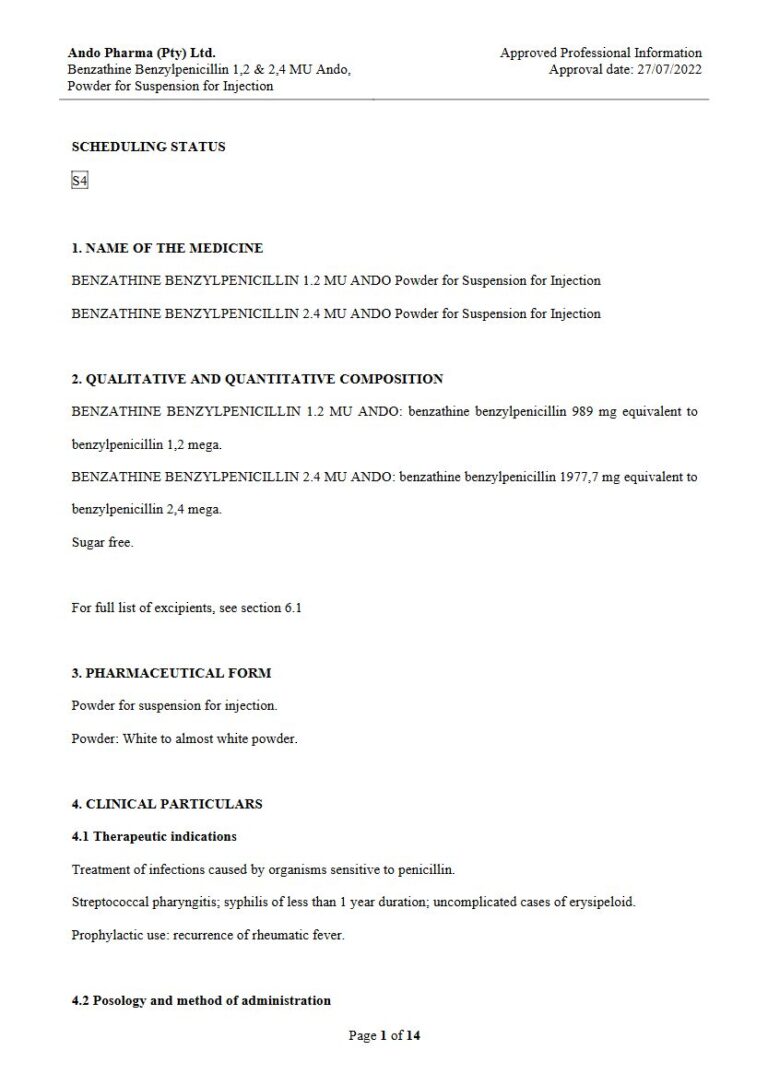
Treatment of infections caused by organisms sensitive to penicillin. Streptococcal pharyngitis; syphilis of less than 1 year duration; uncomplicated cases of erysipeloid. Prophylactic use: recurrence of rheumatic fever.
4.2 Posology and method of administration
Posology
Adults: Streptococcal pharyngitis, and erysipeloid: 1,2 million units. Syphilis: 2,4 million units. Recurrence of rheumatic fever 1,2 million units. Children: 600 000 units to 1,2 million units. Should be administered by deep intramuscular injection once a month.
Method of administration
FOR INTRAMUSCULAR USE ONLY. Not for intravenous (IV) use. See section 6.6 for preparation of suspension.
4.3 Contraindications
Must not be administered to patients who are allergic to penicillin or cephalosporins or to any ingredient of Benzathine Benzylpenicillin Ando listed in section 6. Babies in the neonatal period born to mothers allergic to penicillin. Cases of cross-sensitivity to other beta-lactams have been reported. Should not be used in life-threatening conditions e.g. endocarditis, peritonitis or meningitis where very high doses of penicillin is indicated. Must not be administered intravenously (IV).
4.4 Special warnings and precautions for use
FOR INTRAMUSCULAR USE ONLY. Benzathine Benzylpenicillin Ando should not be used in tissues with reduced perfusion. Before initiating therapy with Benzathine Benzylpenicillin Ando, a careful investigation should be made concerning previous hypersensitivity reactions to penicillins, cephalosporins or other beta-lactam medicines (see sections 4.3 and 4.8). When administered to a patient with penicillin allergy, anaphylactic shock may occur. If an allergic reaction occurs, Benzathine Benzylpenicillin Ando must be discontinued and appropriate therapy instituted. Epinephrine (adrenaline), corticosteroids, antihistamines and appropriate IV fluids should be used to treat anaphylaxis (see section 4.3). Prior to treatment, a hypersensitivity test should be performed if possible. The patient should be made aware of the possible occurrence of allergic symptoms and of the need to report them. Caution should be exercised in patients with the following conditions: - allergic diathesis or bronchial asthma (there is an increased risk of a hypersensitivity reaction): - renal insufficiency; - impaired hepatic function. Based on a general principle, particularly in some exposed patients, medical observation should if possible be ensured for at last half an hour after the administration of this antibiotic, as severe immediate allergic reactions may occur even after the first administration. Beta-lactams are associated with a risk of encephalopathy (confusion, altered levels of consciousness, epilepsy or movement abnormalities), particularly in cases of overdose or impaired renal function. When treating syphilis, a Jarisch-Herxheimer reaction may occur as a result of the bactericidal action of penicillin on pathogens. Within 2 to 12 hours after administration headaches, fever, sweating, shivering, myalgia, arthralgia, nausea, tachycardia, increased blood pressure followed by hypotension may occur. These symptoms resolve after 10 to 12 hours. Patients should be informed that this is a usual, transient sequela of antibiotic therapy. Appropriate therapy should be instituted to suppress or attenuate a Jarisch-Herxheimer reaction (see section 4.8). With long-term treatment (more than a single dose), periodic assessment of organ system functions, including renal, hepatic and haematopoietic function is recommended. Prolonged use of Benzathine Benzylpenicillin Ando may occasionally result in an overgrowth of non-susceptible organisms or yeast and patients should be observed carefully for superinfections. Antibiotic-associated colitis has been reported with nearly all antibacterial medicines including Benzathine Benzylpenicillin Ando and may range in severity from mild to life threatening (see section 4.8). Therefore, it is important to consider this diagnosis in patients who present with diarrhoea during or subsequent to the administration of any antibiotics. Should antibiotic-associated colitis occur, Benzathine Benzylpenicillin Ando should be discontinued, a medical practitioner be consulted, and an appropriate therapy initiated. Anti-peristaltic medicines are contraindicated in this situation. If neurological involvement cannot be excluded in patients with congenital syphilis, forms of penicillin that reach a higher level in cerebrospinal fluid should be used. In diseases such as severe pneumonia, empyema, sepsis, meningitis or peritonitis, which require higher serum penicillin levels, alternative treatment such as the watersoluble alkali salt of benzylpenicillin should be considered.
4.5 Interaction with other medicines and other forms of interaction
Concomitant administration of Benzathine Benzylpenicillin Ando is not recommended with: - bacteriostatic antibiotics: based on the general principle not to combine bactericidal and bacteriostatic antibiotics. Caution should be exercised when co-administering the following: - probenecid: the administration of probenecid leads to inhibition of the tubular secretion of benzylpenicillin, resulting in an increase in the serum concentration and prolongation of the elimination half-life. Furthermore, probenecid inhibits the penicillin transport from the cerebrospinal fluid, so that the concomitant administration of probenecid reduces the penetration of benzylpenicillin into brain tissue even further. - methotrexate: when taken at the same time as benzylpenicillin benzathine, the excretion of methotrexate is reduced. This can lead to increased methotrexate toxicity. The combination with methotrexate is not recommended. - anticoagulants: concomitant use with oral anticoagulants may increase the antivitamin K effect and the risk of bleeding. It is recommended that the International Normalised Ratio (INR) is monitored frequently, and the posology of the antivitamin K drug adjusted accordingly, both during and after treatment with Benzathine Benzylpenicillin Ando.
4.6 Fertility, pregnancy and lactation
Pregnancy
Benzathine Benzylpenicillin Ando crosses the placenta. 10-30 % of maternal plasma concentrations are found in the foetal circulation. High concentrations are also reached in the amniotic fluid. Animal studies do not indicate direct or indirect harmful effects with respect to reproductive toxicity. Safety and efficacy during pregnancy has not been established.
Breastfeeding
Benzathine Benzylpenicillin Ando is excreted in human milk in small amounts. The concentration in maternal milk may reach 2 to 15 % of the mother's serum concentrations. Safety and efficacy during breastfeeding has not been established.
Fertility
No fertility studies have been conducted in humans. Reproductive studies on mice, rats and rabbits have not revealed any negative effects on fertility. No long-term fertility studies on laboratory animals are available.
4.7 Effects on ability to drive and use machines
Benzathine Benzylpenicillin Ando is not known to affect the ability of a patient to drive or use machines, but the effect on the individual should be known before they attempt to drive or use machines. Due to the occurrence of possible serious undesirable effects (e.g., anaphylactic shock with collapse and anaphylactoid reactions, see also section 4.8), Benzathine Benzylpenicillin Ando can have a major influence on the ability to drive and use machines.
4.8 Undesirable effects
Summary of the safety profile
The most frequent and common adverse reactions related to benzylpenicillin benzathine are: candidiasis, diarrhoea, nausea, laboratory investigation changes.
Table 1 - Tabulated list of adverse drug reactions by MedDRA System Organ Class.
MedDRA System Organ class
Frequent
Less frequent
Frequency unknown
Infections and infestations
Candidiasis
Blood and lymphatic system disorders
Leukopenia, thrombocytopenia, agranulocytosis
Haemolytic anaemia, neutropenia, prolongation of bleeding time, defective platelet function
Immune system disorders
Allergic reactions which may include exfoliative dermatitis, other skin rashes, interstitial nephritis and vasculitis, may occur
Angioedema, erythema multiform, arthralgia, anaphylactic shock with collapse and anaphylactoid reactions (asthma, purpura, gastrointestinal)
Serum sickness, a generalised sensitivity reaction with urticaria, fever, joint pains and eosinophilia can develop within a few hours to several weeks after starting treatment; superinfection by resistant species, such as pseudomonas or candida, which do not respond to penicillin therapy, may occur. Some patients with syphilis and other spirochaete infections may have a Jarisch Herxheimer reaction shortly after starting treatment with Benzathine Benzylpenicillin Ando. Symptoms can include fever, chills, headache. and reactions at the site of the lesions.
Gastrointestinal disorders
Diarrhoea, nausea, stomatitis and glossitis, vomiting
Heartburn, pseudo-membranous colitis (see section 4.4)
Hepato-biliary disorders
Hepatitis, cholestasis, increases in liver enzyme values
Skin and subcutaneous tissue disorders
A sore mouth or tongue and a black hairy tongue
Renal and urinary disorders
Nephropathy, interstitial nephritis
General disorders and administration site conditions
Pain at the injection site, injection site infiltrates, Hoignu00e9 syndrome, Nicolau syndrome
Investigations
Positive direct Coombs' test, False-positive urinary protein determination when precipitation techniques are used (Folin-Ciocalteu-Lowry method, biuret method), False-positive urinary amino acid determination (ninhydrin method), Simulation of Pseudobisal buminaemia when using electrophoresis methods to determine albumin, False-positive nonenzymatic urinary glucose detection and urobilinogen detection, Increased levels when determining 17 ketosteroids in urine (when the Zimmermann reaction is used) (see section 4.4)
4.9 Overdose
At extremely high doses, penicillins can induce neuromuscular excitability or epileptiform seizures. If overdose is suspected, supportive treatment and symptomatic measures are indicated. Benzylpenicillin can be haemodialysed.
