
Bimagam 0.03 % Eye drops
PDF Leaflet Revision Date: 17 October 2023
Clinical Summary
Quick overview from the medicine insert
Indication
Reduction of elevated intraocular pressure in chronic open-angle glaucoma and ocular hypertension.
Dosage (summary)
1 drop in affected eye(s) once daily in the evening.
Onset of Action / Duration
Onset: 4 hours, Duration: 24 hours
Special Populations
- Elderly
- Hepatic impairment
- Renal impairment
Pregnancy & Breastfeeding
Not recommended during pregnancy or breastfeeding due to unknown safety.
Key Drug Interactions
- Other prostaglandin analogues may reduce IOP-lowering effect
Contraindications
- Hypersensitivity to bimatoprost or benzalkonium chloride
Common side effects
- Eyelash growth
- Conjunctival hyperemia
- Ocular pruritus
Counselling Points
- Avoid contact with skin to prevent hair growth
- Remove contact lenses before use
Serious warnings
- Potential for permanent iris pigmentation
- Caution in patients with respiratory issues
Important Disclaimer
The Bimagam 0.03 % Eye drops professional information leaflet below is the property of Austell Pharmaceuticals and is provided on Medinsert exactly as issued, with no.. alterations or editorial changes. We make every effort to keep content current by updating documents as soon as new versions become available. Medinsert serves as a trusted access point for healthcare professionals, but does not replace official sources or clinical judgement. For more details, please read our full disclaimer. read more>>
 Healthcare Professionals Only
This content is for registered healthcare professionals
Sign in or create a free account to read the full package insert.
Free for HPCSA-registered professionals. Powered by Medinsert.
Clinical Particulars
Section 4 of the official insert — extracted exactly as issued, no alterations
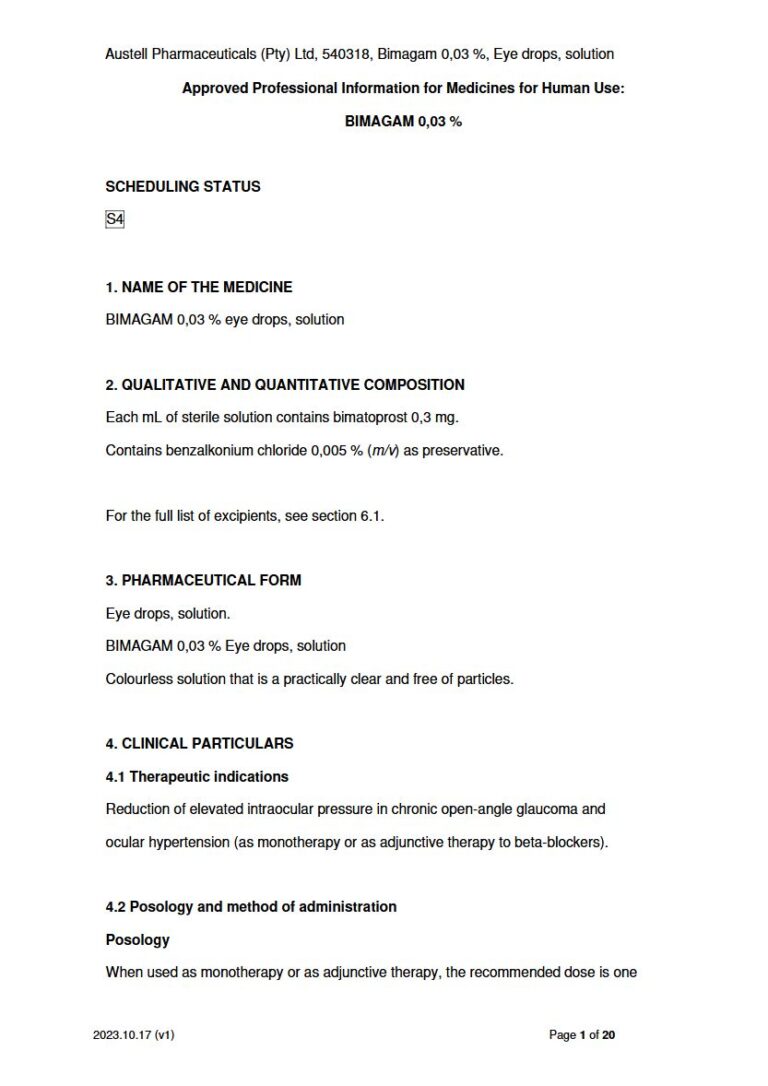
4.1 Therapeutic indications
Reduction of elevated intraocular pressure in chronic open-angle glaucoma and ocular hypertension (as monotherapy or as adjunctive therapy to beta-blockers).
4.2 Posology and method of administration
Posology
When used as monotherapy or as adjunctive therapy, the recommended dose is one drop of BIMAGAM 0,03 % eye drops in the affected eye(s) once daily, administered in the evening. The dose should not exceed once daily as more frequent administration may lessen the intraocular pressure lowering effect.
Special populations
Elderly population
No dosage adjustment in elderly patients is necessary.
Hepatic and renal impairment
BIMAGAM 0,03 % eye drops has not been studied in patients with renal or moderate to severe hepatic impairment and should therefore be used with caution in such patients. In patients with a history of mild liver disease or abnormal ALT, AST and/or bilirubin at baseline, BIMAGAM 0,03 % eye drops had no adverse effect on liver function over 24 months.
Paediatric population
BIMAGAM 0,03 % eye drops has only been studied in adults and therefore its use is not recommended in children or adolescents (under the age of 18).
Method of administration
BIMAGAM 0,03 % is for ocular use only. To prevent contamination of the dropper tip and solution, care should be taken not to touch the eyelids, surrounding areas or other surfaces with the dropper tip of the bottle. If more than one topical ophthalmic medication is being used, the medicines should be administered at least 5 minutes apart.
4.3 Contraindications
- Hypersensitivity to bimatoprost, benzalkonium chloride or to any of the other excipients listed in section 6.1.
4.4 Special warnings and precautions for use
Ocular
Before treatment is initiated, patients should be informed of the possibility of prostaglandin analogue periorbitopathy (PAP) eyelash growth, darkening of the eyelid skin and increased iris pigmentation, since these have been observed during treatment with bimatoprost as in BIMAGAM 0,03 %. Some of these changes may be permanent and may lead to differences in appearance between the eyes when only one eye is treated. Increased iris pigmentation is likely to be permanent. The pigmentation change is due to increased melanin content in the melanocytes rather than to an increase in the number of melanocytes. The long-term effects of increased iris pigmentation are not known. Iris colour changes seen with ophthalmic administration of bimatoprost may not be noticeable for several months to years. Typically, the brown pigmentation around the pupil spreads concentrically towards the periphery of the iris and the entire iris or parts become more brownish. Neither naevi nor freckles of the iris appear to be affected by the treatment. At 12 months, the incidence of iris hyperpigmentation with bimatoprost 0,3 mg/mL was 1,5 % (see section 4.8) and did not increase following 3 years treatment. Periorbital tissue pigmentation has been reported to be reversible in some patients.
Cystoid macular oedema has been less frequently reported following treatment with bimatoprost 0,3 mg/mL eye drops, solution. Therefore, BIMAGAM 0,03 % should be used with caution in patients with known risk factors for macular oedema (e.g. aphakic patients, pseudophakic patients with a torn posterior lens capsule).
There have been less frequent spontaneous reports of reactivation of previous corneal infiltrates or ocular infections with bimatoprost 0,3 mg/mL eye drops, solution. BIMAGAM 0,03 % should be used with caution in patients with a prior history of significant ocular viral infections (e.g. herpes simplex) or uveitis/iritis.
BIMAGAM 0,03 % has not been studied in patients with inflammatory ocular conditions, neovascular, inflammatory, angle-closure glaucoma, congenital glaucoma or narrow-angle glaucoma.
Skin
There is a potential for hair growth to occur in areas where BIMAGAM 0,03 % solution comes repeatedly in contact with the skin surface. Thus, it is important to apply BIMAGAM 0,03 % as instructed and avoid it running onto the cheek or other skin areas.
Respiratory
BIMAGAM 0,03 % has not been studied in patients with compromised respiratory function. While there is limited information available on patients with a history of asthma or COPD, there have been reports of exacerbation of asthma, dyspnoea and COPD, as well as reports of asthma, in post marketing experience. The frequency of these symptoms is not known. Patients with COPD, asthma or compromised respiratory function due to other conditions should be treated with caution.
Cardiovascular
BIMAGAM 0,03 % has not been studied in patients with heart block more severe than first degree or uncontrolled congestive heart failure. There have been a limited number of spontaneous reports of bradycardia or hypotension with bimatoprost 0,3 mg/mL eye drops, solution. BIMAGAM 0,03 % should be used with caution in patients predisposed to low heart rate or low blood pressure.
Other information
Concomitant use with other prostaglandin analogues
In studies of bimatoprost 0,3 mg/mL in patients with glaucoma or ocular hypertension, it has been shown that the more frequent exposure of the eye to more than one dose of bimatoprost daily may decrease the IOP-lowering effect (see section 4.5). Patients using BIMAGAM 0,03 % with other prostaglandin analogues should be monitored for changes to their intraocular pressure.
Bacterial keratitis
There have been reports of bacterial keratitis associated with the use of multiple dose containers of topical ophthalmic products. These containers had been inadvertently contaminated by patients who, in most cases, had a concurrent ocular disease. Patients with a disruption of the ocular epithelial surface are at greater risk of developing bacterial keratitis. Patients should be instructed to avoid allowing the tip of the dispensing container to contact the eye or surrounding structures to avoid eye injury and contamination of the solution.
Contact lenses
BIMAGAM 0,03 % contains the preservative benzalkonium chloride, which may be absorbed by and cause discolouration of soft contact lenses. Patients wearing soft (hydrophilic) contact lenses should be instructed to remove contact lenses prior to administration of BIMAGAM 0,03 % and wait at least 15 minutes following administration before reinserting soft contact lenses. BIMAGAM 0,03 % should not be administered while wearing contact lenses.
Excipient: Benzalkonium chloride
BIMAGAM 0,03 % contains 0,05 mg benzalkonium chloride (a preservative) in each millilitre eye drop solution which is equivalent to 0,005 % (m/v). As the possibility of adverse effects on the corneal permeability, and the danger of disruption of the corneal epithelium with prolonged or repeated usage of benzalkonium chloride preserved ophthalmological preparations, cannot be excluded, regular ophthalmological examination is required. Caution should be exercised in the use of benzalkonium chloride preserved topical medication over an extended period in patients with extensive ocular surface disease.
4.5 Interaction with other medicines and other forms of interaction
No interaction studies have been performed. No interactions are anticipated in humans, since systemic concentrations of bimatoprost are extremely low (less than 0,2 ng/mL) following ocular dosing with bimatoprost 0,3 mg/mL eye drops, solution. Bimatoprost is biotransformed by any of multiple enzymes and pathways, and no effects on hepatic medicine metabolising enzymes were observed in preclinical studies. In clinical studies, BIMAGAM 0,03 % eye drops was used concomitantly with a number of different ophthalmic beta-blocking medicines without evidence of interactions. Concomitant use of BIMAGAM 0,03 % and antiglaucomatous medicines other than topical beta-blockers has not been evaluated during adjunctive glaucoma therapy. There is a potential for the IOP-lowering effect of prostaglandin analogues (e.g. BIMAGAM 0,03 %) to be reduced in patients with glaucoma or ocular hypertension when used with other prostaglandin analogues (see section 4.4).
4.6 Fertility, pregnancy and lactation
The safety of BIMAGAM 0,03 % during pregnancy and lactation has not been established.
Pregnancy
There are no adequate data from the use of bimatoprost in pregnant women. Animal studies have shown reproductive toxicity at high maternotoxic doses. BIMAGAM 0,03 % should not be used during pregnancy unless clearly necessary.
Breastfeeding
It is unknown whether bimatoprost is excreted in human breast milk. Animal studies have shown excretion of bimatoprost in breast milk. It is recommended that BIMAGAM 0,03 % not be used in breastfeeding mothers.
Fertility
There are no data on the effects of bimatoprost on human fertility.
4.7 Effects on ability to drive and use machines
BIMAGAM 0,03 % has negligible influence on the ability to drive and use machines. if transient blurred vision or dizziness occurs at instillation, the patient should wait until the vision clears or dizziness subsides before driving or using machines.
4.8 Undesirable effects
a. Summary of the safety profile
In clinical studies, over 1800 patients have been treated with bimatoprost 0,3 mg/mL eye drops. On combining the data from phase III monotherapy and adjunctive bimatoprost 0,3 mg/mL eye drops usage, the most frequently reported adverse reactions were:
u2022 growth of eyelashes in the first year with the incidence of new reports decreasing at 3 years
u2022 conjunctival hyperaemia (mostly trace to mild and thought to be of a non-inflammatory nature) in the first year with the incidence of new reports decreasing at 3 years
u2022 ocular pruritus in the first year with the incidence of new reports decreasing at 3 years.
b. Tabulated list of adverse reactions
The table below shows all adverse drug reactions (ADRs) observed during clinical trials and postmarket spontaneous reports with bimatoprost 0,3 mg/mL eye drops, solution. Most were ocular, mild and none was serious.
System Organ Class Frequency Frequent Less Frequent Not known Immune system disorders Hypersensitivity reaction including signs and symptoms of eye allergy and allergic dermatitis Nervous system disorders Headache Dizziness Eye disorders Conjunctival / ocular hyperaemia, eye (ocular) pruritus, prostaglandin analogue periorbitopathy, superficial punctate keratitis, corneal erosion, ocular burning, ocular irritation, allergic conjunctivitis, blepharitis, Retinal haemorrhage, uveitis, cystoid macular oedema, iritis, blepharospasm, eyelid retraction, periorbital erythema, eyelid oedema Periorbital and lid changes including deepening of the eyelid sulcus, ocular discomfort worsening of visual acuity, asthenopia, conjunctival oedema, foreign body sensation, ocular dryness, eye pain, photophobia, tearing / lacrimation increased, eye discharge, visual disturbance/blurred vision, increased iris pigmentation, eyelash growth, Eyelash darkening, eyelid erythema, eyelid pruritus cataract Vascular disorders Hypertension Respiratory, thoracic and mediastinal disorders Asthma, asthma exacerbation, COPD exacerbation and dyspnoea Gastrointestinal disorders Nausea Skin and subcutaneous tissue disorders Pigmentation of periocular skin skin hyperpigmentation, blepharal pigmentation Hirsutism Skin discoloration (periocular) abnormal hair growth General disorders and administration site conditions Asthenia, peripheral oedema Investigations Liver function test abnormal Infections and infestations Infection (primarily colds and upper respiratory tract infections)
c. Description of selected adverse reactions
Prostaglandin analogue periorbitopathy (PAP)
Prostaglandin analogues including bimatoprost as in BIMAGAM 0,03 % can induce periorbital lipodystrophic changes which can lead to deepening of the eyelid sulcus, ptosis, enophthalmos, eyelid retraction, involution of dermatochalasis and inferior scleral show. Changes are typically mild, can occur as early as one month after initiation of treatment with bimatoprost as in BIMAGAM 0,03 %, and may cause impaired field of vision even in the absence of patient recognition. PAP is also associated with periocular skin hyperpigmentation or discolouration and hypertrichosis. All changes have been noted to be partially or fully reversible upon discontinuation or switch to alternative treatments.
Iris hyperpigmentation
Increased iris pigmentation is likely to be permanent. The pigmentation change is due to increased melanin content in the melanocytes rather than to an increase in the number of melanocytes. The long-term effects of increased iris pigmentation are not known. Iris colour changes seen with ophthalmic administration of bimatoprost as in BIMAGAM 0,03 % may not be noticeable for several months to years. Typically, the brown pigmentation around the pupil spreads concentrically towards the periphery of the iris and the entire iris or parts become more brownish. Neither naevi nor freckles of the iris appear to be affected by the treatment. At 12 months, the incidence of iris hyperpigmentation with bimatoprost as in BIMAGAM 0,03 % eye drops, solution was 0,5 %. At 12 months, the incidence with bimatoprost 0,03 % eye drops, solution was 1,5 % and did not increase following 3 years treatment.
4.9 Overdose
No case of overdose has been reported and is unlikely to occur after ocular administration. If overdose occurs, treatment should be symptomatic and supportive.
