
Inoxab 200 200 mg Metered Dose Inhaler
PDF Leaflet Revision Date: 24 October 2023
Clinical Summary
Quick overview from the medicine insert
Indication
Prophylaxis of asthma symptoms.
Dosage (summary)
Initial: 400 u03bcg daily; max: 1600 u03bcg.
Onset of Action / Duration
Onset: 20 mins, Duration: Not specified
Special Populations
- Children over 12 years
- Patients with hepatic impairment
Pregnancy & Breastfeeding
Safety not established.
Key Drug Interactions
- CYP3A4 inhibitors
- Itraconazole
- Ketoconazole
Contraindications
- Hypersensitivity to budesonide
- Active pulmonary tuberculosis
Common side effects
- Oropharyngeal candidiasis
- Dysphonia
- Paradoxical bronchospasm
Counselling Points
- Rinse mouth after use
- Do not stop abruptly
- Use bronchodilators before inhaler
Serious warnings
- Adrenal suppression
- Pneumonia risk in COPD patients
Important Disclaimer
The Inoxab 200 200 mg Metered Dose Inhaler professional information leaflet below is the property of Macleods Pharmaceuticals Sa and is provided on Medinsert exactly as issued, with no.. alterations or editorial changes. We make every effort to keep content current by updating documents as soon as new versions become available. Medinsert serves as a trusted access point for healthcare professionals, but does not replace official sources or clinical judgement. For more details, please read our full disclaimer. read more>>
 Healthcare Professionals Only
This content is for registered healthcare professionals
Sign in or create a free account to read the full package insert.
Free for HPCSA-registered professionals. Powered by Medinsert.
Clinical Particulars
Section 4 of the official insert — extracted exactly as issued, no alterations
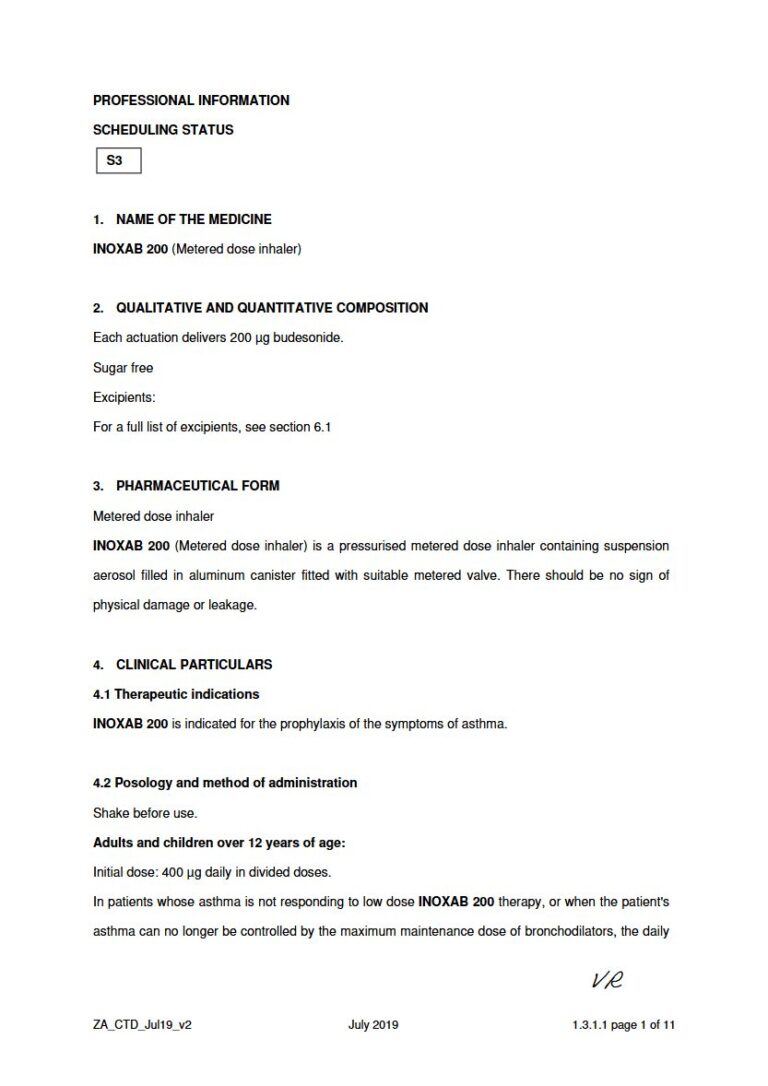
4.1 Therapeutic indications
INOXAB 200 is indicated for the prophylaxis of the symptoms of asthma.
4.2 Posology and method of administration
Shake before use. Adults and children over 12 years of age: Initial dose: 400 u03bcg daily in divided doses. In patients whose asthma is not responding to low dose INOXAB 200 therapy, or when the patient's asthma can no longer be controlled by the maximum maintenance dose of bronchodilators, the daily dosage may be increased up to 1600 u03bcg. In controlled patients, twice daily administration may be adequate. THE MAINTENANCE DOSE SHOULD BE INDIVIDUALISED AND SHOULD BE THE LOWEST POSSIBLE DOSAGE. Patients on concomitant therapy with inhaled bronchodilators should use the bronchodilators several minutes before the inhalation of INOXAB 200 to minimise possible local side-effects, such as cough. The use of a spacer device is recommended when the daily dose exceeds 400 u03bcg in adults and for all doses in children over 12 years of age. This will improve lung deposition and will reduce the systemic absorption of budesonide. Rinse the mouth after each dosage administration. Treatment with inhaled steroids should not be stopped abruptly.
4.3 Contraindications
INOXAB 200 is contraindicated in:
- Patients with hypersensitivity to budesonide, or any of the components of INOXAB 200, listed in section 6.1.
- Patients with active or quiescent pulmonary tuberculosis or with other untreated airway infections of bacterial, fungal or viral origin.
4.4 Special warnings and precautions for use
Patients should be carefully instructed in the correct use of the inhaler, making sure that the inhaler in activation is synchronised with inspiration. Patients should also be made aware of the prophylactic nature of INOXAB 200 therapy, and that it should be taken even when they are asymptomatic.
Adrenal suppression may occur. Bacterial and fungal (including Candida) infections of the mouth and throat may occur. Patients with high blood levels of Candida precipitants, indicating a previous infection, are most likely to develop this complication. Some patients may find it helpful to rinse their mouth thoroughly with water after inhalation. The water should not be swallowed.
Paradoxical bronchospasm may occur, with an immediate increase in wheezing after dosing. If this occurs, treatment with inhaled budesonide should be discontinued immediately, the patient assessed and alternative therapy instituted if necessary. INOXAB 200 is not intended for rapid relief of acute episodes of asthma where an inhaled short-acting bronchodilator is required. If patients find short-acting bronchodilator treatment ineffective or they need more inhalations than usual, medical attention must be sought. In this situation consideration should be given to the need for or an increase in their regular therapy, e.g. higher doses of inhaled INOXAB 200 or the addition of a long acting beta agonist, or for a course of oral glucocorticosteroid.
Systemic effects may occur with any inhaled corticosteroids including INOXAB 200, particularly at high doses prescribed for long periods. These effects are much less likely to occur with inhalation treatment than with oral corticosteroids. Possible systemic effects include Cushing's syndrome, Cushingoid features, adrenal suppression, growth retardation in children and adolescents, decrease in bone mineral density, cataract, glaucoma and more rarely, a range of psychological or behavioural effects including psychomotor hyperactivity, sleep disorders, anxiety, depression or aggression (particularly in children). It is important, therefore, that the dose of inhaled corticosteroid is titrated to the lowest dose at which effective control of asthma is maintained.
Reduced liver function affects the elimination of corticosteroids causing lower elimination rate and higher systemic exposure. Be aware of possible systemic side effects.
Pneumonia in patients with Chronic Obstructive Pulmonary Disease (COPD) An increase in the incidence of pneumonia, including pneumonia requiring hospitalisation, has been observed in patients with COPD receiving inhaled corticosteroids including INOXAB 200. There is some evidence of an increased risk of pneumonia with increasing steroid dose but this has not been demonstrated conclusively across all studies.
Visual disturbance may be reported with systemic and topical corticosteroid use. If a patient presents with symptoms such as blurred vision or other visual disturbances, the patient should be considered for referral to an ophthalmologist for evaluation as soon as possible of possible causes which may include cataract, glaucoma or rare diseases, such as central serous chorioretinopathy (CSCR) which have been reported after use of systemic and topical corticosteroids.
Paediatric population Influence on growth It is recommended that the height of children receiving prolonged treatment with INOXAB 200 is regularly monitored. If growth is slowed, therapy should be re-evaluated with the aim of reducing the dose of inhaled corticosteroid, if possible, to the lowest dose at which effective control of asthma is maintained. The benefit of the corticosteroid therapy and the possible risk of growth suppression must be carefully weighed. In addition, consideration should be given to referring the patient to a paediatric respiratory specialist.
Transfer of patients, dependent upon oral steroids, to treatment with INOXAB 200 demands special care, and is preferably done when the patient is in a relatively stable phase. INOXAB 200 should be given in combination with the previously used oral steroid dose for about ten days. After this period of time, reduction of the oral corticosteroid can be started with a dose reduction corresponding to about 1 mg prednisolone per day per week. Some patients may experience uneasiness during the withdrawal period, due to decreased steroid effect. Acute exacerbations, accompanied by increased mucus viscosity and mucus plugging may require complementary treatment with an oral corticosteroid. It is important to monitor intercurrent infections and treat them appropriately.
Appropriate measures should be taken to protect the patient against stress situations, e.g. severe infections, surgery. Treatment with inhaled steroids should not be stopped abruptly. Some patients may experience uneasiness during the withdrawal period due to a decreased steroid effect. The medical practitioner may have to explain the reason for INOXAB 200 treatment in order to encourage the patient to continue. The length of time needed for the body to regain its natural production of corticosteroid in sufficient amounts is often extensive. Thus, during physically stressful situations such as severe infections, trauma and surgical operations, it will be necessary to give the patient an additional oral steroid dose. Acute exacerbations, accompanied by increased mucus viscosity and mucus plugging may require complementary treatment with an oral corticosteroid.
4.5 Interaction with other medicines and other forms of interaction
The metabolism of budesonide as contained in INOXAB 200 is primarily mediated by CYP3A4. Co-treatment with CYP3A inhibitors, e.g. itraconazole, ketoconazole, HIV protease inhibitors and cobicistat-containing products, are expected to increase the risk of systemic side effects. The combination of INOXAB 200 with potent CYP3A inhibitors should be avoided unless the benefit outweighs the increased risk of systemic corticosteroid side effects, in which case patients should be monitored for systemic corticosteroid side effects. If INOXAB 200 is co-administered with anti-fungals (such as itraconazole and ketoconazole), the period between treatments should be as long as possible. A reduction of the INOXAB 200 dose could be considered. Limited data about this interaction for high-dose inhaled INOXAB 200 indicate that marked increases in plasma levels (on average four-fold) may occur if itraconazole, 200 mg once daily, is administered concomitantly with inhaled budesonide (single dose of 1000 u03bcg). Raised plasma concentrations of and enhanced effects of corticosteroids have been observed in women also treated with oestrogens and contraceptive steroids, but no effect has been observed with budesonide and concomitant intake of low dose combination oral contraceptives. Because adrenal function may be suppressed, an ACTH stimulation test for diagnosing pituitary insufficiency might show false results (low values).
4.6 Fertility, pregnancy and lactation
Safety in pregnancy and lactation has not been established.
4.7 Effects on ability to drive and use machines
INOXAB 200 may cause blurred vision. If symptoms are severe, the patient should not drive or operate machinery.
4.8 Undesirable effects
The following adverse reactions have been reported in association with INOXAB 200.
| System organ class | Frequency | Undesirable effect |
|---|---|---|
| Infections and infestations | Frequent | Oropharyngeal candidiasis, Pneumonia (in COPD patients) |
| Immune system disorders | Less frequent | Immediate and delayed hypersensitivity reactions including rash, contact dermatitis, urticaria, angioedema and anaphylactic reaction |
| Endocrine/ metabolic disorders | Less frequent | Signs and symptoms of systemic corticosteroid effects including Adrenal suppression, Growth retardation |
| Psychiatric disorders | Frequent | Psychotic behaviour - this may include nervousness, restlessness and depression |
| Less frequent | Anxiety, Psychomotor hyperactivity, Sleep disorders, Aggression, Behavioural changes (predominantly in children) | |
| Nervous system disorders | Less frequent | Tremor**, Headache |
| Eye disorders | Less frequent | Cataract formation after prolonged use, Vision, blurred |
| Frequency unknown | Glaucoma | |
| Ear and labyrinth disorders | Frequent | Dysphonia, Candida albicans infections of the mouth and throat, dryness of mouth and throat, bad taste. |
| Respiratory disorders | Frequent | Local irritation and paradoxical bronchoconstriction. Pulmonary infiltrates with eosinophilia may occur, Cough, Hoarseness |
| Gastrointestinal disorders | Less frequent | Nausea and diarrhoea |
| Skin and subcutaneous tissue disorders | Frequent | Skin thinning and purpura. Other skin reactions may include urticaria, rashes and dermatitis |
| Less frequent | Bruising | |
| Musculoskeletal and connective tissue disorders | Less frequent | Muscle spasm |
| General disorders | Less frequent | Tiredness and thirst |
* Rare in children ** based on the frequency reported in clinical trials Occasionally, signs or symptoms of systemic glucocorticosteroid-side effects may occur with inhaled glucocorticosteroids, probably depending on dose, exposure time, concomitant and previous corticosteroid exposure and individual sensitivity.
Reporting of suspected adverse reactions Reporting suspected adverse reactions after authorisation of the medicine is important. It allows continued monitoring of the benefit/risk balance of the medicine. Health care providers are asked to report any suspected adverse reactions to SAHPRA via the u201c6.04 Adverse Drug Reactions Reporting Formu201d, found online under SAHPRAu2019s publications: https://www.sahpra.org.za/Publications/Index/8.
4.9 Overdose
Treatment with INOXAB 200 should be continued at the recommended dose to control the asthma and appropriate measures taken to protect the patient against stress situations. Treatment is symptomatic and supportive. Acute overdosage with INOXAB 200, even in excessive doses, is not expected to be a clinical problem. The only harmful effect that follows inhalation of large amounts of the medicine over a short period is suppression of hypothalamic pituitary-adrenal (HPA) function.
