
Burinex 1 mg Tablets
PDF Leaflet Revision Date: 20 August 2025
Clinical Summary
Quick overview from the medicine insert
Indication
Treatment of oedema associated with heart failure, renal disease, and hepatic ascites.
Dosage (summary)
1 mg daily, may increase based on response; consider twice daily for refractory cases.
Onset of Action / Duration
Onset: 30 mins, Duration: 4-6 hours
Special Populations
- Elderly
- Renal impairment
- Hepatic impairment
- Diabetic patients
Pregnancy & Breastfeeding
Avoid in first trimester; contraindicated in breastfeeding.
Key Drug Interactions
- Digitalis glycosides
- Antihypertensives
- NSAIDs
- Lithium
- Potassium depleting medicines
Contraindications
- Hypersensitivity to bumetanide
- Anuria
- Hepatic coma
- Electrolyte depletion
Common side effects
- Headache
- Dizziness
- Electrolyte disturbances
- Fatigue
- Abdominal pain
Counselling Points
- Monitor for dizziness
- Maintain potassium intake
- Report signs of SJS or TEN
Serious warnings
- Risk of SJS and TEN
- Electrolyte imbalance
- Caution in hypotension
Important Disclaimer
The Burinex 1 mg Tablets professional information leaflet below is the property of Adcock Ingram and is provided on Medinsert exactly as issued, with no.. alterations or editorial changes. We make every effort to keep content current by updating documents as soon as new versions become available. Medinsert serves as a trusted access point for healthcare professionals, but does not replace official sources or clinical judgement. For more details, please read our full disclaimer. read more>>
 Healthcare Professionals Only
This content is for registered healthcare professionals
Sign in or create a free account to read the full package insert.
Free for HPCSA-registered professionals. Powered by Medinsert.
Clinical Particulars
Section 4 of the official insert — extracted exactly as issued, no alterations
4.1 Therapeutic indications
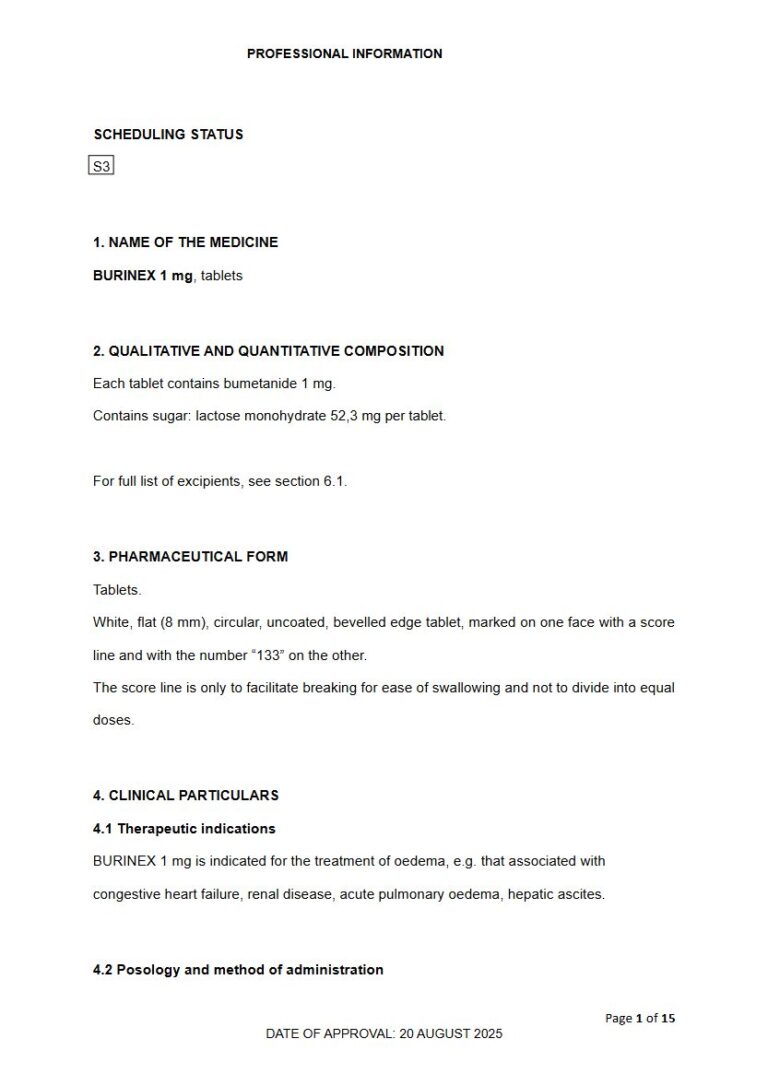
BURINEX 1 mg is indicated for the treatment of oedema, e.g. that associated with congestive heart failure, renal disease, acute pulmonary oedema, hepatic ascites.
4.2 Posology and method of administration
Posology
The following recommendations are based on clinical experience to date: Most patients require a daily dose of 1 mg which can be given as a single morning dose. Depending on the patient's response a second dose can be given six to eight hours later. In refractory cases, the dose can be increased until a satisfactory diuretic response is obtained. The dose should be carefully titrated in each patient according to the patient's response and the required therapeutic activity. As a general rule, in patients not controlled on lower doses, dosage should be started at 5 mg daily and then increased by 5 mg increments every twelve to twenty-four hours until the required response is obtained or side effects appear. Consideration should be given to twice daily dosage rather than once daily.
Paediatric population
Until further experience of paediatric use is accumulated, BURINEX 1 mg should not be given to children.
Method of administration
For oral administration.
4.3 Contraindications
- Hypersensitivity to the active substance, bumetanide or to any of the excipients listed in section 6.1.
- Anuria. Although BURINEX 1 mg can be used to induce diuresis in renal insufficiency, any marked increase in blood urea or the development of oliguria during treatment of severe progressive renal disease is an indication for stopping treatment with BURINEX 1 mg.
- BURINEX 1 mg is contraindicated in hepatic coma and in acute cases of moderately severe or severe liver failure. This does not preclude its use in treatment of ascites due to hepatic cirrhosis, but such therapy is best initiated in hospital.
- BURINEX 1 mg is contraindicated in states of electrolyte depletion.
4.4 Special warnings and precautions for use
Excessively rapid mobilisation of oedema, particularly in elderly patients, may give rise to sudden changes in cardiovascular pressure relationships with circulatory collapse and should be borne in mind when BURINEX 1 mg is given in high doses orally.
Toxic epidermal necrolysis (TEN) and Stevens-Johnson syndrome (SJS)
Toxic epidermal necrolysis (TEN) and Stevens-Johnson syndrome (SJS), which can be life-threatening or fatal, have been reported in relation to non-antibiotic sulphonamide containing products, including BURINEX 1 mg. Patients should be advised of the signs and symptoms of SJS and TEN. If SJS and TEN is suspected, BURINEX 1 mg should be withdrawn immediately. If the patient has developed SJS or TEN, treatment with BURINEX 1 mg must not be restarted in this patient at any time.
Electrolyte imbalance
Electrolyte disturbance is likely to occur in those patients treated with high doses or for prolonged periods, particularly in those patients taking a low salt diet. Periodic checks of serum electrolyte levels, in particular sodium, potassium, chlorides and bicarbonates should be undertaken and where necessary replacement therapy instituted. The precautions to be taken with BURINEX 1 mg are mainly those associated with electrolyte disturbance. Electrolyte depletion may show itself by weakness, dizziness, lethargy, leg cramps, anorexia, vomiting or mental confusion. Patients in whom a risk of depletion is likely, should undergo periodic serum electrolyte determinations (see section 4.8).
BURINEX 1 mg increases the excretion of potassium. This may cause the gradual development of low serum potassium levels. Patients on long-term treatment should, therefore, be encouraged to take a high potassium diet. Potassium chloride supplements are indicated in those patients whose dietary potassium is possibly inadequate, the chloride tending to correct the hypochloraemia and metabolic alkalosis, which is occasionally associated with potassium depletion. Potassium sparing diuretics, such as spironolactone, have been used as an alternative approach. Studies have shown that continued daily administration of BURINEX 1 mg for several months, supplemented with either potassium chloride or spironolactone produced an effective diuresis with minimal changes in serum electrolytes. Low serum potassium levels, it should be noted, increase the sensitivity of the myocardium to the toxic effects of digitalis. It is also important to prevent hypokalaemia in patients with hepatic cirrhosis. Potassium supplements are also indicated in conditions associated with a particular tendency to potassium depletion, e.g., long-term treatment with corticosteroids, ulcerative colitis, prolonged vomiting or diarrhoea.
Hepatic Impairment
Encephalopathy may be precipitated in patients with pre-existing hepatic impairment.
Hypotension
Caution should be exercised when BURINEX 1 mg is used in patients with hypotension.
Hyperuricaemia
BURINEX 1 mg may cause an increase in blood uric acid.
Urinary tract obstruction
BURINEX 1 mg should be used with caution in patients with potential obstruction of the urinary tract.
Renal Impairment
Patients with chronic renal failure on high doses of BURINEX 1 mg should remain under constant hospital supervision.
Diabetic patients
Periodic checks on urine and blood glucose should be made in diabetics and patients suspected of latent diabetes.
Hypersensitivity
Patients allergic to sulphonamides may show hypersensitivity to BURINEX 1 mg.
Excipient warning
BURINEX 1 mg tablets contain lactose monohydrate as an excipient and patients with rare hereditary problems of galactose intolerance, total lactase deficiency or glucose-galactose malabsorption should not take BURINEX 1 mg.
4.5 Interaction with other medicines and other forms of interaction
Dose adjustment of hypoglycaemic medicines may be necessary in patients with diabetes mellitus.
Digitalis glycosides
Hypokalaemia increases the sensitivity to digitalis glycosides which might result in digitalis toxicity (nausea, vomiting, and dysrhythmias). Potassium level and signs for digitalis toxicity should be monitored. Therefore, the dose of bumetanide may need adjustment when given in conjunction with cardiac glycosides.
Non-depolarising neuromuscular blocking medicines
Hypokalemia increases the sensitivity to non-depolarising neuromuscular blocking medicines.
Antihypertensive medicines and medicines inducing postural hypotension
BURINEX 1 mg may potentiate the effect of antihypertensive medicines. Therefore, patients taking these medicines should be monitored and dosage adjustment should occur where necessary.
NSAIDs
Certain non-steroidal anti-inflammatory drugs have been shown to antagonise the action of diuretics.
Lithium
BURINEX 1 mg reduces lithium clearance resulting in high serum levels of lithium. This may result in increased lithium toxicity, including increased risk of cardiotoxic and neurotoxic effects of lithium. Therefore, it is recommended that lithium levels are carefully monitored and where necessary the lithium dosage is adjusted in patients receiving this combination.
Anti-dysrhythmics
Concomitant use of BURINEX 1 mg and class III anti-dysrhythmic medicines may result in increased risk of electrolyte imbalance and subsequent cardiotoxicity (QT prolongation, torsades de pointes, cardiac arrest). Patientsu2019 electrolyte levels should be monitored as should symptoms of dysrhythmias.
Aminoglycosides
The ototoxic effects of aminoglycosides may be increased by concomitant administration of potent diuretics such as BURINEX 1 mg.
Potassium depleting medicines
The potassium depleting effect of BURINEX 1 mg may be increased by other potassium depleting medicines (see section 4.4 and 4.8).
Probenecid
Probenecid inhibits the renal tubular secretion of BURINEX 1 mg leading to a diminished natriuresis.
Proton pump inhibitors
Administration of proton pump inhibitors has been associated with development of hypomagnesaemia. Hypomagnesaemia may be exacerbated with co-administration of BURINEX 1 mg and particular attention to magnesium levels should be given when this combination is used.
4.6 Fertility, pregnancy and lactation
Pregnancy
The use of BURINEX 1 mg in the first trimester of pregnancy should be avoided.
Breastfeeding
BURINEX 1 mg should not be used during breastfeeding.
Fertility
No human data available.
4.7 Effects on ability to drive and use machines
BURINEX 1 mg has no or negligible direct influence on the ability to drive and use machines. However, the patient should be informed that dizziness may occur during treatment and this should be taken into account while driving or using machines.
4.8 Undesirable effects
a. Summary of the safety profile
The estimation of the frequency of undesirable effects is based on analysis of pooled data from clinical studies and spontaneous reporting. Based on pooled data from clinical studies of more than 1,000 patients treated with bumetanide, approximately 12 % of patients may be expected to experience an undesirable effect. The most commonly reported undesirable effects during treatment were headache and electrolyte disturbances (including hypokalaemia, hyponatraemia, hypochloraemia and hyperkalaemia) that occurred in approximately 4 % of patients and were followed by dizziness (including orthostatic hypotension and vertigo) and fatigue that occurred in approximately 3% of patients. Electrolyte disturbances can occur especially during long term treatment. Renal failure has been reported in post-marketing safety surveillance. Severe cutaneous adverse reactions (SCARs), including Stevens-Johnson syndrome (SJS), toxic epidermal necrolysis (TEN), have been reported in association with bumetanide (see section 4.4).
b. Tabulated summary of adverse reactions
Undesirable effects are listed by MedDRA system organ class.
Blood and lymphatic system disorders
Uncommon Bone marrow failure and pancytopaenia, thrombocytopaenia, leukopaenia including neutropaenia, anaemia.
Endocrine disorders
Frequency not known Hyperglycaemia
Metabolism and nutrition disorders
Common Electrolyte imbalance (including hypokalaemia, hyponatraemia, hypochloraemia and hyperkalaemia). Uncommon Dehydration, glucose metabolism disorder, hyperuricaemia and gout.
Nervous system disorders
Common Dizziness (including orthostatic hypotension and vertigo), fatigue (including lethargy, somnolence, asthenia and malaise), headache. Uncommon Syncope.
Ear and labyrinth disorders
Uncommon Hearing disturbances (reversible).
Cardiac disorders
Uncommon Chest pain and discomfort.
Vascular disorders
Uncommon Hypotension.
Respiratory, thoracic and mediastinal disorders
Uncommon Dyspnoea, cough.
Gastrointestinal disorders
Common Abdominal pain and discomfort, nausea. Uncommon Vomiting, diarrhoea, constipation, dry mouth and thirst. Frequency not known Pancreatitis (with high doses).
Hepatobiliary disorders
Frequency not known Encephalopathy in patients with pre-existing hepatic disease, abnormalities of serum levels of hepatic enzymes
Skin and subcutaneous tissue disorders
Uncommon Rash (various types of rash reactions such as erythematous, maculo-papular and pustular have been reported). Dermatitis, eczaema, urticaria, pruritus, photosensitivity. Frequency not known Stevens - Johnson syndrome (SJS), Toxic epidermal necrolysis (TEN).
Musculoskeletal and connective tissue disorders
Common Muscle spasms, pain and myalgia. Frequency not known Arthralgia
Renal and urinary disorders
Common Micturition disorder. Uncommon Renal impairment (including renal failure).
Reproductive system and breast disorders
Frequency not known Gynaecomastia and painful breasts.
General disorders and administration site conditions
Uncommon Peripheral oedema.
4.9 Overdose
Symptoms are those caused by excessive diuresis. Generally, measures should be taken to restore blood volume, maintain blood pressure and correct electrolyte disturbance. No other specific treatment appears to be necessary.
