
Pharma-Q Bupivacaine Injection 50 mg/10 ml Solution for injection
PDF Leaflet Revision Date: 08 September 2023
Clinical Summary
Quick overview from the medicine insert
Indication
Used for peripheral nerve block, caudal or epidural block.
Dosage (summary)
Max 150 mg per injection; 2 mg/kg body mass.
Onset of Action / Duration
Onset: Rapid, Duration: Up to 8 hours
Special Populations
- Elderly
- Hepatic impairment
- Renal impairment
- Pregnant women
Pregnancy & Breastfeeding
Use in pregnancy not established; minimal risk in breastfeeding.
Key Drug Interactions
- Amiodarone
- Propranolol
- Calcium-channel blockers
Contraindications
- Hypersensitivity to bupivacaine
- Intravenous regional anaesthesia
- Active CNS disease
- Coagulation disorders
Common side effects
- Bradycardia
- Hypotension
- Nausea
- Urinary retention
Counselling Points
- Avoid driving until effects are known.
- Monitor for signs of toxicity.
- Resuscitative equipment must be available.
Serious warnings
- Cardiac arrest risk
- CNS toxicity
- Hypotension during epidural anaesthesia
Important Disclaimer
The Pharma-Q Bupivacaine Injection 50 mg/10 ml Solution for injection professional information leaflet below is the property of Pharma-Q Holdings and is provided on Medinsert exactly as issued, with no.. alterations or editorial changes. We make every effort to keep content current by updating documents as soon as new versions become available. Medinsert serves as a trusted access point for healthcare professionals, but does not replace official sources or clinical judgement. For more details, please read our full disclaimer. read more>>
 Healthcare Professionals Only
This content is for registered healthcare professionals
Sign in or create a free account to read the full package insert.
Free for HPCSA-registered professionals. Powered by Medinsert.
Clinical Particulars
Section 4 of the official insert — extracted exactly as issued, no alterations
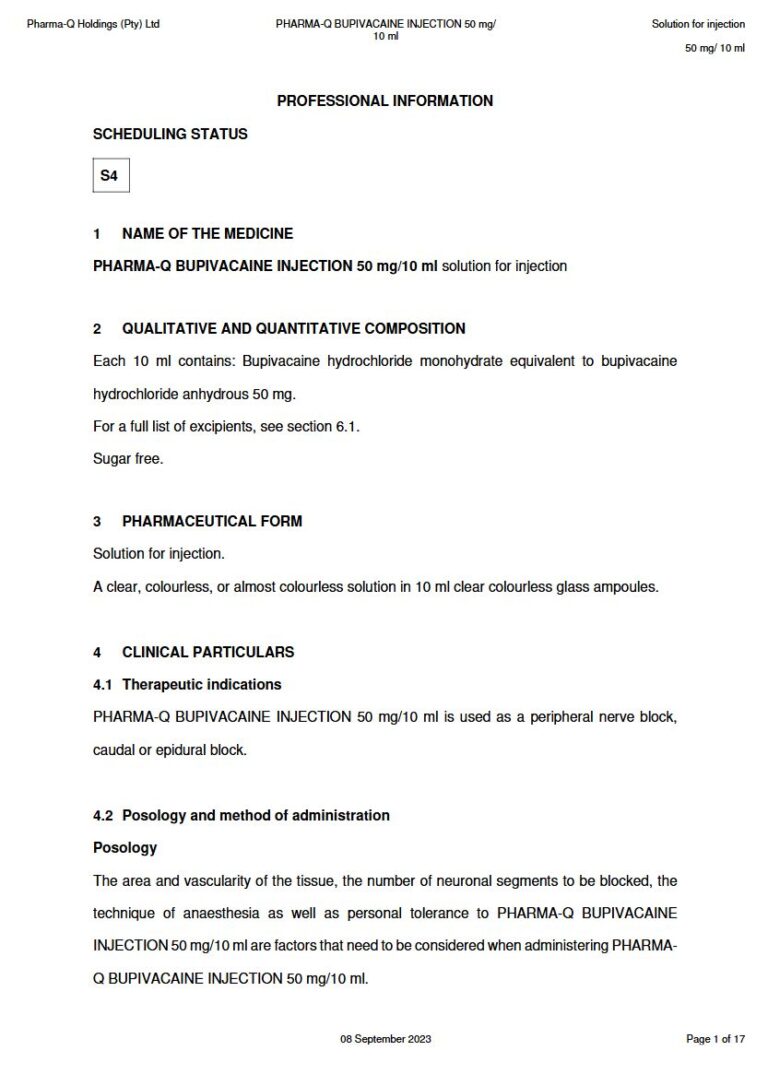
4.1 Therapeutic indications
PHARMA-Q BUPIVACAINE INJECTION 50 mg/10 ml is used as a peripheral nerve block, caudal or epidural block.
4.2 Posology and method of administration
Posology
The area and vascularity of the tissue, the number of neuronal segments to be blocked, the technique of anaesthesia as well as personal tolerance to PHARMA-Q BUPIVACAINE INJECTION 50 mg/10 ml are factors that need to be considered when administering PHARMA-Q BUPIVACAINE INJECTION 50 mg/10 ml.
The utmost care should be taken to prevent an accidental intravascular injection, always including careful aspiration. When the correct dose of PHARMA-Q BUPIVACAINE INJECTION 50 mg/10 ml is administered, complete sensory blockage will occur; however, motor blockade depends on the dose of PHARMA-Q BUPIVACAINE INJECTION 50 mg/10 ml administered. The duration of anaesthesia is such that in most cases, a single dose will be sufficient. The following dosages are recommended as a guide for use and have generally proved satisfactory in the average adult. The maximum recommended dose of PHARMA-Q BUPIVACAINE INJECTION 50 mg/10 ml in a single injection is 150 mg and should not be exceeded unless there are special considerations present. Where dosage is calculated on the patientu2019s mass, this should not exceed 2 mg/kg body mass up to a maximum of 150 mg.
Procedure: Dose: Additional Info
ml mg
Trigeminal block 0,5 - 4 2,5 - 20
Axillary block 15 - 30 75 - 150
Intercostal block 3 - 5 15 - 25 The dose indicated is for every segment.
Epidural anaesthesia 10 - 20 50 - 100
Continuous epidural anaesthesia Starting dose of 10 ml followed by 3 ml u2013 5 ml u2013 8 ml every 4 u2013 6 hours. The dose depends on the number of segments to be rendered analgesic and the patientu2019s age.
Caudal anaesthesia 15 u2013 30 75 u2013 150
Special populations
Patients treated with anti-dysrhythmic medicines class III (e.g., amiodarone) should be under close surveillance and ECG monitoring, since cardiac effects may be additive (see section 4.5).
Paediatric population
PHARMA-Q BUPIVACAINE INJECTION 50 mg/10 ml is not recommended for children younger than 12 years.
4.3 Contraindications
- Hypersensitivity to bupivacaine hydrochloride or to any of the excipients (see section 6.1).
- Known hypersensitivity to local anaesthetic medicines of the amide type.
- Intravenous regional anaesthesia (Bieru2019s block).
- Epidural anaesthesia, regardless of the local anaesthetic used, has its own general contraindications which include:
- Active disease of the central nervous system such as meningitis, poliomyelitis, intracranial haemorrhage, sub-acute combined degeneration of the cord due to pernicious anaemia, and cerebral and spinal tumours.
- Tuberculosis of the spine.
- Pyogenic infection of the skin at or adjacent to the site of lumbar puncture.
- Cardiogenic or hypovolaemic shock.
- Coagulation disorders or ongoing anticoagulation treatment.
4.4 Special warnings and precautions for use
DURING LOCAL ANAESTHESIA RESUSCITATIVE MEDICINES AND EQUIPMENT MUST BE PRESENT AT ALL TIMES. Before any nerve block is attempted, intravenous access for resuscitation purposes should be established. Medical practitioners should have received adequate and appropriate training in the procedure to be performed and should be familiar with the diagnosis and treatment of side effects, systemic toxicity or other complications (see section 4.9). There have been reports of cardiac arrest during the use of bupivacaine, as in PHARMA-Q BUPIVACAINE INJECTION 50 mg/10 ml, for epidural anaesthesia or peripheral nerve blockade where resuscitative efforts have been difficult and were required to be prolonged before the patient responded. Bupivacaine, as in PHARMA-Q BUPIVACAINE INJECTION 50 mg/10 ml, may cause acute toxicity effects on the central nervous and cardiovascular systems if utilised for local anaesthetic procedures resulting in high blood concentrations of bupivacaine. This is especially the case after unintentional intravascular administration. Ventricular dysrhythmia, ventricular fibrillation, sudden cardiovascular collapse, and death have been reported in connection with high systemic concentrations of bupivacaine. Major peripheral nerve blocks may require the administration of a large volume of local anaesthetic in areas of high vascularity, often close to large vessels where there is an increased risk of intravascular injection and/or systemic absorption. This may lead to high plasma concentrations. PHARMA-Q BUPIVACAINE INJECTION 50 mg/10 ml appears to be more cardiotoxic than other local anaesthetics. Fatalities have occurred since toxicity is difficult to treat. The central nervous system and cardiac toxicity can be enhanced by hypoxia and acidosis. Overdosage or accidental intravenous injection may give rise to toxic reactions. Paracervical block with amide-type local anaesthetics, such as PHARMA-Q BUPIVACAINE INJECTION 50 mg/10 ml, during labour often precedes foetal bradycardia and may be associated with foetal acidosis. The risk increases with premature birth, toxaemia of pregnancy, and foetal distress. Paracervical block using PHARMA-Q BUPIVACAINE INJECTION 50 mg/10 ml is not recommended. Inappropriate positioning of the patient may be a contributory factor for women in labour. Injection of repeated doses of PHARMA-Q BUPIVACAINE INJECTION 50 mg/10 ml may cause significant increases in blood levels with each repeated dose due to accumulation of bupivacaine. Tolerance varies with the status of the patient.
4.5 Interactions with other medicines
PHARMA-Q BUPIVACAINE INJECTION 50 mg/10 ml should be used with caution in patients receiving other local anaesthetics or medicines structurally related to amide-type local anaesthetics, e.g., certain anti-dysrhythmics, such as lidocaine (lignocaine), since systemic toxic effects are additive (see section 4.2). Specific interaction studies with bupivacaine and anti-dysrhythmic medicines class III (e.g., amiodarone) have not been performed, but caution should be advised (see also section 4.4). Propranolol may reduce the clearance of PHARMA-Q BUPIVACAINE INJECTION 50 mg/10 ml. There is a risk of increased bupivacaine toxicity when these medicines are used concomitantly. There is a possible risk that the adverse effects of PHARMA-Q BUPIVACAINE INJECTION 50 mg/10 ml on the heart may be enhanced in patients taking calcium-channel blockers. Interactions between PHARMA-Q BUPIVACAINE INJECTION 50 mg/10 ml and histamine H2-antagonists, such as cimetidine and ranitidine, resulted in a decreased clearance of bupivacaine and an increased plasma concentration, respectively, but had no significant clinical effects.
4.6 Fertility, pregnancy and lactation
Safe use in pregnancy and lactation, other than for use in labour, has not yet been established (see section 4.4). The use of local anaesthetics during pregnancy in the presence of foetal hypoxia or acidosis may be dangerous. Foetal bradycardia frequently follows paracervical block with some amide-type local anaesthetics and may be associated with foetal acidosis. Added risk appears to be present in prematurity, toxaemia of pregnancy and foetal distress.
Breastfeeding
Bupivacaine is distributed into breast milk, but in such small quantities that there is no risk of affecting the child at therapeutic dose levels.
4.7 Effects on ability to drive and use machines
Besides the direct anaesthetic effect on sensory and motive functioning, PHARMA-Q BUPIVACAINE INJECTION 50 mg/10 ml may have an effect on mental function and co-ordination even in the absence of overt CNS toxicity and may temporarily impair locomotion and alertness. Patients should be instructed that they should avoid potentially hazardous tasks such as driving and operating machinery until they know how PHARMA-Q BUPIVACAINE INJECTION 50 mg/10 ml affects them.
4.8 Undesirable effects
a. Summary of the safety profile
PHARMA-Q BUPIVACAINE INJECTION 50 mg/10 ml may have side effects:
u2022 side effects apparent after local anaesthesia may be due to the anaesthetic or to errors in technique or may be the result of blockade of the sympathetic nervous system.
u2022 local anaesthetics may have systemic adverse effects as a result of the raised plasma concentrations, which ensue when the rate of absorption into the circulation exceeds the rate of breakdown.
b. Tabulated summary of adverse reactions
The frequency of adverse reactions listed below is defined using the following convention: frequent; less frequent or frequency unknown (cannot be estimated from the available data).
4.9 Overdose
Accidental intravascular injections of local anaesthetics may cause immediate (within seconds to a few minutes) systemic toxic reactions. In the event of overdose, systemic toxicity appears later (15 u2013 60 minutes after injection) due to the slower increase in local anaesthetic blood concentration.
Treatment of overdose: Maintenance of the airways and ventilation with oxygen of the patient during respiratory distress. Treatment of milder symptoms of systemic toxicity may not be required but if convulsions occur, they can be controlled with oxygen and by rapid intravenous administration of a suitable benzodiazepine or a short-acting barbiturate e.g. thiopentone 100 mg u2013 200 mg or diazepam 5 mg u2013 10 mg. During circulatory distress intravenous fluids, and when necessary, vasopressors can be administered.
