
Betaphlem Syrup
PDF Leaflet Revision Date: 31 August 2022
Clinical Summary
Quick overview from the medicine insert
Indication
Adjunctive therapy in respiratory tract disorders with excessive viscous mucous.
Dosage (summary)
Adults: 10-15 ml three times daily; Children 6-12 years: 5 ml three times daily; Children 2-5 years: 1.25-2.5 ml four times daily.
Special Populations
- History of peptic ulcer
- Asthmatic patients
- Severe respiratory failure
- Debilitated patients
Pregnancy & Breastfeeding
Safety in pregnancy not established; unknown if excreted in breast milk.
Key Drug Interactions
- Incompatible with pholcodeine linctus
Contraindications
- Hypersensitivity to carbocisteine
- Active peptic ulcer
Common side effects
- Nausea
- Vomiting
- Diarrhoea
- Headache
- Dizziness
Counselling Points
- Avoid in children under 2 years
- Contains sucrose; caution in patients with fructose intolerance
Serious warnings
- Caution in patients with a history of peptic ulcer
- Risk of airway obstruction due to increased secretions
Important Disclaimer
The Betaphlem Syrup professional information leaflet below is the property of Ranbaxy Pharmaceuticals and is provided on Medinsert exactly as issued, with no.. alterations or editorial changes. We make every effort to keep content current by updating documents as soon as new versions become available. Medinsert serves as a trusted access point for healthcare professionals, but does not replace official sources or clinical judgement. For more details, please read our full disclaimer. read more>>
 Healthcare Professionals Only
This content is for registered healthcare professionals
Sign in or create a free account to read the full package insert.
Free for HPCSA-registered professionals. Powered by Medinsert.
Clinical Particulars
Section 4 of the official insert — extracted exactly as issued, no alterations
4.1 Therapeutic indications
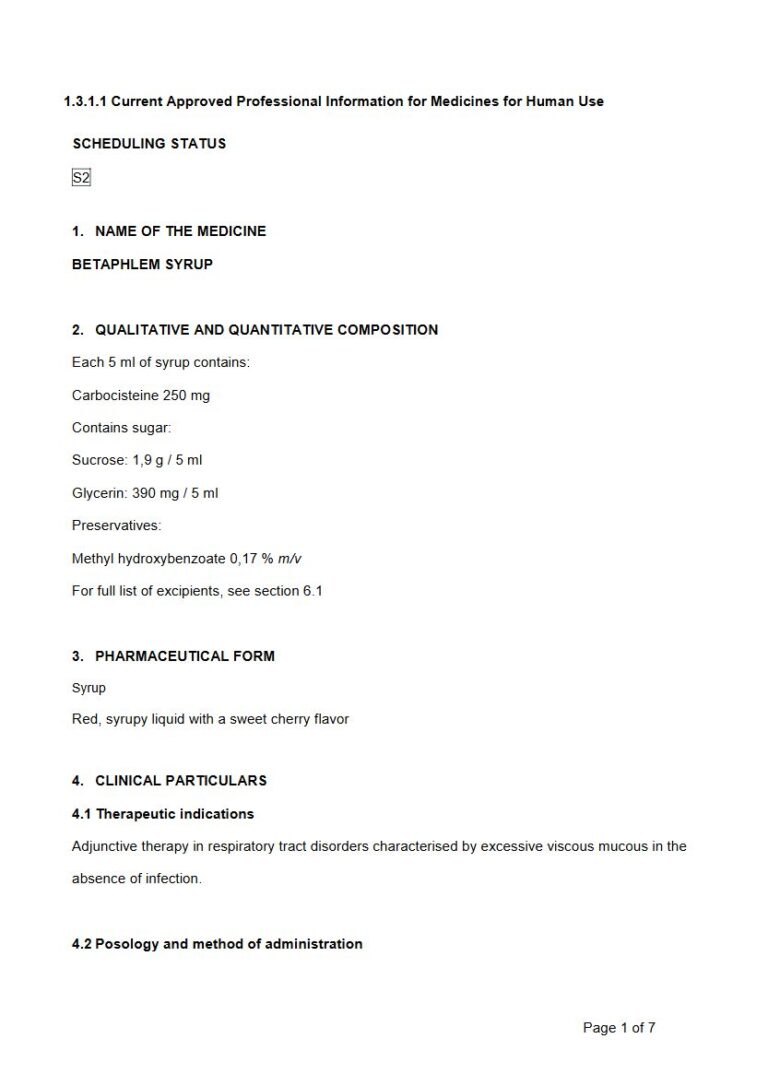
Adjunctive therapy in respiratory tract disorders characterised by excessive viscous mucous in the absence of infection.
4.2 Posology and method of administration
Not recommended for children under 2 years. Adults: Two to three medicine measures (10 ml to 15 ml), three times daily. Children: 6 - 12 years: One medicine measures (5 ml) three times daily. Children: 2 - 5 years: A quarter to half a medicine measures (1,25 - 2,5) ml four times daily, according to age.
4.3 Contraindications
- Hypersensitivity to carbocisteine, or to any of the excipients listed in section 6.1.
- Active peptic ulcer.
- The safety in pregnancy has not been established.
- Incompatible with pholcodeine linctus.
4.4 Special warnings and precautions for use
BETAPHLEM SYRUP should be administered with caution to patients with a history of peptic ulcer and should be avoided in patients with active ulceration.
- In patients with a history of gastric or duodenal ulcer;
- Asthmatic patients with a history of bronchospasm;
- Severe respiratory failure;
- Debilitated patients.
By decreasing the cough reflex there is a risk of obstruction of the airways as a consequence of the secretions amount increase. The use of carbocisteine implies a decrease in the mucus viscosity and removal, either through the ciliary activity of the epithelium, or by the cough reflex. Therefore it is expected an increase of cough and sputum. This association of this medicine with antitussive medication is not recommended.
Caution is advised in the administration of carbocisteine in individuals susceptible to gastroduodenal ulcers, as mucolytics have the capacity to destroy of the gastric mucosal barrier.
This medicine contains sucrose. Patients with rare hereditary problems of fructose intolerance, glucose-galactose malabsorption or sucrase-isomaltase insufficiency should not take this medicine. This medicine contains methyl parahydroxybenzoate. May cause allergic reactions (possibly delayed).
4.5 Interaction with other medicines and other forms of interaction
Incompatible with pholcodeine linctus.
4.6 Fertility, pregnancy and lactation
The safety of BETAPHLEM SYRUP in pregnancy has not been established.
Breast-feeding: It is unknown whether carbocisteine/metabolites are excreted in human milk.
Fertility: There is no known relevant data available on the effects of carbocisteine on fertility.
4.7 Effects on ability to drive and use machines
Carbocisteine has no or negligible influence on the ability to drive and use machines.
4.8 Undesirable effects
System Organ Class Less frequent Frequency Unknown
- Cardiac disorders: Palpitations
- Endocrine disorders: Hypothyroidism
- Gastrointestinal disorders: Nausea, vomiting, diarrhoea, gastrointestinal bleeding, Gastric discomfort
- Immune system disorders: Urticaria, bronchospasm, rash
- Musculoskeletal and connective tissue disorders: Muscle pain
- Nervous system disorders: Headache, dizziness, urinary incontinence, palpitations
- Respiratory, thoracic and mediastinal disorders: Shortness of breath, Bronchorrhea
- Skin and subcutaneous tissue disorders: Steven - Johnsons syndrome, erythema multiforme
4.9 Overdose
Refer to side-effects and special precautions. Treatment is supportive and symptomatic.
