
Kyprolis 60 Mg/50 Ml Solution
PDF Leaflet Revision Date: 01 March 2024
Clinical Summary
Quick overview from the medicine insert
Indication
Treatment of relapsed or refractory multiple myeloma.
Dosage (summary)
IV infusion, starting at 20 mg/mu00b2, increased to 27 mg/mu00b2 or 56 mg/mu00b2 based on regimen.
Special Populations
- Renal impairment
- Hepatic impairment
- Elderly patients
Pregnancy & Breastfeeding
Not recommended during pregnancy or breastfeeding.
Key Drug Interactions
- Dexamethasone
- Lenalidomide
- Daratumumab
Contraindications
- Hypersensitivity to carfilzomib
- Breastfeeding
Common side effects
- Anaemia
- Thrombocytopenia
- Neutropenia
- Nausea
- Fatigue
Counselling Points
- Hydration required before treatment
- Monitor for infusion reactions
- Use effective contraception during treatment
Serious warnings
- Cardiac failure
- Pulmonary toxicity
- Acute renal failure
- Tumor lysis syndrome
Important Disclaimer
The Kyprolis 60 Mg/50 Ml Solution professional information leaflet below is the property of Amgen South Africa and is provided on Medinsert exactly as issued, with no.. alterations or editorial changes. We make every effort to keep content current by updating documents as soon as new versions become available. Medinsert serves as a trusted access point for healthcare professionals, but does not replace official sources or clinical judgement. For more details, please read our full disclaimer. read more>>
 Healthcare Professionals Only
This content is for registered healthcare professionals
Sign in or create a free account to read the full package insert.
Free for HPCSA-registered professionals. Powered by Medinsert.
Clinical Particulars
Section 4 of the official insert — extracted exactly as issued, no alterations
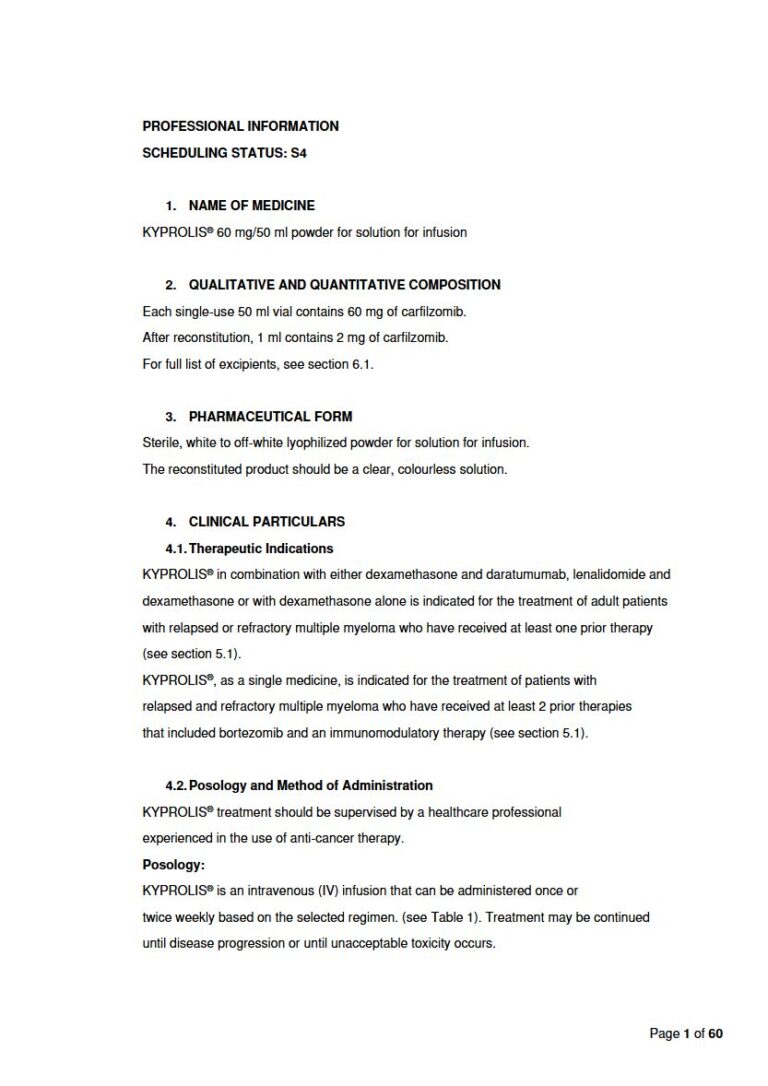
4.1. Therapeutic Indications
KYPROLIS u00ae in combination with either dexamethasone and daratumumab, lenalidomide and dexamethasone or with dexamethasone alone is indicated for the treatment of adult patients with relapsed or refractory multiple myeloma who have received at least one prior therapy (see section 5.1). KYPROLIS u00ae , as a single medicine, is indicated for the treatment of patients with relapsed and refractory multiple myeloma who have received at least 2 prior therapies that included bortezomib and an immunomodulatory therapy (see section 5.1).
4.2. Posology and Method of Administration
KYPROLIS u00ae treatment should be supervised by a healthcare professional experienced in the use of anti-cancer therapy. Posology: KYPROLIS u00ae is an intravenous (IV) infusion that can be administered once or twice weekly based on the selected regimen. (see Table 1). Treatment may be continued until disease progression or until unacceptable toxicity occurs.
4.3. Contraindications
- Hypersensitivity to the active substance or to any of the excipients listed in section 6.1
- Women who are breast feeding (see section 4.6).
As KYPROLIS u00ae is administered in combination with other medicinal products, refer to their professional information for additional contraindications.
4.4. Special Warnings and Precautions for Use
As KYPROLIS u00ae is administered in combination with other medicinal products, the summary of product characteristics of these other medicinal products must be consulted prior to initiation of treatment with KYPROLIS u00ae. As lenalidomide may be used in combination with KYPROLIS u00ae, particular attention to the lenalidomide pregnancy testing and prevention requirements is needed (see section 4.6).
Cardiac disorders: New or worsening cardiac failure (e.g., congestive cardiac failure, pulmonary oedema) decreased ejection fraction) myocardial ischaemia and infarction have occurred following administration of KYPROLIS u00ae. Death due to cardiac arrest has occurred within a day of KYPROLIS u00ae administration and fatal outcomes have been reported with cardiac failure and myocardial infarction. While adequate hydration is required prior to dosing in Cycle 1, all patients should be monitored for evidence of volume overload, especially patients at risk for cardiac failure. The total volume of fluids may be adjusted as clinically indicated in patients with baseline cardiac failure or who are at risk for cardiac failure (see section 4.2).
Stop KYPROLIS u00ae for Grade 3 or 4 cardiac events until recovery and consider whether to restart KYPROLIS u00ae at 1 dose level reduction based on a benefit/risk assessment (see section 4.2). The risk of cardiac failure is increased in elderly patients (u2265 75 years). The risk of cardiac failure is also increased in Asian patients. It should be noted that patients with New York Heart Association (NYHA) Class III and IV heart failure, recent myocardial infarction, cardiac conduction abnormalities, angina pectoris or dysrhythmias uncontrolled by medications were excluded from the clinical trials. These patients may be at greater risk for cardiac complications and should have a comprehensive cardiological assessment (particularly, blood pressure control and volume of fluids management) prior to starting treatment with KYPROLIS u00ae. Subsequently these patients should be treated with caution and remain under close follow up.
Electrocardiographic changes: There have been cases of QT interval prolongation reported in clinical studies and post-marketing. Cases of ventricular tachycardia have been reported in patients receiving KYPROLIS u00ae.
Pulmonary toxicity: Acute Respiratory Distress Syndrome (ARDS), acute respiratory failure, and acute diffuse infiltrative pulmonary disease such as pneumonitis and interstitial lung disease have occurred in patients receiving KYPROLIS u00ae. Some of these events have been fatal. KYPROLIS u00ae should be discontinued in these cases (see section 4.2).
Pulmonary hypertension: Pulmonary hypertension has been reported commonly in patients treated with KYPROLIS u00ae. Some of these events have been fatal. Evaluate as appropriate. Stop KYPROLIS u00ae for pulmonary hypertension until resolved or returned to baseline and consider whether to restart KYPROLIS u00ae based on a benefit/risk assessment (see Section 4.2).
Dyspnoea: Dyspnoea was reported very commonly in patients treated with KYPROLIS u00ae. Evaluate dyspnoea to exclude cardiopulmonary conditions including cardiac failure and pulmonary syndromes. Stop KYPROLIS u00ae for Grade 3 and 4 dyspnoea until resolved or returned to baseline and consider whether to restart KYPROLIS u00ae based on a benefit/risk assessment (see sections 4.2 and 4.8).
Hypertension: Hypertension occurred very commonly and included cases of hypertensive crisis and hypertensive emergency. Some of these events have been fatal. Hypertension was reported more frequently in patients who received Kyprolis u00ae in combination with daratumumab. It is recommended to control hypertension prior to starting KYPROLIS u00ae. All patients should be routinely evaluated for hypertension while on KYPROLIS u00ae and treated as needed. If the hypertension cannot be controlled, KYPROLIS u00ae dose should be discontinued until resolved. In case of hypertensive crisis, KYPROLIS u00ae should be discontinued (see section 4.2).
Acute renal failure: Cases of acute renal failure have been reported in patients who received KYPROLIS u00ae. Some of these events have been fatal. Acute renal failure was reported more frequently in patients with advanced relapsed and refractory multiple myeloma who received Kyprolis monotherapy. Acute renal failure was reported more frequently in patients with advanced relapsed and refractory multiple myeloma who received KYPROLIS u00ae monotherapy. This incidence was increased in patients with a lower baseline creatinine clearance, than among subjects with higher baseline creatinine clearance. Renal function with regular measurement of the serum creatinine and/or estimated creatinine clearance should be monitored. Reduce or stop KYPROLIS u00ae as appropriate (see section 4.2).
Tumour lysis syndrome: Cases of tumour lysis syndrome (TLS), including fatal outcome, have been reported in patients who received KYPROLIS u00ae. Patients with a high tumour burden should be considered to be at greater risk for TLS. Ensure that patients are well hydrated before administration of KYPROLIS u00ae in Cycle 1, and in subsequent cycles as needed. Uric acid lowering medicines should be considered in patients at high risk for TLS. Monitor for evidence of TLS during treatment including regular measurement of serum electrolytes, and manage promptly. Interrupt KYPROLIS u00ae until TLS is resolved (see section 4.2).
Infusion reactions: Infusion reactions, including life-threatening reactions, have been reported in patients who received KYPROLIS u00ae. Signs and symptoms may include fever, chills, arthralgia, myalgia, facial flushing, facial oedema, laryngeal oedema, vomiting, weakness, shortness of breath, hypotension, syncope, bradycardia, chest tightness, or angina pectoris. These reactions can occur immediately following or up to 24 hours after administration of KYPROLIS u00ae. Dexamethasone should be administered prior to KYPROLISu00ae to reduce the incidence and severity of reactions (see section 4.2).
Haemorrhage and Thrombocytopenia: Cases of haemorrhage (e.g. gastrointestinal, pulmonary and intracranial haemorrhage) have been reported in patients treated with KYPROLIS u00ae, often associated with thrombocytopenia. Some of these events have been fatal (see section 4.8). KYPROLIS u00ae causes thrombocytopenia with platelet nadirs observed on Day 8 or Day 15 of each 28 day cycle usually with recovery to baseline platelet count by the start of the next cycle (see section 4.8). Monitor platelet counts frequently during treatment with KYPROLIS u00ae. Reduce or stop dose as appropriate (see section 4.2).
Venous thromboembolic events: Cases of venous thromboembolic events, including deep vein thrombosis and pulmonary embolism with fatal outcomes, have been reported in patients who received KYPROLIS u00ae. Patients with known risk factors for thromboembolism u2013 including prior thrombosis u2013 should be closely monitored. Thromboprophylaxis should be considered based on an individual benefit/risk assessment. Caution should be used in the concomitant administration of other products that may increase the risk of thrombosis (e.g. erythropoietic medicines or hormone replacement therapy). Patients and physicians are advised to observe for the signs and symptoms of thromboembolism. Patients should be instructed to seek medical care if they develop symptoms such as shortness of breath, chest pain, haemoptysis, arm or leg swelling or pain.
Hepatic toxicity: Cases of hepatic failure, including fatal cases, have been reported. KYPROLIS u00ae can cause elevations of serum transaminases (see section 4.8). Monitor liver enzymes regularly, regardless of baseline values. Reduce or stop dose as appropriate (see section 4.2).
Thrombotic microangiopathy: Cases of thrombotic microangiopathy, including thrombotic thrombocytopenic purpura and haemolytic uremic syndrome (TTP/HUS) have been reported in patients who received KYPROLIS u00ae. Some of these events have been fatal. Monitor for signs and symptoms of TTP/HUS. If the diagnosis is suspected, stop KYPROLIS u00ae and evaluate patients for possible TTP/HUS. If the diagnosis of TTP/HUS is excluded, KYPROLIS u00ae can be restarted. The safety of reinitiating KYPROLIS u00ae therapy in patients previously experiencing TTP/HUS is not known.
Posterior reversible encephalopathy syndrome: Posterior reversible encephalopathy syndrome (PRES), formerly termed reversible Posterior leukoencephalopathy syndrome (RPLS), is a neurological disorder, which can present with seizure, headache, lethargy, confusion, blindness, altered consciousness, and other visual and neurological disturbances, along with hypertension, and the diagnosis is confirmed by neuro radiological imaging. Cases of PRES have been reported in patients receiving KYPROLIS u00ae. Discontinue KYPROLIS u00ae if PRES is suspected. The safety of reinitiating KYPROLIS u00ae therapy in patients previously experiencing PRES is not known.
Hepatitis B Virus (HBV) Reactivation: Cases of Hepatitis B Virus (HBV) reactivation have been reported in patients receiving KYPROLIS u00ae. Patients should be tested for HBV infection before initiating treatment. For patients who are carriers of HBV, prophylaxis with antivirals should be considered. Carriers of HBV who require treatment with KYPROLIS u00ae should be closely monitored for signs and symptoms of active HBV infection throughout and following the end of treatment. Consider consulting a specialist for patients who test positive for HBV infection prior to or during treatment. The safety of resuming KYPROLIS u00ae after HBV reactivation is adequately controlled is not known. Therefore, prescribers should weigh the risks and benefits when considering resumption of therapy in this situation.
Progressive Multifocal Leukoencephalopathy: Cases of Progressive Multifocal Leukoencephalopathy (PML) have been reported in patients treated with KYPROLIS u00ae who have had prior or concurrent immunosuppressive therapy. The causal relationship with KYPROLIS u00ae is unknown. Patients should be monitored for any new or worsening neurologic, cognitive or behavioural signs or symptoms that may be suggestive of PML as part of the differential diagnosis of CNS disorders. If PML is suspected, further Kyprolis administration must be suspended and the patients should be promptly referred to a specialist and appropriate diagnostic testing should be initiated. Discontinue KYPROLISu00ae if PML diagnosis is confirmed.
Increased Incidence of Fatal and Serious Adverse Events in Combination with Melphalan and Prednisone in Newly Diagnosed Transplant-Ineligible Multiple Myeloma Patients: In a clinical trial of 955 transplant ineligible patients with newly diagnosed multiple myeloma randomized to KYPROLIS u00ae (20/36 mg/m 2 by 30 minute infusion twice weekly for four weeks of each six week cycle), melphalan and prednisone (KMP) or bortezomib, melphalan and prednisone (VMP), a higher incidence of fatal adverse events (6.5 % versus 4.3 %), a higher incidence of serious adverse events (49.6 % versus 42.1 %) and a higher incidence of any grade adverse events involving cardiac failure (10.8 % versus 4.3 %), hypertension (24.7 % versus 8.1 %), acute renal failure (13.9 % versus 6.2 %), and dyspnoea (18.1 % versus were observed in patients in the KMP arm compared to patients in the VMP arm. This study did not meet its primary outcome measure of superiority in progression free survival (PFS) for the KMP arm. KYPROLIS u00ae in combination with melphalan and prednisone is not indicated for transplant-ineligible patients with newly diagnosed multiple myeloma.
4.5. Interactions with Other Medicines
Carfilzomib, as found in KYPROLIS u00ae, is primarily metabolised via peptidase and epoxide hydrolase activities, and as a result, the pharmacokinetic profile of carfilzomib is unlikely to be affected by concomitant administration of cytochrome P450 inhibitors and inducers. Carfilzomib is not expected to influence exposure of other medicines (see section 5.2). Based on in vitro and in vivo data, carfilzomib is not expected to inhibit CYP3A4/5 activities and/or affect the exposure to CYP3A4/5 substrates. A clinical trial using oral midazolam as a CYP3A probe demonstrated that the pharmacokinetics of midazolam were unaffected by concomitant carfilzomib administration. Carfilzomib is a P glycoprotein (P-gp) substrate but not a BCRP substrate. However, given that carfilzomib is administrated intravenously and is extensively metabolised, the pharmacokinetic profile of carfilzomib is unlikely to be to be affected by P-gp or BCRP inhibitors or inducers. In vitro, at concentrations (3 u03bcm) lower than those expected at therapeutic doses, carfilzomib inhibits the efflux transport of digoxin, a P-gp substrate, by 25%. Caution should be observed when carfilzomib is combined with substrates of P-gp (e.g. digoxin, colchicine).
4.6. Fertility, Pregnancy and Lactation
Women of childbearing potential / Contraception in males and females: Females and males of reproductive potential should be advised to avoid conceiving/fathering a child while being treated with KYPROLIS u00ae. Females patients of child bearing potential treated with KYPROLIS u00ae and/or their male partners should use effective contraception methods or abstain from sexual activity during and for 30 days after treatment with KYPROLIS u00ae (see Section 5.). Male patients treated with KYPROLIS u00ae and/or their female partners (if of childbearing potential) should use effective contraceptive methods or abstain from sexual activity while treated with KYPROLIS u00ae and for 90 days after treatment. If pregnancy occurs during this time, patients should be apprised of the potential hazard to the foetus. It is not known if KYPROLIS u00ae will reduce the efficacy of oral contraceptives. Due to an increased risk of venous thrombosis associated with KYPROLIS u00ae, patients currently using oral contraceptives or a hormonal method of contraception associated with a risk of thrombosis should consider an alternative method of effective contraception (see sections 4.4 and 4.8).
Pregnancy: There are no data on the use of KYPROLIS u00ae in pregnant women. KYPROLIS u00ae caused embryo-foetal toxicity in pregnant rabbits at doses that were lower than in patients receiving the recommended dose (see section 5.3). KYPROLIS u00ae should only be used during pregnancy if the potential benefits to the mother outweigh the potential risks to the foetus.
Breastfeeding: Mothers should not breastfeed their infants as KYPROLIS u00ae is present in human breast milk.
Fertility: No fertility studies have been performed (see section 5.3).
4.7. Effects on Ability to Drive and Use Machines
No studies on the effects of KYPROLIS u00ae on the ability to drive or use machines have been performed. Fatigue, dizziness, fainting and/or a drop in blood pressure have been observed in clinical trials. Patients being treated with KYPROLIS u00ae should, therefore, be advised not to drive or operate machinery if they experience any of these symptoms.
4.8. Undesirable Effects
Summary of safety profile: Serious adverse reactions that may occur during KYPROLIS u00ae treatment include: cardiac failure, myocardial infarction, cardiac arrest, myocardial ischemia, interstitial lung disease, pneumonitis, acute respiratory distress syndrome, acute respiratory failure, pulmonary hypertension, dyspnoea, hypertension including hypertensive crisis, acute kidney injury, tumour lysis syndrome, infusion related reaction, gastrointestinal haemorrhage, intracranial haemorrhage, pulmonary haemorrhage, thrombocytopenia, hepatic failure, hepatitis B virus reactivation, PRES and thrombotic microangiopathy. The most common adverse reactions (occurring in > 20 % of patients) were: anaemia, thrombocytopenia, neutropenia, nausea diarrhoea, fatigue, pyrexia, respiratory tract infection, dyspnoea, and cough.
Combination with Dexamethasone and Daratumumab: In CANDOR, in which Kyprolis 20/56 mg/m 2 twice weekly was administered in both trial arms, deaths due to adverse events within 30 days of the last dose of any study treatment occurred in 30/308 (10 %) patients in the carfilzomib-dexamethasone-daratumumab (KdD) arm compared with 8/153 (5 %) patients in the carfilzomib-dexamethasone (Kd) arm. The most common cause of death occurring in patients (%) in the two arms (KdD versus Kd) was infections 14 (5 %) versus 4 (3 %). The risk of fatal treatment-emergent adverse events was higher among subjects u2265 65 years of age. Serious adverse events were reported in 56 % of the patients in the KdD arm and 46 % of the patients in the Kd arm. The most common serious adverse events reported in the KdD arm as compared with the Kd arm were anaemia (2 % versus 1 %), diarrhoea (2 % versus 0 %), pyrexia (4 % versus 2 %), pneumonia (12 % versus 9 %), influenza (4 % versus 1 %), sepsis (4 % versus 1 %) and bronchitis (2 % versus 0 %). Grade u2265 3 adverse events occurred in 82 % of patients in the KdD arm as compared with 74 % in the Kd arm. The most frequently reported (occurring in u2265 10 % of subjects in either treatment group [KdD, Kd]) grade u2265 3 adverse events included thrombocytopenia (24 %, 16 %), hypertension (18 %, 13 %), anaemia (17 %, 14 %), and pneumonia (13 %, 9 %). Discontinuation of any study treatment due to any adverse events occurred in 22 % of patients in the KdD arm versus 25 % in the Kd arm.
4.9. Overdose
Acute onset of chills, hypotension, renal insufficiency, thrombocytopenia, and lymphopenia have been reported following a dose of 200 mg of KYPROLIS u00ae administered in error. There is no known specific antidote for carfilzomib overdose. In the event of an overdose, the patient should be monitored, specifically for the side effects and/or adverse medicine reactions (see section 4.8).
