
Cefalexin 250 Capsules Resmed 250 mg Capsule
PDF Leaflet Revision Date: 03 August 2022
Clinical Summary
Quick overview from the medicine insert
Indication
Treatment of infections caused by susceptible micro-organisms.
Dosage (summary)
Adults: 250 mg every 6 hours; up to 4 g daily in divided doses.
Onset of Action / Duration
Onset: 1 hour, Duration: 6-8 hours
Special Populations
- Elderly
- Renal impairment
Pregnancy & Breastfeeding
Safety in pregnancy and lactation not established.
Key Drug Interactions
- Uricosuric drugs increase plasma levels
- Nephrotoxic antibiotics may increase nephrotoxicity
- Oral anticoagulants may prolong prothrombin time
Contraindications
- Hypersensitivity to cefalexin
- Allergy to cephalosporins
Common side effects
- Nausea
- Vomiting
- Diarrhoea
- Rash
- Hypersensitivity reactions
Counselling Points
- Monitor for allergic reactions
- Take with caution if allergic to penicillins
- Report severe diarrhea immediately
Serious warnings
- Risk of anaphylaxis
- Pseudomembranous colitis
- Renal impairment caution
Important Disclaimer
The Cefalexin 250 Capsules Resmed 250 mg Capsule professional information leaflet below is the property of Resmed Healthcare and is provided on Medinsert exactly as issued, with no.. alterations or editorial changes. We make every effort to keep content current by updating documents as soon as new versions become available. Medinsert serves as a trusted access point for healthcare professionals, but does not replace official sources or clinical judgement. For more details, please read our full disclaimer. read more>>
 Healthcare Professionals Only
This content is for registered healthcare professionals
Sign in or create a free account to read the full package insert.
Free for HPCSA-registered professionals. Powered by Medinsert.
Clinical Particulars
Section 4 of the official insert — extracted exactly as issued, no alterations
4.1 Therapeutic indications
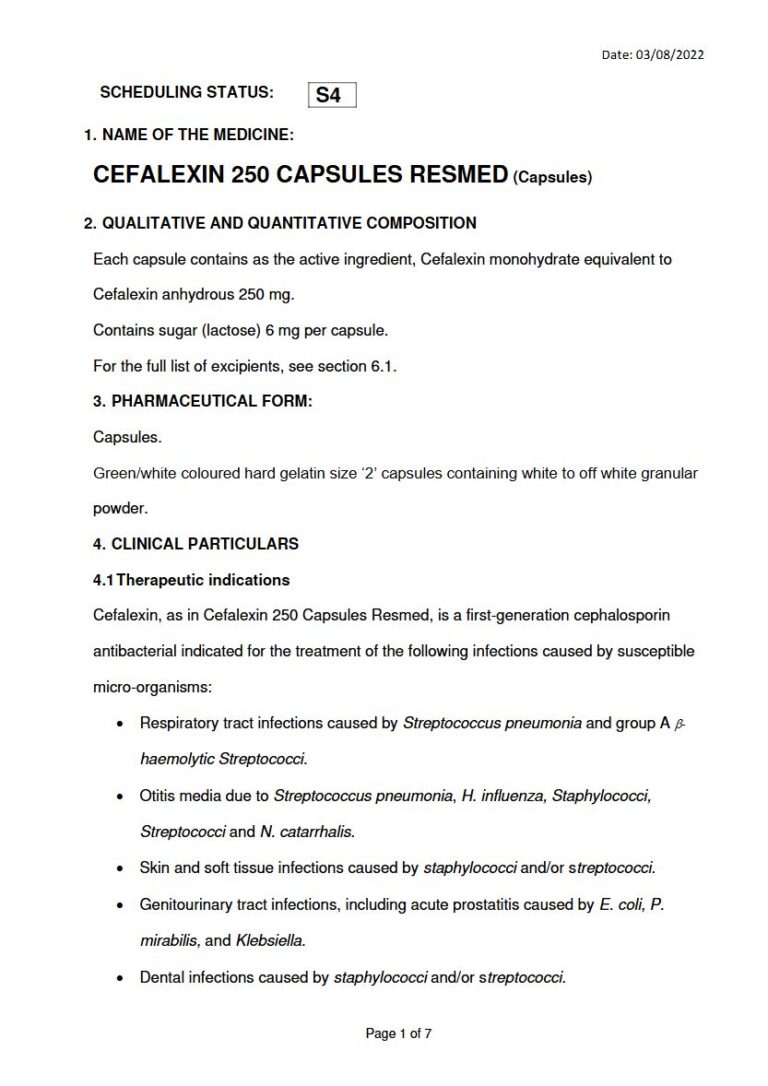
Cefalexin, as in Cefalexin 250 Capsules Resmed, is a first-generation cephalosporin antibacterial indicated for the treatment of the following infections caused by susceptible micro-organisms:
- Respiratory tract infections caused by Streptococcus pneumonia and group A u03b2-haemolytic Streptococci.
- Otitis media due to Streptococcus pneumonia, H. influenza, Staphylococci, Streptococci and N. catarrhalis.
- Skin and soft tissue infections caused by staphylococci and/or streptococci.
- Genitourinary tract infections, including acute prostatitis caused by E. coli, P. mirabilis, and Klebsiella.
- Dental infections caused by staphylococci and/or streptococci.
Appropriate culture and susceptibility studies should be performed to determine susceptibility of causative organism to cefalexin. Renal function studies should be performed when indicated.
4.2 Posology and method of administration
Posology
Adults: The adult dosage ranges from 1-4 g daily in divided doses. The usual adult dose is 250 mg every 6 hours. For skin and soft tissue infections, streptococcal pharyngitis and mild uncomplicated urinary tract infections, the usual dosage is 250 mg every 6 hours or 500 mg every 12 hours. For more severe infections or those caused by less susceptible organisms, larger doses may be needed. If daily doses greater than 4 grams are required, parenteral cephalosporins, in appropriate doses, should be considered.
Special populations
The elderly and patients with impaired renal function: As for adults. Reduce dosage if renal function is markedly impaired.
Paediatric population
Children: The usual recommended dosage for children is 25 mg/kg/day to 50 mg/kg/day in divided doses every six hours. The use of capsules is not feasible in young children. In the treatment of beta-haemolytic streptococcal infections, a therapeutic dose should be administered for at least 10 days.
Method of administration
Capsules for oral use.
4.3 Contraindications
Hypersensitivity to cefalexin or to any of the excipients of Cefalexin 250 Capsules Resmed listed in section 6.1. Cefalexin is contra-indicated in patients with known allergy to the cephalosporin group of antibiotics.
4.4 Special warnings and precautions for use
Before therapy with cefalexin is instituted, careful enquiry should be made concerning previous hypersensitivity reactions to cephalosporins, penicillins and other medicine. Cefalexin should be administered with caution to penicillin-sensitive patients. There is some evidence of cross-allergenicity between the penicillins and cephalosporins. Patients have been reported to have had severe reactions (including anaphylaxis) to both.
The diagnosis of pseudomembranous colitis must be considered in patients who develop diarrhoea in association with its use. Such colitis may be life-threatening and appropriate measures should be taken, including discontinuation of Cefalexin 250 Capsules Resmed.
Cefalexin 250 Capsules Resmed should be administered with caution to patients with renal impairment and dosage reduction may be necessary. Acute renal tubular necrosis may occur following excessive dosage and has been associated with its use in older patients, those with pre-existing renal impairment, or with concomitant administration of nephrotoxic medicines such as aminoglycosides.
Positive results to the direct Coombsu2019 test have been found during treatment with cephalosporins, which can interfere with blood cross matching. A false positive reaction for glucose in the urine may occur with Benedictu2019s or Fehlingu2019s solution or with copper sulphate test tablets.
Prolonged use of Cefalexin 250 Capsules Resmed may result in the overgrowth of non-susceptible organisms. Careful observation of the patient is essential. If superinfection occurs during therapy, appropriate measures should be taken.
Acute generalised exanthematous pustulosis (AGEP) has been reported in association with cefalexin treatment. At the time of prescription patients should be advised of the signs and symptoms and monitored closely for skin reactions. If signs and symptoms suggestive of these reactions appear, cefalexin should be withdrawn immediately and an alternative treatment considered. Most of these reactions occurred most likely in the first week during treatment.
Cefalexin 250 Capsules Resmed contains lactose. Patients with the rare hereditary conditions of galactose intolerance, total lactose deficiency, glucose-galactose malabsorption should not take Cefalexin 250 Capsules Resmed. Contains lactose which may have an effect on the glycaemic control of patients with diabetes mellitus.
4.5 Interaction with other medicines and other forms of interaction
As cephalosporins like cefalexin are only active against proliferating microorganisms, they should not be combined with bacteriostatic antibiotics. Concomitant use of uricosuric drugs (e.g. probenecid) suppresses renal drug elimination. As a result, cefalexin plasma levels are increased and sustained for longer periods. If associated with highly potent diuretics (ethacrynic acid, furosemide) or other potentially nephrotoxic antibiotics (aminoglycosides, polymyxin, colistin), cephalosporins may show higher nephrotoxicity. Combined use of cephalosporins and oral anticoagulants may prolong prothrombin time. A potential interaction between cefalexin and metformin may result in an accumulation of metformin and could result in fatal lactic acidosis. Hypokalaemia has been described in patient taking cytotoxic drugs for leukaemia when they were given gentamicin and cefalexin.
4.6 Fertility, pregnancy and lactation
Safety in pregnancy and lactation has not been established.
4.7 Effects on ability to drive and use machines.
None known.
4.8 Undesirable effects
Blood and the lymphatic system disorders:
- Frequent: eosinophilia.
- Less frequent: Hypoprothrombinaemia, neutropenia, thrombocytopenia, agranulocytosis; there may be a positive response to the Coombsu2019 test, but haemolytic anaemia rarely occurs.
Nervous system disorders:
- Less frequent: convulsions and other signs of CNS toxicity have been associated with high doses, especially in patients with severe renal impairment.
Gastrointestinal disorders:
- Frequent: Nausea, vomiting and diarrhoea.
- Less frequent: pseudomembranous colitis.
Hepato-biliary disorders:
- Less frequent: Transient increases in hepatic enzyme levels, hepatitis, cholestatic jaundice.
Skin:
- Frequent: Rash.
- Less frequent: erythema multiforme, Stevens-Johnson syndrome, toxic epidermal necrolysis.
Renal and urinary disorders:
- Less frequent: acute interstitial nephritis.
Other:
- Frequent: Hypersensitivity reactions including skin rashes, urticaria, eosinophilia, fever, reactions resembling serum sickness and anaphylaxis.
- Frequency unknown: vulval irritation, abdominal cramps, headache, dizziness, drowsiness and fatigue.
4.9 Overdose
Treatment is symptomatic and supportive. Cefalexin is removed by haemodialysis and peritoneal dialysis.
