
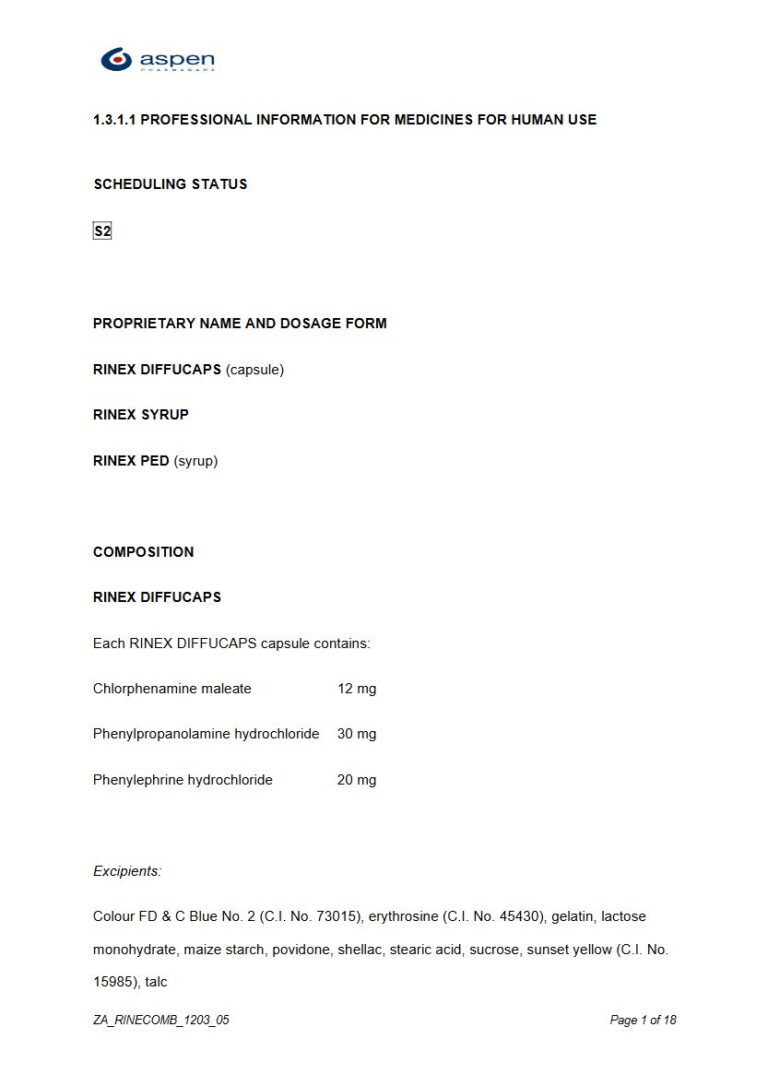
Rinex Diffucaps, Rinex 5 ml Capsules
PDF Leaflet Revision Date: 02 March 2012
Clinical Summary
Quick overview from the medicine insert
Indication
Symptomatic relief of nasal congestion due to common cold, flu, and allergies.
Dosage (summary)
Adults: 1 capsule every 8-12 hours or 5 ml 3-4 times daily. Children 6-12: 2.5 ml 3-4 times daily.
Special Populations
- Children under 6 years
- Children under 12 years for DIFFUCAPS
Pregnancy & Breastfeeding
Safety in pregnancy and lactation not established; avoid in pregnancy.
Key Drug Interactions
- Alcohol: Potentiates sedation
- Antihypertensives: Reversal of action
- CNS depressants: Enhanced effects
Contraindications
- Hypersensitivity to ingredients
- Acute asthma attacks
- Monoamine oxidase inhibitors
- Hypertension
- Hyperthyroidism
- Cardiovascular disease
Common side effects
- Sedation
- Dizziness
- Nausea
- Palpitations
- Increased blood pressure
Counselling Points
- Avoid alcohol
- Do not drive or operate machinery if drowsy
- Consult doctor if symptoms persist after 7 days
Serious warnings
- Do not exceed recommended dose
- Use caution in cardiovascular disease
- May cause drowsiness
Important Disclaimer
The Rinex Diffucaps, Rinex 5 ml Capsules professional information leaflet below is the property of Pharmacare and is provided on Medinsert exactly as issued, with no.. alterations or editorial changes. We make every effort to keep content current by updating documents as soon as new versions become available. Medinsert serves as a trusted access point for healthcare professionals, but does not replace official sources or clinical judgement. For more details, please read our full disclaimer. read more>>
 Healthcare Professionals Only
This content is for registered healthcare professionals
Sign in or create a free account to read the full package insert.
Free for HPCSA-registered professionals. Powered by Medinsert.
Clinical Particulars
Section 4 of the official insert — extracted exactly as issued, no alterations
4.1 Therapeutic indications
RINEX is indicated for:
- The symptomatic relief of nasal congestion due to the common cold and flu, hay fever, allergic rhinitis, other upper respiratory allergies, or associated with sinusitis.
- Relief of Eustachian tube congestion as an adjunct to treatment of middle ear infection.
4.2 Posology and method of administration
DO NOT EXCEED THE RECOMMENDED DOSE.
RINEX DIFFUCAPS
Adults and children 12 years and older: One capsule every 8 to 12 hours. Do not chew the capsule or the content.
RINEX SYRUP
NOT FOR CHILDREN UNDER 6 YEARS OF AGE.
Adults and children 12 years and older: One medicine measure (5 ml) 3 to 4 times daily.
Children 6 to 12 years: Half a medicine measure (2.5 ml) 3 to 4 times daily.
RINEX PED syrup
NOT FOR CHILDREN UNDER 6 YEARS OF AGE.
Children 6 to 12 years: One medicine measure (5 ml) 3 to 4 times daily.
4.3 Contraindications
- Hypersensitivity to any of the active ingredients or excipients in RINEX (see COMPOSITION).
- During acute attacks of asthma.
- Patients on a monoamine oxidase inhibitor for depression (e.g. tranylcypromine) or within two weeks of stopping treatment.
- Safety in pregnancy and lactation has not been established (see HUMAN REPRODUCTION).
- Patients with hypertension, hyperthyroidism or cardiovascular disease, such as ischaemic heart disease.
- RINEX PED syrup and RINEX SYRUP are contraindicated in children under six years of age.
- RINEX DIFFUCAPS is contraindicated in children under twelve years of age.
4.4 Special warnings and precautions for use
RINEX should not be taken for more than seven days. After 5 to 7 days tachyphylaxis may occur and the product loses effect. If symptoms do not improve, or are accompanied by fever, consult a doctor.
Exceeding the recommended dosage may result in nervousness, dizziness, sleeplessness, tremulousness or cardiac dysrhythmia. This may also occur in sensitive individuals at small doses.
RINEX should be used with caution in patients with:
- Occlusive vascular disease including arteriosclerosis and aneurysms.
- Closed-angle glaucoma.
- Phaeochromocytoma.
Severe hypertensive episodes leading to intracranial haemorrhage have followed phenylpropanolamine ingestion. Patients should be informed of the dangers of exceeding the recommended dose; in particular the increased risk of serious adverse events such as hypertensive crisis and haemorrhagic stroke. Patients with cardiovascular disease, hypertension or hyperthyroidism should not use the RINEX products (see CONTRAINDICATIONS).
In addition, RINEX may aggravate conditions such as diabetes, glaucoma or prostatic enlargement. Patients on monoamine oxidase inhibitors (e.g. tranylcypromine) should not use RINEX (see CONTRAINDICATIONS).
RINEX should be used with care in conditions such as narrow angle glaucoma, urinary retention and prostatic hypertrophy. RINEX may also suppress positive skin results and should thus be stopped several days before the test.
RINEX should be used with caution in patients who may be hypersensitive to the effects of sympathomimetics, particularly those with hyperthyroidism. Great care is also needed in patients with cardiovascular disease such as ischaemic heart disease; dysrhythmias or tachycardia; occlusive vascular disorders, including arteriosclerosis, hypertension, or aneurysms. Reversal of action of many antihypertensive agents occurs in patients given sympathomimetics, and therefore special care is advisable in patients receiving antihypertensive therapy (see INTERACTIONS).
4.5 Interactions with other medicines
Alcohol: Potentiates sedation.
Antihypertensive agents including alpha- and beta-blockers: Reversal of action of antihypertensive agents.
Cardiac glycosides, quinidine or tricyclic antidepressants: Increased risk of dysrhythmias may occur in patients.
Halothane, or other halogenated anaesthetics: May induce ventricular fibrillation.
Hypnotics and anxiolytics: May cause potentiation of drowsiness.
Monoamine oxidase inhibitors, atropine and tricyclic antidepressants: Enhancement of antimuscarinic effects.
Phenytoin: Chlorphenamine, as contained in RINEX, inhibits phenytoin metabolism leading to phenytoin toxicity.
Central nervous system depressants, including alcohol, barbiturates, hypnotics, narcotic analgesics, sedatives and tranquilisers: Enhancement of sedative effects.
Interactions are possible with reserpine, tricyclic antidepressants, digoxin and alpha-methyldopa.
4.6 Fertility, pregnancy and lactation
Safety in pregnancy and lactation has not been established. Phenylephrine hydrochloride is best avoided in pregnancy, because of the potential promotion of uterine contractility and peripheral vasoconstriction, with the possibility of foetal hypoxia.
4.7 Effects on ability to drive and use machines
The use of RINEX may cause drowsiness and impaired concentration, which is aggravated by the simultaneous intake of alcohol and other central nervous system depressants; patients affected should not drive or operate machinery.
4.8 Undesirable effects
Chlorphenamine
Blood and the lymphatic system disorders
Less frequent: Agranulocytosis, leucopenia and haemolytic anaemia
Psychiatric disorders
Less frequent: Depression, nightmares, irritability
Frequency unknown: Euphoria
Nervous system disorders
Frequent: Sedation varying from slight drowsiness to deep sleep, and including lassitude, dizziness
Less frequent: Incoordination, headache, impaired concentration
Eye disorders
Less frequent: Blurred vision
Ear and labyrinth disorders
Less frequent: Tinnitus
Cardiac disorders
Less frequent: Palpitation, tachycardia, dysrhythmia
Vascular disorders
Less frequent: Hypotension
Respiratory, thoracic and mediastinal disorders
Less frequent: Increased viscosity of bronchial secretions
Gastrointestinal disorders
Less frequent: Nausea, vomiting, diarrhoea or constipation, anorexia or increased appetite, abdominal pain, dyspepsia, dryness of the mouth and epigastric pain
Hepato-biliary disorders
Less frequent: Hepatitis, jaundice
Skin and subcutaneous tissue disorders
Less frequent: Allergic reactions including exfoliative dermatitis and cross-sensitivity to related medicines may occur, photosensitivity and skin reactions such as urticaria
Musculoskeletal, connective tissue and bone disorders
Less frequent: Muscular weakness, twitching
Renal and urinary disorders
Less frequent: Urinary retention
Frequency unknown: Difficulty in micturition, dysuria
General disorders and administrative site conditions
Less frequent: Tightness of the chest
Paradoxical central nervous system stimulation may occur, especially in children, with insomnia, nervousness, tachycardia, tremors and convulsions
Phenylpropanolamine
Psychiatric disorders
Frequency unknown: Fear, anxiety, restlessness, tremor, insomnia, confusion, irritability, weakness and psychotic states
Gastrointestinal disorders
Frequency unknown: Nausea, vomiting, appetite may be reduced, hypersalivation
Metabolism and nutritional disorders
Frequency unknown: Altered metabolism including disturbances of glucose metabolism
Phenylephrine
Psychiatric disorders
Frequent: Nervousness, irritability, restlessness, and excitability
Frequency unknown: Fear, anxiety, tremor, insomnia, confusion, weakness and psychotic states
Nervous system disorders
Frequent: Headache, dizziness, insomnia
Eye disorders
Frequency unknown: Mydriasis, acute angle closure glaucoma
Cardiac disorders
Frequency unknown: Tachycardia or bradycardia, cardiac dysrhythmias, angina pain, palpitations, cardiac arrest
Vascular disorders
Frequent: Increased blood pressure
Frequency unknown: Hypotension with dizziness, fainting and flushing may occur, haemorrhagic stroke, flushing, sweating, vasoconstriction
Respiratory, thoracic and mediastinal disorders
Frequency unknown: Dyspnoea
Gastrointestinal disorders
Frequent: Nausea, vomiting, diarrhoea
Frequency unknown: Appetite may be reduced, hypersalivation
Metabolism and nutritional disorders
Frequency unknown: Altered metabolism including disturbances of glucose metabolism
Skin and subcutaneous tissue disorders
Frequency unknown: Allergic reactions such as rash, urticaria, allergic dermatitis, hypersensitivity reactions, including cross-sensitivity with other sympathomimetics
Renal and urinary disorders
Frequency unknown: Difficulty in micturition, urinary retention, dysuria.
4.9 Overdose
Chlorphenamine
The main symptoms of overdosage with chlorphenamine in infants and children include ataxia, excitement, hallucinations, muscle tremor, convulsions, dilated pupils, dry mouth, flushed face and hyperpyrexia. Deepening coma, cardiorespiratory collapse and death may occur within 18 hours. In adults, the usual symptoms are drowsiness, coma and convulsions. Hypertension may also occur. Elderly patients are more susceptible to these central nervous system depressant and hypotensive effects even at therapeutic doses.
Phenylpropanolamine
Overdosage with phenylpropanolamine may cause giddiness, headache, nausea, vomiting, sweating, thirst, palpitations, difficulty in micturition, muscular weakness and tremors, anxiety, restlessness and insomnia. Overdosage may also cause psychoses, hallucinations and cardiorespiratory collapse. Severe increase in blood pressure may occur. Treatment with alpha-adrenergic blocking agents to reduce blood pressure should be instituted if myocardial ischaemia or encephalopathy is provoked.
Phenylephrine
Overdosage with phenylephrine may cause headache, hypertension, palpitations and vomiting. Severe increase in blood pressure may occur. Treatment with alpha-adrenergic blocking agents to reduce blood pressure should be instituted if myocardial ischaemia or encephalopathy is provoked. Unless contraindications exist, the stomach should be emptied by gastric lavage. Further treatment is symptomatic and supportive.
