
Rhineton Syrup 5 ml Syrup
PDF Leaflet Revision Date: 10 November 2022
Clinical Summary
Quick overview from the medicine insert
Indication
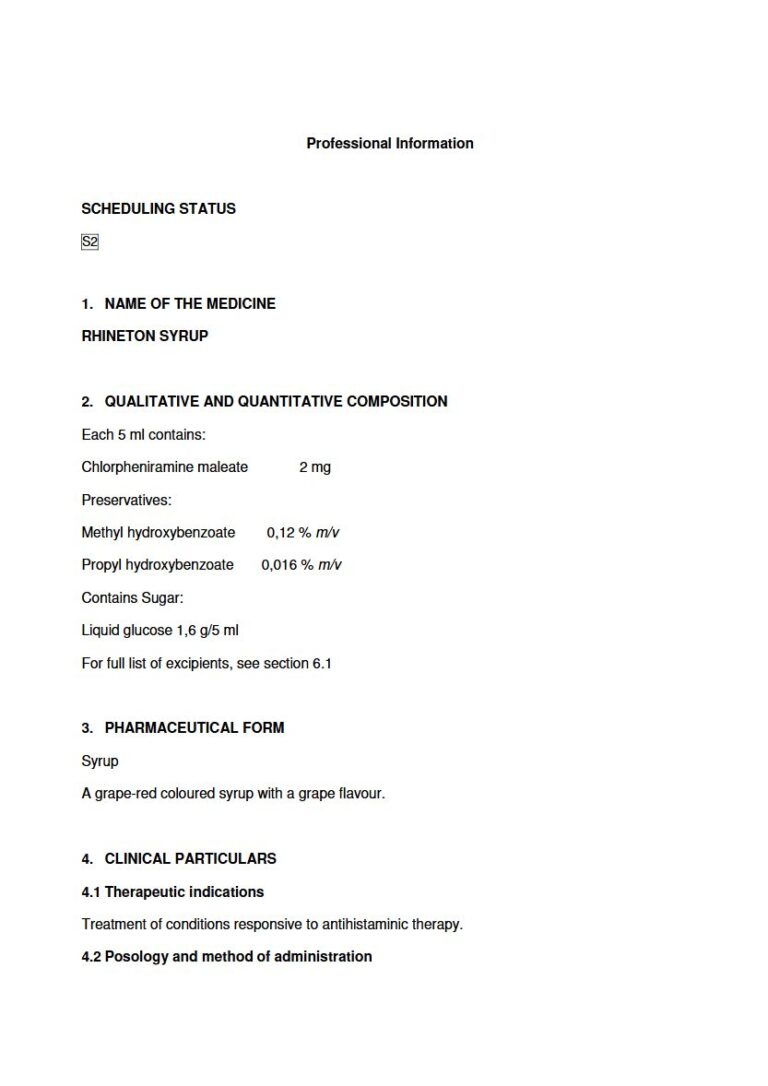
Treatment of conditions responsive to antihistaminic therapy.
Dosage (summary)
Adults: 5-20 ml daily in divided doses.
Onset of Action / Duration
Onset: 2-3 hours, Duration: 4-6 hours
Special Populations
- Geriatrics
- Diabetes mellitus
- Epilepsy
- Bladder neck obstruction
- Prostatic hypertrophy
Pregnancy & Breastfeeding
Not recommended in early pregnancy; avoid in breastfeeding due to potential infant irritability.
Key Drug Interactions
- CNS depressants
- Alcohol
- Antimuscarinic drugs
Contraindications
- Neonates
- Lactation
- Epilepsy
- Acute asthma attacks
Common side effects
- Drowsiness
- Dizziness
- Nausea
- Dry mouth
- Blurred vision
Counselling Points
- Avoid alcohol and CNS depressants
- Do not operate machinery if drowsy
- Monitor for unusual excitement in children
Serious warnings
- May impair ability to drive
- Risk of drowsiness
- Caution in geriatric patients
Important Disclaimer
The Rhineton Syrup 5 ml Syrup professional information leaflet below is the property of Ranbaxy Pharmaceuticals and is provided on Medinsert exactly as issued, with no.. alterations or editorial changes. We make every effort to keep content current by updating documents as soon as new versions become available. Medinsert serves as a trusted access point for healthcare professionals, but does not replace official sources or clinical judgement. For more details, please read our full disclaimer. read more>>
 Healthcare Professionals Only
This content is for registered healthcare professionals
Sign in or create a free account to read the full package insert.
Free for HPCSA-registered professionals. Powered by Medinsert.
Clinical Particulars
Section 4 of the official insert — extracted exactly as issued, no alterations
4.1 Therapeutic indications
Treatment of conditions responsive to antihistaminic therapy.
4.2 Posology and method of administration
Posology
Adults 5 ml - 20 ml daily in divided doses.
Children
- 1-2 years 2,5 ml ( 1 / 2 medicine measure) orally twice daily.
- 2-5 years 2,5 ml ( 1 / 2 medicine measure) orally every 4 to 8 hours to a maximum of 15 ml daily.
- 6-12 years 5 ml (1 medicine measure) orally every 4 to 8 hours to a maximum of 30 ml daily.
Method of administration
Oral administration.
4.3 Contraindications
RHINETON SYRUP is contra-indicated in:
- In neonates and lactation (see Section 4.6).
- Paediatrics u2013 Not recommended for newborn or premature infants because it causes anticholinergic side effects such as excitation of the central nervous system and increased tendency towards convulsions.
- Epilepsy.
- Acute attacks of asthma.
4.4 Special warnings and precautions for use
This medicine may lead to drowsiness and impaired concentration that may be aggravated by simultaneous intake of alcohol and other central nervous system depressants. Patients should be advised, particularly in the initiation therapy, against taking charge of vehicles or machinery or performing potentially hazardous tasks where loss of concentration could lead to accidents. Avoid use of alcohol or CNS depressants. Inform your physician if taking other medications (see Section 4.5). Drowsiness may occur (see Section 4.4).
Geriatrics u2013 Dizziness, confusion and hypotension is more likely to occur in geriatric patients taking antihistamines. Except under special circumstances RHINETON SYRUP should not be used when the following medical problems exist and the risk benefit should also be considered: Bladder neck obstruction, prostatic hypertrophy, hypokalaemia, closed angle-glaucoma and open angle glaucoma. RHINETON SYRUP contains 1.6 g of liquid glucose per 5 ml. This should be taken into account in patients with diabetes mellitus. Patients with rare glucose-galactose malabsorption should not take this medicine. RHINETON SYRUP contains methyl hydroxybenzoate and propyl hydroxybenzoate which may cause allergic reactions (possibly delayed).
4.5 Interaction with other medicines and other forms of interaction
- Sedating antihistamines may enhance the sedative effects of the CNS depressants including alcohol, barbiturates, hypnotics, opioid analgesics, anxiolytic sedatives, and antipsychotics.
- Sedating antihistamines have an additive antimuscarinic action with other antimuscarinic drugs, such as atropine and some antidepressants (both tricyclics and MAOIu2019s).
4.6 Fertility, pregnancy and lactation
Pregnancy: RHINETON SYRUP should not be administered during the early months of pregnancy because of foetal abnormalities in studies in animals.
Breast-feeding mothers: Use of RHINETON SYRUP is not recommended; it may cause unusual excitement or irritability in nursing infants.
4.7 Effects on ability to drive and use machines
The anticholinergic properties of chlorphenamine may cause drowsiness, dizziness, blurred vision and psychomotor impairment, which can seriously hamper the patients' ability to drive and use machinery.
4.8 Undesirable effects
System Organ Class Frequency Adverse reaction
Blood and lymphatic system disorders Frequency unknown Haemolytic anaemia, blood dyscrasias
Immune system disorders Frequency unknown Allergic reaction, angioedema, anaphylactic reactions
Metabolism and nutrition disorders Frequency unknown Anorexia
Psychiatric disorders Frequency unknown Confusion*, excitation*, irritability*, nightmares*, depression
Nervous system disorders* Frequent Sedation, somnolence, disturbance in attention, abnormal coordination, dizziness, headache
Eye disorders Frequent Blurred vision
Ear and labyrinth disorders Frequency unknown Tinnitus
Cardiac disorders Frequency unknown Palpitations, tachycardia, arrythmias
Vascular disorders Frequency unknown Hypotension
Respiratory, thoracic and mediastinal disorders Frequency unknown Thickening of bronchial secretions
Gastrointestinal disorders Frequent Nausea, dry mouth Frequency unknown Vomiting, abdominal pain, diarrhoea, dyspepsia
Hepato-biliary disorders Frequency unknown Hepatitis, including jaundice
Skin and subcutaneous tissue disorders Frequency unknown Exfoliative dermatitis, rash, urticaria, photosensitivity
Musculoskeletal and connective tissue disorders Frequency unknown Muscle twitching, muscle weakness
Renal and urinary disorders Frequency unknown Urinary retention
General disorders and administration site conditions Frequent Fatigue Frequency unknown Chest tightness
* Children and the elderly are more susceptible to neurological anticholinergic effects and paradoxical excitation (eg. increased energy, restlessness, nervousness).
Reporting of suspected adverse reactions
Reporting suspected adverse reactions after authorisation of the medicine is important. It allows continued monitoring of the benefit/risk balance of the medicine. Health care providers are asked to report any suspected adverse reactions to SAHPRA via the u201c6.04 Adverse Drug Reactions Reporting Formu201d, found online under SAHPRAu2019s publications: https://www.sahpra.org.za/
4.9 Overdose
Anticholinergic effects u2013 clumsiness or unsteadiness, severe drowsiness, severe dryness of mouth, nose, or throat, flushing or redness of face, shortness of breath or troubled breathing, cardiac arrhythmias, central nervous system depression and stimulation, hypotension. There is no antidote for overdose with antihistamines. Treatment is symptomatic and supportive.
