
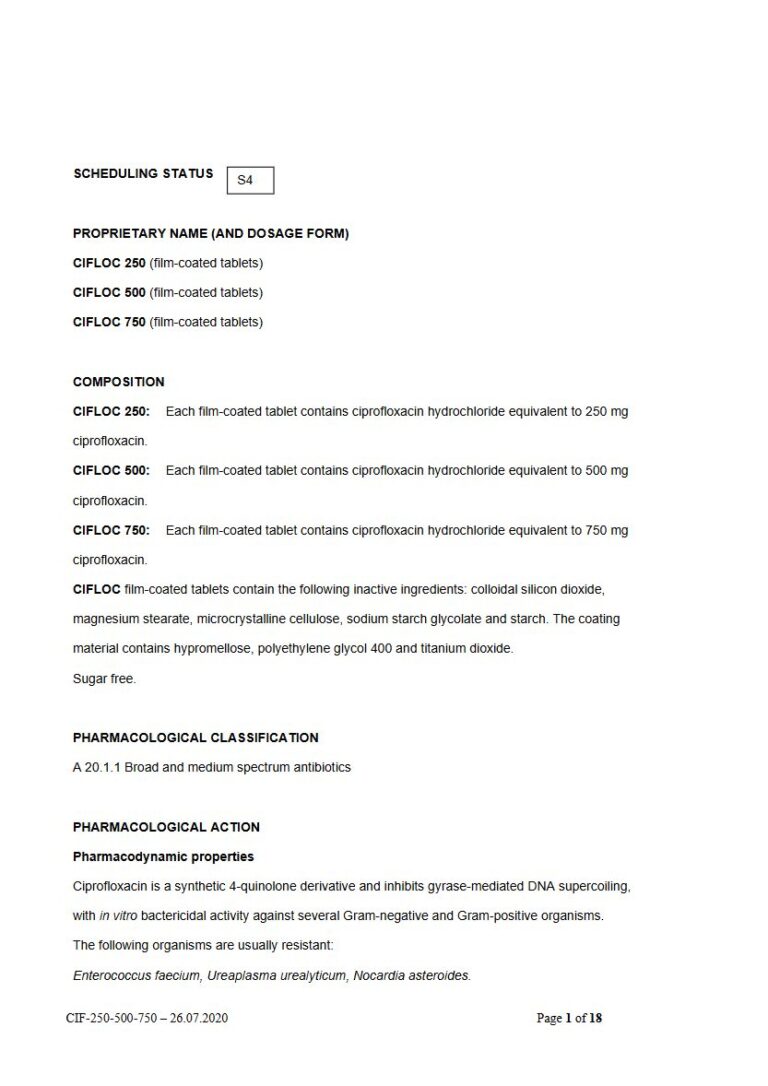
Cifloc 250 mg, 500 mg, 750 mg FC tablets
PDF Leaflet Revision Date: 26 July 2020
Clinical Summary
Quick overview from the medicine insert
Indication
Severe and/or complicated infections caused by ciprofloxacin sensitive bacteria.
Dosage (summary)
250-750 mg twice daily; adjust for renal impairment.
Onset of Action / Duration
Onset: 1-3 hours, Duration: 3-5 hours
Special Populations
- Elderly
- Renal impairment
- Hepatic impairment
Pregnancy & Breastfeeding
Contraindicated in pregnancy and lactation.
Key Drug Interactions
- Tizanidine
- Theophylline
- Clozapine
- Ropinirole
- Warfarin
Contraindications
- Pregnancy
- Lactation
- Children under 18
- Hypersensitivity to ciprofloxacin
- Myasthenia gravis
Common side effects
- Nausea
- Diarrhoea
- Headache
- Dizziness
- Rash
Counselling Points
- Stay hydrated
- Avoid sun exposure
- Report CNS symptoms
- Monitor blood glucose in diabetics
Serious warnings
- Risk of tendon rupture
- CNS effects
- QT prolongation
- Photosensitivity
Important Disclaimer
The Cifloc 250 mg, 500 mg, 750 mg FC tablets professional information leaflet below is the property of Dr Reddy’S Laboratories and is provided on Medinsert exactly as issued, with no.. alterations or editorial changes. We make every effort to keep content current by updating documents as soon as new versions become available. Medinsert serves as a trusted access point for healthcare professionals, but does not replace official sources or clinical judgement. For more details, please read our full disclaimer. read more>>
 Healthcare Professionals Only
This content is for registered healthcare professionals
Sign in or create a free account to read the full package insert.
Free for HPCSA-registered professionals. Powered by Medinsert.
Clinical Particulars
Section 4 of the official insert — extracted exactly as issued, no alterations
4.1 Therapeutic indications
CIFLOC is indicated for the treatment of severe and /or complicated infections caused by ciprofloxacin sensitive bacteria where other antimicrobials, approved for a similar indication and to which the causative bacteria are sensitive, were considered not to be an appropriate treatment option, have failed, are contraindicated or not tolerated. CIFLOC is not indicated/approved for the initiation of treatment (first line treatment) of infections described as mild/moderate/acute and uncomplicated, caused by bacteria sensitive to ciprofloxacin, unless treatment with other appropriate antimicrobials, approved for a similar indication and to which the causative bacteria are sensitive, have failed, are contraindicated or not tolerated.
CIFLOC is indicated for the treatment of the following bacterial infections where these infections are compliant with the indication context:
- Severe and/or complicated lower respiratory tract infections caused by Escherichia coli, Klebsiella pneumoniae, Enterobacter cloacae, Proteus mirabilis, Pseudomonas aeruginosa*, Haemophilus influenzae and Haemophilus para-influenzae.
- Severe and/or complicated urinary tract infections caused by Escherichia coli, Klebsiella pneumoniae, Enterobacter cloacae, Serratia marcescens, Proteus mirabilis, Providencia rettgeri, Morganella morganii, Citrobacter diversus, Citrobacter freundii, Pseudomonas aeruginosa*, Staphylococcus epidermidis and Streptococcus faecalis.
- Skin and soft tissue infections caused by Escherichia coli, Klebsiella pneumoniae, Enterobacter cloacae, Proteus mirabilis, Proteus vulgaris, Providencia stuartii, Morganella morganii, Citrobacter freundii, Pseudomonas aeruginosa*, Staphylococcus aureus, Staphylococcus epidermidis and Streptococcus pyogenes.
- Severe and/or complicated gastro-intestinal infections: Infective diarrhoea caused by E. coli, Campylobacter jejuni, Shigella flexneri and Shigella sonnei.
- Severe and /or complicated bone infections: Osteomyelitis due to susceptible Gram-negative organisms.
* In the treatment of infections caused by Pseudomonas aeruginosa, an aminoglycoside must be administered concomitantly. Appropriate culture and susceptibility tests should be performed before treatment in order to isolate and identify organisms causing infection and to determine their susceptibility to CIFLOC. Therapy with CIFLOC may be initiated in severe and/or complicated infections before results of these tests are known; once results become available, appropriate therapy should be continued.
4.3 Contraindications
Pregnancy and lactation. Children under 18 years and in growing adolescents. Experimental evidence indicates that species variable reversible lesions of the cartilage of weight-bearing joints has been seen in immature members of certain animal species. Patients who have shown hypersensitivity to ciprofloxacin or any other quinolones, or to any of the inactive ingredients in the formulation (see COMPOSITION). Concomitant administration of CIFLOC and tizanidine (see INTERACTIONS). Concomitant use of ciprofloxacin with other medicines known to prolong the QT interval, or in patients with disorders that prolong the QT interval to such an extent that it leads to prolonged QTcF interval known to be associated with serious and potentially fatal dysrhythmias or if symptomatic dysrhythmias occur with concomitant use at time intervals shorter than QT intervals usually associated with dysrhythmias. A history of tendon, muscle, joint, nerve, central nervous system, epilepsy or psychotic disorders especially those related to previous quinolone/fluoroquinolone use where alternative, appropriate antibiotic choices are available for treatment. Myasthenia gravis where alternative appropriate antibiotic choices are available to treat these patients. Aortic aneurysm and/or dissection or in patients with risk factors or conditions predisposing for aortic aneurysm and/or dissection if alternative appropriate antibiotic choices are available. Concomitant use of fluoroquinolones with ACE inhibitors/angiotensin receptor blockers in patients with moderate to severe renal impairment and in the elderly. Use of fluoroquinolones is contraindicated in patients with confirmed mitral valve and /aortic valve regurgitation unless no safer appropriate alternative antibiotic is available, has failed or is not well tolerated.
4.4 Special warnings and precautions for use
CIFLOC should be used with caution as many patients may experience adverse reactions that may be disabling, long-lasting and potentially irreversible. CIFLOC should be used with caution in patients with a history of convulsive disorders or a history of CNS disorders (see Central Nervous System/Psychiatric below). Patients should be advised to stop treatment immediately at the first signs of peripheral and central nervous system effects (including peripheral neuropathy, psychosis, anxiety, insomnia, depression, hallucinations, suicidal thoughts, confusion, impairment of vision, hearing, smell and taste) and to contact their medical practitioner for further advice. Side effects of the musculoskeletal system including tendinitis, tendon rupture, myalgia, muscle weakness, arthralgia and joint swelling may occur (see Musculoskeletal system below). Crystalluria related to the use of CIFLOC has been observed. Patients receiving CIFLOC should be well hydrated and excessive alkalinity of the urine should be avoided. Side effects that may be potentially life-threatening are pancytopenia and marrow depression (see SIDE EFFECTS). Concurrent administration with methotrexate may increase the concentration of methotrexate to toxic levels (see INTERACTIONS). Gastrointestinal System: In the event of severe and persistent diarrhoea during or after treatment a doctor must be consulted, since this symptom can hide a serious intestinal disease (life-threatening pseudomembranous colitis with possible fatal outcome), requiring immediate treatment (see SIDE EFFECTS). In such cases CIFLOC must be discontinued and appropriate therapy initiated (e.g. vancomycin, orally). Medicines that inhibit peristalsis are contraindicated in this situation. Central Nervous System: In epileptics and in patients who have suffered from previous CNS disorders (e.g. lowered convulsion threshold, previous history of convulsion, reduced cerebral blood flow, altered brain structure or stroke), CIFLOC should only be used where alternative appropriate therapies have failed, are contraindicated or not tolerated, since these patients are endangered due to possible central nervous system side effects. Cases of status epilepticus have been reported (see CONTRAINDICATIONS and SIDE EFFECTS). In some instances, the CNS reactions occurred already after the first administration of CIFLOC. Depression or psychosis can progress to self-endangering behaviour. In these cases CIFLOC has to be discontinued (see CONTRAINDICATIONS and SIDE EFFECTS). Cases of polyneuropathy (based on neurological symptoms such as pain, burning, sensory disturbances or muscle weakness, alone or in combination) have been reported in patients receiving CIFLOC. CIFLOC should be discontinued in patients experiencing symptoms of neuropathy, including pain, burning, tingling, numbness and/or weakness in order to prevent the development of an irreversible condition (see SIDE EFFECTS). Hypersensitivity: In some instances, hypersensitivity and allergic reactions (as listed under SIDE EFFECTS) may occur after the first administration. Anaphylactic/anaphylactoid reactions (e.g. facial, vascular and laryngeal oedema, dyspnoea) can progress to life-threatening shock, in some instances after the first administration. In these cases CIFLOC has to be discontinued and medical treatment (e.g. treatment for shock) is required. Musculoskeletal System: The use of CIFLOC in patients with myasthenia gravis is contraindicated if alternative appropriate antibiotic choices are available (see CONTRAINDICATIONS). CIFLOC may exacerbate the symptoms of myasthenia gravis. Caution is advised as fluoroquinolones, including CIFLOC, are associated with an increased risk of tendonitis and tendon rupture in all ages (see CONTRAINDICATIONS and SIDE EFFECTS). This risk is further increased in older patients usually over 60 years of age, in patients taking corticosteroid medicines, in patients with solid organ (kidney, heart or lung) transplants. Factors, in addition to age and corticosteroid use, that may independently increase the risk of tendon rupture include strenuous physical activity, renal failure, and previous tendon disorders such as rheumatoid arthritis. Tendonitis and tendon rupture have also occurred in patients taking fluoroquinolones, like CIFLOC, who do not have the above risk factors. Tendonitis and tendon rupture (especially Achilles tendon), sometimes bilateral, may occur with CIFLOC, even within the first 48 hours of treatment. Inflammation and ruptures of tendon may also occur up to several months after discontinuation of CIFLOC therapy. At any sign of tendonitis (e.g. painful swelling, inflammation), the administration of CIFLOC should be discontinued and a medical practitioner be consulted. Care should be taken to keep the affected limb at rest. CIFLOC should not be used in patients with a history of tendon disorders, especially those related to previous exposure to quinolone or fluoroquinolone use (see CONTRAINDICATIONS). Photosensitivity: CIFLOC has been shown to produce photosensitivity reactions. Patients taking CIFLOC should avoid direct exposure to excessive sunlight or UV-light (e.g. sunlamps). Therapy should be discontinued if photosensitisation (i.e. sunburn-like reactions) occur. Cardiac disorders: There is some evidence of an increased risk of aortic aneurysm and/or dissection after intake of fluoroquinolones, particularly in the elderly population. Therefore, fluoroquinolones such as CIFLOC, should only be used in patients at risk after careful benefit-risk assessment and if no other treatment options are available (see CONTRAINDICATIONS). Patients at risk are patients with a positive family history of aneurysmal disease, pre-existing aortic disease and/or dissection or other risk factors or conditions predisposing to aortic aneurysm and dissection e.g. Marfan syndrome, Vascular Ehlers-Danlos syndrome, Takayasu arteritis, giant cell arteritis, Behcetu2019s disease, hypertension and known atherosclerosis. Therefore, CIFLOC, should only be prescribed to patients with a pre-existing dilated aorta, aortic aneurysm/dissection, or the presence of other risk factors predisposing to aortic aneurysm/dissection, where other antimicrobials have been considered not to be an appropriate treatment option, have failed, are contraindicated or cannot be tolerated. In case of sudden abdominal, chest or back pain, patients should be advised to immediately go to their medical practitioner or a hospital emergency department. CIFLOC has been associated with QT prolongation (see CONTRAINDICATIONS and SIDE EFFECTS). Concomitant use of CIFLOC with medicines or in patients with disorders that can result in prolongation of the QT interval is contraindicated if concomitant use leads to prolongation of QTc interval associated with serious or potentially fatal dysrhythmias or symptomatic dysrhythmias occur at QTc intervals less than usually associated with dysrhythmias (e.g. class IA or III antidysrhythmics, tricyclic antidepressants, macrolides, antipsychotics), (see INTERACTIONS) or congenital long QT syndrome, risk of Torsades de Pointes, uncorrected electrolyte imbalance such as hypokalaemia or hypomagnesaemia and cardiac disease such as heart failure, myocardial infarction, or bradycardia. A pre-treatment ECG and frequent follow up ECG monitoring is mandatory with concomitant use to determine whether concomitant use is contraindicated. There is some evidence, although inconclusive, of a possible association between oral fluoroquinolone use and mitral valve and/or aortic valve regurgitation. A thorough cardiovascular examination including an echocardiogram, should be performed before oral fluoroquinolones are prescribed. Fluoroquinolones should not be prescribed to patients with mitral valve and or aortic valve regurgitation (see CONTRAINDICATIONS). Renal or hepatic impairment: Care is necessary in patients with impaired renal or hepatic function. Alteration of the dosage regimen is necessary for patients with impairment of renal function or with impairment of both renal and hepatic function (see DOSAGE AND DIRECTIONS FOR USE). Concomitant use of fluoroquinolones and ACE inhibitors/angiotensin receptor blockers may precipitate acute kidney injury in patients, especially those with moderate to severe renal impairment and elderly patients (see CONTRAINDICATIONS). Renal function should be assessed before initiation of treatment, and monitored during treatment with fluoroquinolones and ACE inhibitors/angiotensin receptor blockers.
4.5 Interactions with other medicines
Concomitant administration of CIFLOC and tizanidine has been reported to significantly increase the tizanidine plasma concentration. Use of CIFLOC with tizanidine is contraindicated (see CONTRAINDICATIONS). Concurrent administration of CIFLOC with theophylline may lead to elevated plasma concentrations of theophylline and prolongation of its elimination half-life. This may result in increased risk of theophylline-related adverse reactions. If concomitant use cannot be avoided, plasma levels of theophylline should be monitored and dosage adjustments made as appropriate. Concomitant administration of CIFLOC and clozapine has been reported to increase the plasma concentrations of clozapine and N-desmethylclozapine. Clinical surveillance and appropriate adjustment of clozapine dosage during and shortly after co-administration with CIFLOC are advised. Concomitant administration of CIFLOC and ropinirole has been reported to increase the mean C max and mean AUC of ropinirole. Monitoring for ropinirole-related side effects and appropriate dose adjustment of ropinirole is recommended during and shortly after co-administration with CIFLOC. The simultaneous administration of CIFLOC and multivalent cation-containing medicines and mineral supplements (e.g. calcium, magnesium, aluminium, iron), polymeric phosphate binders (e.g. sevelamer), sucralfate or antacids and highly buffered medicines (e.g. anti-retrovirals) containing magnesium, aluminium or calcium reduces the absorption of ciprofloxacin. Consequently, CIFLOC should be administered either 1 u2013 2 hours before, or at least 4 hours after these preparations. This restriction does not apply to antacids belonging to the class of H 2 receptor blockers. The concurrent administration of dairy products or mineral fortified drinks alone (e.g. milk, yoghurt, calcium fortified orange juice) and CIFLOC should be avoided because the absorption of ciprofloxacin is reduced. Dietary calcium as part of a meal, however, does not significantly affect absorption. Concomitant administration of the non-steroidal anti-inflammatory drug fenbufen with quinolones, like CIFLOC, has been reported to increase the risk of central nervous system stimulation and convulsive seizures. Monitoring of serum creatinine concentrations is advised in patients on concomitant ciclosporin therapy, as increases in serum creatinine concentrations have been observed. The simultaneous administration of CIFLOC and warfarin may intensify the action of warfarin. Concurrent administration of CIFLOC and glibenclamide can intensify the action of glibenclamide (hypoglycaemia) (see WARNINGS AND SPECIAL PRECAUTIONS). Probenecid interferes with renal secretion of ciprofloxacin. Co-administration of probenecid and CIFLOC increases the ciprofloxacin serum concentrations. Metoclopramide accelerates the absorption of CIFLOC, resulting in a shorter time to reach maximum plasma concentrations. No effect was seen on the bioavailability of CIFLOC. Concomitant administration of CIFLOC and omeprazole results in a slight reduction of C max and AUC of ciprofloxacin. Renal tubular transport of methotrexate may be inhibited by concomitant administration of CIFLOC potentially leading to increased plasma levels of methotrexate. This might increase the risk of methotrexate-associated toxic reactions. Therefore, patients under methotrexate therapy should be carefully monitored when concomitant CIFLOC therapy is indicated. Simultaneous administration of CIFLOC and phenytoin may result in increased or reduced serum levels of phenytoin such that monitoring of phenytoin serum levels is recommended. CIFLOC should be used with caution in patients receiving medicines known to prolong the QT interval (e.g. Class IA and III antidysrhythmics, tricyclic antidepressants, macrolides, antipsychotics, antihistamines and pentamidine) as CIFLOC may have an additive effect on the QT interval (see WARNINGS AND SPECIAL PRECAUTIONS). Concomitant use of fluoroquinolones and ACE inhibitors/angiotensin receptor blockers may precipitate acute kidney injury (see CONTRAINDICATIONS). The use of enalapril, an angiotensin converting enzyme (ACE) inhibitor, may lead to renal impairment due to altered renal haemodynamics in particular clinical situations or with other medicines that affect glomerular filtration. Increased serum creatinine and blood urea nitrogen, and more rarely crystalluria and macrohaematuria, have been observed in patients taking CIFLOC.
4.6 Fertility, pregnancy and lactation
Safety during pregnancy and lactation has not been established (see CONTRAINDICATIONS). Mothers taking CIFLOC should not breastfeed their infants.
4.7 Effects on ability to drive and use machines
CIFLOC may impair the ability to drive or operate machinery, especially when alcohol is also taken.
4.8 Undesirable effects
The following side effects have been observed:
Infections and Infestations: Frequent: Moniliasis Less frequent: Pseudomembranous colitis (which may be life-threatening with possible fatal outcomes), moniliasis (oral), moniliasis (gastrointestinal), vaginal moniliasis
Blood and lymphatic system disorders: Frequent: Eosinophilia, leukopenia Less frequent: Agranulocytosis, haemolytic anaemia, anaemia, granulocytopenia, leucocytosis, thrombocytopenia, thrombocythaemia (thrombocytosis), pancytopenia, bone marrow suppression
Immune system disorders: Less frequent: Hypersensitivity reactions, including anaphylactoid (anaphylactic) reaction, allergic reaction, shock (anaphylactic; life threatening), serum sickness like reaction. (See also u201cSkin and subcutaneous tissue disordersu201d).
Metabolism and nutrition disorders: Frequent: Anorexia Less frequent: Hyperglycaemia, hypoglycaemia (particularly in diabetic patients) Frequency not known: Hypoglycaemic coma
Psychiatric disorders: Frequent: Insomnia, agitation, confusion Less frequent: Hallucination, psychosis, anxiety, abnormal dreams (nightmares), depression Frequency not known: Nervousness
Nervous system disorders: Frequent: Headache, dizziness, taste perversion Less frequent: Migraine, syncope, paraesthesia (peripheral paralgesia), tremor (trembling), Grand mal convulsion, convulsion, intracranial hypertension, ataxia, hyperaesthesia, hypoaesthesia, hypertonia, taste loss (impaired taste), parosmia (impaired smell), anosmia (usually reversible on discontinuation) Frequency not known: Peripheral neuropathy and polyneuropathy
Eye disorders: Less frequent: Abnormal vision (visual disturbances), diplopia, chromatopsia
Ear and labyrinth disorders: Less frequent: Tinnitus, transitory deafness (especially at high frequencies)
Cardiac disorders: Less frequent: Tachycardia Frequency not known: ECG QT prolonged, ventricular dysrhythmias (including torsade de pointes)
Vascular disorders: Frequent: Thrombophlebitis Less frequent: Hypotension, vasculitis (petechiae, haemorrhagic bullae, papules, crust formation), vasodilation (hot flushes)
Respiratory, thoracic and mediastinal disorders: Less frequent: Dyspnoea, larynx oedema
Gastrointestinal disorders: Frequent: Nausea, diarrhoea, vomiting, abdominal pain, dyspepsia, flatulence Less frequent: Pancreatitis, dysphagia
Hepato-biliary disorders: Frequent: Bilirubinaemia Less frequent: Jaundice, cholestatic jaundice, hepatitis, liver necrosis (very rarely progressing to life-threatening hepatic failure)
Skin and subcutaneous tissue disorders: Frequent: Rash, pruritus, maculopapular rash, urticaria Less frequent: Stevens-Johnson Syndrome, toxic epidermal necrolysis (Lyellu2019s Syndrome), fixed eruption, photosensitivity reaction, pruritic rash, petechia (punctate skin haemorrhages), erythema multiforme (minor), erythema nodosum, oedema (vascular), sweating
Musculoskeletal, connective tissue and bone disorders: Frequent: Arthralgia (joint pain) Less frequent: Pain in extremities, back pain, myalgia (muscular pain), joint disorder (joint swelling), tendonitis (predominantly achillo tendonitis), partial or complete tendon rupture (predominantly Achilles tendon), myasthenia, exacerbation of symptoms of myasthenia gravis, twitching Frequency not known: Tenosynovitis
Renal and urinary disorders: Less frequent: Acute kidney failure, renal failure, abnormal kidney function, haematuria, crystalluria, interstitial nephritis
General disorders and administration site conditions: Frequent: Asthenia (general feeling of weakness, tiredness) Less frequent: Pain, chest pain, drug fever, oedema (peripheral, face), abnormal (unsteady) gait Frequency not known: Tiredness
Investigations: Frequent: increased SGOT (AST), increased SGPT (ALT), abnormal liver function test, increased alkaline phosphatase, increased creatinine, increased blood urea Less frequent: Altered prothrombin values, increased amylase, increased lipase
Post-marketing Experience: Cases of mitral valve and/or aortic valve regurgitation were reported in patients treated with oral fluoroquinolones. Due to insufficient post marketing information in the reported cases, it is unknown whether fluoroquinolone use was the causative factor, or a contributory factor or played no role in the reported cases where mitral cases and/or aortic regurgitation was diagnosed.
4.9 Overdose
In the event of overdosage, reversible renal toxicity has been reported. Therefore, apart from routine emergency measures, it is recommended to monitor renal function and to administer Mg- or Ca-containing antacids which reduce the absorption of CIFLOC. Only a small amount of ciprofloxacin (< 10 %) is removed from the body after haemodialysis or peritoneal dialysis. Treatment should be symptomatic and supportive.
