
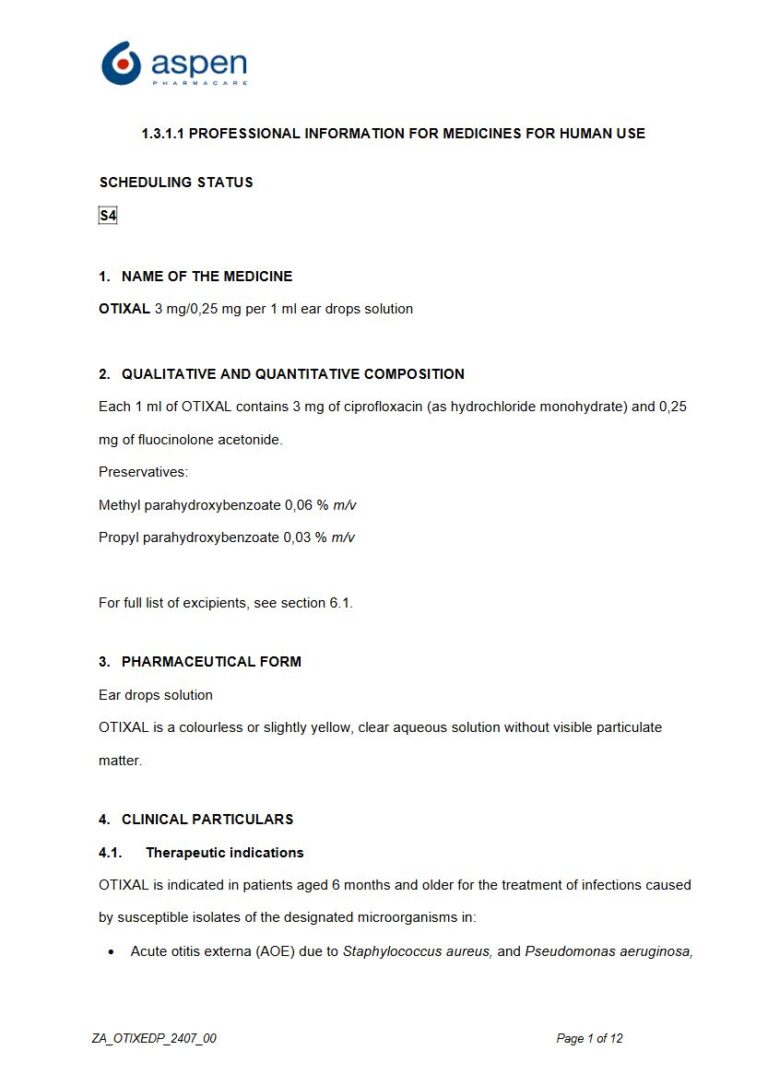
Otixal 3 mg/0,25 mg per 1 ml Ear drops solution
PDF Leaflet Revision Date: 23 July 2024
Clinical Summary
Quick overview from the medicine insert
Indication
Treatment of acute otitis externa and acute otitis media with tympanostomy tubes.
Dosage (summary)
Instil 6 to 8 drops in the affected ear twice daily for 7 days.
Special Populations
- Children under 6 months
Pregnancy & Breastfeeding
May be used during pregnancy and breastfeeding due to negligible systemic absorption.
Key Drug Interactions
- Warfarin
- Caffeine
- Theophylline
Contraindications
- Hypersensitivity to ciprofloxacin or fluocinolone
- Viral infections of the ear
- Fungal infections of the ear
Common side effects
- Ear pain
- Dizziness
- Skin rash
- Blurred vision
Counselling Points
- Warm the bottle before use
- Do not swallow or inject
- Report any skin rash immediately
Serious warnings
- Serious hypersensitivity reactions
- Risk of superinfection
- Not for ophthalmic use
Important Disclaimer
The Otixal 3 mg/0,25 mg per 1 ml Ear drops solution professional information leaflet below is the property of Pharmacare and is provided on Medinsert exactly as issued, with no.. alterations or editorial changes. We make every effort to keep content current by updating documents as soon as new versions become available. Medinsert serves as a trusted access point for healthcare professionals, but does not replace official sources or clinical judgement. For more details, please read our full disclaimer. read more>>
 Healthcare Professionals Only
This content is for registered healthcare professionals
Sign in or create a free account to read the full package insert.
Free for HPCSA-registered professionals. Powered by Medinsert.
Clinical Particulars
Section 4 of the official insert — extracted exactly as issued, no alterations
4.1. Therapeutic indications
OTIXAL is indicated in patients aged 6 months and older for the treatment of infections caused by susceptible isolates of the designated microorganisms in:
- Acute otitis externa (AOE) due to Staphylococcus aureus, and Pseudomonas aeruginosa,
- Acute otitis media in patients with tympanostomy tubes (AOMT) due to Staphylococcus aureus, Streptococcus pneumoniae, Haemophilus influenzae, Moraxella catarrhalis and Pseudomonas aeruginosa.
4.2. Posology and method of administration
Posology
Adults and children aged 6 months and older: Instil 6 to 8 drops in the affected ear twice a day for 7 days.
Paediatric population: The safety and efficacy of OTIXAL in children younger than 6 months has not yet been established.
Method of administration: Auricular use.
Precautions to be taken before handling or administering OTIXAL: The solution should be warmed before its use, by holding the bottle in the hand for several minutes. This will avoid the discomfort that may result from the instillation of a cold solution into the ear canal. The patient should lie with the affected ear upward and then for patients with otitis externa the drops should be instilled pulling several times on the auricle. For patients with acute otitis media with tympanostomy tubes, the tragus should be pumped 4 times by pushing inward to facilitate penetration of the drops into the middle ear. This position should be maintained for around 1 minute to facilitate penetration of the drops into the ear. Repeat, if necessary, for the opposite ear.
4.3. Contraindications
OTIXAL is contraindicated in:
- Patients with hypersensitivity to ciprofloxacin hydrochloride, fluocinolone acetonide or any member of the quinolone class of antimicrobial medicine, or to any excipients in OTIXAL (see section 6.1).
- Viral infections of the external ear canal, including varicella and herpes simplex infections and fungal otic infections.
4.4. Special warnings and precautions for use
OTIXAL is for auricular use only, not for ophthalmic use, inhalation or injection. OTIXAL should not be swallowed or injected.
Anaphylactic reactions: Serious and occasionally fatal hypersensitivity (anaphylactic) reactions, some following the first dose, have been reported in patients receiving systemic quinolones. Serious acute hypersensitivity reactions may require immediate emergency treatment.
If otorrhea persists after a full course of therapy, or if two or more episodes of otorrhea occur within six months, further evaluation is recommended to exclude an underlying condition such as cholesteatoma, foreign body, or a tumour. If after the treatment some signs and symptoms persist, further evaluation is recommended to reassess the disease and the treatment.
Skin rash: OTIXAL should be discontinued at the first appearance of a skin rash or any other sign of hypersensitivity.
Superinfection: As with other antibiotic preparations, the use of OTIXAL may result in overgrowth of non-susceptible organisms, including bacterial strains, yeast and fungi. If superinfection occurs, appropriate therapy should be initiated.
Photoallergic reactions: Some patients taking systemic quinolones have shown moderate to severe skin sensitivity to the sun. Due to the site of administration, it is unlikely that OTIXAL may produce photoallergic reactions.
Corticosteroids: Corticosteroids may reduce resistance to, and aid in, the establishment of bacterial, viral, or fungal infections and mask the clinical signs of an infection, preventing recognition of ineffectiveness of the antibiotic, or may suppress hypersensitivity reactions to substances in OTIXAL.
Visual disturbance: Visual disturbance may be reported with systemic and topical corticosteroid use. If a patient presents with symptoms such as blurred vision or other visual disturbances, the patient should be considered for referral to an ophthalmologist for evaluation of possible causes which may include cataract, glaucoma or rare diseases such as central serous chorioretinopathy (CSCR) which have been reported after use of systemic and topical corticosteroids.
Paediatric population: Safety and efficacy of OTIXAL has not been established in children younger than 6 months.
4.5. Interaction with other medicines and other forms of interaction
No interaction studies have been performed with OTIXAL. However, due to negligible plasma levels observed after application in the ear (see section 5.2), it is unlikely that ciprofloxacin or fluocinolone acetonide, as contained in OTIXAL, may show clinically meaningful systemic interaction with other medicines.
Warfarin: The systemic administration of some quinolones, as contained in OTIXAL, has been shown to enhance the effects of the oral anticoagulant, warfarin, and its derivatives, and has been associated with transient elevations in serum creatinine in patients receiving ciclosporin concomitantly.
Caffeine, Theophylline: Oral administration of ciprofloxacin, as contained in OTIXAL, has been shown to inhibit cytochrome P450 CYP1A2 and CYP3A4 isozymes, and alter the metabolism of methylxanthine compounds (caffeine, theophylline). Following topical otic administration of OTIXAL, ciprofloxacin plasma concentrations are low, and it is unlikely that an interaction involving P450 metabolism with concomitant medicines would result in clinically relevant changes in plasma levels of methylxanthine compounds.
It is recommended not to use other ear preparations concomitantly. If more than one medicine needs to be administered by this route, it is advised to administer them apart.
4.6. Fertility, pregnancy and lactation
The safety of OTIXAL in pregnancy and lactation has not been established.
Pregnancy: As there is very little systemic absorption, OTIXAL may be used during pregnancy.
Breastfeeding: As there is very little systemic absorption, OTIXAL may be used during breastfeeding.
Fertility: No animal studies have been performed to evaluate the effect on fertility of OTIXAL.
4.7. Effects on ability to drive and use machines
OTIXAL has no or negligible influence on the ability to drive and operate machinery due to the route of administration and the conditions of use. Patients should not drive, use machinery or perform any tasks that require concentration until they are certain that OTIXAL do not adversely affect their ability to do so safely (see section 4.4 and 4.8).
4.8. Undesirable effects
a) Tabulated list of adverse reactions
System organ class
- Frequent: Candidiasis, ear infection fungal, contralateral otitis media
- Less frequent: Dysgeusia, Paraesthesia (tingling in ears), dizziness, headache, crying
- Frequency unknown (cannot be estimated from the available data): Vision, blurred (see also section 4.4), Ear pain, ear discomfort, ear pruritus, Hypoacusis, tinnitus, otorrhoea, ear congestion, tympanic membrane disorder, auricular swelling, Flushing, Vomiting, Skin exfoliation, rash erythematous, rash, granulation tissue, Irritability, fatigue, Medicine residue, Device occlusion (tympanostomy tube obstruction)
b) Description of selected adverse reactions
Serious and occasionally fatal hypersensitivity (anaphylactic) reactions, some following the first dose, have been reported in patients receiving systemic quinolone therapy. Some reactions were accompanied by cardiovascular collapse, loss of consciousness, angioedema (including laryngeal, pharyngeal or facial oedema), airway obstruction, dyspnoea, urticaria, and itching.
Ruptures of the shoulder, hand, Achilles or other tendons that required surgical repair or resulted in prolonged disability have been reported in patients receiving systemic fluoroquinolones. Studies and post marketing experience with systemic fluoroquinolones indicate that the risk of these ruptures may be increased in patients receiving corticosteroids, especially geriatric patients and in tendons under high stress, including the Achilles tendon. To date, clinical and post marketing data have not demonstrated a clear association between otic administration of ciprofloxacin and these musculoskeletal and connective tissue adverse reactions.
c) Paediatric population: OTIXAL has been shown to be safe in paediatric patients 6 months of age or older.
Reporting of suspected adverse reactions: Reporting suspected adverse reactions after authorisation of the medicine is important. It allows continued monitoring of the benefit/risk balance of the medicine. Healthcare providers are asked to report any suspected adverse reactions to SAHPRA via the Med Safety APP (Medsafety X SAHPRA) and eReporting platform (who - umc.org) found on SAHPRA website. Aspen Pharmacare: E-mail: [email protected] Tel: 0800 118 088
4.9. Overdose
Symptoms: No case of overdose has been reported. Due to negligible plasma levels observed after application in the ear, it is unlikely that topically applied ciprofloxacin or fluocinolone acetonide may show clinically meaningful systemic effects. Acute overdosage is very unlikely to occur, however, in the case of chronic overdosage or misuse, the features of hypercortisolism may appear. The limited holding capacity of the ear canal for topical otic products practically precludes overdosing via the ototopical route. However, oral ingestion of OTIXAL resulting in overdose or long-term ototopical therapy may produce suppression of the hypothalamic-pituitary-adrenal (HPA) axis. Although decreases in paediatric growth velocity and/or suppression of cortisol plasma concentrations may be more pronounced after substantial overdose or prolonged treatment (e.g. several months) with OTIXAL, the effect is expected to be transient (days to weeks) and easily reversible with no long-term sequelae.
Treatment: If OTIXAL is accidentally swallowed, treatment will include the administration of activated charcoal and antacids containing magnesium or calcium. Further management should be as clinically indicated or as recommended by the national poisons centre, where available.
