
Tubramak 100 Mg/50 mg Tablets
PDF Leaflet Revision Date: 25 April 2023
Clinical Summary
Quick overview from the medicine insert
Indication
Treatment of pulmonary multidrug-resistant tuberculosis and multibacillary leprosy.
Dosage (summary)
Adults: 100 mg/day for MDR-TB; 50 mg/day for leprosy. Children: 50 mg/day for leprosy.
Special Populations
- Renal impairment
- Hepatic impairment
Pregnancy & Breastfeeding
Safety in pregnancy not established; avoid breastfeeding due to potential skin discoloration in infants.
Key Drug Interactions
- QT prolonging medicines
- CYP3A substrates
Contraindications
- Hypersensitivity to clofazimine
- QT interval prolongation
Common side effects
- Nausea
- Vomiting
- Abdominal pain
- Skin discoloration
Counselling Points
- Take with food for better absorption
- Importance of adherence to therapy
- Monitor for signs of adverse reactions
Serious warnings
- Risk of QT prolongation
- Gastrointestinal disorders
- Skin discoloration may cause depression
Important Disclaimer
The Tubramak 100 Mg/50 mg Tablets professional information leaflet below is the property of Macleods Pharmaceuticals Sa and is provided on Medinsert exactly as issued, with no.. alterations or editorial changes. We make every effort to keep content current by updating documents as soon as new versions become available. Medinsert serves as a trusted access point for healthcare professionals, but does not replace official sources or clinical judgement. For more details, please read our full disclaimer. read more>>
 Healthcare Professionals Only
This content is for registered healthcare professionals
Sign in or create a free account to read the full package insert.
Free for HPCSA-registered professionals. Powered by Medinsert.
Clinical Particulars
Section 4 of the official insert — extracted exactly as issued, no alterations
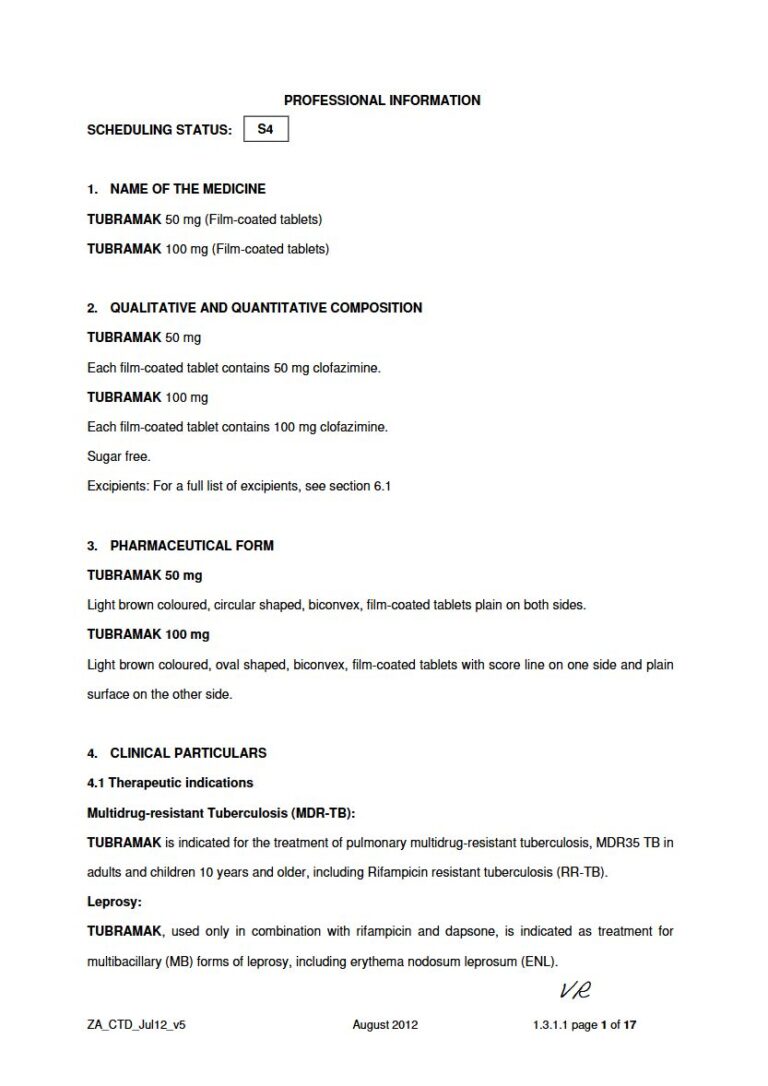
4.1 Therapeutic indications
Multidrug-resistant Tuberculosis (MDR-TB): TUBRAMAK is indicated for the treatment of pulmonary multidrug-resistant tuberculosis, MDR35 TB in adults and children 10 years and older, including Rifampicin resistant tuberculosis (RR-TB).
Leprosy: TUBRAMAK, used only in combination with rifampicin and dapsone, is indicated as treatment for multibacillary (MB) forms of leprosy, including erythema nodosum leprosum (ENL). Multidrug therapy (MDT) is necessary in order to prevent the emergence of resistant strains of Mycobacterium leprae.
4.2 Posology and method of administration
Posology: Multibacillary leprosy TUBRAMAK is administered as part of a multidrug therapy, in combination with dapsone and rifampicin for the treatment of multibacillary leprosy. Multidrug therapy (MDT) is necessary in order to prevent the emergence of resistant strains of Mycobacterium leprae.
For the treatment of leprosy, the WHO recommends the following regimens:
- MDT dosage
Dapsone Rifampicin TUBRAMAK (clofazimine)
- Adults and adolescents (15 years and above)
Days 1-28 100 mg once daily as self-medication Day 1 only of each cycle* 600 mg under supervision Day 1 only of each cycle* 300 mg under supervision and Days 2-28 50 mg once daily as self-medication
- Children (10 to 14 years)
Days 1-28 50 mg once daily as self-medication Day 1 only of each cycle* 450 mg under supervision Day 1 only of each cycle* 150 mg under supervision and Days 2-28 50 mg on alternate days (i.e. day 3, 5, 7,..) as self-medication
This triple combination should be administered for 12 months (i.e.*12 consecutive 28-day treatment cycles). An additional 12 months of this triple combination may be necessary for MB patients showing evidence of relapse.
Children below 10 years The dose should be adjusted according to body weight: 1 to 2 mg/kg clofazimine + 10 to 20 mg/kg rifampicin + 1 to 2 mg/kg dapsone. As an example, TUBRAMAK once a month under supervision + 50 mg twice a week as self-medication + rifampicin 300 mg once a month under supervision + dapsone 25 mg once a day as self-medication. Treatment of children below 10 years of age is possible only if dapsone tablets of 25 mg are commercially available.
Patients with erythema nodosum leprosum (ENL) Adults and children If the patient develops erythema nodosum leprosum, treatment with dapsone and rifampicin should be continued as before, and the dosage of TUBRAMAK should be raised to 200 to 300 mg per day, given under medical supervision. These high daily doses must not be given for longer than 3 months (see section 4.4). The dose of TUBRAMAK should be gradually reduced, first to 100 mg twice daily for 12 weeks and then to 100 mg once daily for a further 12 to 24 weeks.
Multidrug-resistant tuberculosis (MDR-TB) Dosage: For the treatment of pulmonary MDR-TB: Adults and adolescents: u2022 For adults weighing at least 30 kg, the recommended dosage is 100 mg/day. u2022 For adults weighing less than 30 kg, the recommended dosage is 50 mg/day. Children (10 years of age and over): u2022 For children weighing at least 30 kg, the recommended dosage is 2-5 mg/kg/day, not exceeding 100 mg/day. u2022 For children weighing less than 30 kg, the recommended dosage is 2-5 mg/kg/day, not exceeding 50 mg/day. If a dose lower than 50 mg/day is required, the 50 mg dose can be given every other day.
Dosing in special populations Safety and efficacy have not been established in HIV infected patients on antiretroviral therapy Renal impairment There are no data available in patients with renal impairment. Caution is advised when administered to patients with renal impairment. Hepatic impairment There are no data available in patients with hepatic impairment. TUBRAMAK should not be administered to patients with hepatic impairment (see section 4.4 and section 5). No dosing recommendations can be made in the following groups of patients as efficacy and safety have not been established: u2022 Patients co-infected with HIV and treated for HIV infection u2022 Patients with hepatic impairment u2022 Women who are pregnant u2022 Patients co-infected with hepatitis B and/ or C.
Method of administration It is recommended to take TUBRAMAK during a meal or with a glass of milk to ensure maximum absorption.
4.3 Contraindications
- TUBRAMAK is contraindicated in patients with known hypersensitivity to clofazimine or any of the excipients of TUBRAMAK, listed in section 6.1.
- Patients with acquired or congenital QT interval prolongation including torsades de Pointes (see section 4.4).
- Concomitant use with medicines known to prolong QTc interval up to the time intervals known to induce serious dysrhythmias.
4.4 Special warnings and precautions for use
Accumulation of clofazimine Deposition of large amounts of clofazimine in the intestinal mucosa causes irritations resulting in gastrointestinal disorders (e.g. abdominal pain (sometimes intermittent), nausea, vomiting and diarrhoea), usually of moderate intensity but sometimes more severe in case of higher dosage (200-300 mg/day) and prolonged (more than 6 months). Clofazimine has a heterogeneous distribution profile in the body and its elimination is slow. Clofazimine mainly accumulates in adipose tissue, the reticuloendothelial system (macrophages, histiocytes and spleen) and in the skin. The adverse effects of clofazimine are mainly related to its reuptake by tissues and organs. Therefore, administration of large doses over long periods should be avoided. Daily doses of TUBRAMAK greater than 100 mg should be administered as short as possible (< 3 months) and only under close medical supervision. After prolonged administration of high doses, clofazimine can accumulate in several organs, body fluids and tissues in the form of crystals. In the viscera, the most important deposits are in the jejunum and then the spleen. Deposition of crystals in the mesenteric lymph nodes, and / or histiocytes of the laminapropria of the jejunal mucosa, may lead to intestinal obstruction. Deaths following the occurrence of gastrointestinal adverse events have been reported. If gastrointestinal disturbances occur during treatment, the dose or the time taken should be reduced. Symptoms may regress slowly when treatment is stopped. In case of persistent diarrhoea or vomiting, the patient must be hospitalised.
Modification of the colour of the skin and body fluids Medical practitioners should be informed that cutaneous dyschromia due to TUBRAMAK may cause depression (2 cases of suicide in a depressive context have been reported). Patients should be advised of possible abnormal discoloration of the conjunctiva, tear fluid, sweat, sputum, urine, faeces, sperm, breast milk, hair and reddish to dark brown skin discoloration. Patients should be informed that the skin colour is reversible but it may take several months or years to disappear after discontinuation of treatment with TUBRAMAK.
Torsades de pointe and QT prolongation Cases of Torsades de Pointes with QT prolongation have been reported in patients receiving TUBRAMAK mostly at doses higher than usually recommended or in combination with other QT-prolonging medicines (such as bedaquiline, fluoroquinolones, delamanid, rilpivirine, lopinavir, atazanavir, nelfinavir, saquinavir). Concomitant administration with other medicines known to prolong QTc interval up to the time intervals known to induce serious dysrhythmias is contraindicated (see section 4.3 and section 4.5). TUBRAMAK should be discontinued if the QTc prolongation exceeds 500 milliseconds (ms) and/or the Qtc prolongation exceeds 60 milliseconds (ms) from baseline or if the patient develops dysrhythmias. Patients receiving TUBRAMAK at recommended doses and/or doses higher than usually recommended and/or in combination with QT-prolonging medicines, should have regular clinical monitoring at baseline and regular ECGs performed to monitor for QT prolongation and cardiac dysrhythmias.
Treatment compliance TUBRAMAK should never be given as monotherapy to treat leprosy. TUBRAMAK should be administered in combination with rifampicin and dapsone (see section 4.2). Multidrug therapy is necessary to prevent the development of resistant strains of Mycobacterium leprae. Patients should be informed of the importance of good adherence to prescribed therapy to prevent the emergence of treatment resistance. Irregular administration of treatment and poor compliance can delay healing or make it incomplete, causing the patient to become a source of infection. Poor compliance can eventually lead to the development of infirmities and deformities. Whenever possible, it is necessary to ensure that non-observant patients are correctly assessed, receive appropriate health education and that their treatment is well supervised. Patients should be educated to recognise the signs of a response to treatment and relapse of the disease upon discontinuation of treatment, and should be made aware of the importance of promptly informing their healthcare provider upon manifestations of these symptoms.
Leprosy reactions WHO recommends never interrupting multidrug therapy in leprosy reactions, (see section 4.2) the dose of TUBRAMAK to be administered in patients who develop chronic or corticodeficant leprosy glandular leprosy (ENL) reactions. Some data indicate that the frequency and severity of an ENL would tend to decrease in patients with multibacillary leprosy treated with multidrug therapy. This could be related to the anti-inflammatory properties of clofazimine. However, transient and unexplained increases in the number of adverse reactions have also been observed in patients with multibacillary leprosy, most commonly in the first year of multidrug therapy. Leprosy reactions usually respond satisfactorily to conventional anti-inflammatory medicines (prednisolone).
4.5 Interaction with other medicines and other forms of interaction
Dapsone TUBRAMAK appears to have no important effects on the pharmacokinetics of dapsone, although a transient increase in the urinary excretion of dapsone occurred in a few patients. Limited data suggesting that dapsone inhibits the anti-inflammatory activity of TUBRAMAK have not been confirmed. If leprosy-associated inflammatory reactions develop in patients being treated with dapsone and TUBRAMAK, it is still advisable to continue treatment with both medicines.
Rifampicin TUBRAMAK reduces rifampicin absorption in leprosy patients, increasing the time it takes for the peak serum concentration to be reached and prolonging the elimination half-life. Total exposure (AUC) of rifampicin was not affected, so this interaction is unlikely to be clinically significant.
Isoniazid In volunteers receiving clofazimine (150 mg daily) and standard doses of isoniazid (300 mg daily), elevated concentrations of TUBRAMAK were detected in plasma and urine, compared to clofazimine alone.
Interaction with QT prolonging medicines Cases of Torsades de Pointes with QT prolongation have been reported in patients receiving TUBRAMAK in combination with QT prolonging medicines. Caution is recommended when clofazimine is administered with other medicines (e.g: bedaquiline, fluoroquinolones, delamanid, azithromycin, rilpivirine, lopinavir, atazanavir, nelfinavir, saquinavir) with known QT interval prolonging potential (see section 4.3 and section 4.4).
Effects of TUBRAMAK on CYP3A (CYP3A4 and CYP3A5) substrates: As TUBRAMAK is predicted to be a moderate to strong inhibitor of CYP3A (CYP3A4 and CYP3A5) substrates, caution should be exercised while co-administering TUBRAMAK with other medicines which are CYP3A substrates. No clinical interaction studies have been performed with other CYP3A substrates. Clofazimine inhibits the CYP3A enzyme in vitro. Based on Physiologically Based Pharmacokinetic Modelling (PBPK) modeling results, clofazimine is predicted to be a moderate to strong CYP3A inhibitor. Hence, caution should be exercised with the concomitant administration of TUBRAMAK and CYP3A substrates (e.g.: anti-mycobacterial medicines (bedaquiline, delamanid, clarithromycin), selected unboosted anti-retrovirals (amprenavir, delaviridine, efavirenz, etravirine, indinavir, nelfinavir, raltegravir, rilpivirine, simeprevir, maraviroc), anti-hyperlipidaemic medicines and anti-hypertension medicines (simvastatin, lovastatin, losartan, verapamil, diltiazem, nitrendipine, amlodipine, nislodipine, nifedipine, eplerenone, felodipine, lercanidipine), anti-diabetics (pioglitazone, repaglinide, saxagliptin)).
Effects of other medicines on TUBRAMAK: In a healthy volunteer study of a combination regimen including clofazimine, cycloserine, ethionamide, para-aminosalicyclic acid, and pyridoxine, the Cmax and Tmax values of clofazimine were similar to those reported in other studies where clofazimine was administered alone, suggesting no major effects of these medicines on the pharmacokinetics of clofazimine. In patients with pulmonary TB, where clofazimine was dosed alone and in combination with bedaquiline, pyrazinamide and pretomanid, the Cmax and AUC values of clofazimine were similar between the groups suggesting no major effects of these medicines on the pharmacokinetics of clofazimine.
4.6 Fertility, pregnancy and lactation
Pregnancy Safety of clofazimine in pregnancy has not been established and experience with TUBRAMAK in pregnancy is limited. Clofazimine crosses the placenta. No teratogenic effects have been observed in the animal, but adverse effects have been reported in the foetus at high doses. There are no clinical data available to evaluate the teratogenic or fetotoxic effect in humans. A brownish to reddish discoloration that has been reversible in a few months has been observed in neonates. The use of TUBRAMAK in pregnancy can be considered in patients with limited treatment options. Appropriate counselling of pregnant woman and her partner should be done.
Breast feeding Safety of clofazimine in lactation has not been established. Clofazimine passes into breast milk and skin discoloration may occur in children, therefore women using TUBRAMAK should not breastfeed their infants.
Fertility No specific recommendation regarding TUBRAMAK treatment in women of childbearing age is justified on the basis of existing data.
4.7 Effects on ability to drive and use machines
TUBRAMAK has a moderate influence on the ability to drive vehicles and use machines. Because of the risk of dizziness, fatigue, headache and vision problems such as: decreased visual acuity, impaired peripheral vision and adjustment to day and night vision, and drowsiness and nausea associated with TUBRAMAK, any patient receiving TUBRAMAK should be cautioned about their ability to drive or operate hazardous machinery.
4.8 Undesirable effects
The side effects are listed below. Within each system organ class, the adverse drug reactions are ranked by frequency.
The following side effects have been reported:
- Blood and lymphatic system disorders Less frequent: Splenic infarction, agranulocytosis
- Metabolism and nutrition disorders Frequency unknown: Metabolic acidosis
- Psychiatric disorders Less frequent: Depression due to skin discoloration
- Nervous system disorders Less frequent: Headaches, dizziness, drowsiness
- Eye disorders Frequent: Conjunctival staining and pigmentation of the cornea, vision problems such as decreased visual acuity, visual field defect, adjustment to day and night vision, dryness and eye irritation. Less frequent: Pigmentation of the macula, corneal deposits, decreased tear production
- Cardiac disorders Less frequent: cardiac dysrhythmia including Torsades de pointe, QT prolongation
- Vascular disorders Less frequent: Lymphoedema
- Respiratory, thoracic and mediastinal disorders Frequency unknown: Tinted expectoration Frequent: sputum discoloured
- Hepatobiliary disorders Less frequent: Hepatitis, increased blood bilirubin, jaundice, increased aspartate aminotransferase
- Gastrointestinal disorders Frequent: Nausea, vomiting, abdominal pain, diarrhoea, stool discolouration. Less frequent: Decreased appetite, enteropathy by crystal deposits in the digestive mucosa, constipation, gastrointestinal bleeding, taste disorders Frequency unknown: Bowel obstruction, abdominal discomfort
- Skin and subcutaneous tissue disorders Frequent: Abnormal staining of sweat, cutaneous dyschromism, change of hair colour, ichthyosis, dry skin, rash, itching. Less frequent: Photosensitivity reactions, acneiform dermatitis. Frequency unknown: Exfoliative dermatitis
- Renal and urinary disorders Frequent: Chromaturia
- Reproductive system and breast disorders Frequent: Colouring of breast milk
- General disorders and administrative site conditions Less frequent: Asthenia, pyrexia, fatigue
- Investigations Frequent: Weight loss
- Less frequent: Elevation of blood sugar
Reporting of suspected adverse reactions Reporting suspected adverse reactions after authorisation of the medicine is important. It allows continued monitoring of the benefit/risk balance of the medicine. Health care providers are asked to report any suspected adverse reactions to SAHPRA via the u201c6.04 Adverse Drug Reactions Reporting Formu201d, found online under SAHPRAu2019s publications: https://www.sahpra.org.za/Publications/Index/8.
4.9 Overdose
Signs and symptoms Cases of torsade de pointes with QT prolongation have been reported following overdosage with clofazimine (see Section 4.4). There are no specific data concerning the treatment of clofazimine overdosage.
Management of overdose In case of overdose symptomatic and supportive treatment will be prescribed if necessary.
