
Menograine 25 μg Tablets
PDF Leaflet Revision Date: 24 November 2022
Clinical Summary
Quick overview from the medicine insert
Indication
Prevention of migraine.
Dosage (summary)
Adults: 1 tablet morning and night, may increase to 3 tablets twice daily if necessary.
Special Populations
- Renal impairment
- Cerebrovascular disease
- Heart disease
- Depression history
Pregnancy & Breastfeeding
Use with caution; not recommended in pregnancy, especially first trimester; excreted in breast milk.
Key Drug Interactions
- Methylphenidate
- Tricyclic antidepressants
- Beta-blockers
- CNS depressants
Contraindications
- Hypersensitivity to clonidine
- Porphyria
- Severe bradydysrhythmia
Common side effects
- Drowsiness
- Dry mouth
- Dizziness
- Headache
Counselling Points
- Do not stop therapy without consulting a healthcare provider
- Carry a reserve supply of tablets
- Avoid driving or operating machinery if drowsy
Serious warnings
- Risk of rebound hypertension on withdrawal
- Caution in patients with cardiac conduction abnormalities
Important Disclaimer
The Menograine 25 μg Tablets professional information leaflet below is the property of Pharmacare and is provided on Medinsert exactly as issued, with no.. alterations or editorial changes. We make every effort to keep content current by updating documents as soon as new versions become available. Medinsert serves as a trusted access point for healthcare professionals, but does not replace official sources or clinical judgement. For more details, please read our full disclaimer. read more>>
 Healthcare Professionals Only
This content is for registered healthcare professionals
Sign in or create a free account to read the full package insert.
Free for HPCSA-registered professionals. Powered by Medinsert.
Clinical Particulars
Section 4 of the official insert — extracted exactly as issued, no alterations
4.1. Therapeutic indications
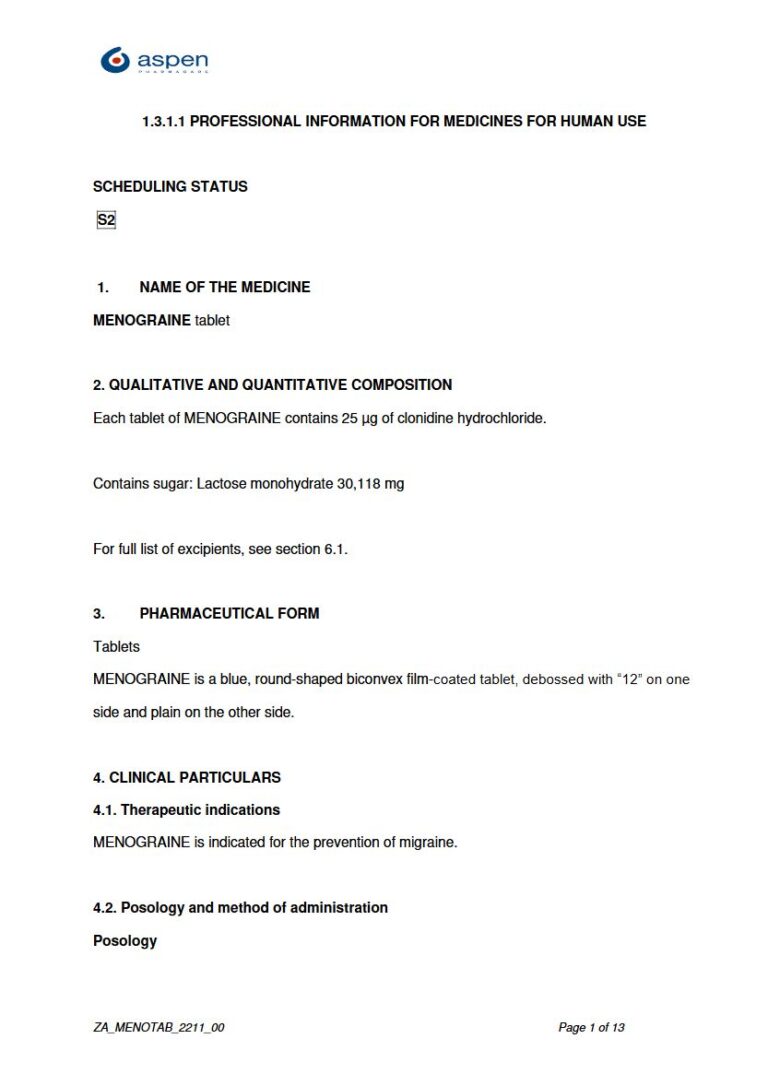
MENOGRAINE is indicated for the prevention of migraine.
4.2. Posology and method of administration
Posology
Adults
Take one tablet morning and night, increasing to three tablets twice daily if necessary.
Method of administration
For oral administration. The coated tablet should not be chewed because of bad taste.
4.3. Contraindications
MENOGRAINE is contraindicated in:
u2022 Patients with hypersensitivity to clonidine or to any of the ingredients as contained in MENOGRAINE (see section 6.1).
u2022 Patients with porphyria.
u2022 Patients with severe bradydysrhythmia resulting from either sick-sinus syndrome or AV block of 2nd or 3rd degree.
4.4. Special warnings and precautions for use
Methylphenidate
Serious adverse events, including sudden death, have been reported in concomitant use with methylphenidate. The safety of using methylphenidate in combination with MENOGRAINE has not been systematically evaluated.
Depression
MENOGRAINE should not be used in patients with a previous history of depressive illness, since further depressive episodes have been reported in such patients.
MENOGRAINE should be used with caution in patients with cerebrovascular disease, heart disease including myocardial infarction, coronary insufficiency, heart failure, renal impairment, occlusive peripheral vascular disorder such as Raynaudu2019s disease, polyneuropathy and constipation.
Dysrhythmia
Depending on the dose given, clonidine as contained in MENOGRAINE, can cause bradycardia. In patients with pre-existing cardiac conduction abnormalities, dysrhythmia have been observed after high doses of clonidine, as contained in MENOGRAINE.
Withdrawal
Withdrawal of MENOGRAINE therapy should be gradual as sudden discontinuation may cause rebound hypertension, sometimes severe. Caution should therefore be observed where antihypertensive medicines are being used, as potentiation of the hypotensive effect may occur. Provided the recommended MENOGRAINE dosage regimen is followed, no difficulty with hypotension should arise during the routine management of patients with migraine. Patients should be instructed not to discontinue therapy without consulting their healthcare provider. Following sudden discontinuation of MENOGRAINE after prolonged treatment with high doses, agitation, restlessness, palpitations, rapid rise in blood pressure, nervousness, tremor, headache or nausea have been reported. When discontinuing therapy with MENOGRAINE, the medical practitioner should reduce the dose gradually over 2 to 4 days. Symptoms of increased catecholamine release such as agitation, sweating, tachycardia, headache, and nausea may also occur. Beta-blockers can exacerbate the rebound hypertension and if MENOGRAINE is being given concurrently with a beta-blocking medicine, MENOGRAINE should not be discontinued until several days after the withdrawal of the beta-blocker. Patients should be warned of the risk of missing a dose or stopping the medicine without consulting their doctor and should carry a reserve supply of MENOGRAINE tablets.
Anaesthesia
Although hypotension may occur during anaesthesia in patients treated with clonidine, as contained in MENOGRAINE, clonidine should not be withdrawn, indeed, if necessary, it should be given intravenously during the operation to avoid the risk of rebound hypertension. Intravenous injection of clonidine should be given slowly to avoid a possible transient pressor effect especially in patients already receiving other antihypertensive medicines such as guanethidine or reserpine.
Contact lenses
Patients who wear contact lenses should be warned that treatment with clonidine, as contained in MENOGRAINE, may cause decreased lacrimation.
Paediatric population
The use and the safety of MENOGRAINE in children and adolescents under 18 years have insufficient evidence in randomized controlled trials and therefore cannot be recommended for use in this population.
Excipients
MENOGRAINE contains lactose. Patients with rare hereditary problems of fructose intolerance, glucose-galactose malabsorption or sucrase-isomaltase insufficiency should not take MENOGRAINE.
4.5. Interaction with other medicines and other forms of interaction
Antidepressants, vasodilators, diuretics and antihypertensive medicines
The hypotensive effect may be antagonized by tricyclic antidepressants and enhanced by vasodilators, diuretics or other antihypertensive medicines. Orthostatic hypotension may be provoked or aggravated by concomitant administration of tricyclic antidepressants or neuroleptics with alpha-receptor blocking properties. It may be necessary to adjust the dosage of MENOGRAINE, if these medicines are administered concurrently.
Beta-blockers and cardiac glycosides
Beta-blockers can cause severe rebound hypertension. Concomitant use of beta-blockers and/or cardiac glycosides can cause bradycardia or dysrhythmia (AV-block) in isolated cases. It cannot be ruled out that concomitant administration of a beta-receptor blocker will cause or potentiate peripheral vascular disorders. If during combined treatment with a beta-blocker there is need to interrupt or discontinue antihypertensive therapy, the beta-blocker must always be discontinued slowly first (reducing the dose gradually to avoid sympathetic hyperactivity) and then the clonidine, which should also be reduced gradually over several days if previously given in high doses.
CNS depressants
Central nervous system depressants can cause enhanced sedation. Although there is no experience from clinical trials, the effect of tranquillisers, hypnotics or alcohol could theoretically be potentiated by clonidine, as contained in MENOGRAINE.
Mirtazapine
Substances with alpha 2 -receptor blocking properties, such as mirtazapine, may abolish the alpha 2 - receptor mediated effects of clonidine, as contained in MENOGRAINE in a dose-dependent manner.
4.6. Fertility, pregnancy and lactation
Safety in pregnancy and lactation has not been established. Use with caution in pregnancy and lactation.
Pregnancy
There is limited amount of data from the use of clonidine, as contained in MENOGRAINE, in pregnant women. As with all medicines, clonidine, as contained in MENOGRAINE, should not be used in pregnancy, especially the first trimester. In animal studies involving doses higher than the equivalent maximum therapeutic dose in man, effects on foetal development were only seen in one species. Foetal malformations did not occur. Careful monitoring of mother and child is recommended. Clonidine, as contained in MENOGRAINE, passes the placental barrier and may lower the heart rate of the foetus. Postpartum, a transient rise in blood pressure in the new-born cannot be excluded. There is no adequate experience regarding the long-term effects of prenatal exposure.
Breastfeeding
Clonidine, as contained in MENOGRAINE, is excreted in human milk. However, there is insufficient information on the effect on new-borns. The use of clonidine is therefore not recommended during breast feeding.
Fertility
No clinical studies on the effect on human fertility have been conducted with clonidine. Non-clinical studies with clonidine, as contained in MENOGRAINE indicate no direct or indirect harmful effects with respect to the fertility index.
4.7. Effects on ability to drive and use machines
MENOGRAINE has a moderate influence. MENOGRAINE may lead to drowsiness and impaired concentration, which may be aggravated by simultaneous intake of alcohol or other central nervous system depressant medicines. Patients should be warned not to take charge of vehicles or machinery or perform potentially hazardous tasks where loss of concentration may lead to accidents.
4.8. Undesirable effects
a) Summary of the safety profile
Drowsiness, dry mouth, dizziness, and headache commonly occur during the initial stages of therapy with MENOGRAINE. Most adverse effects are mild and tend to diminish with continued therapy.
b) Tabulated list of adverse reactions
System organ class Frequent Less frequent Frequency unknown (cannot be estimated from the available data)
Endocrine disorders Gynaecomastia, Metabolism and nutrition disorders Anorexia, fluid retention Psychiatric disorders Depression, sleep disturbances Hallucination Anxiety, vivid dreams, loss of libido, confusional state, delusional perception Nervous system disorders Drowsiness, dizziness, headache, sedation Paraesthesia Eye disorders Dry, itching, or burning sensations in the eye, accommodation disorder, decreased lacrimation Cardiac disorders Bradycardia sinus, bradycardia with atrioventricular block, other electro cardiographic disturbances, heart failure,
Vascular disorders Slight orthostatic hypotension Raynaudu2019s syndrome Respiratory, thoracic and mediastinal disorders Nasal dryness Gastrointestinal disorders Constipation, dry mouth, nausea, salivary gland pain, vomiting Parotid pain, colonic pseudo-obstruction Skin and subcutaneous tissue disorders Rashes and pruritus, alopecia, urticaria Musculoskeletal and connective tissue disorders Cramps Renal and urinary disorders Urinary retention or incontinence Reproductive system and breast disorders Impotence, erectile dysfunction General disorders and administrative site conditions Fatigue Malaise Investigations Transient abnormalities in liver function tests, increases in blood pressure and transient hyperglycaemia
c) Description of selected adverse reactions
Metabolism and nutrition disorders Fluid retention may occur and is usually transient but may be responsible for a reduction in the hypotensive effect during continued treatment. Investigations Large doses have been associated with initial increases in blood pressure and transient hyperglycaemia, although these do not persist during continued therapy.
Reporting of suspected adverse reactions
Reporting suspected adverse reactions after authorisation of the medicine is important. It allows continued monitoring of the benefit/risk balance of the medicine. Healthcare providers are asked to report any suspected adverse reactions to SAHPRA via the u201c 6.04 Adverse Drug Reaction Reporting Formu201d, found online under SAHPRAu2019s publications : https://www.sahpra.org. za/Publications/Index/8 Aspen Pharmacare: E-mail: [email protected] Tel: 0800 118 088
4.9. Overdose
Symptoms
Symptoms of overdosage are due to a generalised sympathetic depression and include pupillary constriction, somnolence including coma, transient hypertension, bradycardia, hypothermia, sedation, miosis, respiratory depression including apnoea, convulsions, occasionally vomiting and dryness of the mouth.
Treatment
Treatment is supportive and symptomatic. An alpha adreno-receptor blocking medicine may be given if necessary. Administration of activated charcoal should be performed where appropriate. Supportive care may include atropine sulfate for symptomatic bradycardia, and intravenous fluids and/or inotropic sympathomimetic medicines for hypotension. Severe persistent hypertension may require correction with alpha-adrenoceptor blocking medicines. Naloxone may be a useful adjunct for the management of clonidine-induced respiratory depression.
