
Clopidogrel 75 Biotech 75 mg FC Tablet
PDF Leaflet Revision Date: 06 January 2026
Clinical Summary
Quick overview from the medicine insert
Indication
Reduction of atherosclerotic events in patients with symptomatic atherosclerotic disease.
Dosage (summary)
One tablet daily, with or without food.
Special Populations
- Renal impairment
- Hepatic impairment
Pregnancy & Breastfeeding
Not recommended in pregnancy and lactation; safety not established.
Key Drug Interactions
- NSAIDs
- Warfarin
- CYP2C19 inhibitors
Contraindications
- Hypersensitivity to clopidogrel
- Active bleeding
- Severe liver impairment
Common side effects
- Bleeding
- Thrombocytopenia
- Gastrointestinal hemorrhage
Counselling Points
- Report unusual bleeding
- Discontinue 7 days before surgery
- Inform healthcare providers of clopidogrel use
Serious warnings
- Risk of Thrombotic Thrombocytopenic Purpura (TTP)
- Increased bleeding risk
Important Disclaimer
The Clopidogrel 75 Biotech 75 mg FC Tablet professional information leaflet below is the property of Biotech Laboratories and is provided on Medinsert exactly as issued, with no.. alterations or editorial changes. We make every effort to keep content current by updating documents as soon as new versions become available. Medinsert serves as a trusted access point for healthcare professionals, but does not replace official sources or clinical judgement. For more details, please read our full disclaimer. read more>>
 Healthcare Professionals Only
This content is for registered healthcare professionals
Sign in or create a free account to read the full package insert.
Free for HPCSA-registered professionals. Powered by Medinsert.
Clinical Particulars
Section 4 of the official insert — extracted exactly as issued, no alterations
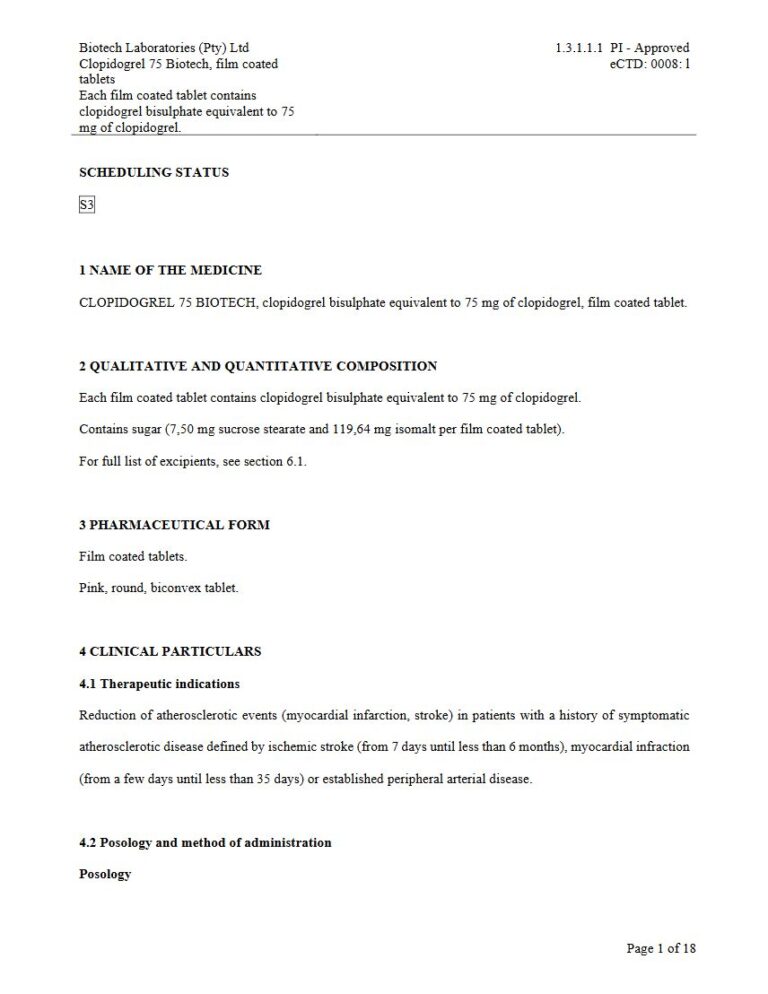
4.1 Therapeutic indications
Reduction of atherosclerotic events (myocardial infarction, stroke) in patients with a history of symptomatic atherosclerotic disease defined by ischemic stroke (from 7 days until less than 6 months), myocardial infraction (from a few days until less than 35 days) or established peripheral arterial disease.
4.2 Posology and method of administration
The adult dosage is a single daily dose of one tablet of CLOPIDOGREL 75 BIOTECH daily, with or without food.
Paediatric population
Safety and efficacy in patients younger than 18 years have not been established (see section 4.3).
Method of administration
For oral administration.
4.3 Contraindications
- Hypersensitivity to clopidogrel or any of the excipients listed in section 6.1.
- Active pathological bleeding such as peptic ulcer and intracranial haemorrhage.
- Safety and efficacy in patients younger than 18 years have not been established.
- Pregnancy and lactation.
- Severe liver impairment.
- Thrombocytopenia, neutropenia and other haematopoietic or haemorrhagic disorders.
- Haemophilia, congenital or acquired, or history of acquired haemophilia related to clopidogrel as in CLOPIDOGREL 75 BIOTECH.
4.4 Special warnings and precautions for use
Thrombotic Thrombocytopenic Purpura (TTP)
Thrombotic thrombocytopenic purpura (TTP) may occur with CLOPIDOGREL 75 BIOTECH, especially during the first two weeks of treatment. Prescribers should warn patients about the signs and symptoms of thrombotic thrombocytopenic purpura. The clinical diagnosis of TTP is characterised by the presence of thrombocytopenia, haemolytic anaemia, neurological symptoms, renal dysfunction and fever. Due to the risk of a fatal outcome, CLOPIDOGREL 75 BIOTECH should be discontinued in the event of suspected TTP. Early treatment with plasmapheresis is indicated in TTP.
Bleeding and haematological disorders
Clopidogrel as in CLOPIDOGREL 75 BIOTECH produces irreversible inhibition of platelet aggregation for the life of a platelet, i.e. for 7 to 10 days. Due to the risk of bleeding and haematological undesirable effects, blood cell count determination and/or other appropriate testing should be promptly considered whenever clinical symptoms suggestive of bleeding arise during the course of treatment (see section 4.8). As with other antiplatelet medicines, CLOPIDOGREL 75 BIOTECH should be used with caution in patients who may be at risk of increased bleeding from trauma, surgery or other pathological conditions and in patients receiving treatment with ASA, heparin, glycoprotein IIb/IIIa inhibitors or non-steroidal anti-inflammatory drugs (NSAIDs) including COX-2 inhibitors, or selective serotonin reuptake inhibitors (SSRIs), or CYP2C19 strong inducers or other medicines associated with bleeding risk such as pentoxifylline (see section 4.5). Patients should be followed carefully for any signs of bleeding including gastrointestinal and intracranial bleeding, especially during the first weeks of treatment and/or after invasive cardiac procedures or surgery. The concomitant administration of CLOPIDOGREL 75 BIOTECH with oral anticoagulants (e.g., warfarin) is not recommended since it may increase the intensity of bleedings (see section 4.5). If a patient is to undergo elective surgery and antiplatelet effect is temporarily not desirable, CLOPIDOGREL 75 BIOTECH should be discontinued 7 days prior to surgery. Patients should inform medical practitioners and dentists that they are taking CLOPIDOGREL 75 BIOTECH before any surgery is scheduled and before any new medicine is taken due to the risk of increased blood loss. CLOPIDOGREL 75 BIOTECH prolongs bleeding time and should be used with caution in patients who have lesions with a propensity to bleed (particularly gastrointestinal and intraocular). Spinal and epidural anaesthesia should not be administered to a patient taking CLOPIDOGREL 75 BIOTECH or for 7 days thereafter. No lumber puncture should be done during these 7 days due to risk of haematoma formation following lumber puncture or spinal and epidural anaesthesia. Patients should be told that it might take longer than usual to stop bleeding when they take CLOPIDOGREL 75 BIOTECH (alone or in combination with ASA), and that they should report any unusual bleeding (site or duration) to their medical practitioner.
Acquired haemophilia
Acquired haemophilia has been reported following use of clopidogrel as in CLOPIDOGREL 75 BIOTECH. In cases of confirmed isolated activated Partial Thromboplastin Time (aPTT) prolongation with or without bleeding, acquired haemophilia should be considered. Patients with a confirmed diagnosis of acquired haemophilia should be managed and treated by specialists, and CLOPIDOGREL 75 BIOTECH should be discontinued.
Cytochrome P450 2C19 (CYP2C19)
Pharmacogenetics: In patients who are poor CYP2C19 metabolisers, CLOPIDOGREL 75 BIOTECH at recommended doses forms less of the active metabolite of clopidogrel and has a smaller effect on platelet function. Tests are available to identify a patient's CYP2C19 genotype. Since clopidogrel as in CLOPIDOGREL 75 BIOTECH is metabolised to its active metabolite partly by CYP2C19, use of medicines that inhibit the activity of this enzyme would be expected to result in reduced medicine levels of the active metabolite of clopidogrel. The clinical relevance of this interaction is uncertain. As a precaution concomitant use of strong or moderate CYP2C19 inhibitors should be discouraged (see section 4.5 for a list of CYP2C19 inhibitors, see also section 5.2). The use of medicines that induce the activity of CYP2C19 would be expected to result in increased medicine levels of the active metabolite of clopidogrel and might potentiate the bleeding risk. As a precaution concomitant use of strong CYP2C19 inducers should be discouraged (see section 4.5).
CYP2C8 substrates
Caution is required in patients treated concomitantly with CLOPIDOGREL 75 BIOTECH and CYP2C8 substrate medicines (see section 4.5).
Cross-reactions among thienopyridines
Patients should be evaluated for history of hypersensitivity to thienopyridines (such as clopidogrel, ticlopidine, prasugrel) since cross-reactivity among thienopyridines has been reported (see section 4.8). Thienopyridines may cause mild to severe allergic reactions such as rash, angioedema, or haematological cross-reactions such as thrombocytopaenia and neutropenia. Patients who had developed a previous allergic reaction and/or haematological reaction to one thienopyridine may have an increased risk of developing the same or another reaction to another thienopyridine. Monitoring for signs of hypersensitivity in patients with a known allergy to thienopyridines is advised.
Renal impairment
Therapeutic experience with clopidogrel as in CLOPIDOGREL 75 BIOTECH is limited in patients with renal impairment. Therefore CLOPIDOGREL 75 BIOTECH should be used with caution in these patients.
Hepatic impairment
Experience is limited in patients with moderate hepatic disease who may have bleeding diatheses. CLOPIDOGREL 75 BIOTECH should therefore be used with caution in this population. In patients with acute myocardial infarction, CLOPIDOGREL 75 BIOTECH therapy should not be initiated within the first few days following myocardial infarction. CLOPIDOGREL 75 BIOTECH cannot be recommended in unstable angina, PTCA (stenting), CABG and acute ischaemic stroke (less than 7 days) due to a lack of data. Patients with rare hereditary problems of fructose intolerance, glucose-galactose malabsorption or sucrase-isomaltase insufficiency should not take this medicine. Patients with rare hereditary problems of fructose intolerance should not take this medicine.
4.5 Interaction with other medicines and other forms of interaction
Non-Steroidal Anti-Inflammatory Drugs (NSAIDs): Concurrent use of aspirin or Non-Steroidal Anti-inflammatory Drugs (NSAIDs), including COX-2 inhibitors, and CLOPIDOGREL 75 BIOTECH may increase the risk of gastrointestinal bleeding and should be co-administered with caution (see section 4.4).
Heparin: Clinical studies indicate that clopidogrel as in CLOPIDOGREL 75 BIOTECH did not necessitate modification of the heparin dose and did not alter the effect of heparin on coagulation. Co-administration of heparin doesnu2019t have an effect on the inhibition of platelet aggregation induced by CLOPIDOGREL 75 BIOTECH. A pharmacodynamic interaction between CLOPIDOGREL 75 BIOTECH and heparin is possible, leading to increased risk of bleeding. Therefore, concomitant use should be undertaken with caution (see section 4.4).
Thrombolytics: The safety of the concomitant administration of CLOPIDOGREL 75 BIOTECH, fibrin or non-fibrin specific thrombolytic medicines and heparins was assessed in patients with acute myocardial infarction. The incidence of clinically significant bleeding was similar to that observed when thrombolytic medicines and heparins are co-administered with acetylsalicylic acid. However, the concomitant use of CLOPIDOGREL 75 BIOTECH with thrombolytic medicines should be undertaken with caution.
Oral anticoagulants: Because of the increased risk of bleeding, the concomitant administration of warfarin with CLOPIDOGREL 75 BIOTECH should be undertaken with caution (see section 4.4).
Glycoprotein IIb/IIIa inhibitors: CLOPIDOGREL 75 BIOTECH should be used with caution in patients who may be at risk of increased bleeding from trauma, surgery or other conditions/disorders that may require concomitant glycoprotein IIb/IIIa inhibitors intake.
Acetylsalicylic acid: A pharmacodynamic interaction between CLOPIDOGREL 75 BIOTECH and acetylsalicylic acid is possible, concomitant use should be undertaken with caution (see section 4.4). Studies however indicate that clopidogrel as in CLOPIDOGREL 75 BIOTECH and acetylsalicylic acid (75 - 325 mg once daily) have been administered together for up to one year.
Medicines associated with bleeding risk: There is an increased risk of bleeding due to the potential additive effect. The concomitant administration of medicines associated with bleeding risk should be undertaken with caution.
Selective Serotonin Reuptake Inhibitors (SSRIs): Since SSRIs affect platelet activation and increase the risk of bleeding, the concomitant administration of SSRIs with CLOPIDOGREL 75 BIOTECH should be undertaken with caution.
Other concomitant therapy: CYP2C19 inhibitors: Since clopidogrel is metabolised to its active metabolite partly by CYP2C19, use of medicines that inhibit the activity of this enzyme would be expected to result in reduced levels of the active metabolite of clopidogrel resulting in decreased antiplatelet activity. As a precaution, concomitant use of strong or moderate CYP2C19 inhibitors and CLOPIDOGREL 75 BIOTECH is not recommended (see sections 4.4 and 5.2). Medicines that inhibit CYP2C19 include omeprazole and esomeprazole, fluvoxamine, fluoxetine, moclobemide, voriconazole, fluconazole, ticlopidine, ciprofloxacin, cimetidine, carbamazepine, efavirenz, oxcarbazepine and chloramphenicol.
Proton Pump Inhibitors (PPI): If a proton pump inhibitor is to be used concomitantly with CLOPIDOGREL 75 BIOTECH, consider using one with less CYP2C19 inhibitory activity. The concomitant use of CLOPIDOGREL 75 BIOTECH with omeprazole or esomeprazole should be discouraged. CLOPIDOGREL 75 BIOTECH can be administered with pantoprazole. There is no evidence that other medicines that reduce stomach acid such as H2-blockers or antacids interfere with antiplatelet activity of CLOPIDOGREL 75 BIOTECH.
Inducers of CYP2C19: Since CLOPIDOGREL 75 BIOTECH is metabolised to its active metabolite partly by CYP2C19, the use of medicines that induce the activity of this enzyme would be expected to result in increased medicine levels of the active metabolite of CLOPIDOGREL 75 BIOTECH. Rifampicin strongly induces CYP2C19, resulting in both an increased level of CLOPIDOGREL 75 BIOTECH active metabolite and platelet inhibition, which in particular might potentiate the risk of bleeding. As a precaution, concomitant use of strong CYP2C19 inducers should be discouraged (see section 4.4). CLOPIDOGREL 75 BIOTECH could inhibit the activity of one of the Cytochrome P450 (CYP) enzymes (CYP2C9). This could lead to increased plasma levels of medicines such as phenytoin, tolbutamide, torsemide, warfarin, tamoxifen, fluvastatin and many NSAIDs which are metabolised by CYP2C9. Data indicate that phenytoin and tolbutamide can be safely co-administered with CLOPIDOGREL 75 BIOTECH. Studies indicate no clinically significant pharmacodynamic interactions when clopidogrel as in CLOPIDOGREL 75 BIOTECH is co-administered with atenolol, nifedipine, or both atenolol and nifedipine. The pharmacodynamic activity of clopidogrel as in CLOPIDOGREL 75 BIOTECH is not significantly influenced by the co-administration of phenobarbital or oestrogen. The pharmacokinetics of digoxin or theophylline are not modified by the co-administration of CLOPIDOGREL 75 BIOTECH. Antacids do not modify the extent of CLOPIDOGREL 75 BIOTECH absorption. CYP2C8 substrate medicines: Concomitant administration of CLOPIDOGREL 75 BIOTECH and medicines primarily cleared by CYP2C8 metabolism (e.g. repaglinide, paclitaxel) should be undertaken with caution due to the risk of increased plasma concentrations. Clinical studies have shown no clinically significant adverse interactions with the following medicine groups, diuretics, beta-blocking medicines, angiotensin converting enzyme inhibitors, calcium antagonists, cholesterol lowering medicines, coronary vasodilators, anti-diabetic medicines (including insulin), anti-epileptic medicines, GPIIb/IIIa antagonists and hormone replacement therapy. As with other oral P2Y12 inhibitors, co-administration of opioid agonists has the potential to delay and reduce the absorption of CLOPIDOGREL 75 BIOTECH presumably because of slowed gastric emptying. The clinical relevance is unknown. Consider the use of a parenteral antiplatelet medicine in acute coronary syndrome patients requiring co-administration of morphine or other opioid agonists.
4.6 Fertility, pregnancy and lactation
The use of CLOPIDOGREL 75 BIOTECH in pregnancy and lactation is not recommended as safety and efficacy have not been established (see section 4.3).
Breastfeeding
It is not known whether CLOPIDOGREL 75 BIOTECH is excreted in human breast milk. Mothers treated with CLOPIDOGREL 75 BIOTECH should not breastfeed their infants.
Fertility
No data available.
4.7 Effects on ability to drive and use machines
No impairment of driving or psychometric performance was observed following CLOPIDOGREL 75 BIOTECH administration.
4.8 Undesirable effects
Bleeding is the most frequent side effect reported with clopidogrel as in CLOPIDOGREL 75 BIOTECH.
Blood and lymphatic system disorders:
Less frequent: Thrombocytopenia (including severe thrombocytopenia), increased bleeding time, leukopenia, eosinophilia, hypertension, haematoma and eye bleeding (mainly conjunctival and intracranial bleeding), neutropenia including severe neutropenia, agranulocytosis, pancytopenia, granulocytopenia, anaemia, aplastic anaemia, acquired haemophilia A and thrombotic thrombocytopenic purpura (TTP).
Immune system disorders:
Less frequent: Cross-reactive medicine hypersensitivity reactions, such as bronchospasm, angioedema, anaphylactoid reactions, serum sickness. Frequency not known: Insulin autoimmune syndrome (IAS) which can lead to severe hypoglycaemia, particularly in patients with HLA DRA4 subtype (more frequent in the Japanese population).
Psychiatric disorders:
Less frequent: Hallucinations, confusion, anxiety, mental depression.
Nervous system disorders:
Less frequent: Headache, dizziness, vertigo, taste disturbances, insomnia, and paraesthesia, intracranial bleeding (some cases fatal).
Cardiac disorders:
Less frequent: Atrial fibrillation or palpitations, Kounis syndrome (vasospastic allergic angina/allergic myocardial infarction).
Vascular disorders:
Frequent: Haematoma (see blood and the lymphatic system disorders) Less frequent: Oedema, serious haemorrhage, haemorrhage of operative wound, vasculitis, hypotension.
Respiratory, thoracic and mediastinal disorders:
Frequent: Chest pain, upper respiratory infection, epistaxis. Less frequent: Respiratory tract bleeding (haemoptysis, pulmonary haemorrhage), bronchospasm, bronchitis, dyspnoea, cough, rhinitis, eosinophilic pneumonia and interstitial pneumonitis.
Gastrointestinal disorders:
Frequent: Diarrhoea and flatulence, abdominal or stomach pain, dyspepsia, gastrointestinal haemorrhage. Less frequent: Gastritis, constipation, vomiting, nausea, peptic ulcer, loss of taste, gastric ulcer, duodenal ulcer, retroperitoneal haemorrhage (including fatal outcome), pancreatitis, colitis (including ulcerative or lymphocytic colitis), stomatitis.
Hepato-biliary disorders:
Less frequent: Acute liver failure, hepatitis, abnormal liver function test.
Skin and subcutaneous tissue disorders:
Frequent: Purpura and bruising. Less frequent: Severe skin reactions including blistering, flaking or peeling of skin, rash, maculopapular, erythematous or exfoliative rash, bullous dermatitis (toxic epidermal necrolysis, Stevens-Johnson Syndrome, erythema multiforme) itching, urticaria, eczema, lichen planus, acute generalised exanthematous pustulosis (AGEP), drug rash with eosinophilia and systemic symptoms (DRESS).
Musculoskeletal and connective tissue disorders:
Less frequent: Gout, arthralgia, back pain, musculoskeletal bleeding (haemarthrosis), arthritis, myalgia.
Renal and urinary disorders:
Less frequent: Haematuria, urinary tract infection, glomerulonephritis, increased blood creatinine.
Reproductive system and breast disorders:
Less frequent: Gynaecomastia.
General disorders and administration site conditions:
Frequent: Bleeding at puncture site, generalised pain. Less frequent: Syncope, tooth disorder, flu-like symptoms, fever, asthenia, and fatigue.
Investigations:
Less frequent: Prolonged bleeding time, decreased neutrophil count, decreased platelet count.
Reporting of suspected adverse reactions
Reporting suspected adverse reactions after authorisation of the medicine is important. It allows continued monitoring of the benefit/risk balance of the medicine. Healthcare providers are asked to report any suspected adverse reactions to SAHPRA via the Med Safety APP (Medsafety X SAHPRA) and eReporting platform (who-umc.org) found on SAHPRA website.
4.9 Overdose
An overdose of CLOPIDOGREL 75 BIOTECH may lead to prolonged bleeding time and subsequent bleeding complication (see section 4.8). Appropriate therapy should be considered if bleedings are observed. No antidote to the pharmacological activity of clopidogrel as in CLOPIDOGREL 75 BIOTECH has been found. If prompt correction of prolonged bleeding time is required, platelet transfusion may reverse the effects of CLOPIDOGREL 75 BIOTECH. Further treatment is symptomatic and supportive.
