
Actincypro 4 mg Tablets
PDF Leaflet Revision Date: 29 January 2025
Clinical Summary
Quick overview from the medicine insert
Indication
Symptomatic treatment of seasonal and perennial rhinitis and pruritus.
Dosage (summary)
Adults: 4-20 mg/day, typically 12-16 mg. Initiate with 4 mg three times daily.
Onset of Action / Duration
Onset: 30 mins, Duration: 4-6 hours
Special Populations
- Elderly
- Children under 2 years
Pregnancy & Breastfeeding
Safety in pregnancy and breastfeeding not established; contraindicated in nursing mothers.
Key Drug Interactions
- Monoamine oxidase inhibitors
- CNS depressants
- Serotonin-enhancing antidepressants
Contraindications
- Hypersensitivity to cyproheptadine
- MAOI therapy
- Closed angle glaucoma
- Stenosing peptic ulcer
- Prostatic hypertrophy
- Bladder neck obstruction
- Pyloroduodenal obstruction
- Elderly, debilitated patients
- Children under 2 years
- Breastfeeding mothers
Common side effects
- Drowsiness
- Somnolence
- Dizziness
- Dry mouth
Counselling Points
- Take with caution if consuming alcohol.
- Monitor for signs of sedation.
- Do not exceed recommended dosage.
Serious warnings
- May cause drowsiness; avoid driving or operating machinery.
- Risk of blood dyscrasias with prolonged use.
Important Disclaimer
The Actincypro 4 mg Tablets professional information leaflet below is the property of Pharmacare and is provided on Medinsert exactly as issued, with no.. alterations or editorial changes. We make every effort to keep content current by updating documents as soon as new versions become available. Medinsert serves as a trusted access point for healthcare professionals, but does not replace official sources or clinical judgement. For more details, please read our full disclaimer. read more>>
 Healthcare Professionals Only
This content is for registered healthcare professionals
Sign in or create a free account to read the full package insert.
Free for HPCSA-registered professionals. Powered by Medinsert.
Clinical Particulars
Section 4 of the official insert — extracted exactly as issued, no alterations
4.1. Therapeutic indications
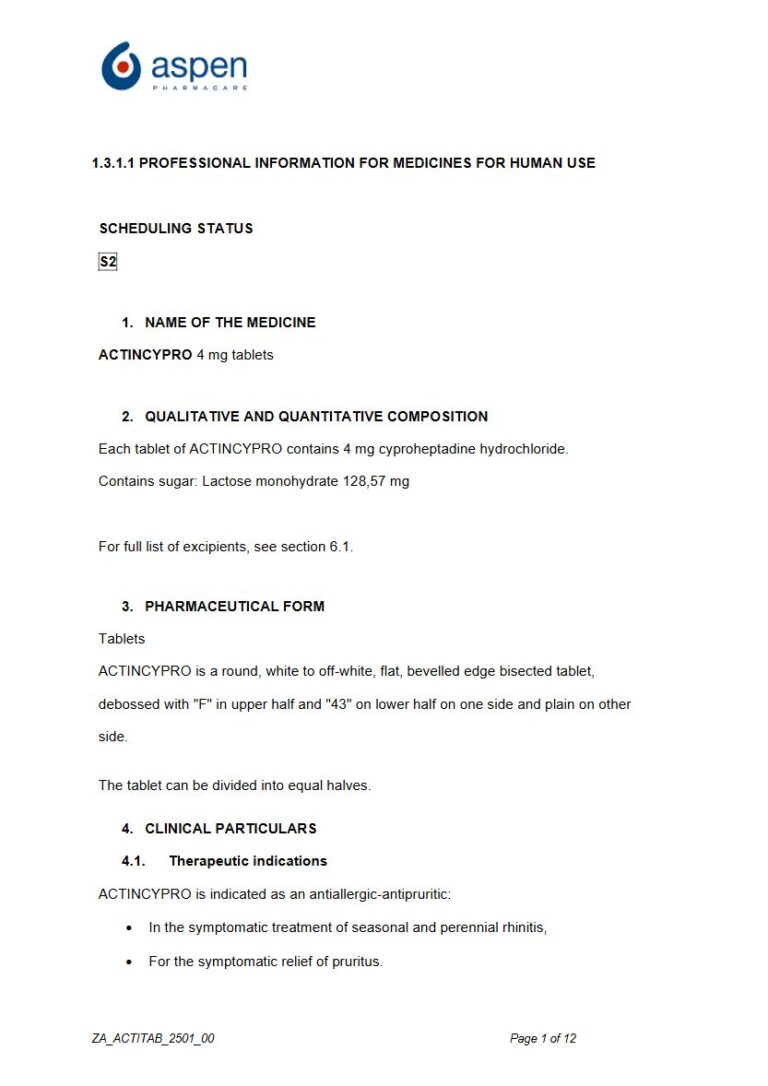
ACTINCYPRO is indicated as an antiallergic-antipruritic:
- In the symptomatic treatment of seasonal and perennial rhinitis,
- For the symptomatic relief of pruritus.
4.2. Posology and method of administration
Posology
Dosage must be individualised. Since the antiallergic effect of a single dose usually lasts four to six hours, the daily requirement should be given in divided doses three times a day or as often as necessary to provide continuous relief.
Adults
The therapeutic range is from 4 to 20 mg a day, the majority of patients requiring 12 mg to 16 mg a day. It is suggested that dosage be initiated with 4 mg (1 tablet) three times a day and adjusted according to the size and response of the patient.
Paediatric population
Children aged 7 to 14 years
The usual dosage is 4 mg (1 tablet) 2 or 3 times a day. This dosage may be adjusted as necessary according to the size and response of the patient. If an additional dose is required, it should be taken preferably at bedtime. The dosage is not to exceed 16 mg a day.
Children aged 2 to 6 years
It is suggested that dosage be initiated with 2 mg (half a tablet) 2 or 3 times a day and adjusted as necessary according to the size and response of the patient. If an additional dose is required, it should be taken at bedtime. The total dosage is not to exceed 8 mg a day (see sections 4.3 and 4.4)
Method of administration
For oral administration.
4.3. Contraindications
ACTINCYPRO is contraindicated in:
- Patients with hypersensitivity to cyproheptadine hydrochloride or to any excipients in ACTINCYPRO (see section 6.1).
- Monoamine oxidase inhibitor therapy.
- Closed angle glaucoma.
- Stenosing peptic ulcer.
- Symptomatic prostatic hypertrophy.
- Bladder neck obstruction.
- Pyloroduodenal obstruction.
- Elderly, debilitated patients.
- Children under the age of 2 years.
- ACTINCYPRO should not be used in new-born or premature infants (see section 4.4).
- Breastfeeding mothers (see section 4.6).
- ACTINCYPRO should not be used for therapy of an acute asthmatic attack.
4.4. Special warnings and precautions for use
ACTINCYPRO may lead to drowsiness and impaired concentration that may be aggravated by the simultaneous intake of alcohol or other central nervous system depressants. Patients should be advised, particularly at the initiation of therapy, against taking charge of vehicles or machinery or performing potentially hazardous tasks where loss of concentration could lead to accidents (see section 4.8).
Lower respiratory tract
Antihistamines should not be used to treat lower respiratory tract symptoms including those of acute asthma (see section 4.3).
Other
Prolonged therapy with antihistamines may cause blood dyscrasias. ACTINCYPRO has an atropine-like action and, therefore, should be used with caution in patients with:
- History of bronchial asthma,
- increased intraocular pressure
- hyperthyroidism,
- cardiovascular disease,
- hypertension.
Use in the elderly
Cyproheptadine as contained in ACTINCYPRO is more likely to cause dizziness, sedation and hypotension in elderly patients (see section 4.3).
Paediatric population
The safety and efficacy in children below the age of two years have not been established.
4.5. Interaction with other medicines and other forms of interaction
- Monoamine oxidase inhibitors (MAOIs) prolong and intensify the anticholinergic effects of ACTINCYPRO (see section 4.3).
- ACTINCYPRO may have additive effects with alcohol and other Central Nervous System (CNS) depressants, (e.g. hypnotics, sedatives, tranquilizers and anti-anxiety medicines) (see section 4.4).
- Medicines with anti-serotonin activity, such as ACTINCYPRO, may interfere with serotonin-enhancing antidepressant medicine.
- ACTINCYPRO may cause a false positive test result for tricyclic anti-depressant medicine when evaluating a urine drug screen.
4.6. Fertility, pregnancy and lactation
Pregnancy
The safety of ACTINCYPRO in pregnancy has not been established.
Breastfeeding
The safety of ACTINCYPRO during breastfeeding has not been established. It is not known whether ACTINCYPRO is excreted in human breast milk. Because of the higher risk of antihistamines for infants generally, and for new-born and premature babies in particular, ACTINCYPRO is contraindicated in nursing mothers (see section 4.3).
Fertility
There are no clinical data on the effects of cyproheptadine on fertility in humans. Cyproheptadine as contained in ACTINCYPRO at about 10 times the human dose had no effect on fertility in a two-litter study in rats or a two-generation study in mice.
4.7. Effects on ability to drive and use machines
ACTINCYPRO may lead to drowsiness and impaired concentration which may be aggravated by simultaneous intake of alcohol or other CNS depressant medicines. Drowsiness may continue the following day. Patients should not drive, use machinery or perform any tasks that require concentration, until they are certain that ACTINCYPRO does not adversely affect their ability to do so (see section 4.4 and 4.8).
4.8. Undesirable effects
a) Summary of the safety profile
The side effects that appear frequently are drowsiness and somnolence.
b) Tabulated list of adverse reactions
System organ class Frequency unknown (cannot be estimated from the available data)
- Blood and the lymphatic system disorders: Agranulocytosis, leukopenia, haemolytic anaemia, thrombocytopenia
- Immune system disorders: Allergic oedema, anaphylactic shock
- Endocrine disorders: Early menses
- Metabolism and nutrition disorders: Anorexia, increased appetite, weight gain
- Psychiatric disorders: Confusion, hallucinations, restlessness, insomnia, irritability, nervousness, excitation, aggressive behaviour, euphoria, hysteria
- Nervous system disorders: Convulsions, dizziness, headache, sedation, sleepiness (often transient), tremor, disturbed coordination, faintness, paraesthesias, neuritis, vertigo
- Eye disorders: Blurred vision, diplopia
- Ear and labyrinth disorders: Tinnitus, acute labyrinthitis
- Cardiac disorders: Tachycardia, palpitation, tightness of chest, extrasystoles
- Vascular disorders: Hypotension
- Respiratory, thoracic and mediastinal disorders: Nasal stuffiness, wheezing, thickening of bronchial secretions, dryness of the nose, mouth and throat, epistaxis
- Gastrointestinal disorders: Constipation, epigastric distress, nausea, vomiting, diarrhoea
- Hepatobiliary disorders: Jaundice, cholestasis, hepatic failure, hepatitis, hepatic function abnormality
- Skin and subcutaneous tissue disorders: Photosensitivity, allergic rash, oedema, excessive perspiration, urticaria
- Renal and urinary disorders: Frequency of micturition, difficult micturition, urinary retention
- General disorders and administrative site conditions: Fatigue, chills
c) Description of selected adverse reactions
Mental alertness
Cyproheptadine as contained in ACTINCYPRO may diminish mental alertness; conversely, particularly in the young child, they may occasionally produce excitation.
Blood dyscrasias
Prolonged therapy with ACTINCYPRO may cause blood dyscrasias.
4.9. Overdose
Symptoms
Cyproheptadine overdosage reactions may vary from hallucinations, central nervous system depression or stimulation to convulsions respiratory and cardiac arrest, and death especially in infants and children. Also, atropine-like signs and symptoms (dry mouth; fixed, dilated pupils; flushing, etc.) as well as gastrointestinal symptoms may occur.
Treatment
Treatment should be supportive and symptomatic. Activated charcoal may reduce absorption of the medicine if given within one or two hours after ingestion. In patients who are not fully conscious or have impaired gag reflex, consideration should be given to administering activated charcoal via a nasogastric tube, once the airway is protected.
Stimulants should not be used. Vasopressors may be used to treat hypotension. Precautions against aspiration must be taken especially in infants and children.
