
Sudapo 5 mg & 10 mg FC tablets
PDF Leaflet Revision Date: 27 January 2026
Clinical Summary
Quick overview from the medicine insert
Indication
Type 2 diabetes mellitus and heart failure.
Dosage (summary)
10 mg once daily for adults.
Special Populations
- Renal impairment
- Hepatic impairment
- Elderly
Pregnancy & Breastfeeding
Contraindicated in pregnancy and breastfeeding.
Key Drug Interactions
- Insulin and insulin secretagogues may increase hypoglycaemia risk.
- Diuretics may increase dehydration risk.
Contraindications
- Type 1 diabetes mellitus
- Moderate to severe renal impairment
- Pregnancy
- Breastfeeding
- History of pancreatitis
Common side effects
- Hypoglycaemia
- Dizziness
- Urinary tract infections
- Genital infections
Counselling Points
- Monitor for signs of ketoacidosis.
- Stay hydrated.
- Report any genital or perineal symptoms.
Serious warnings
- Risk of ketoacidosis
- Volume depletion
- Necrotising fasciitis of the perineum
Important Disclaimer
The Sudapo 5 mg & 10 mg FC tablets professional information leaflet below is the property of Sandoz Sa Pty Ltd and is provided on Medinsert exactly as issued, with no.. alterations or editorial changes. We make every effort to keep content current by updating documents as soon as new versions become available. Medinsert serves as a trusted access point for healthcare professionals, but does not replace official sources or clinical judgement. For more details, please read our full disclaimer. read more>>
 Healthcare Professionals Only
This content is for registered healthcare professionals
Sign in or create a free account to read the full package insert.
Free for HPCSA-registered professionals. Powered by Medinsert.
Clinical Particulars
Section 4 of the official insert — extracted exactly as issued, no alterations
4.1 Therapeutic indications
Type 2 diabetes mellitus:
SUDAPO is indicated in adults aged 18 years and older with type 2 diabetes mellitus:
- as monotherapy as an adjunct to diet and exercise to improve glycaemic control.
- as add-on combination therapy, with glucose-lowering medicines, including metformin, a thiazolidinedione, a sulfonylurea, a DPP4 inhibitor, or insulin, when these, together with diet and exercise, do not provide adequate glycaemic control.
- to reduce the risk of developing new or worsening existing heart failure or cardiovascular death in patients with established cardiovascular (CV) disease or multiple CV risk factors.
Heart failure:
SUDAPO is indicated in adults to reduce the risk of worsening heart failure or cardiovascular death, in patients with heart failure (NYHA class II-IV), and with a left ventricular ejection fraction (LVEF) u2264 40 %.
4.2 Posology and method of administration
Posology:
Type 2 diabetes mellitus:
Monotherapy and add-on combination therapy:
The recommended dose is 10 mg SUDAPO once daily for monotherapy and add-on combination therapy with other glucose-lowering medicines, including metformin, a thiazolidinedione, a sulfonylurea, a DPP4 inhibitor, or insulin.
The recommended starting doses of SUDAPO and metformin when used as initial combination therapy are 10 mg SUDAPO plus 500 mg metformin once daily. Patients with inadequate glycaemic control on this starting dose should have their metformin dose increased according to approved metformin Professional Information.
Use with medicines known to cause hypoglycaemia:
When SUDAPO is used in combination with insulin or an insulin secretagogue, such as a sulfonylurea, a lower dose of insulin or insulin secretagogue may be considered to reduce the risk of hypoglycaemia.
Heart failure:
The recommended dose of SUDAPO is 10 mg taken orally once daily at any time of the day regardless of meals. SUDAPO can be used in conjunction with other heart failure therapies.
Special Populations:
Renal impairment:
No dosage adjustment is required based on renal function. In patients with diabetes mellitus, the glucose lowering efficacy of SUDAPO is reduced in patients with eGFR < 45 mL/min/1,73 m2 (see sections 4.4). Therefore, if eGFR falls below 45 mL/min/1,73 m2, additional glucose lowering treatment should be considered in patients with type 2 diabetes mellitus if further glycaemic control is needed. Treatment with dapagliflozin should be continued for the management of renal and cardiovascular comorbidities.
Hepatic impairment:
No dosage adjustment for SUDAPO is necessary for patients with mild (CHILD-PUGH class A) or moderate (CHILD-PUGH class A) hepatic impairment. SUDAPO is not recommended for patients with severe (CHILD-PUGH class C) hepatic impairment as efficacy has not been established (see section 5.2).
Patients at risk for volume depletion:
For patients at risk for volume depletion due to co-existing conditions or concomitant medications, such as loop diuretics, a 5 mg starting dose of SUDAPO may be appropriate (see section 4.4).
Elderly:
No dosage adjustment for SUDAPO is required based on age (see section 4.4).
Paediatric population:
Safety and effectiveness of SUDAPO in paediatric and adolescent patients have not been established.
Method of administration:
For oral administration.
4.3 Contraindications
- Hypersensitivity to the active substance (dapagliflozin) or to any of the excipients listed in section 6.1.
- Moderate and severe renal impairment with GFR < 45 mL/min/1,73 m2, end stage renal failure or patients on dialysis when used for type 2 diabetes mellitus indication.
- Diabetes mellitus Type 1.
- Pregnant women or women who are breastfeeding their infants (see section 4.6).
- Patients with history of pancreatitis or pancreatic surgery (see 4.4)
4.4 Special warnings and precautions for use
General:
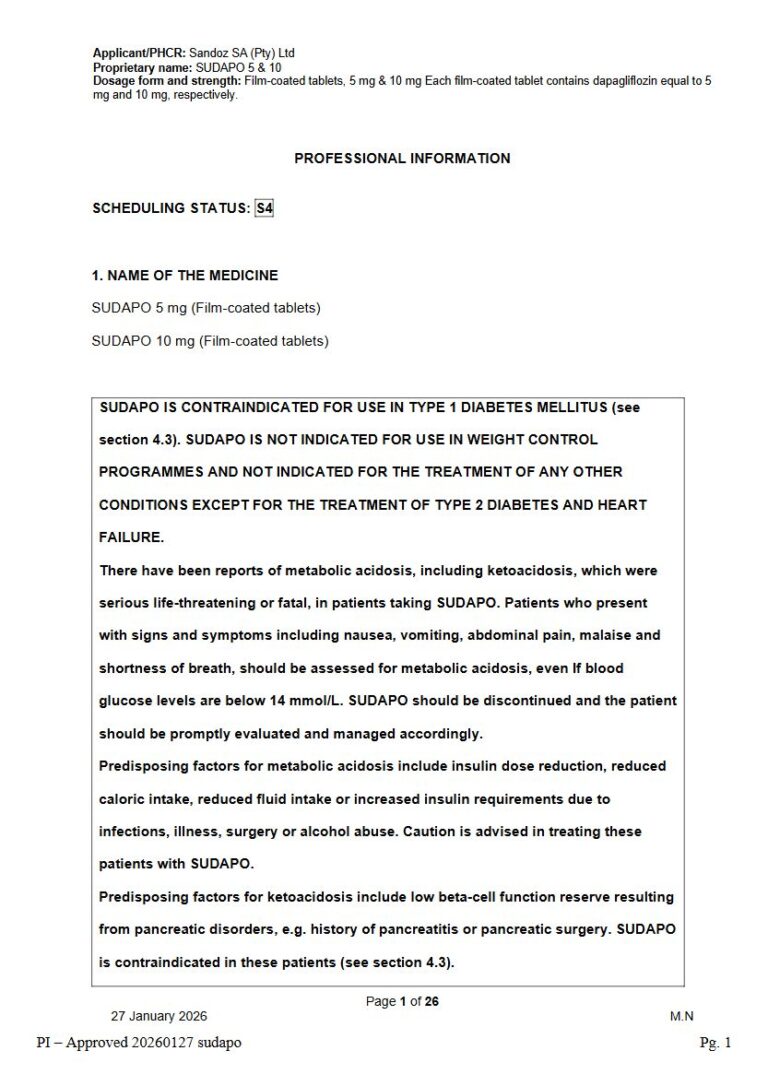
SUDAPO may cause a decrease in systolic blood pressure and diastolic blood pressure. SUDAPO should not be used for the treatment of diabetic ketoacidosis.
Metabolic acidosis including ketoacidosis in patients with diabetes mellitus:
There have been reports of ketoacidosis, including diabetic ketoacidosis, in patients with type 2 diabetes mellitus taking SUDAPO. SUDAPO is contraindicated for the treatment of patients with type 1 diabetes mellitus (see section 4.3). Patients treated with SUDAPO who present with signs and symptoms consistent with ketoacidosis, including nausea, vomiting, abdominal pain, malaise and shortness of breath, should be assessed for ketoacidosis, even if blood glucose levels are below 14 mmol/L (250 mg/dL). If ketoacidosis is suspected, SUDAPO should be discontinued, and the patient should be promptly evaluated.
Predisposing factors for ketoacidosis include low beta-cell function reserve resulting from pancreatic disorders, e.g. history of pancreatitis or pancreatic surgery. SUDAPO is not indicated in these patients (see section 4.3).
Renal impairment:
There is limited experience with initiating treatment with dapagliflozin in patients with eGFR < 25 mL/min/1,73 m2. SUDAPO is not recommended for the treatment of type 2 diabetes mellitus to improve glycaemic control when eGFR is persistently below 45 mL/min/1,73 m2 as the glycaemic efficacy of dapagliflozin is dependent on renal function (see section 4.2). However, treatment with SUDAPO should be continued for the management cardiovascular comorbidities and additional glucose lowering treatment should be considered if further glycaemic control is needed.
Monitoring of renal function is recommended as follows:
- Prior to initiation of SUDAPO and at least annually thereafter.
- Prior to initiation of concomitant medicines that may reduce renal function and periodically thereafter.
- For renal function approaching moderate renal impairment, at least 2 to 4 times per year. If renal function falls below eGFR < 45 mL/min/1,73 m2, SUDAPO treatment should be discontinued (See sections 4.3).
Hepatic impairment:
There is limited experience in clinical studies in patients with hepatic impairment. Dapagliflozin exposure is increased in patients with severe hepatic impairment (see sections 4.2 and 5.2).
Use in patients at risk for volume depletion and/or hypotension:
Dapagliflozin may cause a decrease in systolic and diastolic blood pressure. Due to its mechanism of action, dapagliflozin increases diuresis which may lead to the modest decrease in blood pressure observed in clinical studies (see section 5.1). It may be more pronounced in patients with very high blood glucose concentrations. Caution should be exercised in patients for whom a dapagliflozin-induced drop in blood pressure could pose a risk, such as patients on anti-hypertensive therapy with a history of hypotension or elderly patients. A 5 mg starting dose of SUDAPO may be appropriate in these patients (see section 4.2). In case of intercurrent conditions that may lead to volume depletion (e.g. gastrointestinal illness), careful monitoring of volume status (e.g. physical examination, blood pressure measurements, laboratory tests including haematocrit and electrolytes) is recommended. SUDAPO should be permanently discontinued in patients who develop volume depletion (see section 4.8).
Diabetic ketoacidosis:
Cases of diabetic ketoacidosis (DKA), including life-threatening and fatal cases, have been reported in patients treated with sodium-glucose co-transporter 2 (SGLT2) inhibitors, including dapagliflozin. In a number of cases, the presentation of the condition was atypical with only moderately increased blood glucose values, below 14 mmol/L (250 mg/dL). The risk of diabetic ketoacidosis must be considered in the event of non-specific symptoms such as nausea, vomiting, anorexia, abdominal pain, excessive thirst, difficulty breathing, confusion, unusual fatigue or sleepiness. Patients should be assessed for ketoacidosis immediately if these symptoms occur, regardless of blood glucose level. If ketoacidosis is suspected, SUDAPO should be discontinued and the patient should be promptly evaluated. In patients where DKA is suspected or diagnosed, SUDAPO treatment should be stopped immediately. Treatment should be interrupted in patients who are hospitalised for major surgical procedures or acute serious medical illnesses. Monitoring of ketones is recommended in these patients. Measurement of blood ketone levels is preferred to urine. Treatment with dapagliflozin may be restarted when the ketone values are normal and the patientu2019s condition has stabilised. Before initiating SUDAPO, factors in the patient history that may predispose to ketoacidosis should be considered. Patients who may be at higher risk of DKA include patients with low beta cell function reserve (e.g. type 2 diabetes patients with low C peptide or latent autoimmune diabetes in adults (LADA) or patients with a history of pancreatitis), patients with conditions that lead to restricted food intake or severe dehydration, patients for whom insulin doses are reduced and patients with increased insulin requirements due to acute medical illness, surgery or alcohol abuse. SGLT2 inhibitors should be used with caution in these patients. SUDAPO is contraindicated in patients with type 1 diabetes (see section 4.3).
Restarting SGLT2 inhibitor treatment in patients experiencing a DKA while on SGLT2 inhibitor treatment is not recommended, unless another clear precipitating factor is identified and resolved.
Necrotising fasciitis of the perineum (Fournieru2019s gangrene):
Post-marketing cases of necrotising fasciitis of the perineum (also known as Fournieru2019s gangrene) have been reported in female and male patients taking SGLT2 inhibitors (see section 4.8). This is a rare but serious and potentially life-threatening event that requires urgent surgical intervention and antibiotic treatment. Patients should be advised to seek medical attention if they experience a combination of symptoms of pain, tenderness, erythema, or swelling in the genital or perineal area, with fever or malaise. Be aware that either uro-genital infection or perineal abscess may precede necrotising fasciitis. If Fournieru2019s gangrene is suspected, SUDAPO should be discontinued and prompt treatment (including antibiotics and surgical debridement) should be instituted.
Urinary tract infections:
Urinary glucose excretion may be associated with an increased risk of urinary tract infection; therefore, temporary interruption of SUDAPO should be considered when treating pyelonephritis or urosepsis.
SGLT2 inhibitors such as SUDAPO have been associated with an increased risk of urinary tract infection and/or genital infection in both males and females caused by bacteria and/or fungi. Genital and fungal infections appear to be more common in females. Balanoposthitis in males may result in phimosis. Temporary interruption of dapagliflozin should be considered when treating pyelonephritis or urosepsis. Discontinuation of dapagliflozin may be considered in cases of recurrent urinary tract infections, see section 4.8 Undesirable effects. Evaluate patients for signs and symptoms of urinary tract infections and treat promptly, if indicated.
Use with medicines known to cause hypoglycaemia:
Insulin and insulin secretagogues, such as sulphonylureas, cause hypoglycaemia. Therefore, a lower dose of insulin or an insulin secretagogue may be required to reduce the risk of hypoglycaemia when used in combination with SUDAPO (see section 4.8).
Elderly (u2265 65 years):
Elderly patients may be at a greater risk for volume depletion and are more likely to be treated with diuretics. Elderly patients are more likely to have impaired renal function, and/or to be treated with anti-hypertensive medicines that may cause changes in renal function such as angiotensin-converting enzyme inhibitors (ACE-I) and angiotensin II type 1 receptor blockers (ARB). The same recommendations for renal function apply to elderly patients as to all patients (see sections 4.2, and 5.2).
Cardiac failure:
Experience with dapagliflozin in New York Heart Association (NYHA) class IV is limited.
Paediatric use:
Safety and efficacy of SUDAPO in paediatric patients has not been established.
Lower limb amputations:
An increased in cases of lower limb amputation (primarily of the toe) has been observed in long-term, clinical studies in type 2 diabetes mellitus with SGLT2 inhibitors. It is unknown whether this constitutes a class effect. It is important to counsel patients with diabetes on routine preventative foot care.
Other populations:
Patients with severe renal impairment (eGFR < 20 mL/min/1.73m2) or End Stage Renal Disease or with recent (< 2 months) cardiovascular event or who are breast-feeding or are pregnant, have been excluded from clinical studies.
Urine laboratory assessments:
Due to its mechanism of action, patients taking SUDAPO will test positive for glucose in their urine.
Lactose:
SUDAPO contains lactose monohydrate. Patients with the rare hereditary conditions of galactose intolerance total lactose deficiency or glucose-galactose malabsorption should not take SUDAPO.
4.5 Interactions with other medicines
Pharmacodynamic interactions:
Diuretics:
SUDAPO may add to the diuretic effect of thiazide and loop diuretics and may increase the risk of dehydration and hypotension (see section 4.4).
Insulin and insulin secretagogues:
Insulin and insulin secretagogues, such as sulphonylureas, cause hypoglycaemia. Therefore, a lower dose of insulin or an insulin secretagogue may be required to reduce the risk of hypoglycaemia when used in combination with dapagliflozin in patients with type 2 diabetes mellitus (see sections 4.2 and 4.8).
Pharmacokinetic interactions:
The metabolism of dapagliflozin is primary via glucuronide conjugation mediated by UDP glucuronosyltransferase 1A9 (UGT1A9). The major metabolite, dapagliflozin 3-O-glucuronide, is not an SGLT2 inhibitor. In in vitro studies, dapagliflozin and dapagliflozin 3-O-glucuronide neither inhibited cytochrome P450 (CYP) 1A2, CYP2A6, CYP2B6, CYP2C8, CYP2C9, CYP2C19, CYP2D6, CYP3A4, nor induced CYP1A2, CYP2B6 or CYP3A4. Therefore, dapagliflozin is not expected to alter the metabolic clearance of co-administered medicines that are metabolized by these enzymes. Dapagliflozin is a weak substrate of the P-glycoprotein (P-gp) active transporter and dapagliflozin 3-O-glucuronide is a substrate for the OAT3 active transporter. Dapagliflozin or dapagliflozin 3-O-glucuronide did not meaningfully inhibit P-gp, OCT2, OAT1, or OAT3 active transporters. The dependence of dapagliflozin elimination on dapagliflozin 3-O-glucuronide formation in humans also suggests the possibility of interactions mediated by UGT1A9. Ketoconazole is an in vitro inhibitor of dapagliflozin 3-O-glucuronide formation by UGT1A9 (IC50 = 32 u03bcM).
Effects of other medicines on SUDAPO:
Interaction studies conducted in healthy participants, using mainly a single-dose design, suggest that the pharmacokinetics of dapagliflozin are not altered by metformin (a human OCT-1 and hOCT-2 substrate), pioglitazone (a CYP2C8 [major] and CYP3A4 [minor] substrate), sitagliptin (a human OAT-3 substrate and P-glycoprotein substrate), glimepiride (a CYP2C9 substrate), voglibose (an alpha-glucosidase inhibitor), hydrochlorothiazide, bumetanide, valsartan, or simvastatin (a CYP3A4 substrate). Therefore, meaningful interaction of dapagliflozin with other substrates of hOCT-1, hOCT-2, hOAT-3, P-gp, CYP2C8, CYP2C9, CYP3A4, and other alpha-glucosidase inhibitor would not be expected. Following coadministration of dapagliflozin with rifampicin (an inducer of various active transporters and drug-metabolising enzymes) a 22 % decrease in dapagliflozin systemic exposure (AUC) was observed, but with no clinically meaningful effect on 24-hour urinary glucose excretion. No dose adjustment is recommended. A clinically relevant effect with other inducers (e.g. carbamazepine, phenytoin, phenobarbital) is not expected. Following coadministration of dapagliflozin with mefenamic acid (an inhibitor of UGT1A9), a 55 % increase in dapagliflozin systemic exposure was seen, but with no clinically meaningful effect on 24-hour urinary glucose excretion. No dose adjustment is recommended. Co-administration of dapagliflozin and bumetanide did not meaningfully change the pharmacodynamic effect of dapagliflozin to increase urinary glucose excretion in healthy participants.
4.6 Fertility, pregnancy and lactation
Pregnancy:
SUDAPO is contraindicated in pregnancy (see section 4,3). Maternal exposure to SUDAPO in rat studies was associated with increased incidence and/or severity of renal pelvic and tubular dilatations in progeny. When pregnancy is detected, treatment with SUDAPO should be discontinued.
Breastfeeding:
Mothers on SUDAPO should not breast-feed their infants. It is unknown whether SUDAPO is excreted in human milk. Available pharmacodynamic/toxicological data in animals have shown excretion of dapagliflozin/metabolites in milk. SUDAPO should not be used while breastfeeding and exposure to SUDAPO should be avoided during the first 2 years of life (see section 4. 3).
Fertility:
The effect of SUDAPO on fertility in humans has not been studied. In male and female rats, dapagliflozin showed no effects on fertility at any dose tested.
4.7 Effects on ability to drive and use machines
SUDAPO causes dizziness and may have an influence on the ability to drive and use machines. Patients should also be alerted to the risk of hypoglycaemia when SUDAPO is used in combination with a sulphonylurea or insulin. Patients should therefore be warned to be cautious when driving a vehicle or operating machinery.
4.8 Undesirable effects
System organ class
Frequent
Less Frequent
Infections and infestations
Vulvovaginitis, balanitis and related genital infections, urinary tract infection, including pyelonephritis, cystitis
Fungal infection, necrotising fasciitis of the perineum (Fournieru2019s gangrene)
Metabolism and nutrition disorders
Hypoglycaemia (when used with sulphonylureas (SU) or insulin)
Volume depletion, dehydration, hypovolaemia, hypotension, thirst, diabetic ketoacidosis (when used in type 2 diabetes mellitus)
Nervous system disorders
Dizziness
Gastro-intestinal disorders
Constipation, dry mouth
Skin and sub-cutaneous tissue disorders
Rash
Hyperhidrosis, angioedema
Musculo-skeletal and connective tissue disorders
Back pain
Renal and urinary disorders
Glucosuria, dysuria, polyuria
Nocturia, tubulointerstitial nephritis
Reproductive systems and breast disorders
Vulvovaginal pruritus, pruritus genital
Investigations
Dyslipidaemia, haematocrit increased, creatinine renal clearance decreased during initial treatment
Blood urea increased, blood creatinine increased during initial treatment, weight decreased
Post-marketing adverse events:
Spontaneous reports:
Skin and sub-cutaneous tissue disorders: Rash, rash generalised, rash pruritic, rash macular, rash maculo-papular, rash pustular, rash vesicular, rash erythematous.
Phimosis have been reported with the use of SGLT2 inhibitors such as SUDAPO.
Reporting of suspected adverse reactions:
Reporting suspected adverse reactions after authorisation of SUDAPO is important. It allows continued monitoring of the benefit/risk balance of the medicine. Health care providers are asked to report any suspected adverse reactions to SAHPRA via the Med Safety APP (Medsafety X SAHPRA) and eReporting platform (who-umc.org) found on SAHPRA website. Suspected adverse reactions can also be reported directly to the HCR via the website: https://pvi1j.solutions.iqvia.com or the e-mail address, [email protected].
4.9 Overdose
Symptoms of overdose:
In overdose, side effects may be elicited or exacerbated (see section 4.8). Studies indicate that dapagliflozin did not show any toxicity in healthy participants at single oral doses up to 500 mg (50 times the maximum recommended human dose).
Treatment of overdose:
In the event of an overdose, appropriate supportive treatment should be initiated as dictated by the patient's clinical status. The removal of dapagliflozin by haemodialysis has not been studied.
