
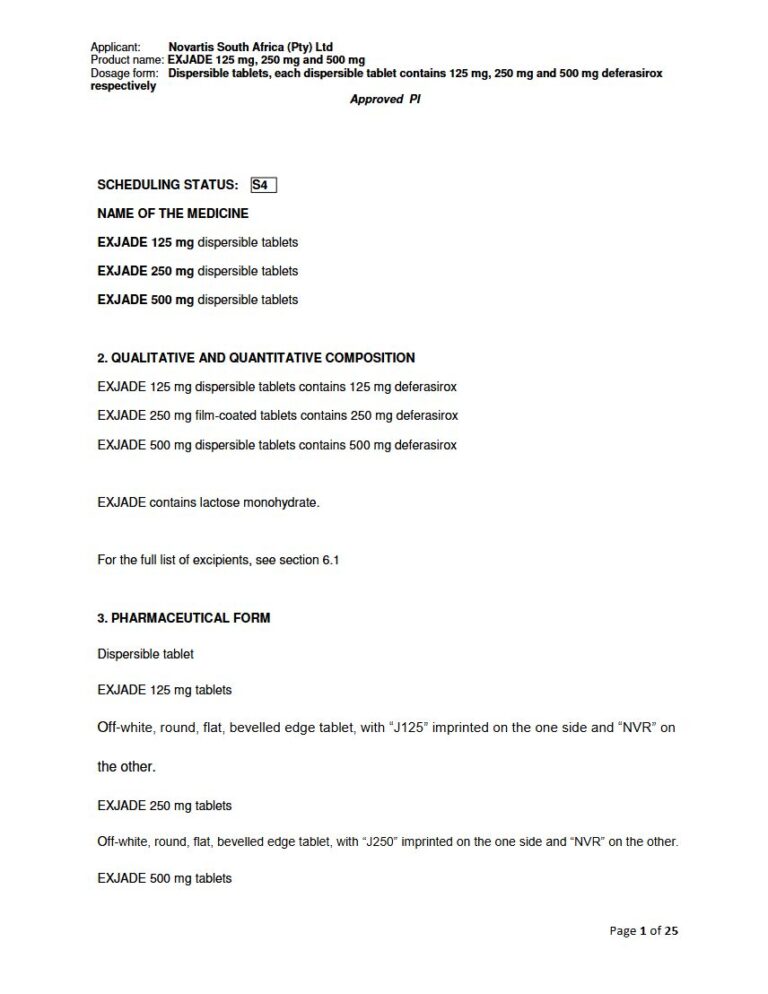
Exjade 125mg. 250mg. 500mg dispersible tablets
PDF Leaflet Revision Date: 15 April 2020
Clinical Summary
Quick overview from the medicine insert
Indication
Treatment of chronic iron overload due to blood transfusions and non-transfusion-dependent thalassemia.
Dosage (summary)
Starting dose: 20 mg/kg for transfusion overload; 10 mg/kg for non-transfusion-dependent thalassemia.
Special Populations
- Elderly patients
- Renal impairment
- Hepatic impairment
Pregnancy & Breastfeeding
Not recommended during pregnancy; safety in breastfeeding not established.
Key Drug Interactions
- NSAIDs
- Corticosteroids
- Oral bisphosphonates
- Anticoagulants
- Repaglinide
- CYP3A4 substrates
Contraindications
- Hypersensitivity
- Creatinine clearance < 60 mL/min
- Severe hepatic impairment
- Pregnancy and lactation
Common side effects
- Gastrointestinal disturbances
- Skin rash
- Increased serum creatinine
- Elevated liver transaminases
Counselling Points
- Take on an empty stomach
- Monitor renal and hepatic function regularly
- Report any signs of severe skin reactions
Serious warnings
- Risk of gastrointestinal ulceration and hemorrhage
- Hepatic failure reports
- Serious skin reactions
Important Disclaimer
The Exjade 125mg. 250mg. 500mg dispersible tablets professional information leaflet below is the property of Novartis and is provided on Medinsert exactly as issued, with no.. alterations or editorial changes. We make every effort to keep content current by updating documents as soon as new versions become available. Medinsert serves as a trusted access point for healthcare professionals, but does not replace official sources or clinical judgement. For more details, please read our full disclaimer. read more>>
 Healthcare Professionals Only
This content is for registered healthcare professionals
Sign in or create a free account to read the full package insert.
Free for HPCSA-registered professionals. Powered by Medinsert.
Clinical Particulars
Section 4 of the official insert — extracted exactly as issued, no alterations
4.1 Therapeutic indications
EXJADE is indicated for the treatment of chronic iron overload due to blood transfusions (transfusional haemosiderosis) in adult and paediatric patients (aged 2 years and over). EXJADE is also indicated for the treatment of chronic iron overload in patients with non-transfusion-dependent thalassemia syndromes aged 10 years and older. EXJADE therapy should only be initiated when there is evidence of iron overload (liver iron concentration (LIC) u22655 mg Fe/g dry weight (dw) or serum ferritin consistently >800 microgram/L).
4.2 POSOLOGY AND METHOD OF ADMINISTRATION
EXJADE must be taken once daily on an empty stomach at least 30 minutes before food, preferably at the same time each day. The tablets are dispersed by stirring in a glass of water or apple or orange juice (100-200 ml) until a fine suspension is obtained. After the suspension has been swallowed, any residue must be resuspended in a small volume of water or juice and swallowed. The tablets must not be chewed or swallowed whole (See Interaction with other medicinal products and other forms of interaction). Dispersion in carbonated drinks or milk is not recommended due to foaming and slow dispersion, respectively.
Posology
Transfusional iron overload
Dosage
It is recommended that therapy with EXJADE be started after the transfusion of approximately 20 units (about 100 ml/kg) of packed red blood cells or when there is evidence from clinical monitoring that chronic iron overload is present (e.g. serum ferritin > 1000 microgram/l). Doses (in mg/kg) must be calculated and rounded to the nearest whole tablet size. EXJADE is available in three tablet strengths (125 mg, 250 mg and 500 mg). The decision to remove accumulated iron should be individualised based on anticipated clinical benefit and risks of chelation therapy.
Starting dose
The starting dose is determined by the frequency of blood transfusions. The recommended initial daily dose of EXJADE is 20 mg/kg body weight.
An initial daily dose of 30 mg/kg may be considered for patients receiving more than 14 ml/kg/month of packed red blood cells (approximately >4 units/month for an adult.) An initial daily dose of 10 mg/kg may be considered for patients receiving less than 7 ml/kg/month of packed red blood cells (approximately <2 units/month for an adult). For patients already well-managed on treatment with deferoxamine, a starting dose of EXJADE that is numerical half that of the deferoxamine dose could be considered (e.g. a patient receiving 40 mg/kg/day of deferoxamine for 5 days per week (or equivalent) could be transferred to a starting daily dose of 20 mg/kg/day of EXJADE).
Non-transfusion-dependent thalassaemia syndrome
Dosage
EXJADE therapy should only be initiated when there is evidence of iron overload (liver iron concentration (LIC) u22655 mg Fe/g dry weight (dw) or serum ferritin consistently >800 microgram/L). In patients with no LIC assessment, caution should be taken during chelation therapy to minimise the risk of over-chelation.
Starting dose
The recommended initial daily dose of EXJADE is 10 mg/kg body weight.
Dose adjustment
It is recommended that serum ferritin be monitored every month to assess the patientsu2019s response to therapy and to minimize the risk of overchelation (see u201cSpecial warnings and precautions for useu201d. Every 3 to 6 months of treatment, consider a dose increase in increments of 5 to 10 mg/kg if the patientu2019s LIC is u22657 mg Fe/g dw, or serum ferritin is consistently >2,000 microgram/L and not showing a downward trend, and the patient is tolerating the drug well. Doses above 20 mg/kg are not recommended because there is no experience with doses above this level in patients with non-transfusion-dependent thalassaemia syndromes. In patients in whom LIC was not assessed and serum ferritin is u22642,000 microgram/L, dosing should not exceed 10 mg/kg. For patients in whom the dose was increased to >10 mg/kg, dose reduction is recommended to 10 mg/kg or less when LIC is <7 mg Fe/g dw or serum ferritin is u22642,000 microgram/L. Once a satisfactory body iron level has been achieved (LIC <3 mg Fe/g dw or serum ferritin <300 microgram/L), treatment should be interrupted. Treatment should be re-initiated when there is evidence from clinical monitoring that chronic iron overload is present.
Special Populations
Elderly patients
The dosing recommendations for elderly patients are the same as described above. In clinical trials, elderly patients experienced a higher frequency of adverse reactions than younger patients and elderly patients should be monitored closely for adverse reactions that may require a dose adjustment.
Patients with renal impairment
EXJADE treatment must be used with caution in patients with serum creatinine levels above the age-appropriate upper limit of the normal range. (see Contraindications) EXJADE should not be used by patients with CrCl below 60 mL/min. (see Contraindications) The initial dosing recommendations for patients with renal impairment are the same as described above. Serum creatinine should be monitored monthly in all patients and if necessary daily doses can be reduced by 10 mg/kg (see section Special Warnings and Precautions for use).
For adult patients, the daily dose of EXJADE may be reduced by 10 mg/kg if a non-progressive rise in serum creatinine by >33 % above the average of the pre-treatment measurements is seen at two consecutive visits, and cannot be attributed to other causes. For paediatric patients, the dose may be reduced by 10 mg/kg if serum creatinine levels rise above the age-appropriate upper limit of normal at two consecutive visits. If there is a progressive increase in serum creatinine beyond the upper limit of normal, EXJADE should be interrupted. Therapy with EXJADE may be reinitiated depending on the individual clinical circumstances.
Patients with hepatic impairment
EXJADE has been studied in a clinical trial in subjects with hepatic impairment. For patients with moderate hepatic impairment (Child-Pugh B), the starting dose should be reduced by approximately 50 %. EXJADE should not be used in patients with severe hepatic impairment (Child-Pugh C) (see Contraindications). Hepatic function in all patients should be monitored before the initiation of treatment, every 2 weeks during the first month and monthly thereafter. (See section Special Warnings and Precautions for use).
Paediatric Population
The dosing recommendations for paediatric patients are the same as for adult patients. It is recommended that serum ferritin be monitored every month to assess the patientu2019s response to therapy and to minimize the risk of overchelation (see u201cSpecial warnings and precautions for useu201d). Changes in weight of paediatric patients over time must be taken into account when calculating the dose.
4.3 CONTRAINDICATIONS
- Hypersensitivity to the active substance or to any of the excipients.
- Creatinine clearance < 60 mL/min
- Repaglinide (see Interaction with other medicinal products and other forms of interaction)
- High risk myelodysplastic syndrome (MDS) patients and patients with other haematological and nonhaematological malignancies with limited expected survival (< 1 year) who are not expected to benefit from chelation therapy due to the rapid progression of their disease.
- Severe hepatic impairment (Child-Pugh C)
- Pregnancy and lactation (See Fertility, pregnancy and lactation)
4.4 SPECIAL WARNINGS AND PRECAUTIONS FOR USE
Concomitant administration of EXJADE with medicine that have known ulcerogenic potential, such as NSAIDs, corticosteroids, or oral bisphosphonates, and use of EXJADE in patients receiving anticoagulants may increase the risk of gastrointestinal complications such as ulceration and haemorrhage. There have been post marketing reports of hepatic failure in patients treated with EXJADE. Most reports of hepatic failure involved patients with significant comorbidities including liver cirrhosis and multi-organ failure; fatal outcomes were reported in some of these patients. The decision to remove accumulated iron should be individualised based on anticipated clinical benefit and risks of chelation therapy. Caution should be used in elderly patients due to a higher frequency of adverse reactions.
Renal impairment
Non-progressive rises in serum creatinine have been noted in patients treated with EXJADE, usually within the normal range. Cases of acute renal failure have been reported (See Undesirable effects). Although causal relationship with EXJADE could not be established, there have been cases of acute renal failure requiring dialysis or with fatal outcome. It is recommended that serum creatinine and/or creatinine clearance be assessed in duplicate before initiating therapy and monitored monthly thereafter.
Patients with pre-existing renal conditions or patients who are receiving other medicinal products that may depress renal function may be more at risk of complications and weekly monitoring of serum creatinine and/or creatinine clearance is recommended in the first month after initiation or modification of therapy (including switching formulation) and monthly thereafter. EXJADE should not be used in patients with creatinine clearance less than 60 mL/min (see Contraindications). Renal tubulopathy has been reported in patients treated with EXJADE. The majority of these patients were children and adolescents with beta-thalassaemia and serum ferritin levels <1,500 microgram/L. Dose reduction or interruption may be considered if abnormalities occur in levels of markers of renal tubular function and/or as clinically indicated. Tests for proteinuria should be performed monthly. Care should be taken to maintain adequate hydration in patients who develop diarrhoea or vomiting.
For adult patients, the daily dose of EXJADE may be reduced by 10 mg/kg if a non-progressive rise in serum creatinine by > 33 % above the average of the pre-treatment measurements is seen at two consecutive visits, and cannot be attributed to other causes (see section 4.2 Posology and method of administration) The recommendations for renal function monitoring are summarized in the Table 1.
Table 1- Recommendations for renal function monitoring
Serum creatinine
Creatinine clearance
Before initiation of therapy
Twice (2x) and/or
Twice (2x)
Contraindicated
>2 times age-appropriate ULN* or <40 mL/min
Monitoring
Monthly and/or
Monthly
For patients with pre-existing renal conditions, or patients who are receiving medicinal products that may depress the renal function as they may be more at risk of complications in the first month after initiation, or modification of therapy (including switching formulation), monitoring should be:
Weekly and/or
Weekly
Reduction of daily dose by 10 mg/kg/day if following renal parameters are observed on two consecutive visits and cannot be attributed to other causes:
Adult patients >33% above pre-treatment average (non-progressive rise)
Pediatric patients > age-appropriate ULN*
After dose reduction, interrupt treatment, if:
Adult and pediatric patients Progressive increase in serum creatinine beyond the upper limit of normal
*ULN: upper limit of the normal range
Hepatic
EXJADE is not recommended in patients with severe hepatic impairment (Child-Pugh C) (see Contraindications). Deferasirox is principally eliminated by glucuronidation and is minimally (about 8 %) metabolised by oxidative cytochrome P450 enzymes. Although uncommon (0.3 %), elevations of transaminases greater than 10 times the upper limit of the normal range, suggestive of hepatitis, have been observed in clinical trials. There have been post marketing reports of hepatic failure in patients treated with EXJADE. Most reports of hepatic failure involved patients with significant comorbidities including liver cirrhosis and multi-organ failure; fatal outcomes were reported in some of these patients. It is recommended that serum transaminases, bilirubin and alkaline phosphatase be monitored before the initiation of treatment, every 2 weeks during the first month and monthly thereafter. If there is a persistent and progressive increase in serum transaminase levels that cannot be attributed to other causes, EXJADE should be interrupted. Once the cause of the liver function test abnormalities has been clarified or after return to normal levels, cautious re-initiation of EXJADE treatment at a lower dose followed by gradual dose escalation may be considered.
Gastrointestinal
Gastrointestinal irritation may occur during EXJADE treatment. Upper gastrointestinal ulceration and haemorrhage have been reported in patients, including children and adolescents, receiving EXJADE. There have been rare reports of fatal GI haemorrhage, especially in elderly patients who had advanced haematologic malignancies and/or low platelet counts. Multiple ulcers have been observed in some patients. Medical practitioners and patients should remain alert for signs and symptoms of GI ulceration and haemorrhage during EXJADE therapy and promptly initiate additional evaluation and treatment if a serious GI adverse event is suspected. There have been reports of ulcers complicated with gastrointestinal perforation (including fatal outcome).
Caution should be exercised in patients who are taking EXJADE in combination with medicines that have known ulcerogenic potential, such as NSAIDs, corticosteroids, or oral bisphosphonates, in patients receiving anticoagulants and in patients with platelet counts <50 x 109/L.
Skin disorders
Severe cutaneous adverse reactions (SCARs), including Stevens-Johnson syndrome (SJS), toxic epidermal necrolysis (TEN) and drug reaction with eosinophilia and systemic symptoms (DRESS) which could be life-threatening or fatal. Patients should be advised of the signs and symptoms of severe skin reactions and be closely monitored. If any SCAR is suspected EXJADE should be discontinued immediately and should not be reintroduced.
Vision and hearing
Auditory (decreased hearing) and ocular (lens opacities) disturbances have been reported with EXJADE treatment (see Section Undesirable effects). Auditory and ophthalmic testing (including fundoscopy) is recommended before the start of EXJADE treatment and at regular intervals thereafter (every 12 months). If disturbances are noted, dose reduction or interruption may be considered.
Blood disorders
There have been post marketing reports (both spontaneous and from clinical trials) of anaemia or detection of anaemia and other cytopenias in patients treated with EXJADE. Although most of these patients had pre-existing haematologic disorders that are frequently associated with bone marrow failure (see section Undesirable effects) the contribution of EXJADE could not always be excluded. Blood counts should be monitored regularly. Dose interruption of treatment with EXJADE should be considered in patients who develop unexplained anaemia or other cytopenias. Reintroduction of therapy with EXJADE may be considered, once the cause of the cytopenia has been elucidated. Body weight and longitudinal growth in paediatric patients should be monitored at regular intervals (every 12 months).
4.5 Interaction with other medicinal products and other forms of interaction
Anticipated interactions resulting in a concomitant use not recommended
The concomitant administration of EXJADE and aluminium-containing antacid preparations has not been formally studied. Although deferasirox has a lower affinity for aluminium than for iron, EXJADE tablets must not be taken with aluminium-containing antacid preparations. Concomitant administration of EXJADE with medicine that have known ulcerogenic potential, such as NSAIDs, corticosteroids, or oral bisphosphonates, and use of EXJADE in patients receiving anticoagulants may increase the risk of gastrointestinal complications such as ulceration and haemorrhage.
Interaction with midazolam and other agents metabolised by CYP3A4
In a healthy volunteer study, the concomitant administration of EXJADE and midazolam (a CYP3A4 substrate) resulted in a decrease of midazolam exposure by 17% (90 % CI: 8 % - 26 %). In the clinical setting, this effect may be more pronounced. Monthly monitoring of serum ferritin is recommended in order to assess the patientu2019s response to therapy and to avoid overchelation. Closer monitoring of serum ferritin levels, as well as renal and hepatic function is recommended during periods of treatment with high doses and when serum ferritin levels are close to the target range. Dose reduction may be considered to avoid overchelation (see u201cPosology and method of administrationu201d).
Lactose
The tablets contains lactose (1,1 mg lactose for each mg of deferasirox). This medicine is not recommended for patients with rare hereditary problems of galactose intolerance, of severe lactase deficiency or of glucose-galactose malabsorption.
Therefore, due to a possible decrease in efficacy, caution should be exercised when deferasirox is combined with substances metabolised through CYP3A4 (e.g. ciclosporin, simvastatin, hormonal contraceptive agents).
Agents that may decrease EXJADE systemic exposure
In a healthy volunteer study, the concomitant administration of EXJADE (single dose of 30 mg/kg) and the potent UDP-glucuronosyltransferase (UGT) inducer rifampicin (repeated dose of 600 mg/day) resulted in a decrease of deferasirox exposure by 44 % (90 % CI: 37 % - 51 %). Therefore, the concomitant use of EXJADE with potent UGT inducers (e.g. rifampicin, phenytoin, phenobarbital, ritonavir) may result in a decrease in EXJADE efficacy. If EXJADE and a potent UGT inducer are used concomitantly, increases in the dose of EXJADE should be considered based on clinical response to therapy.
Interaction with repaglinide and other agents metabolised by CYP2C8
In a healthy volunteer study, the concomitant administration of EXJADE (repeated dose of 30 mg/kg/day) and the CYP2C8 substrate repaglinide (single dose of 0.5 mg) resulted in an increase in repaglinide AUC and Cmax by 131 % (90 % CI: 103 % - 164 %) and 62 % (90 % CI: 42 % - 84 %), respectively. An interaction between EXJADE and other CYP2C8 substrates like paclitaxel cannot be excluded.
Interaction with theophylline and other agents metabolized by CYP1A2
In a healthy volunteer study, the concomitant administration of EXJADE (repeated dose of 30 mg/kg/day) and the CYP1A2 substrate theophylline (single dose of 120 mg) resulted in an increase in theophylline AUC by 84 % (90 % CI: 73 % to 95 %). The single dose Cmax was not affected, but an increase of theophylline Cmax is expected to occur with chronic dosing.
Interaction with busulfan
Based on literature reports, concomitant administration of deferasirox and busulfan resulted in an increase of busulfan exposure (AUC). The AUC increase ranged approximately 40 to 150%. The mechanism of the interaction remains unclear. Caution should be exercised when deferasirox is combined with busulfan and the patientu2019s plasma concentrations of busulfan should be monitored.
When EXJADE and theophylline are used concomitantly, monitoring of theophylline concentration and possible theophylline dose reduction should be considered. An interaction between EXJADE and other CYP1A2 substrates may be possible.
Interaction with food
The bioavailability of EXJADE was increased to a variable extent when taken along with food. EXJADE must therefore be taken on an empty stomach at least 30 minutes before food, preferably at the same time each day (see section Dosage and directions for use). Information on dispersion of EXJADE in fruit juices other than orange and apple is not available.
Other information
No interaction was observed between EXJADE and digoxin in healthy volunteers. The concomitant administration of EXJADE and vitamin C has not been formally studied. Doses of vitamin C up to 200 mg/day have not been associated with adverse consequences. The safety profile of deferasirox in combination with other iron chelators (deferoxamine, deferiprone) observed in clinical trials, post-marketing experience or published literature (as applicable) was consistent with that characterized for monotherapy.
4.6 FERTILITY, PREGNANCY AND LACTATION
Pregnancy
Safety in pregnancy and lactation has not been established. Studies in animals have shown some reproductive toxicity at maternally toxic doses. The potential risk for humans is unknown. EXJADE should not be used during pregnancy (See Contraindications).
Breast-feeding
In animal studies, EXJADE was found to be rapidly and extensively secreted into maternal milk. It is not known if EXJADE is secreted into human milk. Breast-feeding while taking EXJADE is not recommended.
4.7 EFFECTS ON ABILITY TO DRIVE AND USE MACHINES
No studies on the effects of EXJADE on the ability to drive and use machines have been performed. Patients experiencing dizziness should exercise caution when driving or operating machinery (see Undesirable effects).
4.8 UNDESIRABLE EFFECTS
Summary of the safety profile
In clinical trials in patients with transfusional iron overload, the most frequent reactions reported during chronic treatment with EXJADE in adult and paediatric patients included gastrointestinal disturbances in about 26 % of patients (mainly nausea, vomiting, diarrhoea, or abdominal pain), and skin rash in about 7 % of patients. These reactions are dose-dependent. Mild, non-progressive increases in serum creatinine, mostly within the normal range, occur in about 36% of patients. These are dose-dependent, often resolve spontaneously and can sometimes be alleviated by reducing the dose (see section Special Warnings and Precautions for use).
In clinical trials in patients with transfusional iron overload, elevations of liver transaminases were reported in about 2 % of patients. These were not dependent on dose and most of these patients had elevated levels prior to receiving EXJADE. Elevations of transaminases greater than 10 times the upper limit of the normal range, suggestive of hepatitis, were uncommon (0,3 %). There have been post marketing reports of hepatic failure in patients treated with EXJADE. Most reports of hepatic failure involved patients with significant comorbidities including liver cirrhosis and multi-organ failure; fatal outcomes were reported in some of these patients. In a 1-year, randomized, double-blind, placebo-controlled study in patients with non-transfusion-dependent thalassaemia syndromes and iron overload, diarrhoea (9.1%), rash (9.1%), and nausea (7.3 %) were the most frequent study drug-related adverse events reported by patients receiving 10 mg/kg/day of EXJADE. Abnormal serum creatinine and creatinine clearance values were reported in 5.5 % and 1.8%, respectively, of patients receiving 10 mg/kg/day of EXJADE. Elevations of liver transaminases greater than 2 times the baseline and 5 times the upper limit of normal were reported in 1.8% of patients treated with 10 mg/kg/day of EXJADE. High-frequency hearing loss and lenticular opacities (early cataracts) have been uncommonly observed in patients treated with EXJADE (see section Special Warnings and Precautions for use).
The following adverse reactions, listed in Table 2, have been reported in clinical studies following treatment with EXJADE. Adverse reactions are ranked below using the following convention: very common (u2265 1/10); common (u2265 1/100, < 1/10); uncommon (u2265 1/1000, 1/10 000, < 1/1000); very rare (<1/10 000). Within each frequency grouping, adverse reactions are presented in order of decreasing seriousness.
Table 2 u2013 Adverse drug reactions reported in clinical studies
Psychiatric disorders
Uncommon: anxiety, sleep disorder
Nervous system disorders
Common: headache
Uncommon: dizziness
Eye disorders
Uncommon: early cataract, maculopathy
Rare: optic neuritis
Ear and labyrinth disorders
Uncommon: hearing loss
Respiratory, thoracic and mediastinal disorders
Uncommon: pharyngolaryngeal pain
Gastrointestinal disorders
Common: diarrhoea, constipation, vomiting, nausea, abdominal pain, abdominal distension, dyspepsia
Uncommon: Gastritis, gastrointestinal haemorrhage, gastric ulcer (including multiple ulcers), duodenal ulcer, acute pancreatitis
Rare: oesophagitis
Hepatobiliary disorders
Common: Increased transaminases
Uncommon: hepatitis, cholelithiasis
Skin and subcutaneous tissue disorders
Common: rash, pruritus
Uncommon: pigmentation disorder
Rare: erythema multiforme, drug reaction with eosinophilia and systemic symptoms (DRESS)
Renal and urinary disorders
Very common: Increased blood creatinine
Common: proteinuria
Uncommon: renal tubulopathy (Fanconiu2019s syndrome)
General disorders and administration site conditions
Uncommon: pyrexia, oedema, fatigue
Post marketing side effects
Spontaneously reported post marketing adverse reactions, presented in Table 2, are reported voluntarily and it is not possible to reliably establish frequency or a causal relationship to drug exposure.
Renal and urinary disorders: Renal tubular necrosis, acute renal failure (serum creatinine increases > 2 x upper limit of normal), (See u201cSpecial warning and precautions for useu201d) tubulointerstitial nephritis
Blood and lymphatic system disorder: Anaemia
Gastrointestinal disorders: Gastrointestinal perforation, pancreatitis. Cases of serious acute pancreatitis were observed with and without documented underlying biliary conditions.
Hepatobiliary disorders: Hepatic failure
Skin and subcutaneous disorders: Stevens-Johnson syndrome, Leukocytoclastic vasculitis, urticaria, alopecia, toxic epidermal necrolysis (TEN).
Immune system disorders: Hypersensitivity reactions (including anaphylaxis and angioedema) There have been post marketing reports (both spontaneous and from clinical trials) of cytopenias including neutropenia and thrombocytopenia and aggravated anaemia in patients treated with EXJADE. Most of these patients had pre-existing haematologic disorders that are frequently associated with bone marrow failure (See u201cSpecial warnings and precautions for useu201d). The relationship of these episodes to treatment with EXJADE is uncertain (See u201cSpecial warnings and precautions for useu201d).
Paediatric population
Renal tubulopathy has been reported in patients treated with EXJADE. The majority of these patients were children and adolescents with beta-thalassaemia and serum ferritin levels <1,500 microgram/L. In a 5-year observational study in which 267 children aged 2 to 33 % and above the upper limit of normal (ULN) on u22652 consecutive occasions were observed in 3.1 % of children and elevation of alanine aminotransferase (ALT) greater than 5 times the ULN was reported in 4.3 % of children. The most frequently observed AEs with reported suspected relationship to study drug were increase in ALT (21.1 %), increase in aspartate aminotransferase (AST, 11.9 %), vomiting (5.4%), rash (5.0%), increase in blood creatinine (3.8 %), abdominal pain (3.1 %) and diarrhea (1.9 %). Overall growth and development were not affected in this pediatric population.
4.9 OVERDOSE
Single doses up to 40 mg/kg in normal subjects have been well tolerated. Early sign of acute overdose are digestive effects such as abdominal pain, diarrhoea, nausea and vomiting. Hepatic and renal disorders have been reported, including cases of liver enzyme and creatinine increased with recovery after treatment discontinuation. An erroneously administered single dose of 90 mg/kg led to Fanconi syndrome with resolved after treatment. There is no specific antidote for deferasirox. Standard procedures for management of overdose (e.g. induction of emesis or gastric lavage) may be indicated as well as symptomatic treatment, as medically appropriate.
