
Deltybatm 50 mg FC tablets
PDF Leaflet Revision Date: 27 September 2024
Clinical Summary
Quick overview from the medicine insert
Indication
Treatment of pulmonary multi-drug-resistant tuberculosis (MDR-TB).
Dosage (summary)
Adults: 100 mg twice daily for 24 weeks; Children 30-50 kg: 50 mg twice daily.
Special Populations
- Elderly patients (> 65 years)
- Renal impairment
- Hepatic impairment
Pregnancy & Breastfeeding
Not recommended in pregnancy; unknown if excreted in breast milk.
Key Drug Interactions
- Strong CYP3A4 inducers (e.g., carbamazepine)
- QT prolonging medications
Contraindications
- Hypersensitivity to delamanid
- Severe hepatic impairment
- Cardiac failure
- Uncontrolled dysrhythmias
- QT prolongation
Common side effects
- Nausea
- Vomiting
- Headache
- Insomnia
- Dizziness
Counselling Points
- Take with food
- Avoid in pregnancy
- Monitor for cardiac symptoms
Serious warnings
- QT prolongation risk
- Monitor ECG monthly during treatment
Important Disclaimer
The Deltybatm 50 mg FC tablets professional information leaflet below is the property of Viatris Healthcare and is provided on Medinsert exactly as issued, with no.. alterations or editorial changes. We make every effort to keep content current by updating documents as soon as new versions become available. Medinsert serves as a trusted access point for healthcare professionals, but does not replace official sources or clinical judgement. For more details, please read our full disclaimer. read more>>
 Healthcare Professionals Only
This content is for registered healthcare professionals
Sign in or create a free account to read the full package insert.
Free for HPCSA-registered professionals. Powered by Medinsert.
Clinical Particulars
Section 4 of the official insert — extracted exactly as issued, no alterations
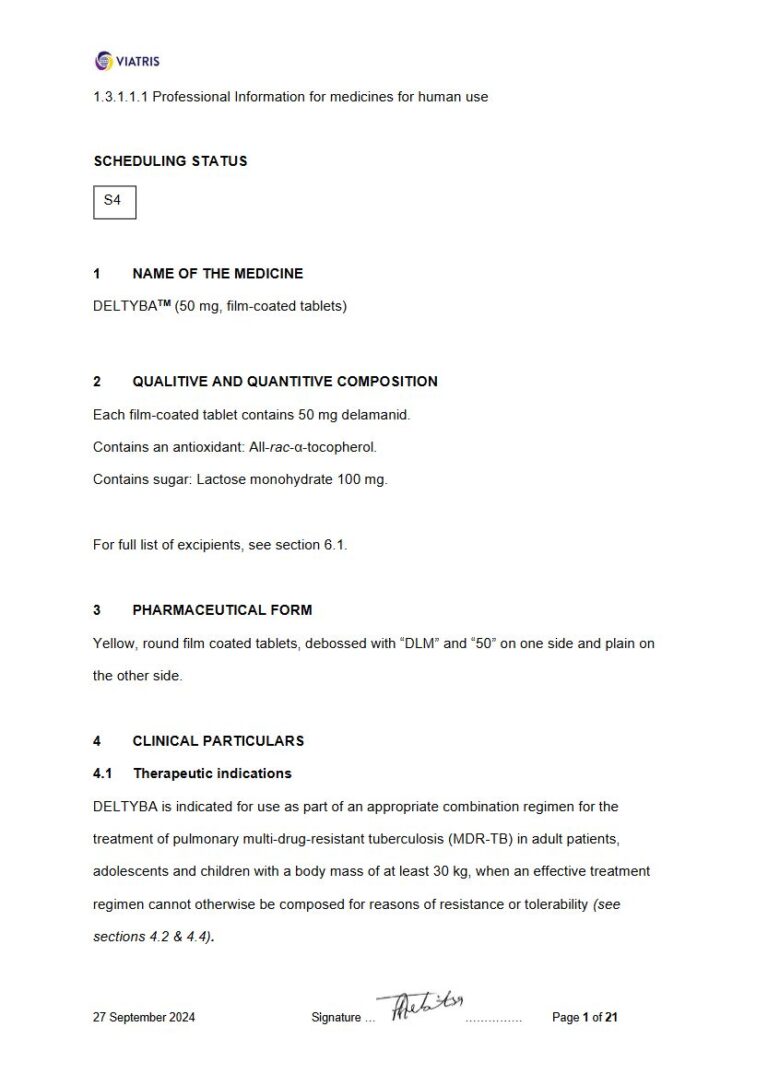
4.1 Therapeutic indications
DELTYBA is indicated for use as part of an appropriate combination regimen for the treatment of pulmonary multi-drug-resistant tuberculosis (MDR-TB) in adult patients, adolescents and children with a body mass of at least 30 kg, when an effective treatment regimen cannot otherwise be composed for reasons of resistance or tolerability (see sections 4.2 & 4.4).
4.2 Posology and method of administration
Posology
The recommended dose for adults is 100 mg twice daily for 24 weeks.
Paediatric population
u2022 Adolescents and children with a body weight of 50 kg or above: the recommended dose is 100 mg twice daily for 24 weeks.
u2022 30 kg or above and less than 50 kg: the recommended dose is 50 mg twice daily for 24 weeks.
DELTYBA must always be administered as part of an appropriate combination regimen for the treatment of multidrug-resistant tuberculosis (MDR-TB), preferably by Direct Observed Therapy (DOT).
Special populations
Elderly patients (> 65 years of age)
Safety and efficacy have not been established in older patients.
Renal impairment
No dose adjustment is considered necessary in patients with mild or moderate renal impairment. There is no data on the use of DELTYBA in patients with severe renal impairment and its use is not recommended.
Hepatic impairment
No dose adjustment is considered necessary in patients with mild hepatic impairment. DELTYBA is not recommended in patients with moderate to severe hepatic impairment (see section 4.3).
Paediatric population
The safety and efficacy of DELTYBA in children with a body weight below 30 kg have not yet been established. Currently available data are described in sections 4.8, 5.1 and 5.2 but no recommendation posology can be made.
Method of administration
Oral use. DELTYBA should be taken with food.
4.3 Contraindications
- Hypersensitivity to delamanid or any of the excipients.
- Serum albumin < 2,8 g/dL.
- Severe hepatic impairment.
- Cardiac failure.
- Uncontrolled brady- or tachydysrhythmias.
- Congenital QT prolongation.
- Concomitant use with medicines known to prolong the QTc interval to time intervals known to induce serious dysrhythmias.
- Patients taking medicines that are strong inducers of CYP3A4 (e.g. carbamazepine).
4.4 Special warnings and precautions for use
There is no data on treatment with DELTYBA for more than 24 consecutive weeks. There is no clinical data on the use of DELTYBA to treat:
- extra pulmonary tuberculosis (e.g. central nervous system, bone);
- infections due to Mycobacterial species other than those of the M. tuberculosis complex;
- latent infection with M. tuberculosis.
There is no clinical data on the use of DELTYBA as part of combination regimens used to treat drug-susceptible M. tuberculosis.
Resistance to delamanid
Delamanid must only be used in an appropriate combination regimen for MDR-TB treatment to prevent development of resistance to delamanid.
QT prolongation
u2022 QT interval prolongation has been observed in patients treated with delamanid.
u2022 This prolongation increases slowly over time in the first 6-10 weeks of treatment and remains stable thereafter. QTc prolongation is very closely correlated with the major delamanid metabolite DM-6705.
u2022 Plasma albumin and CYP3A4 regulate the formation and metabolism of DM-6705 respectively (see Special Considerations below).
General recommendations
u2022 It is recommended that electrocardiograms (ECG) should be obtained before initiation of treatment and monthly during the full course of treatment with delamanid.
u2022 If a QTcF >500 ms is observed either before the first dose of delamanid or during delamanid treatment or a QTcF interval increase of > 60 ms from the baseline with treatment, treatment with delamanid should either not be started or should be discontinued.
u2022 If the QTc interval duration exceeds 450/470 ms for male/female patients during delamanid treatment, these patients should be administered more frequent ECG monitoring.
u2022 It is also recommended that serum electrolytes, e.g. potassium, are obtained at baseline and corrected if abnormal.
Special considerations
Cardiac risk factors
Treatment with DELTYBA should not be initiated in patients with the following risk factors:
u2022 Known congenital prolongation of the QTc-interval or any clinical condition known to prolong the QTc interval or QTc > 500 ms (see section 4.3).
u2022 History of symptomatic cardiac dysrhythmias or with clinically relevant bradycardia (see section 4.3).
u2022 Any predisposing cardiac conditions for dysrhythmia such as severe hypertension, left ventricular hypertrophy (including hypertrophic cardiomyopathy) or congestive cardiac failure accompanied by reduced left ventricle ejection fraction (see section 4.3).
u2022 Electrolyte disturbances, particularly hypokalaemia, hypocalcaemia or hypomagnesaemia.
u2022 Taking medicines that are known to prolong the QTc interval. These include (but are not limited to):
- Antidysrhythmics (e.g. amiodarone, disopyramide, dofetilide, ibutilide, procainamide, quinidine, hydroquinidine, sotalol).
- Neuroleptics (e.g. phenothiazines, sertindole, sultopride, chlorpromazine, haloperidol, mesoridazine, pimozide, or thioridazine), antidepressive medicines.
- Certain antimicrobial medicines, including e.g.:
o macrolides (e.g. erythromycin, clarithromycin);
o moxifloxacin, sparfloxacin or other fluoro-quinolones);
o bedaquiline;
o triazole antifungal medicines;
o pentamidine;
o saquinavir.
- Certain non-sedating antihistamines (e.g. terfenadine, astemizole, mizolastine).
- Certain antimalarials with QT-prolonging potential (e.g. halofantrine, quinine, chloroquine, artesunate/amodiaquine, dihydroartemisinin/piperaquine).
u2022 Cisapride, droperidol, domperidone, bepridil, diphemanil, probucol, levomethadyl, methadone, vinca alkaloids, arsenic trioxide.
Hypoalbuminaemia
u2022 The presence of hypoalbuminaemia is associated with an increased risk of prolongation of the QTc interval in DELTYBA treated patients.
u2022 DELTYBA is contraindicated in patients with albumin < 2,8 g/dL (see section 4.3).
u2022 Patients who commence DELTYBA with serum albumin < 3,4 g/dL or experience a fall in serum albumin into this range during treatment should receive very frequent monitoring of ECGs throughout the full DELTYBA treatment period.
Co-administration with strong inhibitors of CYP3A4
u2022 Co-administration of delamanid with a strong inhibitor of CYP3A4 (lopinavir/ritonavir) was associated with a 30 % higher exposure to the metabolite DM-6705, which has been associated with QTc prolongation.
u2022 Therefore, if co-administration of delamanid with any strong inhibitor of CYP3A4 is considered necessary it is recommended that there is very frequent monitoring of ECGs, throughout the full delamanid treatment period.
Co-administration of delamanid with quinolones
u2022 All QTcF prolongations above 60 ms were associated with concomitant fluoroquinolone use.
u2022 Therefore, if co-administration is considered to be unavoidable in order to construct an adequate treatment regimen for MDR-TB it is recommended that there is very frequent monitoring of ECGs throughout the full delamanid treatment period.
Hepatic impairment
u2022 Deltyba is not recommended in patients with moderate and contraindicated in patients with severe hepatic impairment (see section 4.3).
Metabolism and elimination
u2022 The complete metabolic profile of delamanid in man has not yet been fully elucidated. Therefore, the potential for interactions of clinical significance to occur with delamanid and the possible consequences, including the total effect on the QTc interval, cannot be predicted with confidence.
Lactose warning: DELTYBA contains lactose monohydrate that may have an effect on the glycaemic control of patients with diabetes mellitus. Consequently, patients with rare hereditary problems of galactose intolerance (e.g. galactosaemia), total lactase deficiency, or glucose-galactose malabsorption should not be treated with DELTYBA.
4.5 Interaction with other medicines and other forms of Interaction
Effects of other medicines on Deltyba:
u2022 Cytochrome P450 3A4 inducers
Clinical interactions studies in healthy subjects indicated a reduced exposure to DELTYBA, of up to 45 % following 15 days of concomitant administration of the strong inducer of cytochrome P450 (CYP) 3A4 (Rifampicin 300 mg daily) with DELTYBA (200 mg daily). No clinically relevant reduction in DELTYBA exposure was observed with the weak inducer efavirenz when administered at a dose of 600 mg daily for 10 days in combination with DELTYBA 100 mg twice daily.
u2022 Anti-HIV medicines
In clinical interaction studies in healthy subjects, DELTYBA was administered alone (100 mg twice daily) and with tenofovir disoproxil (245 mg daily) or lopinavir/ritonavir (400/100 mg daily) for 14 days and with efavirenz for 10 days (600 mg daily). DELTYBA exposure remained unchanged (< 25 % difference) with anti-HIV medicines tenofovir disoproxil and efavirenz but was slightly increased with the combination anti-HIV medicines containing lopinavir/ritonavir.
Effects of DELTYBA on other medicines:
In-vitro studies showed that DELTYBA did not inhibit CYP450 isozymes. In-vitro studies showed that DELTYBA and metabolites did not have any effect on the transporters MDR1(pgp), BCRP, OATP1, OATP3, OCT1, OCT2, OATP1B1, OATP1B3 and BSEP, at concentrations of approximately 5 to 20-fold greater than the C max at steady state. However, since the concentrations in the gut can potentially be much greater than these multiples of the C max, there is a potential for DELTYBA to have an effect on these transporters.
u2022 Anti-Tuberculosis medicines
In a clinical interaction study in healthy subjects, DELTYBA was administered alone (200 mg daily) and with rifampicin/isoniazid/pyrazinamide (300/720/1800 mg daily) or ethambutol (1100 mg daily) for 15 days. Exposure of concomitant anti-TB medicines (rifampicin/isoniazid/pyrazinamide) was not affected. Co-administration with DELTYBA significantly increased steady state plasma concentrations of ethambutol by approximately 25 %, the clinical relevance is unknown.
u2022 Anti-HIV medicines
In a clinical interaction study in healthy subjects, delamanid was administered alone (100 mg twice daily) and tenofovir disoproxil (245 mg daily), lopinavir/ritonavir (400/100 mg daily) for 14 days and with efavirenz for 10 days (600 mg daily). Delamanid given in combination with the anti-HIV-medicines, tenofovir disoproxil, lopinavir/ritonavir and efavirenz, did not affect the exposure to these medicines.
u2022 Medicines with the potential to prolong QTc
Care must be taken in using DELTYBA in patients already receiving medicines associated with QT interval prolongation. Co-administration of moxifloxacin and DELTYBA in MDR-TB patients has not been studied. Moxifloxacin is not recommended for use in patients treated with DELTYBA (see section 4.3).
4.6 Fertility, pregnancy and lactation
Safety in pregnancy and lactation has not been established.
Pregnancy
DELTYBA should not be used in pregnant women. There are no or a limited amount of data from the use of DELTYBA in pregnant women. Studies in animals have shown reproductive toxicity.
Deltyba is not recommended in pregnancy and in women of childbearing potential not using contraception.
Lactation
It is unknown whether delamanid/metabolites are excreted in human milk. Available pharmacokinetic/toxicological data in animals have shown excretion of delamanid and/or its metabolites in milk. A risk to the newborns/infants cannot be excluded. It is recommended that women should not breastfeed during treatment with DELTYBA.
Fertility
DELTYBA had no effect on male or female fertility in animals. There are no clinical data on the effects of delamanid on fertility in humans.
4.7 Effects on ability to drive and use machines
DELTYBA may cause adverse reactions such as headaches and tremors and may have no or negligible effect on mental and/or physical abilities to perform or execute tasks or activities requiring mental alertness, judgment and/or sound coordination and vision. Patients should not drive, use machinery or perform any tasks that require concentration, until they are certain that DELTYBA does not adversely affect their ability to do so (see section 4.8).
4.8 Undesirable effects
a. Summary of the safety profile
The most frequently observed adverse drug reactions in patients treated with delamanid + Optimised Background Regimen (OBR) (i.e. incidence > 10 %) are nausea (32,9 %), vomiting (29,9 %), headache (27,6 %), insomnia (27,3 %), dizziness (22.4 %), tinnitus (16,5 %), hypokalaemia (16,2 %), gastritis (15,0 %), decreased appetite (13,1 %), and asthenia (11,3 %).
Tabulated list of adverse reactions
The list of adverse drug reactions and frequencies are based on the results from 2 double-blind placebo-controlled clinical trials (delamanid plus OBR, n = 662 vs placebo plus OBR n = 330). The adverse drug reactions are listed by MedDRA System Organ Class and Preferred Term. Within each System Organ Class, adverse reactions are listed under frequency categories of very common (u22651/10), common (u22651/100 to <1/10), uncommon (u22651/1,000 to <1/100), rare (u22651/10,000 to <1/1,000), very rare (<1/10,000) and not known (cannot be estimated from the available data). Within each frequency grouping, adverse reactions are presented in order of decreasing seriousness.
Tabulated list of adverse reactions
System Organ Class
Frequency very common
Frequency common
Frequency uncommon
Infections and infestations
Herpes zoster
Oropharyngeal candidiasis
Tinea versicolor*
Blood and lymphatic system disorders
Reticulocytosis
Anaemia*
Eosinophilia*
Leukopenia
Thrombocytopenia
Endocrine disorders
Hypothyroidism (hypothyroidism, primary hypothyroidism)
Metabolism and nutrition disorders
Hypokalaemia
Decreased appetite
Hyperuricaemia*
Hypertriglyceridaemia
Dehydration
Hypocalcaemia
Hypercholesterolaemia
Psychiatric disorders
Insomnia
Psychotic disorder
Agitation
Anxiety and anxiety disorder
Depression and depressed mood
Restlessness
Hallucinations
Aggression
Persecutory type delusional disorder
Panic disorder
Adjustment disorder with depressed mood
Neurosis
Dysphoria
Mental disorder
Sleep disorder
Increased libido*
Nervous system disorders
Dizziness*
Headache
Paraesthesia
Tremor
Peripheral neuropathy
Somnolence*
Hypoaesthesia
Lethargy
Balance disorder
Radicular pain
Poor quality sleep
Eye disorders
Dry eye*
Photophobia
Allergic conjunctivitis *
Ear and labyrinth disorders
Tinnitus
Ear pain
Cardiac disorders
Palpitations
First degree atrioventricular block
Ventricular extrasystoles*
Supraventricular extrasystoles
Vascular disorders
Hypertension
Hypotension
Haematoma*
Hot flushes*
Respiratory, thoracic and mediastinal disorders
Haemoptysis
Dyspnoea
Cough
Oropharyngeal pain
Throat irritation
Dry throat*
Rhinorrhoea*
Gastro-intestinal disorders
Vomiting
Diarrhoea*
Nausea
Upper abdominal pain
Gastritis*
Constipation*
Abdominal pain
Lower abdominal pain
Dyspepsia
Abdominal discomfort
Dysphagia
Oral paraesthesia
Abdominal tenderness*
Hepatobiliary disorders
Abnormal hepatic function
Skin and sub-cutaneous tissue disorders
Dermatitis
Urticaria
Pruritic rash *
Pruritus*
Maculopapular rash*
Rash*
Acne
Hyperhidrosis
Alopecia*
Eosinophilic pustular folliculitis*
Generalised pruritus *
Erythematous rash
Musculoskeletal and connective tissue disorders
Arthralgia*
Myalgia*
Osteochondrosis
Muscular weakness
Musculoskeletal pain*
Flank pain
Pain in extremity
Muscle spasms
Renal and urinary disorders
Haematuria*
Urinary retention
Dysuria*
Nocturia
General disorders and administration site conditions
Asthenia
Pyrexia*
Chest pain
Malaise
Chest discomfort*
Peripheral oedema *
Feeling hot
Investigations
Electrocardiogram QT prolonged
Increased blood cortisol
Electrocardiogram ST segment depression
Increased transaminases*
Prolonged activated partial thromboplastin time *
Increased gammaglutamyltransferase *
Decreased blood cortisol
Increased blood pressure
* The frequency for these events was lower for the combined DELTYBA plus OBR group in comparison to the placebo plus OBR group
Description of selected adverse reactions
ECG QT interval prolongation
In patients receiving 200 mg delamanid total daily dose in the phase 2 and 3 trials, the mean placebo corrected increase in QTcF from baseline ranged from 4,7 u2013 7,6 ms at 1 month and 5,3 ms u2013 12,1 ms at 2 months, respectively. The incidence of a QTcF interval > 500 ms ranged from 0,6 % (1/161) u2013 2,1 % (7/341) in patients receiving delamanid 200 mg total daily dose, while the incidence of QTcF change from baseline > 60ms ranged from 3,1 % (5/161) u2013 10,3 % (35/341) in patients receiving delamanid 200 mg total daily dose.
Palpitations
For patients receiving 100 mg DELTYBA + OBR twice daily, the frequency was 8,1 % (frequency category common).
Paediatric population
Based on a study in 13 children and adolescents aged 6 u2013 17 years, the frequency, type and severity of adverse reactions in children are expected to be the same as in adults. Clinical study safety data are not available for children under 6 years.
Hallucinations have been reported predominantly in paediatric patients during post-marketing studies.
4.9 Overdose
u2022 An overdose may precipitate side effects and may increase the severity thereof (see section 4.8).
u2022 Treatment of overdose should involve immediate measures to remove DELTYBA from the gastrointestinal tract and symptomatic and supportive care as required.
u2022 Frequent ECG monitoring should be performed.
