
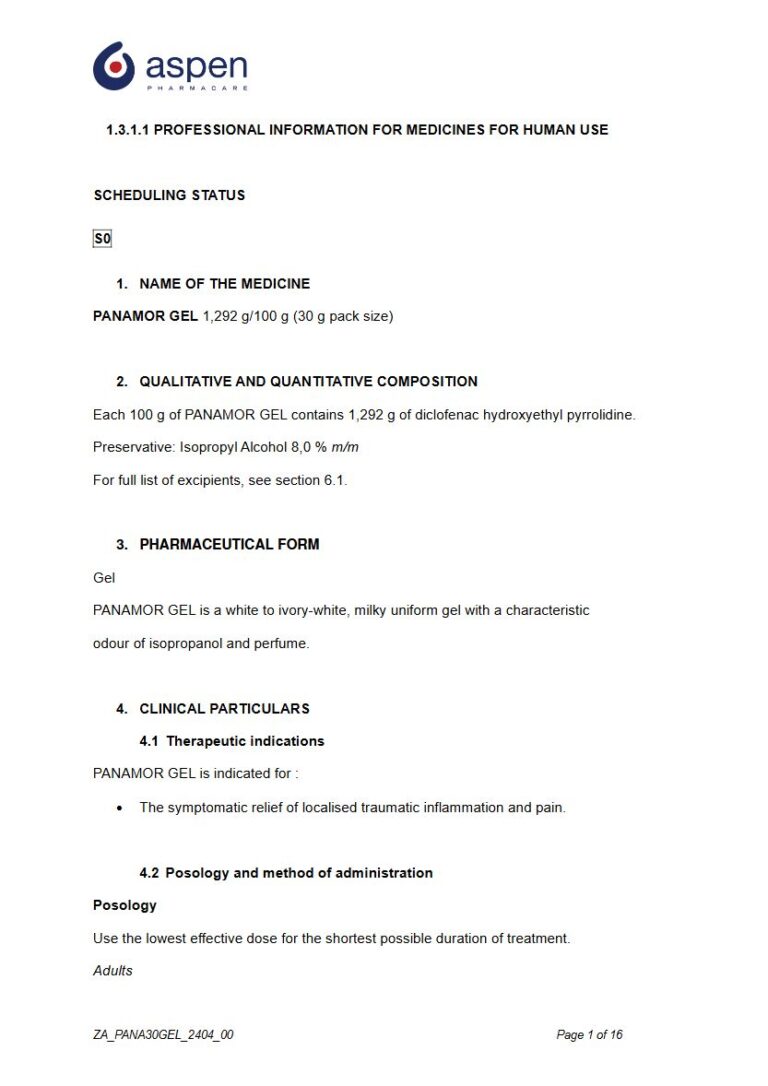
Panamor Gel 1,292 g/100 g Gel
PDF Leaflet Revision Date: 28 April 2024
Clinical Summary
Quick overview from the medicine insert
Indication
Symptomatic relief of localized traumatic inflammation and pain.
Dosage (summary)
Apply 2 g to 4 g (1 to 2 fingertips) 3 to 4 times daily.
Special Populations
- Elderly
- Children under 14 years
Pregnancy & Breastfeeding
Contraindicated in pregnancy and lactation; safety not established.
Key Drug Interactions
- Diuretics
- ACE inhibitors
- Lithium
- Digoxin
- Anticoagulants
Contraindications
- Hypersensitivity to diclofenac or NSAIDs
- Concomitant oral NSAIDs
- Porphyria
- Heart failure
- Gastrointestinal ulceration
Common side effects
- Headache
- Dizziness
- Skin rash
- Gastrointestinal issues
Counselling Points
- Apply only to intact skin
- Wash hands after application
- Avoid sunlight exposure
Serious warnings
- Serious skin reactions
- Gastrointestinal perforation
- Cardiovascular events
Important Disclaimer
The Panamor Gel 1,292 g/100 g Gel professional information leaflet below is the property of Pharmacare and is provided on Medinsert exactly as issued, with no.. alterations or editorial changes. We make every effort to keep content current by updating documents as soon as new versions become available. Medinsert serves as a trusted access point for healthcare professionals, but does not replace official sources or clinical judgement. For more details, please read our full disclaimer. read more>>
 Healthcare Professionals Only
This content is for registered healthcare professionals
Sign in or create a free account to read the full package insert.
Free for HPCSA-registered professionals. Powered by Medinsert.
Clinical Particulars
Section 4 of the official insert — extracted exactly as issued, no alterations
4.1 Therapeutic indications
PANAMOR GEL is indicated for :
- The symptomatic relief of localised traumatic inflammation and pain.
4.2 Posology and method of administration
Posology
Use the lowest effective dose for the shortest possible duration of treatment.
Adults
Depending on the size of the affected area, apply 2 g to 4 g PANAMOR GEL (1 to 2 fingertips) 3 to 4 times daily. The gel should then be rubbed in gently or massaged into the skin in case of muscular pain. After application, the hands should be washed, unless they are the site being treated. Patients should consult their doctor if the condition does not improve or worsens within 7 days of starting treatment. The duration of treatment depends on the indication and the response obtained. It is recommended that treatment be reviewed after 2 weeks.
Paediatric population
There are insufficient data on efficacy and safety available for children and adolescents below 14 years of age. In children aged 14 years and over, if this product is required for more than 7 days for pain relief or if the symptoms worsen the patient/parents of the adolescent is/are advised to consult a doctor.
Method of administration
Topical application
4.3 Contraindications
PANAMOR GEL is contraindicated in:
- Patients with hypersensitivity to diclofenac, acetylsalicylic acid (aspirin) and other non-steroidal anti-inflammatory agents (NSAIDs) or to any of the excipients in PANAMOR GEL (see section 6.1).
- Concomitant use of oral NSAIDs (see section 4.5).
- Concomitant use with other medicines containing diclofenac (see section 4.5).
- Porphyria.
- Patients with heart failure, established ischaemic heart disease and/or cerebrovascular disease (stroke) and peripheral arterial disease.
- Patients with history of gastrointestinal perforation, ulceration, or bleeding (PUBs) related to previous NSAIDs, including PANAMOR GEL.
- Active or history of recurrent gastric ulcer/haemorrhage/perforations.
- Patients with or without chronic asthma in whom attacks of asthma, angioedema, urticaria or acute rhinitis are precipitated by aspirin or other NSAIDs.
- Pregnant and lactating women, as safety has not been established (see section 4.4 and 4.6).
4.4 Special warnings and precautions for use
Undesirable effects
Where PANAMOR GEL is applied to relatively large areas of skin and over a prolonged period, the systemic adverse effects may occur. If they persist or are troublesome, the preparation must be discontinued.
Hypersensitivity reactions
Despite the topical application of the medicine, hypersensitivity reactions of the skin and mucous membranes e.g. asthma, angioedema and urticaria cannot be ruled out in patients who are allergic to diclofenac or certain additives. Patients suffering from asthma (intrinsic) or chronic urticaria are particularly prone to reactions.
Hypertension, heart failure and or cardiovascular events
Caution is required in patients with a history of hypertension and/or heart failure as fluid retention and oedema have been reported in association with PANAMOR GEL therapy. In view of PANAMOR GELu2019s inherent potential to cause fluid retention, heart failure may be precipitated in some compromised patients. Caution is required in patients with significant risk factors for cardiovascular events (e.g. hypertension, hyperlipidaemia, diabetes mellitus, smoking) and should only be treated with diclofenac after careful consideration.
Gastrointestinal perforations/ disease
Elderly: The elderly have an increased frequency of adverse reactions to NSAIDs, including PANAMOR GEL, especially gastrointestinal perforation, ulceration, or bleeding (PUBs) which may be fatal. The risk of gastrointestinal perforation, ulceration, or bleeding (PUBs) is higher with increasing doses of PANAMOR GEL, in patients with a history of ulcers, and the elderly. When gastrointestinal bleeding or ulceration occurs in patients using PANAMOR GEL, treatment with PANAMOR GEL should be stopped. PANAMOR GEL should be given with caution to patients with a history of gastrointestinal disease (e.g. ulcerative colitis, Crohnu2019s disease, hiatus hernia, gastro-oesophageal reflux disease, angiodysplasia) as these conditions may be exacerbated.
Stevens-Johnson Syndrome and Toxic Epidermal Necrolysis
Serious skin reactions, some of them fatal, including exfoliative dermatitis, Stevens-Johnson syndrome (SJS), and toxic epidermal necrolysis (TEN) have been reported (see section 4.8). PANAMOR GEL should be discontinued at the first appearance of skin rash, mucosal lesions, or any other sign of hypersensitivity. The risk of occurrence of these reactions is higher at the beginning of the treatment and in most cases these reactions are manifested during the first month of treatment. Concomitant use of oral NSAID's should be cautioned as the incidence of untoward effects, particularly systemic undesirable effects, may increase.
Monitoring
During prolonged treatment with PANAMOR GEL, blood counts and monitoring of hepatic and renal function are indicated as precautionary measures.
Use in pregnancy
PANAMOR GEL is contraindicated in pregnancy and lactation (see section 4.3 and 4.6).
Bronchial asthma
Like other medicines that inhibit prostaglandin synthetase activity, diclofenac as in PANAMOR GEL, and other NSAIDs can precipitate bronchospasm if administered to patients suffering from or with a previous history of, bronchial asthma.
Hypokalaemia
Risk of renal tubular acidosis and hypokalaemia are associated with NSAID usage.
General
PANAMOR GEL should be applied only to intact non-diseased skin surfaces, and not to skin wounds or open injuries. It should not be allowed to come into contact with the eyes or with mucous membranes. PANAMOR GEL should not be taken by mouth. Patients should be warned against excessive exposure to sunlight in order to reduce the incidence of photosensitivity. PANAMOR GEL can be used with non-occlusive bandages but should not be used with an airtight occlusive dressing. Occlusion can lead to an increase in the amount of diclofenac, as in PANAMOR GEL, absorbed and may thus cause an increase in undesirable effects.
4.5 Interactions with other medicines
Since systemic absorption of diclofenac from a topical application of PANAMOR GEL is very low, such interactions are very unlikely.
Diuretics, angiotensin converting enzyme inhibitors (ACE inhibitors) and Angiotensin II Antagonists (AAII): NSAIDs, such as diclofenac, as in PANAMOR GEL, may decrease the effectiveness of diuretics and other antihypertensive medicines. In some patients with impaired renal function (e.g., dehydrated patients or elderly with impaired renal function) the co-administration of an ACEI or AAII and cyclooxygenase inhibitor medicines may result in the progression of renal function deterioration, including the possibility of acute renal insufficiency, which is usually reversible. The occurrence of these interactions should be considered in patients applying diclofenac, as in PANAMOR GEL, particularly if in large areas of the skin and for prolonged periods, in combination with ACEI or AAII. Consequently, diclofenac combination should be used with caution, especially in elderly patients. Patients should be properly hydrated and the need to monitor the renal function after the beginning of the concomitant therapy and periodically thereafter should be analysed.
Diuretics: Various NSAIDs are liable to inhibit the activity of diuretics. Concomitant treatment with potassium-sparing diuretics may be associated with increased serum potassium levels, hence serum potassium should be monitored.
Anti-hypertensives: Concomitant use of NSAIDs with antihypertensive medicines (i.e. beta-blockers, angiotensin converting enzyme (ACE) inhibitors, diuretics) may cause a decrease in their antihypertensive effect via inhibition of vasodilatory prostaglandin synthesis.
Interactions experienced with systemically absorbed diclofenac
Lithium: When used concomitantly with lithium, NSAIDs like PANAMOR GEL raise the concentration of lithium in the blood. Lithium levels should be monitored more frequently.
Digoxin: Diclofenac may increase plasma concentrations of digoxin.
Other NSAIDs and corticosteroids
NSAIDs: Use of two or more NSAIDs concomitantly could result in an increase in side effects.
Corticosteroids: Increased risk of gastrointestinal perforation, ulceration, or bleeding (PUBs).
Anti-coagulants and anti-platelet medicines
The bioavailability of PANAMOR GEL is reduced by acetylsalicylic acid, (aspirin) and that of acetylsalicylic acid (aspirin), by PANAMOR GEL, when the two medicines are administered together. PANAMOR GEL may enhance the effects of anti-coagulants such as warfarin. Anti-platelet medicines may increase risk of gastrointestinal bleeding.
Selective serotonin re-uptake inhibitors (SSRIs): Selective serotonin re-uptake inhibitors (SSRIs) may increase risk of gastrointestinal bleeding.
Quinolone antimicrobials: Convulsions may occur due to an interaction between quinolones and NSAIDs, as in PANAMOR GEL. This may occur in patients with or without a previous history of epilepsy or convulsions. Therefore, caution should be exercised when considering the use of a quinolone in patients who are already receiving an NSAID.
Mifepristone: NSAIDs should not be used for 8 to12 days after mifepristone administration as NSAIDs can reduce the effects of mifepristone.
4.6 Fertility, pregnancy and lactation
Pregnancy
PANAMOR GEL, should not be used during pregnancy, as safety and efficacy in pregnancy has not been established (see section 4.3). For NSAIDs, such as PANAMOR GEL, with systemic uptake: Inhibition of prostaglandin synthesis may adversely affect the pregnancy and/or the embryo/foetal development. An increased risk of miscarriage and of cardiac malformation and gastroschisis has been reported after use of a prostaglandin synthesis inhibitor in early pregnancy. The risk is believed to increase with dose and duration of therapy.
Use of NSAIDs during the third trimester of pregnancy may result in premature closure of the foetal ductus arteriosus in utero and possibly in persistent pulmonary hypertension of the newborn. The onset of labour may be delayed, and its duration increased. Use of NSAIDs, such as PANAMOR GEL, around 20 weeks gestation or later in pregnancy may cause a rare but serious foetal renal dysfunction leading to oligohyramnios and, in some cases, neonatal renal impairment. Complications of prolonged oligohydramnios include limb contractures and delayed lung maturation, which may require invasive procedures such as exchange transfusion or dialysis, in some cases.
Breastfeeding
Diclofenac passes into breast milk in small amounts. PANAMOR GEL should not be used during lactation, as safety and efficacy in lactation has not been established (see section 4.3).
Fertility
There are no data available on the use of topical formulations of diclofenac, such as PANAMOR GEL, and its effect on fertility in humans.
4.7 Effects on ability to drive and use machines
Cutaneous application of PANAMOR GEL has no or negligible influence on the ability to drive and use machines. Since adverse reactions such as dizziness and headache have been reported in patients using PANAMOR GEL, patients should not drive, use machinery, or perform any tasks that require concentration, until they are certain that PANAMOR GEL does not adversely affect their ability to do so (see section 4.8).
4.8 Undesirable effects
a) Tabulated list of adverse reactions
System organ class
Frequent
Less frequent
Frequency unknown (cannot be estimated from the available data)
Infections and infestations
Pustular rash
Blood and lymphatic system disorders
Bone marrow suppression, (leucopenia, thrombocytopenia, aplastic anaemia)
Immune system disorders
Hypersensitivity reactions (bronchospasm, anaphylactic/anaphylactoid systemic reactions including urticaria), angioedema
Nervous system disorders
Headache, slight dizziness
Cardiac disorders
Peripheral oedema, cardiac failure
Vascular disorders
Hypertension
Respiratory, thoracic, and mediastinal disorders
Asthma
Gastrointestinal disorders*
Peptic ulcers, gastritis, perforation vomiting, flatulence, constipation, dyspepsia, abdominal pain, melaena, haematemesis, ulcerative stomatitis, exacerbation of colitis and Crohnu2019s disease
Gastrointestinal ulceration or haemorrhage, sometimes fatal
Eructation, epigastric pain, nausea, diarrhoea
Hepato-biliary disorders
Jaundice, hepatitis
Elevated transaminase levels
Skin and subcutaneous tissue disorders
Skin rash, eczema, erythema, dermatitis (including contact dermatitis), pruritus
Bullous dermatitis including Stevens-Johnson syndrome (SJS) and toxic epidermal necrolysis (TEN), photosensitivity reactions
Burning sensation at the application site, dry skin, itching, reddening, or smarting of the skin, urticaria, desquamation, skin discolouration
Renal and urinary disorders
Renal failure, nephrotic syndrome
Reporting of suspected adverse reactions
Reporting suspected adverse reactions after authorisation of the medicine is important. It allows continued monitoring of the benefit/risk balance of the medicine. Health care providers are requested to report any suspected adverse drug reactions to SAHPRA via the Med Safety APP (Medsafety X SAHPRA) and eReporting platform (who-umc.org) found on SAHPRA website. Aspen Pharmacare: E-mail: [email protected] Tel: 0800 118 088/ +27 (0)11 239-6200
4.9 Overdose
Symptoms
The low systemic absorption of topical diclofenac renders overdoses very unlikely. However, undesirable effects similar to those observed following an overdose of diclofenac containing tablets can be expected if topical diclofenac preparations, such as PANAMOR GEL is inadvertently ingested.
Treatment
Treatment is symptomatic and supportive. In the event of significant systemic adverse events occurring as a result of improper use, accidental ingestion or overdosage (e.g. in children), general therapeutic measures of the kind normally adopted in order to treat poisoning with non-steroidal anti-inflammatory agents should be resorted to. The use of activated charcoal should be considered, especially within a short time of ingestion.
