
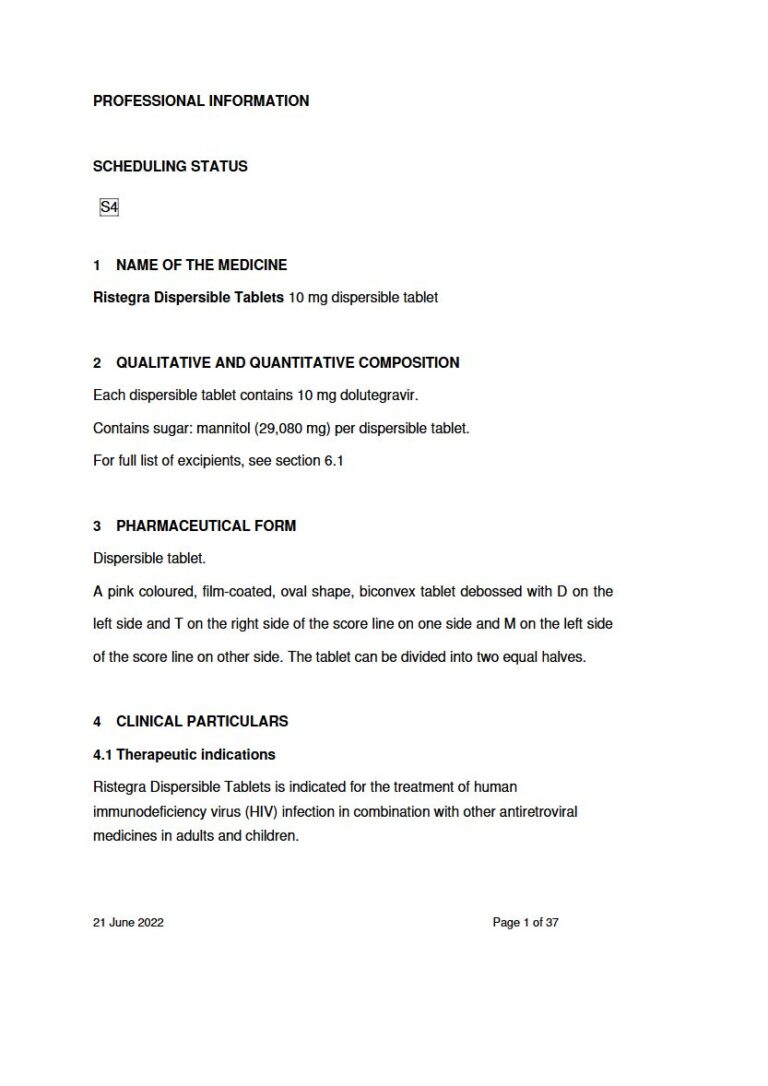
Ristegra Dispersible 10 mg Dispersible Tablets
PDF Leaflet Revision Date: 21 June 2022
Clinical Summary
Quick overview from the medicine insert
Indication
Treatment of HIV infection in combination with other antiretroviral medicines.
Dosage (summary)
Adults: 30 mg once daily or twice daily if resistant. Children: Dosing based on weight.
Special Populations
- Elderly
- Renal impairment
- Hepatic impairment
Pregnancy & Breastfeeding
Contraindicated in first trimester; use with caution in pregnancy and breastfeeding.
Key Drug Interactions
- Etravirine, Efavirenz, Nevirapine, Rifampicin, Carbamazepine
Contraindications
- Hypersensitivity to dolutegravir
- Severe hepatic impairment
- Co-administration with dofetilide and pilsicainide
Common side effects
- Insomnia
- Headache
- Nausea
- Rash
- Fatigue
Counselling Points
- Take with or without food.
- Monitor for signs of hypersensitivity.
- Use effective contraception in women of childbearing potential.
Serious warnings
- Hypersensitivity reactions
- Immune Reconstitution Syndrome
- Osteonecrosis
Important Disclaimer
The Ristegra Dispersible 10 mg Dispersible Tablets professional information leaflet below is the property of Mylan and is provided on Medinsert exactly as issued, with no.. alterations or editorial changes. We make every effort to keep content current by updating documents as soon as new versions become available. Medinsert serves as a trusted access point for healthcare professionals, but does not replace official sources or clinical judgement. For more details, please read our full disclaimer. read more>>
 Healthcare Professionals Only
This content is for registered healthcare professionals
Sign in or create a free account to read the full package insert.
Free for HPCSA-registered professionals. Powered by Medinsert.
Clinical Particulars
Section 4 of the official insert — extracted exactly as issued, no alterations
4.1 Therapeutic indications
Ristegra Dispersible Tablets is indicated for the treatment of human immunodeficiency virus (HIV) infection in combination with other antiretroviral medicines in adults and children.
4.2 Posology and method of administration
Posology: Ristegra Dispersible Tablets should be prescribed by medical practitioners experienced in the management of HIV infection. Dolutegravir is also available as film-coated tablets. The bioavailability of film-coated tablets and dispersible tablets is not comparable therefore they must not be used as direct replacements (see section 5.2). For example, the recommended adult dose for film-coated tablets is 50 mg versus 30 mg for dispersible tablets. Patients changing between film-coated and dispersible tablets should follow the dosing recommendations that are specific for the formulation.
Ristegra Dispersible Tablets 10 mg:
Adults:
- Patients infected with HIV-1 without resistance to the integrase class: The recommended dose of Ristegra Dispersible Tablets 10 mg is 30 mg once daily.
- Patients infected with HIV-1 with resistance to the integrase class (documented or clinically suspected): The recommended dose of Ristegra Dispersible Tablets 10 mg is 30 mg twice daily. The decision to use Ristegra Dispersible Tablets 10 mg for such patients should be informed by the integrase resistance pattern.
Adolescents, children and infants aged at least 4 weeks and weighing at least 3 kg:
Patients infected with HIV-1 without resistance to the integrase class: The recommended dose of Ristegra Dispersible Tablets 10 mg is determined according to weight and age and is presented in the table below.
Table 1a Dispersible tablet dose recommendations in adolescents, children and infants aged at least 4 weeks and weighing at least 3 kg
Body Weight (kg) Dose
- 3 to less than 6: 5 mg once daily (taken as one half of a 10 mg dispersible tablet)
- 6 to less than 10 < 6 months: 10 mg once daily (taken as one 10 mg dispersible tablet)
- u2265 6 months: 15 mg once daily (taken as one and a half 10 mg dispersible tablets)
- 10 to less than 14: 20 mg once daily (taken as two 10 mg dispersible tablets)
- 14 to less than 20: 25 mg once daily (taken as two and a half 10 mg dispersible tablets)
- 20 or greater: 30 mg once daily (taken as three 10 mg dispersible tablets)
Dispersible tablet dose recommendations in adolescents, children and infants aged at least 4 weeks and weighing at least 3 kg: There are insufficient safety and efficacy data available to recommend a dose for Ristegra Dispersible Tablets 10 mg in children below age 4 weeks or weighing less than 3 kg.
Patients infected with HIV-1 with resistance to the integrase class: There are insufficient data to recommend a dose for Ristegra Dispersible Tablets 10 mg in integrase inhibitor resistant adolescents, children and infants.
Missed doses: If the patient misses a dose of Ristegra Dispersible Tablets, the patient should take Ristegra Dispersible Tablets as soon as possible, providing the next dose is not due within 4 hours. If the next dose is due within 4 hours, the patient should not take the missed dose and simply resume the usual dosing schedule.
Special populations:
Elderly: There are limited data available on the use of Ristegra Dispersible Tablets 10 mg in patients aged 65 years and over. However, there is no evidence that elderly patients require a different dose than younger adult patients (see section 5.2 Special Patient Populations).
Renal impairment: No dosage adjustment is required in patients with mild, moderate or severe (CrCl < 30 ml/min, not on dialysis) renal impairment. No data are available in subjects receiving dialysis, although differences in pharmacokinetics are not expected in this population (see section 5.2 Special Patient Populations).
Treatment with Ristegra Dispersible Tablets resulted in an early small increase of mean serum creatinine levels by 10-14 % which remained stable over time and is not considered clinically relevant (see section 4.8).
Hepatic impairment: No dosage adjustment is required in patients with mild hepatic impairment (Child-Pugh grade A or B). Ristegra Dispersible Tablets 10 mg is contraindicated in patients with severe hepatic impairment (Child-Pugh grade C) (see section 4.3).
Method of administration: Dispersible tablets: Ristegra Dispersible Tablets can be taken with or without food. The dispersible tablets may be swallowed whole with drinking water or dispersed in drinking water. When dispersed, the amount of water will depend on the number of tablets prescribed. The tablet should not be chewed, cut or crushed.
4.3 Contraindications
- Ristegra Dispersible Tablets is contraindicated in patients with known hypersensitivity to dolutegravir or to any of the excipients of Ristegra Dispersible Tablets (see section 6.1).
- Ristegra Dispersible Tablets is contraindicated in combination with dofetilide and pilsicainide.
- Ristegra Dispersible Tablets is contraindicated in severe hepatic impairment (Child-Pugh grade C). Ristegra Dispersible Tablets is contraindicated in the first trimester of pregnancy (see section 4.6).
4.4 Special warnings and precautions for use
Hypersensitivity reactions: Hypersensitivity reactions have been reported with integrase inhibitors, including Ristegra Dispersible Tablets and were characterised by rash, constitutional findings and sometimes, organ dysfunction, including liver injury. Discontinue Ristegra Dispersible Tablets and other suspect medicines immediately if signs or symptoms of hypersensitivity reactions develop (including, but not limited to, severe rash or rash accompanied by fever, general malaise, fatigue, muscle or joint aches, blisters, oral lesions, conjunctivitis, facial oedema, hepatitis, eosinophilia, angioedema). Clinical status including liver aminotransferases should be monitored and appropriate therapy initiated. Delay in stopping treatment with Ristegra Dispersible Tablets or other suspect medicines after the onset of hypersensitivity may result in a life-threatening reaction.
Lipodystrophy and metabolic abnormalities: Combination antiretroviral therapy has been associated with the redistribution/accumulation of body fat, including central obesity, dorso-cervical fat, enlargement (buffalo hump), peripheral wasting, facial wasting, breast enlargement and elevated serum lipid and glucose levels in HIV (+) patients. Clinical examination should include evaluation for physical signs of fat redistribution. Patients with evidence of lipodystrophy should have a thorough cardiovascular risk assessment.
Immune Reconstitution Syndrome: In HIV-infected patients with severe immune deficiency at the time of initiation of antiretroviral therapy (ART), an inflammatory reaction to asymptomatic or residual opportunistic infections may arise and cause serious clinical conditions, or aggravation of symptoms. Typically, such reactions have been observed within the first few weeks or months of initiation of ART. Relevant examples are tuberculosis, cytomegalovirus retinitis, generalised and/or focal atypical mycobacterial infections and Pneumocystis jiroveci pneumonia (PJP). Any inflammatory symptoms must be evaluated without delay and treatment initiated when necessary. Auto-immune disorders (such as Gravesu2019 disease, polymyositis and Guillain-Barre syndrome) have also been reported to occur in the setting of immune reconstitution, however, the time to onset is more variable and can occur many months after initiation of treatment and sometimes can be an atypical presentation. Liver chemistry elevations consistent with immune reconstitution syndrome were observed in some hepatitis B and/or C co-infected patients at the start of TIVICAY therapy. Monitoring of liver chemistries is recommended in patients with hepatitis B and/or C co-infection. Particular diligence should be applied in initiating or maintaining effective hepatitis B therapy (referring to treatment guidelines) when starting dolutegravir-based therapy in hepatitis B co-infected patients (see section 4.8).
Osteonecrosis: Although the aetiology is considered to be multifactorial (including corticosteroid use, alcohol consumption, severe immunosuppression, high body mass index), cases of osteonecrosis have been reported, particularly in patients with advanced HIV-disease and/or long-term exposure to combination antiretroviral therapy (cART). Patients should be advised to seek medical advice if they experience joint aches and pain, joint stiffness or difficulty in movement.
Hepatic impairment: The unbound fraction of dolutegravir in the blood is doubled in patients with moderate hepatic impairment. Ristegra Dispersible Tablets is contraindicated in patients with moderate or severe hepatic impairment (Child-Pugh grade C) (see section 4.3). The effect of severe hepatic impairment on the pharmacokinetics of dolutegravir have not been studied.
Interactions: Caution should be given to co-administering medicines (prescription and non-prescription) that may change the exposure of Ristegra Dispersible Tablets or medicines that may have their exposure changed by Ristegra Dispersible Tablets (see sections 4.3 and section 4.5). The recommended adult dose of Ristegra Dispersible Tablets should be given twice daily when co-administered with etravirine (without boosted protease inhibitors), efavirenz, nevirapine, tipranavir/ritonavir, rifampicin, carbamazepine, phenytoin, phenobarbitone and St. Johnu2019s wort (see section 4.5). In paediatric patients, the weight-based once daily dose should be administered twice daily. Ristegra Dispersible Tablets should not be co-administered with polyvalent cation-containing antacids. Ristegra Dispersible Tablets is recommended to be administered 2 hours before or 6 hours after these medicines (see section 4.5). Ristegra Dispersible Tablets is recommended to be administered 2 hours before or 6 hours after taking calcium or iron supplements, or alternatively, administered after food. Ristegra Dispersible Tablets increased metformin concentrations. A dose adjustment of metformin should be considered when starting and stopping co-administration of Ristegra Dispersible Tablets with metformin, to maintain glycaemic control.
Co-infection with Hepatitis B or C: In Phase III studies, patients with hepatitis B and/or C co-infection were permitted to enrol provided that baseline liver chemistry tests did not exceed 5 times the upper limit of normal (ULN). Overall, the safety profile in patients co-infected with hepatitis B and/or C was similar to that observed in patients without hepatitis B or C co-infection, although the rates of AST and ALT abnormalities were higher in the subgroup with hepatitis B and/or C co-infection for all treatment groups. Liver chemistry elevations consistent with immune reconstitution syndrome were observed in some subjects with hepatitis B and/or C co-infection at the start of Ristegra Dispersible Tablets therapy, particularly in those whose anti-hepatitis B therapy was withdrawn.
Opportunistic infections: Patients receiving Ristegra Dispersible Tablets or any other antiretroviral therapy may still develop opportunistic infections and other complications of HIV infection. Therefore, patients should remain under close clinical observation by medical practitioners experienced in the treatment of these associated HIV diseases.
Transmission of infection: Patients should be advised that current antiretroviral therapy, including Ristegra Dispersible Tablets, has not been proven to prevent the risk of transmission of HIV to others through sexual contact or blood contamination. Appropriate precautions should continue to be taken.
4.5 Interaction with other medicines and other forms of interaction
Effect of Ristegra Dispersible Tablets on the pharmacokinetics of other medicines: In vitro, dolutegravir demonstrated no direct, or weak inhibition (IC50 > 50 u03bcM) of the enzymes cytochrome P450 (CYP)1A2, CYP2A6, CYP2B6, CYP2C8, CYP2C9, CYP2C19, CYP2D6 CYP3A, uridine diphosphate glucuronosyl transferase (UGT)1A1 or UGT2B7, or the transporters Pgp, BCRP, OATP1B1, OATP1B3, OCT1 or MRP2. In vitro, dolutegravir did not induce CYP1A2, CYP2B6 or CYP3A4. In vivo, dolutegravir did not have an effect on midazolam, a CYP3A4 probe. Based on these data, Ristegra Dispersible Tablets is not expected to affect the pharmacokinetics of medicines that are substrates of these enzymes or transporters (e.g., reverse transcriptase and protease inhibitors, opioid analgesics, antidepressants, statins, azole antifungals (such as fluconazole, itraconazole, clotrimazole), proton pump inhibitors (such as esomeprazole, lansoprazole, omeprazole), anti-erectile dysfunction medicines (such as sildenafil, tadalafil, vardenafil), acyclovir, valacyclovir, sitagliptin, adefovir).
In medicine interaction studies, dolutegravir, as contained in Ristegra Dispersible Tablets did not have a clinically relevant effect on the pharmacokinetics of the following: tenofovir, methadone, efavirenz, lopinavir, atazanavir, darunavir, etravirine, fosamprenavir, rilpivirine, boceprevir, telaprevir, daclatasvir and oral contraceptives containing norgestimate and ethinyl oestradiol.
In vitro, dolutegravir inhibited the renal organic cation transporter 2 (OCT2) (IC50 = 1.93 u03bcM), multidrug and toxin extrusion transporter (MATE) 1 (IC50 = 6,34 u03bcM) and MATE2-K (IC50 = 24,8 u03bcM). Given dolutegraviru2019s in vivo exposure, it has a low potential to affect the transport of MATE2-K substrates in vivo. In vivo Ristegra Dispersible Tablets may increase plasma concentrations of medicines in which excretion is dependent upon OCT2 (dofetilide, pilsicainide or metformin) (see Table 2: Medicine Interactions u2013 Other medicines). In vitro, dolutegravir inhibited the basolateral renal transporters: organic anion transporter (OAT) 1 (IC50 = 2,12 u03bcM) and OAT3 (IC50 = 1,97 u03bcM). However, dolutegravir had no notable effect on the in vivo pharmacokinetics of the OAT substrates tenofovir and para aminohippurate and therefore has low propensity to cause interactions via inhibition of OAT transporters.
Effect of Other Medicines on the Pharmacokinetics of Ristegra Dispersible Tablets: Ristegra Dispersible Tablets is eliminated mainly through metabolism by UGT1A1. Ristegra Dispersible Tablets is also a substrate of UGT1A3, UGT1A9, CYP3A4, Pgp, and BCRP; therefore, medicines that induce those enzymes may theoretically decrease dolutegravir plasma concentration and reduce the therapeutic effect of Ristegra Dispersible Tablets. Co-administration of Ristegra Dispersible Tablets and other medicines that inhibit UGT1A1, UGT1A3, UGT1A9, CYP3A4, and/or Pgp may increase dolutegravir plasma concentration (see Table 2). In vitro, dolutegravir is not a substrate of human organic anion transporting polypeptide (OATP)1B1, OATP1B3, or OCT1, therefore medicines that solely modulate these transporters are not expected to affect dolutegravir plasma concentration. Efavirenz, nevirapine, rifampicin and tipranavir in combination with ritonavir each reduced the plasma concentrations of dolutegravir significantly and require Ristegra Dispersible Tablets dose adjustment to the recommended dose twice daily. There is evidence that the concentration of isoniazid is increased by dolutegravir, as contained in Ristegra Dispersible Tablets. Etravirine also reduced plasma concentrations, but the effect of etravirine was mitigated by co-administration of the CYP3A4 inhibitors lopinavir/ritonavir, darunavir/ritonavir and is expected to be mitigated by atazanavir/ritonavir.
Therefore, no Ristegra Dispersible Tablets dose adjustment is necessary when co-administered with etravirine and either lopinavir/ritonavir, darunavir/ritonavir, or atazanavir/ritonavir. Another inducer, fosamprenavir in combination with ritonavir decreased plasma concentrations of dolutegravir but does not require a dosage adjustment of Ristegra Dispersible Tablets. Caution is warranted and clinical monitoring is recommended when these combinations are given in INI-resistant patients (see Table 2: Medicine Interactions u2013 HIV-1 Antiviral Medicines). A medicine interaction study with the UGT1A1 inhibitor, atazanavir, did not result in a clinically meaningful increase in the plasma concentrations of dolutegravir. Tenofovir, ritonavir, lopinavir/ritonavir, darunavir/ritonavir, rilpivirine, bocepravir, telaprevir, prednisone, rifabutin, and omeprazole had no or a minimal effect on dolutegravir pharmacokinetics, therefore no Ristegra Dispersible Tablets dose adjustment is required when co-administered with these medicines.
Table 2: Medicine Interactions
Concomitant Medicine Class: Medicine Name Effect on Concentration of Ristegra Dispersible Tablets or Concomitant Medicine Clinical Comment
HIV-1 Antiviral Medicines Non-nucleoside Reverse Transcriptase Inhibitor: Etravirine (ETR) without boosted protease inhibitor Dolutegravir u2193 AUC u2193 71 % C max u2193 52 % C u01ac u2193 88 % ETR u2194 Etravirine without boosted protease inhibitors decreased plasma dolutegravir concentration. The recommended dose of Ristegra Dispersible Tablets should be given twice daily when co-administered with etravirine without boosted protease inhibitors. Ristegra Dispersible Tablets should not be used with etravirine without co-administration of atazanavir/ritonavir, darunavir/ritonavir or lopinavir/ritonavir in INI-resistant patients.
Protease Inhibitor: Lopinavir/ritonavir + Etravirine (LPV/RTV + ETR) Dolutegravir u2194 AUC u2191 11 % C max u2191 7 % C u01ac u2191 28 % LPV u2194 RTV u2194 Lopinavir/ritonavir and etravirine did not change dolutegravir plasma concentration to a clinically relevant extent. No dose adjustment is necessary.
Protease Inhibitor: Darunavir/ritonavir + Etravirine Dolutegravir u2193 AUC u2193 25 % C max u2193 12 % C u01ac u2193 36 % DRV u2194 RTV u2194 Darunavir/ritonavir and etravirine did not change dolutegravir plasma concentration to a clinically relevant extent. No dose adjustment is necessary.
Concomitant Medicine Class: Medicine Name Effect on Concentration of Ristegra Dispersible Tablets or Concomitant Medicine Clinical Comment
Non-nucleoside Reverse Transcriptase Inhibitor: Efavirenz (EFV) Dolutegravir u2193 AUC u2193 57 % C max u2193 39 % C u01ac u2193 75 % EFV u2194 Efavirenz decreased dolutegravir plasma concentrations. The recommended dose of Ristegra Dispersible Tablets should be given twice daily when co-administered with efavirenz. Alternative combinations that do not include efavirenz should be used where possible in INI-resistant patients.
Non-nucleoside Reverse Transcriptase Inhibitor: Nevirapine Dolutegravir u2193 Co-administration with nevirapine has the potential to decrease dolutegravir plasma concentration due to enzyme induction and has not been studied. Effect of nevirapine on dolutegravir exposure is likely similar to or less than that of efavirenz. The recommended dose of Ristegra Dispersible Tablets should be given twice daily when co-administered with nevirapine. Alternative combinations that do not include nevirapine should be used where possible in INI-resistant patients.
Protease Inhibitor (PI): Atazanavir (ATV) Dolutegravir u2191 AUC u2191 91 % C max u2191 50 % C u01ac u2191 180 % ATV u2194 Atazanavir increased dolutegravir plasma concentration. No dose adjustment is necessary.
Protease Inhibitor: Atazanavir/ritonavir (ATV + RTV) Dolutegravir u2191 AUC u2191 62 % C max u2191 33 % C u01ac u2191 121 % ATV u2194 RTV u2194 Atazanavir/ritonavir increased dolutegravir plasma concentration. No dose adjustment is necessary.
Concomitant Medicine Class: Medicine Name Effect on Concentration of Ristegra Dispersible Tablets or Concomitant Medicine Clinical Comment
Protease Inhibitor: Tipranavir/ritonavir (TPV+RTV) Dolutegravir u2193 AUC u2193 59 % C max u2193 47 % C u01ac u2193 76 % ATV u2194 RTV u2194 Tipranavir/ritonavir decreases dolutegravir concentrations. The recommended dose of Ristegra Dispersible Tablets should be given twice daily when co-administered with tipranavir/ritonavir. Alternative combinations that do not include tipranavir/ritonavir should be used where possible in INI resistant patients.
Protease Inhibitor: Fosamprenavir/ritonavir (FPV+RTV) Dolutegravir u2193 AUC u2193 35 % C max u2193 24 % C u01ac u2193 49 % FPV u2194 RTV u2194 Fosamprenavir/ritonavir decreases dolutegravir concentrations, but based on limited data, did not result in decreased efficacy in Phase III studies. No dose adjustment is necessary in INI-nau00efve patients. Alternative combinations that do not include fosamprenavir/ritonavir should be used where possible in INI resistant patients.
Protease Inhibitor: Nelfinavir Dolutegravir u2194 This interaction has not been studied. Although an inhibitor of CYP3A4, based on data from other inhibitors, an increase is not expected. No dose adjustment is necessary.
Protease Inhibitor: Lopinavir/ritonavir (LPV+RTV) DTG u2194 AUC u2193 4 % Cmax u2194 6 % LPV u2194 RTV u2194 Lopinavir/ritonavir did not change dolutegravir plasma concentration to a clinically relevant extent. No dose adjustment is necessary.
Protease Inhibitor: Darunavir/ritonavir (DRV/RTV) Dolutegravir u2193 AUC u2193 22 % C max u2193 11 % C u01ac u2193 38 % DRV u2194 RTV u2194 Darunavir/ritonavir did not change dolutegravir plasma concentration to a clinically relevant extent. No dose adjustment is necessary.
Nucleoside Reverse Transcriptase Inhibitor: Tenofovir (TDV) Dolutegravir u2194 AUC u2194 C max u2193 3 % C u01ac u2193 8 % TDV u2194 AUC u2191 12 % C max u2191 9 % C u01ac u2191 19 % Tenofovir did not change dolutegravir plasma concentration to a clinically relevant extent. No dose adjustment is necessary.
Protease Inhibitor: Darunavir/ritonavir + Etravirine (DRV/RTV + ETR) Dolutegravir u2193 AUC u2193 25 % C max u2193 12 % C u01ac u2193 36 % DRV u2194 RTV u2194 Darunavir/ritonavir and etravirine did not change dolutegravir plasma concentration to a clinically relevant extent. No dose adjustment is necessary.
Other Medicines Concomitant Medicine Class: Medicine Name Effect on Concentration of Ristegra Dispersible Tablets or Concomitant Medicine Clinical Comment
Dofetilide Pilsicainide Dofetilide u2191 Pilsicainide u2191 Co-administration of dolutegravir has the potential to increase dofetilide or pilsicainide plasma concentration via inhibition of OCT2 transporter; co-administration has not been studied. Dofetilide or pilsicainide co-administration with Ristegra Dispersible Tablets is contraindicated due to the potential life-threatening toxicity caused by high dofetilide or pilsicainide concentration (see section 4.3).
Carbamazepine Dolutegravir u2193 AUC u2193 49 % Cmax u2193 33 % C u01ac u2193 73 % Carbamazepine decreased dolutegravir plasma concentration. The recommended dose of Ristegra Dispersible Tablets should be given twice daily when co-administered with carbamazepine. Alternatives to carbamazepine should be used where possible for INI resistant patients.
Phenytoin Phenobarbitone St. Johnu2019s wort Dolutegravir u2193 Co-administration with these metabolic inducers has the potential to decrease dolutegravir plasma concentration due to enzyme induction and has not been studied. Effect of these metabolic inducers on dolutegravir exposure is likely similar to carbamazepine. The recommended dose of Ristegra Dispersible Tablets should be given is twice daily when co-administered with these metabolic inducers. Alternative combinations that do not include these metabolic inducers should be used where possible in INI-resistant patients.
Oxcarbazepine Dolutegravir u2193 This interaction has not been studied. Although an inducer of CYP3A4, based on data from other inducers, a clinically significant decrease in dolutegravir is not expected. No dose adjustment is necessary.
Concomitant Medicine Class: Medicine Name Effect on Concentration of Ristegra Dispersible Tablets or Concomitant Medicine Clinical Comment
Antacids containing polyvalent cations (e.g., Al or Ca) Dolutegravir u2193 AUC u2193 74 % C max u2193 72 % C u01ac u2193 74 % Co-administration of antacids containing polyvalent cations decreased dolutegravir plasma concentration. Ristegra Dispersible Tablets is recommended to be administered 2 hours before or 6 hours after taking antacid products containing polyvalent cations.
Calcium supplements Dolutegravir u2193 AUC u2193 39 % C max u2193 37 % C u01ac u2193 39 % Ristegra Dispersible Tablets is recommended to be administered 2 hours before or 6 hours after taking products containing calcium, or alternatively, administer with food.
Iron supplements Dolutegravir u2193 AUC u2193 54 % C max u2193 57 % C u01ac u2193 56 % Ristegra Dispersible Tablets is recommended to be administered 2 hours before or 6 hours after taking products containing iron, or alternatively, administer with food.
Concomitant Medicine Class: Medicine Name Effect on Concentration of Ristegra Dispersible Tablets or Concomitant Medicine Clinical Comment
Metformin Metformin u2191 When co-administered with dolutegravir 50 mg film coated tablets QD (four times per day) Metformin AUC u2191 79 % C max u2191 66 % When co-administered with dolutegravir 50 mg BD (twice daily) Metformin AUC u2191 145 % C max u2191 111 % Co-administration of dolutegravir increased metformin plasma concentration. A dose adjustment of metformin should be considered when starting and stopping co-administration of Ristegra Dispersible Tablets with metformin, to maintain glycaemic control.
Rifampicin Dolutegravir u2193 AUC u2193 54 % Rifampicin decreased dolutegravir plasma concentration. The recommended dose of Ristegra Dispersible Tablets should be given twice daily when co-administered with rifampicin. Alternatives to rifampicin should be used where possible for INI resistant patients.
4.6 Fertility, pregnancy and lactation
Women of childbearing potential/ Contraception in males and females: Women of childbearing potential should be counseled about the potential risk of neural tube defects with dolutegravir (see below), including consideration of using effective contraceptive measures. Perform pregnancy testing before initiation of Ristegra Dispersible Tablets in women of childbearing potential to exclude inadvertent (unintentional) use of Ristegra Dispersible Tablets during the first trimester of pregnancy. If a woman plans pregnancy, the benefits and the risks of starting or continuing treatment with dolutegravir versus using another antiretroviral regimen should be discussed with her.
Pregnancy: Use of dolutegravir at the time of conception was associated with a small increase in the prevalence of neural tube defects (0,19%) compared to non-dolutegravir regimens (0,11%). Most neural tube defects occur within the first 4 weeks of embryonic development after conception (approximately 6 weeks after the last menstrual period). If a pregnancy is confirmed in the first trimester while on dolutegravir, the benefits and risks of continuing dolutegravir versus switching to another antiretroviral regimen should be discussed with the patient, taking the gestational age and the critical time period of neural tube defect development into account. Dolutegravir may be used during the second and third trimester of pregnancy when the expected benefit outweighs the potential risk to the foetus. Dolutegravir was shown to cross the placenta in humans, leading to significant exposure to the foetus, but the implications of such exposure are not yet known.
Breastfeeding: HIV infected women should not breast-feed their infants in order to avoid transmission of HIV or follow appropriate guidelines. Dolutegravir is excreted in human breast milk in small amounts. There is insufficient information on the effects of dolutegravir in neonates/infants.
Fertility: There are no data on the effects of dolutegravir on human male or female fertility. Animal studies indicate no effects of dolutegravir on male or female fertility.
4.7 Effects on ability to drive and use machines
Ristegra Dispersible Tablets may cause dizziness. The clinical status of the patient and the adverse event profile of Ristegra Dispersible Tablets should be borne in mind when considering the patient's ability to drive or operate machinery.
4.8 Undesirable effects
Adverse drug reactions (ADRs) are listed below by system organ class and by frequency. Tabulated summary of adverse reactions (Table 3)
Immune system disorders
- Less frequent: Hypersensitivity (see section 4.4)
- Immune Reconstitution Syndrome (see section 4.4)
Psychiatric disorders
- Frequent: Insomnia, Abnormal dreams, Depression, Anxiety
- Less frequent: Suicide ideation or suicide attempt (particularly in patients with a pre-existing history of depression or psychiatric illness)
Nervous system disorders
- Frequent: Headache, Dizziness
Gastrointestinal disorders
- Frequent: Nausea, Diarrhoea, Vomiting, Flatulence, Upper abdominal pain
- Less frequent: Abdominal pain, Abdominal discomfort
Hepatobiliary disorders
- Less frequent: Hepatitis
Skin and subcutaneous tissue disorders
- Frequent: Rash, Pruritus
General disorders and administration site conditions
- Frequent: Fatigue
The safety profile was similar across the treatment nau00efve, treatment experienced (and integrase nau00efve) and integrase resistant patient populations.
Post-marketing data: Hepatobiliary disorders: acute hepatic failure (acute hepatic failure has been reported in a dolutegravir-containing regimen. The contribution of dolutegravir in these cases is unclear).
Musculoskeletal and connective tissue disorders: arthralgia, myalgia
Investigations: weight increased.
Description of selected adverse reactions: Changes in laboratory chemistries: Increases in serum creatinine occurred within the first week of treatment with Ristegra Dispersible Tablets and remained stable through 48 weeks. In treatment nau00efve patients a mean change from baseline of 9,96 u03bcmol/u2113 (range: - 53 u03bcmol/u2113 to 54,8 u03bcmol/u2113) was observed after 48 weeks of treatment. Creatinine increases were comparable by background NRTIs and were similar in treatment experienced patients. These changes are not considered to be clinically relevant since they do not reflect a change in glomerular filtration rate (see section 5.1 Effects on Renal Function and section 4.2 Posology, Special populations). Small increases in total bilirubin (without clinical jaundice) may occur on Ristegra Dispersible Tablets and raltegravir (but not efavirenz) arms in the programme. These changes are not considered clinically relevant as they likely reflect competition between Ristegra Dispersible Tablets and unconjugated bilirubin for a common clearance pathway (UGT1A1) (see section 5.2 Biotransformation). Asymptomatic creatine phosphokinase (CPK) elevations mainly in association with exercise have also been reported with Ristegra Dispersible Tablets therapy.
Paediatric population: Based on limited available data in children and adolescents (6 to less than 18 years of age), there were no additional types of adverse reactions beyond those observed in the adult population.
Reporting of suspected adverse reactions: Reporting suspected adverse reactions after authorisation of the medicine is important. It allows continued monitoring of the benefit/risk balance of the medicine. Health care providers are asked to report any suspected adverse reactions to SAHPRA via the u201c6.04 Adverse Drug Reactions & Quality Problem Reporting Formu201d, found online under SAHPRAu2019s publications: https://sahpra.org.za/wp-ontent/uploads/2020/01/6.04_ARF1_v5.1_27Jan2020.pdf
4.9 Overdose
Management should be as clinically indicated or as recommended by the national poisons centre, where available. There is no specific treatment for an overdose of Ristegra Dispersible Tablets. If overdose occurs, the patient should be treated supportively with appropriate monitoring as necessary. As Ristegra Dispersible Tablets is highly bound to plasma proteins, it is unlikely that it will be significantly removed by dialysis.
