
Ruby 3 mg/0,03 mg FC tablets
PDF Leaflet Revision Date: 18 October 2024
Clinical Summary
Quick overview from the medicine insert
Indication
Prevention of pregnancy (oral contraception).
Dosage (summary)
One tablet daily for 28 days, starting on day 1 of the menstrual cycle.
Special Populations
- Hepatic impairment
- Renal impairment
Pregnancy & Breastfeeding
Contraindicated in pregnancy; not recommended during breastfeeding.
Key Drug Interactions
- Antibiotics
- Enzyme inducers
- Potassium-sparing medications
Contraindications
- Hypersensitivity to components
- Thrombosis history
- Severe hepatic disease
- Severe renal insufficiency
- Breast cancer history
Common side effects
- Nausea
- Headache
- Depression
- VTE
- Migraine
Counselling Points
- Use additional contraception for first 7 days if starting RUBY
- Report any unusual symptoms immediately
- Regular breast examinations recommended
Serious warnings
- Increased risk of thromboembolism
- Monitor for signs of thrombosis
- Potential liver tumors
Important Disclaimer
The Ruby 3 mg/0,03 mg FC tablets professional information leaflet below is the property of Pharma Dynamics and is provided on Medinsert exactly as issued, with no.. alterations or editorial changes. We make every effort to keep content current by updating documents as soon as new versions become available. Medinsert serves as a trusted access point for healthcare professionals, but does not replace official sources or clinical judgement. For more details, please read our full disclaimer. read more>>
 Healthcare Professionals Only
This content is for registered healthcare professionals
Sign in or create a free account to read the full package insert.
Free for HPCSA-registered professionals. Powered by Medinsert.
Clinical Particulars
Section 4 of the official insert — extracted exactly as issued, no alterations
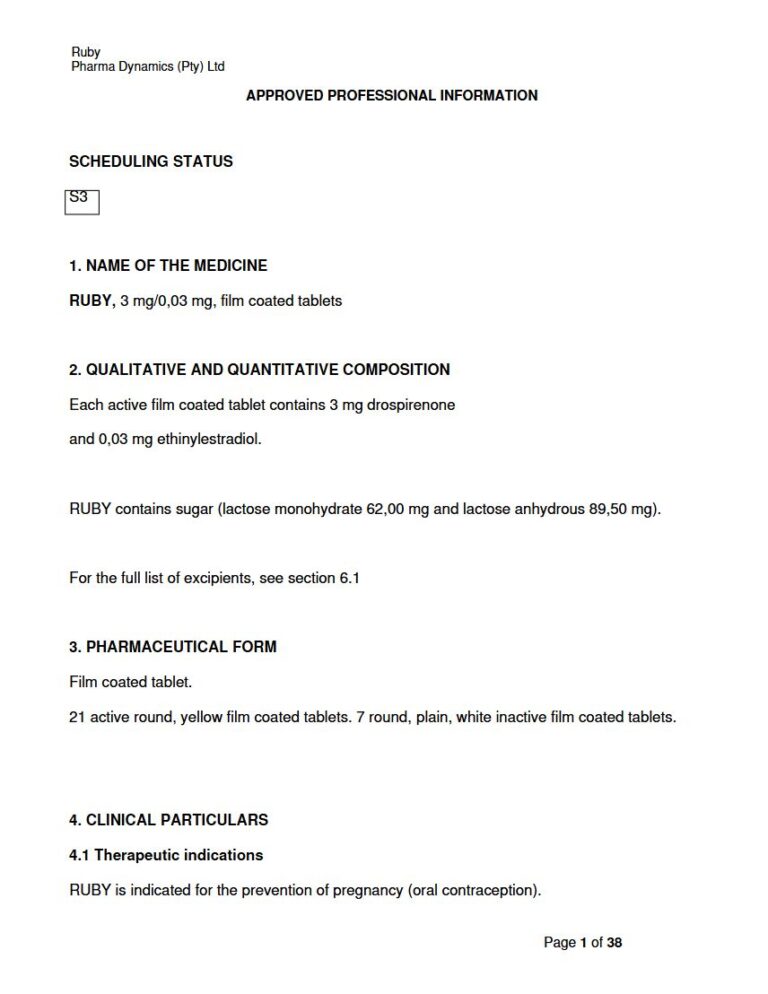
4.1 Therapeutic indications
RUBY is indicated for the prevention of pregnancy (oral contraception).
4.2 Posology and method of administration
Method of administration
Oral use.
Taking RUBY for the first time
The first tablet should be started on the first day of the menstrual cycle (day 1 of the cycle) by selecting the appropriate tablet for that day of the week (e.g. MON for Monday). One tablet should be taken daily (preferably after the evening or at bedtime) for 28 consecutive days. The tablet is swallowed whole with some liquid.
Withdrawal bleeding usually starts on day 2 to 3 after starting the inactive white tablets and may not have finished before the next pack is started. Each subsequent pack is started the day after the last tablet of the current pack. If RUBY is started during the last part of the week, the very first cycle may be slightly shortened.
How to start RUBY
No preceding hormonal contraceptive uses (in the past month)
Tablet-taking has to start on day 1 of natural cycle (i.e., the first day of the menstrual bleeding). An additional barrier method is recommended for the first 7 days of tablet-taking during the first cycle.
Changing from another combined oral contraceptive, vaginal ring, or transdermal patch to RUBY
The first RUBY tablet should be taken on the day after the last active tablet of the previous combined oral contraceptive, but at the latest on the day following the usual tablet-free or inactive tablet interval of the previous combined oral contraceptive.
In case a vaginal ring or transdermal patch has been used, the woman should start using RUBY preferably on the day of removal, but at the latest when the next application would have been due.
Changing from a Progestogen-only-Pill (POP or mini-pill, injection, implant) or from a progestogen-releasing intrauterine system (IUS)
Switching from mini pills to RUBY can be done on any day, from an implant or intrauterine system on the day of its removal and from an injectable when the next injection would be due. In all these cases additional contraceptive precautions are required for the first 7 days of tablet-taking.
Following 1st trimester abortion or miscarriage
Oral contraception may be started immediately. Additional contraceptive precautions are not required.
Following delivery or 2nd trimester abortion or miscarriage
For use in lactation u2013 see section 4.6. Oral contraception can be started by non-lactating women 21 to 28 days after a delivery or 2nd trimester abortion. If oral contraception is started later, one of the barrier methods as additional contraceptive precaution is also required for the first 7 days.
If intercourse has already taken place, pregnancy should be excluded before tablet intake is started, or it should be delayed until the first menstrual bleeding.
Management of missed tablets
Missed hormone-free white film-coated tablets can be disregarded. However, they should be discarded to avoid unintentionally prolonging the hormone-free white tablet phase. The following advice only refers to missed hormone-containing yellow film-coated tablets:
If the user is less than 12 hours late in taking the yellow active tablet
- Contraceptive protection is not reduced, and additional contraceptive precautions are not required. Take the tablet as soon as you remember and take the next tablet on the scheduled time.
If the user is more than 12 hours late in taking the yellow active tablet
If she is more than 12 hours late in taking any active tablet, contraceptive protection may be reduced. The management of missed tablets can be guided by the following two basic rules:
- Tablet-taking must never be discontinued for longer than 7 days.
- Uninterrupted tablet-taking for 7 days are required to attain adequate suppression of the hypothalamic-pituitary-ovarian axis.
Accordingly the following advice can be given in daily practice:
First 7 days of active tablet-taking (Day 1 to 7)
The user should take the last missed tablet as soon as she remembers, even if this means taking two tablets at the same time. She then continues to take tablets at her usual time. In addition, a barrier method such as a condom should be used for the next 7 days. If intercourse took place in the preceding 7 days, the possibility of a pregnancy should be considered. The more tablets that are missed and the closer they are to the inactive tablet phase, the higher the risk of a pregnancy.
Second 7 days of active tablet-taking (Day 8 to 14)
The user should take the last missed tablet as soon as she remembers, even if this means taking two tablets at the same time. She then continues to take tablets at her usual time. Provided that the woman has taken her tablets correctly in the 7 days preceding the first missed tablet, there is no need to use extra contraceptive precautions. However, if this is not the case, or if she missed more than 1 tablet, the woman should be advised to use extra precautions for 7 days.
Third 7 days of active tablet-taking (Day 15 to 21)
The risk of reduced reliability is imminent because of the forthcoming inactive tablet phase. However, by adjusting the tablet-intake schedule, reduced contraceptive protection can still be prevented. If either of the following two options is adhered to, there is no need to use extra contraceptive precautions, provided that in the 7 days preceding the first missed tablet the woman has taken all tablets correctly. If this is not the case, the woman should be advised to follow the first of these two options, and also to use extra precautions for the next 7 days.
- The user should take the last missed tablet as soon as she remembers, even if this means taking two tablets at the same time. She then continues to take tablets at her usual time until the active tablets are used up. The 7 inactive tablets must be discarded. The next pack must be started right away. The user is unlikely to have a withdrawal bleed until the end of the active tablets section of the second pack, but she may experience spotting or breakthrough bleeding on active tablet-taking days.
- The woman may also be advised to discontinue active tablet-taking from the current pack. She should then have a tablet-free interval of up to 7 days, including the days she missed tablets, and subsequently continue with the next pack, starting in the silver section with the tablet for the appropriate day of the week. If the woman missed active tablets and subsequently has no withdrawal bleed in the inactive tablet phase, the possibility of a pregnancy should be considered.
Inactive tablet-taking
Missing any of the white inactive tablets can be ignored but beginning a new cycle on time is essential. However, they should be discarded to avoid unintentionally prolonging the inactive tablet phase.
Advice in case of gastrointestinal disturbances:
In case of severe gastrointestinal disturbances, absorption may not be complete and additional contraceptive measures should be taken.
If vomiting occurs within 3 to 4 hours after active tablet taking, the advice concerning missing tablets is applicable. If the woman does not want to change her normal tablet-taking schedule, she must take the extra tablet(s) needed from another pack.
Postponing a period
In order to postpone the menstrual bleeding, a new pack of RUBY should be started without taking the inactive white tablets from the current pack. The extension can be carried on for as long as wished until the end of the second pack. During the use of the second pack, breakthrough-bleeding or spotting may occur. Regular intake of RUBY can be restored after the usual 7 white inactive tablets or tablet-free days.
Special populations
Geriatric patients
Not applicable. RUBY is not indicated after menopause.
Patients with hepatic impairment
RUBY is contraindicated in women with severe hepatic diseases (see section 4.3).
Patients with renal impairment
RUBY is contraindicated in women with severe renal insufficiency or acute renal failure (see section 4.3).
4.3 Contraindications
RUBY should not be used in the following conditions. Should any of the conditions appear for the first time during RUBY use, the product should be stopped immediately.
- Hypersensitivity to drospirenone, ethinylestradiol or to any of the ingredients of RUBY (see section 6.1)
- hereditary or acquired predisposition for venous or arterial thrombosis, such as activated protein C-resistance, antithrombin-III-deficiency, protein C-deficiency, protein S deficiency, hyperhomocysteinemia and antiphospholipid antibodies (anticardiolipin-antibodies, lupus anticoagulant)
- deep venous thrombosis or pulmonary embolism (present or history)
- arterial thrombosis (e.g. cerebrovascular accident, myocardial infarction) or prodromal conditions (e.g. angina pectoris, transient ischemic attack) (present or history)
- severe or multiple risk factor(s) for arterial factors:
- diabetes mellitus with vascular symptoms
- uncontrolled hypertension
- severe dyslipoproteinemia
- smoking tobacco
- underlying abnormality of the coagulation system
- active and severe hepatic disease (presence or history), cholestatic or active
- severe renal insufficiency or acute renal failure. Potassium excretory capacity may be limited in patients with renal insufficiency. These patients must be monitored for hyperkalaemia when additionally, concomitant potassium sparing medicines are taken (see sections 4.4 and 4.5)
- hepatic tumours, benign or malignant (presence or history)
- personal and family history of breast cancer
- previous proven deep-vein thrombosis (DVT)
- previous pulmonary embolism
- inherited thrombophilia
- patients known with inherited genetic mutations: BRCA1 and BRCA 2 genes
- early menstrual periods (before the age of 12 years)
- history of non-cancerous breast diseases (atypical hyperplasia or lobular carcinoma in situ
- previous treatment using radiation therapy to the chest or breast
- previous exposure to diethylstilbestrol (DES)
- known or suspected malignant conditions of the genital organs or the breasts if sex steroid-influenced
- vaginal bleeding (abnormal or undiagnosed)
- history of migraine headaches with focal neurological symptoms (see section 4.4)
- pregnancy (known or suspected)
- major surgery with prolonged immobilisation.
4.4 Special warnings and precautions for use
If any of the following conditions/risk factors mentioned below is present, appear for the first time or aggravate, the benefits of using RUBY must be weighed against possible risks for each individual woman and discussed with the woman before she decides to start using the medicine. In the event of aggravation, exacerbation or first appearance of any of these conditions or risk factors, the woman should contact her medical practitioner. The medical practitioner should then decide on whether RUBYu2019s use should be discontinued.
Circulatory disorders
An increased risk for venous (deep vein thrombosis, pulmonary embolism) and arterial (myocardial infarction, transient ischaemic attack) thromboembolism have been associated with the use of combined oral contraceptives. The risk for venous thromboembolism is highest during the first year of use. This increased risk is present after initially starting a combined oral contraceptive, such as RUBY, (following a 4 week or greater pill-free interval) the same or a different combined oral contraceptive. Study data suggests this increased risk is mainly present during the first 3 months of use. Overall the risk for venous thromboembolism (VTE) in users of low combined oral contraceptives is two to three-fold higher than for non-users of combined oral contraceptives who are not pregnant. Venous thromboembolism (VTE) may be life-threatening or may have a fatal outcome (in 1 to 2 % of the cases). The occurrence of thrombosis has been reported in other blood vessels e.g. hepatic, mesenteric, renal, cerebral or retinal veins and arteries, in combined oral contraceptive including RUBY users. There is no consensus as to whether the occurrence of these events is associated with the use of combined oral contraceptives such as RUBY.
Symptoms of deep venous thrombosis (DVT) may include:
- unilateral swelling of the leg or along a vein in the leg
- pain or tenderness in the leg which may be felt only when standing or walking, increased warmth in the affected leg; red or discoloured skin on the leg.
Symptoms of pulmonary embolism (PE) may include:
- sudden severe pain in the chest, which may increase with deep breathing, whether or not it radiates to the left arm
- sudden onset of unexplained breathlessness or rapid breathing
- sudden onset of coughing which may bring up blood
- sense of anxiety, severe light headedness or dizziness
- rapid or irregular heartbeat.
Some of these symptoms (e.g. shortness of breath, coughing) are non-specific and might be misinterpreted as more common or less severe events (e.g. respiratory tract infections).
An arterial thromboembolic event can include cerebrovascular accident, vascular occlusion or myocardial infarction (MI).
Symptoms of a cerebrovascular accident can include:
- weakness or very marked numbness suddenly affecting one side or one part of the body (face, arm or leg)
- sudden confusion, trouble speaking, or understanding
- sudden partial or complete loss of vision, in one or both eyes, diplopia
- sudden trouble walking, dizziness, loss of balance or coordination
- any unusual, severe, prolonged headache with no known cause
- collapse or fainting with or without focal seizure
- sudden pain, swelling and slight blue discolouration of an extremity, acute abdomen.
Symptoms of myocardial infarction (MI) can include:
- pain, discomfort, pressure, heaviness, sensation of squeezing or fullness in the chest, arm or below the breastbone
- discomfort radiating to the back, jaw, throat, arm, stomach
- fullness, indigestion or choking feeling
- sweating, nausea, vomiting or dizziness
- extreme weakness, anxiety or shortness of breath
- rapid or irregular heartbeats.
Arterial thromboembolic events may be life-threatening or may have a fatal outcome.
Risk factors for venous thromboembolic complications when using RUBY:
- increased age
- positive family history of venous thromboembolism (if a hereditary predisposition is known or suspected, the woman should be referred to a specialist for advice before deciding about any combined oral contraceptive use)
- prolonged immobilisation, major surgery, any surgery to the legs or major trauma. It is advisable to discontinue the use of RUBY (in the case of elective surgery at least four weeks in advance) and not resume until two weeks after complete remobilisation in these situations. Antithrombotic treatment should be considered if the use of RUBY has not been discontinued in advance
- obesity (body mass index more than 30 kg/m2).
Risk factors for arterial thromboembolic complications when using RUBY:
- increasing age
- smoking (with heavier smoking and increasing age, the risk increases further, women over 35 years should be strongly advised not to smoke if they wish to use a combined oral contraceptive)
- dyslipoproteinaemia
- hypertension
- valvular heart disease
- atrial fibrillation.
There is no consensus about the possible role of varicose veins and superficial thrombophlebitis in venous thromboembolism. The increased risk of thromboembolism in the puerperium must be considered (see section 4.6). The presence of one or more serious risk factor or multiple risk factors for venous arterial disease respectively, can also constitute to a contraindication. Possible symptoms of thrombosis should be reported, and anticoagulant therapy should be considered. Other medical conditions which have been associated with adverse vascular events include diabetes mellitus, systemic lupus erythematosus, haemolytic uremic syndrome, and chronic inflammatory bowel disease (Crohnu2019s disease or ulcerative colitis) and sickle cell disease. An increase in frequency or severity of migraine may be reason for immediate discontinuation of RUBY.
Biochemical factors that may be indicative of hereditary or acquired predisposition for venous or arterial thrombosis include Activated Protein C (APC) resistance, hyperhomocysteinaemia, antithrombin-III deficiency, protein C deficiency, protein S deficiency, antiphospholipid antibodies (anticardiolipin antibodies, lupus anticoagulant).
Migraine
An increase in frequency or severity of migraine during combined oral contraceptive use (which may be prodromal of a cerebrovascular event) may be a reason for immediate discontinuation of the combined oral contraceptive, such as RUBY (see section 4.3).
Tumours
An increased risk of cervical cancer has been reported in long-term users of combined oral contraceptives. The most important risk factor for cervical cancer is persistent human papilloma virus infection. Some epidemiological studies have indicated that long term use of combined oral contraceptives may further contribute to this increased risk but there continues to be controversy about the extent to which this finding is attributable to confounding effects e.g., cervical screening and sexual behaviour including the use of barrier contraceptives. Benign liver tumours, and malignant liver tumours have been reported in users of combined oral contraceptives. These tumours have led to life-threating intra-abdominal haemorrhages. A hepatic tumour should be considered in the differential diagnosis when severe upper abdominal pain, liver enlargement or signs of intra-abdominal haemorrhage occur in women taking combined oral contraceptives. Malignancies may be life threatening or may have a fatal outcome.
Breast cancer
RUBY contains (oestrogen and progestogen) which, on prolonged use, may increase the risk of developing breast cancer. A meta-analysis of prospective epidemiological studies from 1992 to 2018 reported a significant increase in the risk of developing breast cancer in 55,575 women 40 - 59 years of age who used menopausal hormone therapy (MHT). The risk increased steadily with duration of use and was slightly greater for oestrogen-progestogen than oestrogen only preparations, and the risk persisted for more than 10 years after stopping the treatment. The relative risk (RR) to develop breast cancer for oestrogen-progestogen preparations was 1.60 at 1 - 4 years and RR = 2.08 at 5 - 14 years, while that for oestrogen only preparations was 1.17 at 1 - 4 years and 1.33 at 5 - 14 years. There was no risk of to develop breast cancer in women who started MHT at 60 years of age. All women on RUBY should receive yearly breast examinations by a healthcare provider and perform monthly breast self-examinations. Mammography evaluations should be done based on patient age, risk factors, and prior mammogram results.
Other conditions
Potassium sparing medication
The progestogen component in RUBY is an aldosterone antagonist with potassium sparing properties. Potassium excretion capacity may be limited in patients with renal insufficiency. In a clinical study, drospirenone intake did not show an effect on serum potassium concentration in patients with mild or moderate renal impairment. A theoretical risk for hyperkalaemia can be assumed only for patients with renal impairment whose pre-treatment serum potassium is in the upper reference range, and who are additionally using potassium sparing medicines. Therefore, it is recommended to check serum potassium during the first treatment cycle in patients presenting with renal insufficiency and a pre-treatment serum potassium in the upper reference range, and particularly during concomitant use of the following medicines during the first treatment cycle (see sections 4.3 and 4.5):
- ACE inhibitors
- angiotensin II receptor antagonists
- aldosterone antagonists
- potassium sparing diuretics
- NSAIDs (used for long term treatment).
Hypertriglyceridaemia
Women with hypertriglyceridaemia, or a family history thereof, may be at an increased risk of pancreatitis when using RUBY.
Blood pressure
Although small increases in blood pressure have been reported in many women taking combined oral contraceptives such as RUBY, clinically relevant increases are rare. Only in these rare cases an immediate discontinuation of combined oral contraceptives use is justified. If, during the use of a combined oral contraceptives in pre-existing hypertension, constantly elevated blood pressure values or a significant increase in blood pressure do not respond adequately to antihypertensive treatment, RUBY must be withdrawn. Where considered appropriate, combined oral contraceptives use may be resumed if normotensive values can be achieved with antihypertensive therapy.
The following conditions have been reported to occur, or deteriorate with both pregnancy and combined oral contraceptives use but the relevance of an association with RUBY is inconclusive:
- jaundice and/or pruritus related to cholestasis
- gallstone formation
- porphyria
- systemic lupus erythematosus
- haemsolytic uremic syndrome
- sydenhamu2019s chorea
- herpes gestationis
- otosclerosis related hearing loss.
Angioedema
In women with hereditary angioedema exogenous estrogens may induce or exacerbate symptoms of angioedema.
Cholestatic jaundice
Acute or chronic disturbances of liver function may necessitate the discontinuation of RUBY use until markers of liver function return to normal. Recurrence of cholestatic jaundice and/or cholestasis-related pruritus which previously occurred during pregnancy or during previous use of sex steroids necessitates the discontinuation of RUBY.
Diabetes mellitus
Although RUBY may have an effect on peripheral insulin resistance and glucose tolerance, there is no evidence for a need to alter the therapeutic regimen in diabetics using RUBY due its low ethinylestradiol content of 0,03 mg per tablet. However, diabetic women should be carefully observed, particularly in the early stage of RUBY use.
Crohnu2019s disease and ulcerative colitis
Worsening of endogenous depression, of epilepsy, of Crohn's disease and of ulcerative colitis has been reported during RUBY use.
The following conditions may develop or worsen with the use of RUBY:
- Chloasma
May occur occasionally, especially in women with a history with chloasma gravidarum. Women with a tendency to chloasma should avoid exposure to the sun or ultraviolet radiation when taking RUBY.
Respiratory
Asthma may worsen in women using RUBY.
Depressed mood and depression
Depressed mood and depression are well-known undesirable effects of hormonal contraceptive use (see section 4.8). Depression can be serious and is a well-known risk factor for suicidal behaviour and suicide. Women should be advised to contact their medical practitioner in case of mood changes and depressive symptoms, including shortly after initiating the treatment.
Medical examination/consultation
Prior to the initiation or reinstitution of RUBY a complete medical history (including family history) should be taken and pregnancy must be ruled out. Blood pressure should be measured and a physical examination should be performed, guided by the contraindications (see section 4.3) and warnings (see section 4.4). It is important to draw a woman's attention to the information on venous and arterial thrombosis, the symptoms of VTE and ATE, the known risk factors and what to do in the event of a suspected thrombosis. The woman should also be instructed to carefully read the user leaflet and to adhere to the advice given. The frequency and nature of examinations should be based on established practice guidelines and be adapted to the individual woman.
Women should be advised that oral contraceptives do not protect against HIV infections (AIDS) and other sexually transmissible diseases. The efficacy of combined oral contraceptives may be reduced in the event of missed tablets, vomiting or severe diarrhoea (see section 4.2), or concomitant medication (see section 4.8) which may interact with combined oral contraceptives.
Reduced cycle control
Irregular bleeding (spotting or breakthrough bleeding) may occur especially during the first months of use. The evaluation of any irregular bleeding is only meaningful after an adaption of about three cycles.
If bleeding irregularities persist or occur after previously regular cycles, then non-hormonal causes should be considered and adequate diagnostic measures are indicated to exclude malignancy or pregnancy. These may include curettage.
In some women withdrawal bleeding may not occur during the inactive tablet phase. If RUBY has been taken according to the directions described under section 4.2, it is unlikely that the woman is pregnant. However, if RUBY has not been taken according to these directions prior to the first missed withdrawal bleed or if two withdrawal bleeds are missed, pregnancy must be ruled out before RUBY use is continued.
Concomitant antibiotic therapy:
Oral contraceptive failure may occur with concomitant antibiotic therapy. For maximal protection, additional non-hormonal contraception is recommended for the duration of antibiotic therapy and for seven days thereafter. Those on long-term antibiotic therapy need only take extra precautions for the first two weeks of antibiotic therapy. Spotting and breakthrough bleeding are possible signs of diminished contraceptive effectiveness.
Lactose:
RUBY contains lactose. Patients with rare hereditary problems of galactose intolerance, total lactase deficiency, or glucose-galactose malabsorption should not take RUBY. RUBY contains lactose which may have an effect on the glycaemic control of patients with diabetes mellitus.
4.5 Interaction with other medicines and other forms of interaction
Medicines that increase clearance and clearance efficacy by enzyme induction:
An increased clearance of sex hormones, which lead to reduced contraceptive protection and increased breakthrough bleeding have been associated with the concomitant use of hydantoins, barbiturates, bosentan, carbamazepine, phenytoin, primidone, rifampicin, and HIV medicines ritonavir, nevirapine and efavirenz and possibly also oxcarbazepine, topiramate, felbamate, griseofulvin and the herbal remedy St. Johnu2019s wort (Hypericum perforatum).
Women on short-term treatment (up to one week) with any of the above-mentioned classes of medicines or individual medicines should temporarily use a barrier method in addition to the combined oral contraceptive (i.e. during the time of concomitant medicine administration) and 28 days after use.
Long-term treatment: stopped
In women on long-term treatment with hepatic enzyme-inducing active substances, another reliable, non-hormonal, method of contraception is recommended.
Antibiotics (interference with enterohepatic circulation)
Some clinical reports suggest that enterohepatic circulation of oestrogens may decrease when certain antibiotic medicines are given, which may reduce ethinylestradiol concentrations (e.g. penicillins, tetracyclines). Reduced contraceptive effectiveness is also known with antibiotics such as ampicillin and tetracyclines and the antifungal, griseofulvin.
Long-term users of antibiotic therapy should be advised to use an alternative or additional method of contraception to avoid an unplanned pregnancy. Women on rifampicin treatment should use a barrier method in addition to the combined oral contraceptive during the time of rifampicin administration and for 28 days after its discontinuation. If concomitant medicine administration runs beyond the end of the active tablets in the RUBY blister pack, the next RUBY pack should be started without the usual inactive tablet interval.
The dose of RUBY may be increased in women receiving chronic treatment with hepatic enzyme inducing medicines. If a high contraceptive dosage appears to be unsatisfactory or unreliable (in the case of irregular bleeding) another non-hormonal, method of contraception should be advised.
Substances interfering with the metabolism of combined oral contraceptives such as RUBY (enzyme inhibitors):
Inhibitors of the cytochrome P450 systems are unlikely to influence the metabolism of drospirenone as the main metabolites are generated without the involvement of this system. The clinical relevance of potential interactions with enzyme inhibitors remains unknown.
Concomitant administration of strong CYP3A4 inhibitors can increase plasma concentrations of the estrogen or the progestin or both.
In a multiple dose study with a drospirenone (3 mg/day) / ethinylestradiol (0,02 mg/day) combination, co-administration of the strong CYP3A4 inhibitor ketoconazole for 10 days increased the AUC (0-24h) of drospirenone and ethinylestradiol 2,7 fold and 1,4 fold respectively. Etoricoxib doses of 60 to 120 mg/day have been shown to increase plasma concentrations of ethinylestradiol 1,4 to 1,6-fold, respectively when taken concomitantly with a combined hormonal contraceptive containing 0,035 mg ethinylestradiol.
Effects of combined oral contraceptives such as RUBY on other medicines:
RUBY may affect the metabolism of certain other medicines. Accordingly, plasma and tissue concentrations may either increase (e.g. ciclosporin) or decrease (e.g. lamotrigine). Based on in vitro inhibition studies and in vivo interaction studies in female volunteers using omeprazole, simvastatin and midazolam as market substrates, an interaction of drospirenone at doses of 3 mg with the metabolism of other medicines is unlikely.
Clinical data suggests that ethinylestradiol is inhibiting the clearance of CYP1A2 substrates leading to a weak (e.g. theophylline) or moderate (e.g. tizanidine) increase in their plasma concentration.
Other interactions
The following medications have the potential to increase potassium levels and should be tested for serum potassium during the first treatment cycle (see sections 4.3 and 4.4):
- ACE inhibitors
- angiotensin II receptor antagonists
- aldosterone antagonists
- potassium sparing diuretics
- NSAIDs (used for long term treatment).
However, in studies evaluating the interaction of drospirenone (combined with estradiol) with an ACE inhibitor or indomethacin, no clinically or statistically significant differences in serum potassium concentrations were observed.
Note: The prescribing information of concomitant medications should be consulted to identify potential interactions.
Changes in laboratory test
The use of RUBY may influence the results of certain laboratory tests e.g. the liver, thyroid, adrenal and renal functions, plasma levels of proteins (e.g. corticosteroid binding globulin and lipid/lipoprotein fractions) and carrier proteins, parameter of carbohydrate metabolism, parameters of coagulation and fibrinolysis. Changes generally remain within the normal laboratory range. Drospirenone causes an increase in plasma rennin activity and plasma aldosterone is induced by its mild antimineralocorticoid activity.
4.6 Fertility, pregnancy and lactation
Pregnancy
RUBY is contraindicated during pregnancy. The use of RUBY should be discontinued if pregnancy is confirmed.
Breastfeeding
RUBY may reduce the production and change the composition of breast milk. Therefore, the use of RUBY is not recommended until the breastfeeding mother has completely weaned her child. Small amounts of the contraceptive steroids and/or their metabolites may be excreted with the milk.
4.7 Effects on ability to drive and use machines
No studies on the effects on the ability to drive and use machines have been performed. No effects on ability to drive and use machines have been observed in users of RUBY. There are no studies on whether RUBY affects mental or physical abilities to execute tasks or activities requiring mental alertness, judgment and/or sound coordination and vision.
4.8 Undesirable effects
Summary of the safety profile
The most serious adverse effects associated with the use of combined oral contraceptives are also listed under section 4.4.
Tabulated list of adverse effects
System Organ Class
Frequency
Side effects
Immune system disorders
Less frequent
Asthma, hypersensitivity
Endocrine disorders
Frequency unknown
Pancreatitis, gall stone formation, changes in glucose tolerance or effect on peripheral insulin resistance, Crohnu2019s disease, ulcerative colitis, chloasma
Psychiatric disorders
Frequent
Less frequent
Depression/depressive mood, emotional lability, decrease and loss of libido
Increased libido
Nervous system disorders
Frequent
Headache, drowsiness
Eye disorders
Less frequent
Contact lens intolerance
Ear and labyrinth disorders
Frequency unknown
Hypoacusis
Vascular disorders
Frequent
Less frequent
Frequency unknown
Migraine
Hypertension, hypotension
Venous thromboembolism (VTE), Arterial thromboembolism (ATE), venous and arterial, thromboembolic events* (peripheral deep venous occlusion, thrombosis and embolism/pulmonary vascular occlusion, thrombosis, embolism and infarction/myocardial infarction and stroke not specified as haemorrhagic)*
Gastrointestinal disorders
Frequent
Less frequent
Nausea, abdominal pain
Vomiting, diarrhoea
Hepatobiliary disorders
Frequency unknown
Liver tumours (benign and malignant), jaundice, alterations in liver function tests
Skin and subcutaneous tissue disorders
Less frequent
Frequency unknown
Acne, eczema, pruritis, alopecia, hirsutism
Erythema nodosum*, erythema multiforme*
Reproductive system and breast disorders
Frequent
Less frequent
Frequency unknown
Vaginal discharge, vaginal candidiasis, menstrual disorders, intermenstrual bleeding, breakthrough bleeding or spotting, breast tenderness, breast pain
Breast hypertrophy, vaginal infection
Breast secretion, malignant neoplasms
General disorders and administrative site conditions
Less frequent
Fluid retention, weight loss or gain, fatigue, fever
*Post marketing reported adverse events.
a. Description of selected adverse reactions
Increased risk of adverse effects: As discussed in section 4.4, women using CHCs are at increased risk of arterial and venous thrombotic and thrombo-embolic events, including myocardial infarction, stroke, transient ischaemic attacks, venous thrombosis and pulmonary embolism. Serious adverse effects in women using COCs: Venous thromboembolic disorders, arterial thromboembolic disorders, hypertension, liver tumours. Deterioration or occurrence of the following serious adverse effects are inconclusive in women using COCs: Crohn's disease, ulcerative colitis, epilepsy, uterine myoma, porphyria, systemic lupus erythematosus, herpes gestationis, Sydenham's chorea, haemolytic uremic syndrome, cholestatic jaundice, chloasma, acute or chronic disturbances of liver function (which may necessitate discontinuation), symptoms of angioedema that may be induced or exacerbated in those women with hereditary angioedema exogenous estrogens.
4.9 Overdose
Signs and symptoms: Nausea, vomiting and slight vaginal bleeding in young girls.
Management of overdose: There is no known antidote, and the treatment should be symptomatic and supportive.
