
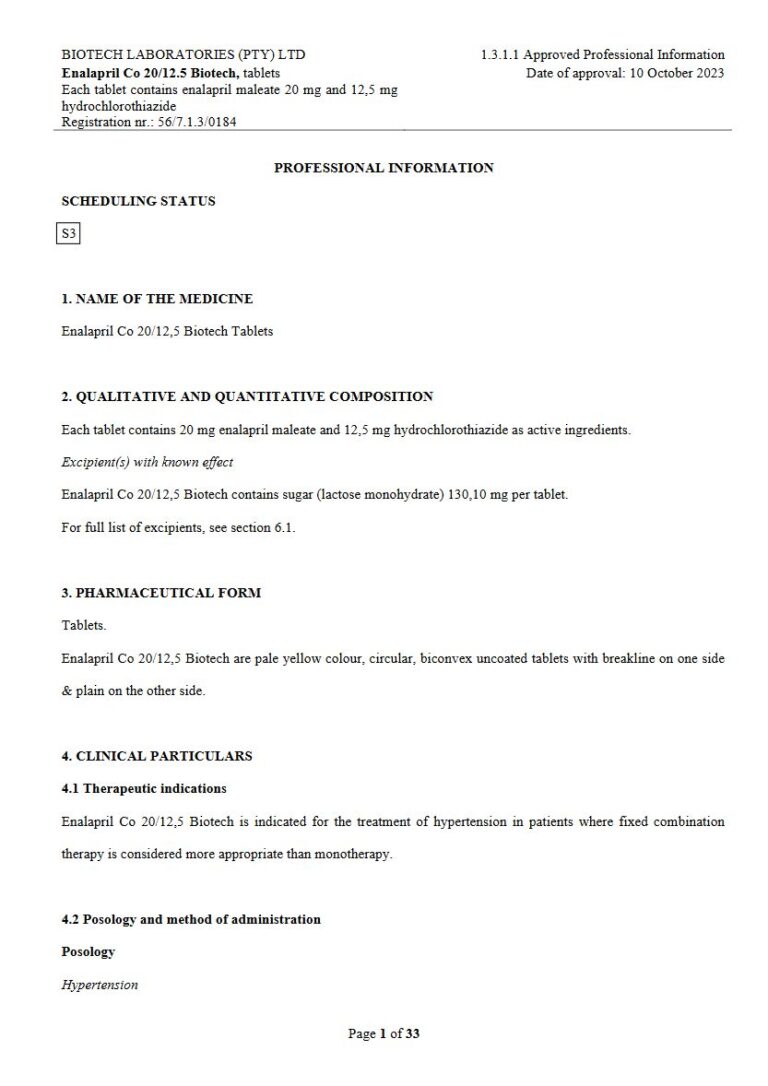
Enalapril Co 20/12.5 Biotech 20 mg and 12,5 mg Tablets.
PDF Leaflet Revision Date: 10 October 2023
Clinical Summary
Quick overview from the medicine insert
Indication
Treatment of hypertension where fixed combination therapy is preferred.
Dosage (summary)
1 tablet once daily, may increase to 2 tablets if necessary.
Special Populations
- Renal impairment
- Hepatic impairment
Pregnancy & Breastfeeding
Contraindicated in pregnancy and breastfeeding.
Key Drug Interactions
- Potassium-sparing diuretics
- Lithium
- NSAIDs
- Fluoroquinolones
Contraindications
- Hypersensitivity
- Severe renal impairment
- Anuria
- Angioedema history
- Pregnancy
- Lactation
Common side effects
- Headache
- Cough
- Dizziness
- Hypotension
Counselling Points
- Monitor blood pressure regularly
- Report signs of angioedema
- Avoid potassium supplements without consulting
Serious warnings
- Risk of angioedema
- Hypotension
- Electrolyte imbalance
Important Disclaimer
The Enalapril Co 20/12.5 Biotech 20 mg and 12,5 mg Tablets. professional information leaflet below is the property of Biotech Laboratories and is provided on Medinsert exactly as issued, with no.. alterations or editorial changes. We make every effort to keep content current by updating documents as soon as new versions become available. Medinsert serves as a trusted access point for healthcare professionals, but does not replace official sources or clinical judgement. For more details, please read our full disclaimer. read more>>
 Healthcare Professionals Only
This content is for registered healthcare professionals
Sign in or create a free account to read the full package insert.
Free for HPCSA-registered professionals. Powered by Medinsert.
Clinical Particulars
Section 4 of the official insert — extracted exactly as issued, no alterations
4.1 Therapeutic indications
Enalapril Co 20/12,5 Biotech is indicated for the treatment of hypertension in patients where fixed combination therapy is considered more appropriate than monotherapy.
4.2 Posology and method of administration
Posology
Hypertension
The usual dosage is 1 tablet, administered once daily. If necessary, the dosage may be increased to a maximum of 2 tablets, administered once daily.
Special populations
Dosage in Renal insufficiency
Thiazides, including hydrochlorothiazide as contained in Enalapril Co 20/12,5 Biotech may not be appropriate diuretics for use in patients with renal impairment and are ineffective at creatinine clearance values of 30 ml/min or below (i.e., moderate or severe renal insufficiency). Enalapril Co 20/12,5 Biotech is not to be used as initial therapy in any patient with renal insufficiency. In patients with renal clearance of > 30 and < 80 ml/min, Enalapril Co 20/12,5 Biotech may be used but only after titration of the individual components.
Paediatric population
Safety and effectiveness in children have not been established.
Method of administration
Oral use.
4.3 Contraindications
- Hypersensitivity to enalapril, hydrochlorothiazide, other sulphonamide derived medicines or to any of the excipients of Enalapril Co 20/12,5 Biotech (see section 6.1).
- Severe renal impairment (creatinine clearance u2264 30 ml/min).
- Anuria.
- A history of angioedema related to previous therapy with ACE inhibitors or angiotensin receptor blockers (ARBs): These patients must never again be given these medicines.
- Hereditary or idiopathic angioedema.
- Hypertrophic obstructive, cardiomyopathy (HOCM).
- Pregnancy and lactation (see section 4.6).
- Severe hepatic impairment.
- Bilateral renal artery stenosis.
- Renal artery stenosis in patients with a single kidney.
- Aortic stenosis.
- Concomitant use of Enalapril Co 20/12,5 Biotech with potassium sparing diuretics such as spironolactone, triamterene, amiloride (see section 4.5).
- Porphyria.
- Lithium therapy: Concomitant administration with Enalapril Co 20/12,5 Biotech may lead to toxic blood concentrations of lithium (see section 4.5).
- The concomitant use of Enalapril Co 20/12,5 Biotech with aliskiren-containing medicines is contraindicated (see section 4.4).
- Patients with Addisonu2019s disease.
- Concomitant use with fluoroquinolones in patients with moderate to severe renal impairment (creatinine clearance u2264 30 ml/min) and in elderly patients (see section 4.5).
- Combination with sacubitril/valsartan due to increased risk of angioedema. Do not administer Enalapril Co 20/12,5 Biotech within 36 hours of switching to or from sacubitril/valsartan, a medicine containing a neprilysin inhibitor (see sections 4.4 and 4.5).
- Patients with a history of previous and/or current basal cell carcinoma and/or squamous cell carcinomas of the skin and lip.
4.4 Special warnings and precautions for use
Hypotension and Electrolyte Fluid Imbalance
Symptomatic hypotension is seen in uncomplicated hypertensive patients. In hypertensive patients receiving Enalapril Co 20/12,5 Biotech, symptomatic hypotension may occur following the initial dose; this is more likely to occur if the patient has been volume depleted, e.g., by diuretic therapy, dietary salt restriction, diarrhoea or vomiting (see sections 4.5 and 4.8). Previous diuretic therapy should be discontinued for 2-3 days prior to initiation of treatment with Enalapril Co 20/12,5 Biotech. Regular determination of serum electrolytes should be performed at appropriate intervals in such patients. Special attention should be paid to patients with ischemic heart or cerebrovascular disease in whom an excessive fall in blood pressure could result in a myocardial infarction or cerebrovascular accident. In hypertensive patients with heart failure, with or without associated renal insufficiency, symptomatic hypotension has been observed. This is most likely to occur in those patients with more severe degrees of heart failure, as reflected by the use of high doses of loop diuretics, hyponatraemia or functional renal impairment. In these patients, therapy should be started under medical supervision and the patients should be followed closely whenever the dose of Enalapril Co 20/12,5 Biotech and/or diuretic is adjusted. Similar considerations may apply to patients with ischaemic heart or cerebrovascular disease in whom an excessive fall in blood pressure could result in a myocardial infarction or cerebrovascular accident.
Thiazides (including hydrochlorothiazide) can cause fluid or electrolyte imbalance (hypokalaemia, hyponatraemia, and hypochloremic alkalosis). Warning signs of fluid or electrolyte imbalance are xerostomia, thirst, weakness, lethargy, somnolence, restlessness, muscle pain or cramps, muscular fatigue, hypotension, oliguria, tachycardia, and gastrointestinal disturbances such as nausea and vomiting.
Should a woman become pregnant while receiving Enalapril Co 20/12,5 Biotech, the treatment must be stopped promptly and switched to a different class of antihypertensive medicine. Should a woman contemplate pregnancy, the doctor should institute alternative medication (see section 4.6)
4.5 Interactions with other medicines
Enalapril Maleate - Hydrochlorothiazide
Dual blockade of the renin - angiotensin - aldosterone system (RAAS)
Data have shown that dual blockade of the renin-angiotensin-aldosterone-system (RAAS) through the combined use of ACE-inhibitors, angiotensin II receptor blockers or aliskiren is associated with a higher frequency of adverse events such as hypotension, hyperkalaemia and decreased renal function (including acute renal failure) compared to the use of a single RAAS-acting medicine (see sections 4.3, 4.4 and 5.1).
Other Antihypertensive medicines
Concomitant use of these medicines may increase the hypotensive effects of enalapril and hydrochlorothiazide. Concomitant use with nitroglycerin and other nitrates, or other vasodilators, may further reduce blood pressure.
Fluoroquinolones
Concomitant use of fluoroquinolones and ACE inhibitors/Angiotensin receptor blockers may precipitate acute kidney injury. The mechanism of the possible interaction between the different classes of medicines, over and above different mechanisms of kidney damage, is unknown (see section 4.3).
4.6 Fertility, pregnancy and lactation
Women of child - bearing potential
Patients planning pregnancy should be changed to alternative antihypertensive treatments. When pregnancy is diagnosed, treatment with Enalapril Co 20/12,5 Biotech should be stopped immediately, and, if appropriate, alternative therapy should be started.
Pregnancy
Enalapril Co 20/12,5 Biotech is contraindicated during pregnancy. Pregnant women should be informed of the potential hazards to the foetus and must not take Enalapril Co 20/12,5 Biotech during pregnancy (see section 4.3). Foetal exposure to ACE inhibitors during the first trimester of pregnancy has been reported to be associated with an increased risk of malformations of the cardiovascular (atrial and/or ventricular septal defect, pulmonic stenosis, patent ductus arteriosus) and central nervous system (microcephaly spins bifida) and of kidney malformations. Enalapril Co 20/12,5 Biotech passes through the placenta and can be presumed to cause disturbance in foetal blood pressure regulatory mechanisms. Oligohydramnios as well as hypotension, oliguria and anuria in new-borns, have been reported after administration of ACE inhibitors [as contained in Enalapril Co 20/12,5 Biotech] during the second and third trimester. Cases of defective skull ossification have been observed. Prematurity and low birth mass can occur.
Breastfeeding
Enalapril Co 20/12,5 Biotech is contraindicated during breastfeeding. Both enalapril and thiazides, including hydrochlorothiazide, as in Enalapril Co 20/12,5 Biotech, appear in human milk. If use of Enalapril Co 20/12,5 Biotech is deemed essential, the patient should stop breastfeeding. Hydrochlorothiazide in high doses causing intense diuresis can inhibit the milk production.
Fertility
There are no data on fertility.
4.7 Effects on ability to drive and use machines
When driving vehicles or operating machines it should be taken into account that dizziness or weariness may occur (see section 4.8).
4.8 Undesirable effects
a. Summary of the safety profile
The most common side effects reported were headache and cough.
b. Tabulated list of adverse reactions
The following undesirable side effects have been reported for enalapril maleate :
| System organ class | Frequent | Less frequent | Frequency unknown |
|---|---|---|---|
| Blood and lymphatic system disorders | Anaemia (including aplastic and haemolytic), neutropenia, decreases in haemoglobin, decreases in haematocrit, thrombocytopenia, agranulocytosis, bone marrow depression, pancytopenia, lymphadenopathy | ||
| Immune system disorders | Hypersensitivity/ angio - oedema of the face, extremities, lips, tongue, glottis and/or larynx | ||
| Autoimmune diseases | |||
| Endocrine disorders | Syndrome of inappropriate antidiuretic hormone secretion (SIADH) | ||
| Metabolism and nutrition disorders | Hypoglycaemia (see section 4.4), anorexia | Gout | |
| Psychiatric disorder | Depression | Confusion | |
| Nervous system disorders | Dizziness, headache, | Somnolence, paraesthesia, | syncope, taste alterations |
| Eye disorders | Blurred vision | ||
| Ear and labyrinth disorders | Tinnitus | ||
| Cardiac disorders | Chest pain, rhythm disturbances, angina pectoris, tachycardia | Palpitations, myocardial infarction or cerebrovascular accident*, possibly secondary to excessive hypotension in high risk patients (see section 4.4) | |
| Vascular disorders | Hypotension (including orthostatic hypotension) | Flushing, orthostatic hypotension, Raynaud's phenomenon | |
| Respiratory, thoracic, and mediastinal disorders | Cough, dyspnoea | Rhinorrhoea, sore throat and hoarseness, bronchospasm/asthma, pulmonary infiltrates, rhinitis, allergic alveolitis/eosinophilia, pneumonia | |
| Gastrointestinal disorders | Nausea, diarrhoea, abdominal pain | Ileus, pancreatitis, vomiting, dyspepsia, constipation, gastric irritations, dry mouth, peptic ulcer, stomatitis/aphthous ulcerations, glossitis, intestinal angioedema, flatulence | |
| Hepatobiliary disorders | Hepatic failure, hepatitis u2013 either hepatocellular or cholestatic, hepatitis including necrosis, cholestasis (including jaundice) | ||
| Skin and subcutaneous tissue disorders | Rash, Diaphoresis, pruritus, urticaria, alopecia, erythema multiforme, Stevens-Johnson syndrome, exfoliative dermatitis, toxic epidermal necrolysis, erythroderma, pemphigus | ||
| A symptom complex has been reported which may include some or all of the following: fever, serositis, vasculitis, myalgia/myositis, arthralgia/arthritis, a positive ANA, elevated ESR, eosinophilia, and leucocytosis. Rash, photosensitivity or other dermatologic manifestations may occur. | |||
| Musculoskeletal, connective tissue, and bone disorder | Muscle cramps | Arthralgia | |
| Renal and urinary disorder | Renal dysfunction, renal failure, proteinuria | Oliguria | |
| Reproductive system and breast disorders | Impotence, gynecomastia | ||
| General disorder and administration site conditions | Asthenia, fatigue | Malaise, fever | |
| Investigations | Hyperkalaemia, increases in serum creatinine | Increases in blood urea, hyponatraemia, elevations of liver enzymes, elevations of serum bilirubin |
4.9 Overdose
No specific information is available on the treatment of overdosage with Enalapril Co 20/12,5 Biotech. Treatment is symptomatic and supportive. Therapy with Enalapril Co 20/12,5 Biotech should be discontinued and the patient observed closely. Suggested measures include induction of emesis, administration of activated charcoal, and administration of a laxative if ingestion is recent, and correction of dehydration, electrolyte imbalance and hypotension by established procedures, introduced within 2 hours of ingestion. Enalapril maleate The most prominent features of overdosage reported to date are marked hypotension, beginning some six hours after ingestion of tablets, concomitant with blockade of the renin-angiotensin system, and stupor. Symptoms associated with overdosage of ACE inhibitors may include circulatory shock, electrolyte disturbances, renal failure, hyperventilation, tachycardia, palpitations, bradycardia, dizziness, anxiety, and cough. The recommended treatment of overdosage is intravenous infusion of normal saline solution. If hypotension occurs, the patient should be placed in the shock position. If ingestion is recent, take measures aimed at eliminating enalapril maleate (e.g., emesis, administration of absorbents, and sodium sulfate). If available, angiotensin II infusion and/or intravenous catecholamines may be beneficial. Enalaprilat may be removed from the general circulation by haemodialysis (see section 4.4). Pacemaker therapy is indicated for therapy-resistant bradycardia. Vital signs, serum electrolytes and creatinine concentrations should be monitored continuously. Hydrochlorothiazide The most common signs and symptoms observed are those caused by electrolyte depletion (hypokalaemia, hypochloraemia, hyponatraemia) and dehydration resulting from excessive diuresis. If digitalis has also been administered, hypokalaemia may accentuate cardiac dysrhythmias.
