
Xtandi 40 mg Capsule
PDF Leaflet Revision Date: 29 February 2024
Clinical Summary
Quick overview from the medicine insert
Indication
Treatment of metastatic hormone-sensitive and castration-resistant prostate cancer in adult men.
Dosage (summary)
160 mg once daily; reduce to 120 mg or 80 mg if toxicity occurs.
Special Populations
- Elderly
- Hepatic impairment
- Renal impairment
Pregnancy & Breastfeeding
Contraindicated in women; may impair male fertility.
Key Drug Interactions
- Strong CYP2C8 inhibitors
- Warfarin
- CYP3A4 inhibitors
Contraindications
- Hypersensitivity
- Uncontrolled seizures
- Not for use in women
Common side effects
- Fatigue
- Hot flushes
- Hypertension
- Fractures
- Cognitive disorder
Counselling Points
- Take capsules whole with water
- Use contraception during and for 3 months after treatment
- Monitor for signs of gastrointestinal bleeding
Serious warnings
- Risk of seizure
- Posterior reversible encephalopathy syndrome
- Second primary malignancies
Important Disclaimer
The Xtandi 40 mg Capsule professional information leaflet below is the property of Astellas Pharma and is provided on Medinsert exactly as issued, with no.. alterations or editorial changes. We make every effort to keep content current by updating documents as soon as new versions become available. Medinsert serves as a trusted access point for healthcare professionals, but does not replace official sources or clinical judgement. For more details, please read our full disclaimer. read more>>
 Healthcare Professionals Only
This content is for registered healthcare professionals
Sign in or create a free account to read the full package insert.
Free for HPCSA-registered professionals. Powered by Medinsert.
Clinical Particulars
Section 4 of the official insert — extracted exactly as issued, no alterations
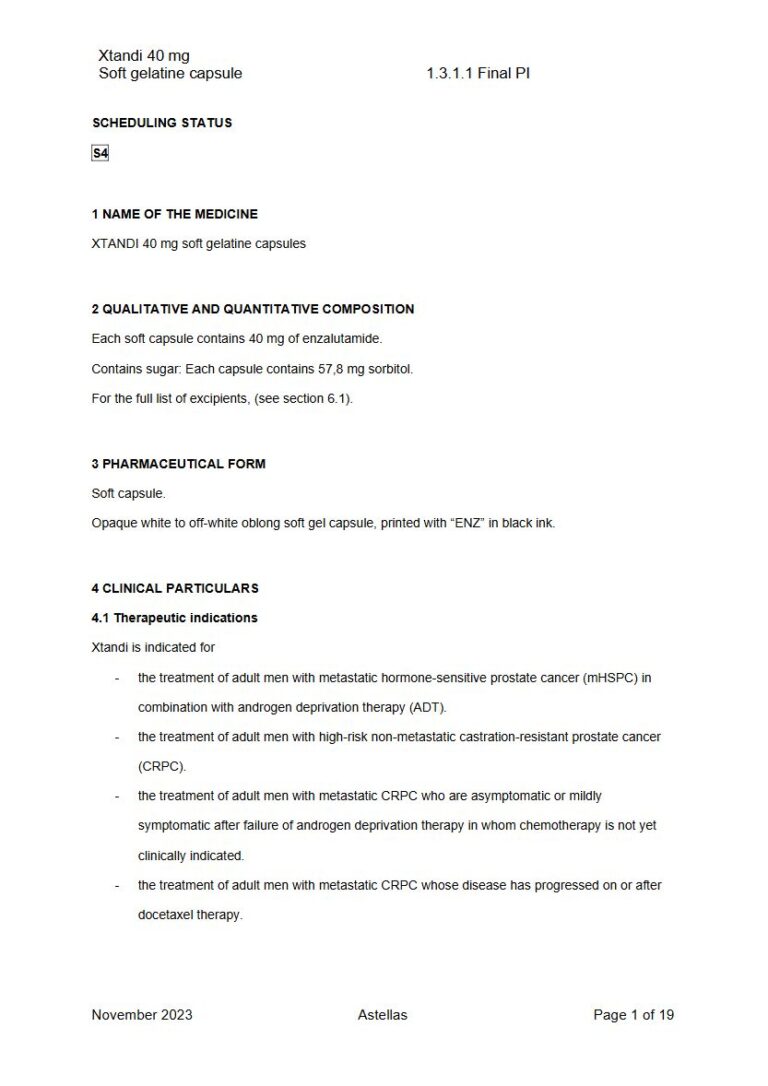
4.1 Therapeutic indications
Xtandi is indicated for
- the treatment of adult men with metastatic hormone-sensitive prostate cancer (mHSPC) in combination with androgen deprivation therapy (ADT).
- the treatment of adult men with high-risk non-metastatic castration-resistant prostate cancer (CRPC).
- the treatment of adult men with metastatic CRPC who are asymptomatic or mildly symptomatic after failure of androgen deprivation therapy in whom chemotherapy is not yet clinically indicated.
- the treatment of adult men with metastatic CRPC whose disease has progressed on or after docetaxel therapy.
4.2 Posology and method of administration
Posology
The recommended dose of Xtandi is 160 mg (four 40 mg capsules) as a single oral daily dose. Medical castration with a luteinising hormone-releasing hormone (LHRH) analogue should be continued during treatment of patients not surgically castrated. If a patient misses taking Xtandi at the usual time, the prescribed dose should be taken as close as possible to the usual time. If a patient misses a dose for a whole day, treatment should be resumed the following day with the usual daily dose. If a patient experiences a u2265 Grade 3 toxicity or an intolerable adverse reaction, dosing should be withheld for one week or until symptoms improve to u2264 Grade 2, then resumed at a reduced dose (120 mg or 80 mg) if warranted. The patient then requires frequent monitoring for the return of that adverse reaction.
Concomitant use with strong CYP2C8 inhibitors
The concomitant use of strong CYP2C8 inhibitors should be avoided if possible. If patients must be co-administered a strong CYP2C8 inhibitor, the dose of Xtandi should be reduced to 80 mg once daily. If co-administration of the strong CYP2C8 inhibitor is discontinued, the Xtandi dose should be returned to the dose used prior to initiation of the strong CYP2C8 inhibitor (see section 4.5).
Special Populations
Elderly patients
No dose adjustment is necessary for elderly patients (see section 5.2).
Hepatic impairment
No dose adjustment is necessary for patients with mild, moderate or severe hepatic impairment (Child-Pugh Class A, B or C, respectively). An increased drug half-life has however been observed in patients with severe hepatic impairment (see sections 4.4 and 5).
Patients with renal impairment
No dose adjustment is necessary for patients with mild or moderate renal impairment (see section 5.2). Caution is advised in patients with severe renal impairment or end-stage renal disease (see section 4.4).
Paediatric population
There is no relevant use of this medicine in the paediatric population, as prostate cancer is not present in children and adolescents.
Method of administration
Xtandi is for oral use. The soft capsules should not be chewed, dissolved or opened but should be swallowed whole with water, and can be taken with or without food.
4.3 Contraindications
Hypersensitivity to the active substance or to any of the excipients. Uncontrolled seizures (see section 4.4). Not to be used in women.
4.4 Special warnings and precautions for use
Risk of Seizure: Caution should be used in administering Xtandi to patients with a history of seizures or other predisposing factors including, but not limited to, underlying brain injury, stroke, primary brain tumours or brain metastases, or alcoholism. In addition, the risk of seizure may be increased in patients receiving concomitant medicines that lower the seizure threshold. Permanently discontinue Xtandi in patients who develop a seizure during treatment. (see section 4.3)
Posterior reversible encephalopathy syndrome: There have been rare reports of posterior reversible encephalopathy syndrome (PRES) in patients receiving Xtandi (see section 4.8). PRES is a rare, reversible, neurological disorder which can present with rapidly evolving symptoms including seizure, headache, confusion, blindness, and other visual and neurological disturbances, with or without associated hypertension. A diagnosis of PRES requires confirmation by brain imaging, preferably magnetic resonance imaging (MRI). Discontinuation of Xtandi in patients who develop PRES is recommended.
Second Primary Malignancies: Cases of second primary malignancies have been reported in patients treated with enzalutamide in clinical studies. In phase 3 clinical studies, the most frequently reported events in enzalutamide treated patients, and greater than placebo, were bladder cancer (0.3 %), adenocarcinoma of the colon (0.2 %), transitional cell carcinoma (0.2 %) and bladder transitional cell carcinoma (0.1 %). Patients should be advised to promptly seek the attention of their healthcare provider if they notice signs of gastrointestinal bleeding, macroscopic haematuria, or other symptoms such as dysuria or urinary urgency develop during treatment with enzalutamide.
Renal Impairment: Caution is required in patients with severe renal impairment as Xtandi has not been studied in this patient population.
Severe Hepatic Impairment: An increased drug half-life has been observed in patients with severe hepatic impairment, possibly related to increased tissue distribution. A prolonged time to reach steady state concentrations is however anticipated, and the time to maximum pharmacological effect as well as time for onset and decline of enzyme induction (see section 4.5) may be increased.
Excipients: Xtandi contains sorbitol (E420). Patients with the rare hereditary condition of sorbitol intolerance should not take Xtandi.
4.5 Interactions with other medicines
Enzalutamide is a potent enzyme inducer and may lead to loss of efficacy of many commonly used medicines (see section 4.5). A review of concomitant medicines should therefore be conducted when initiating Xtandi treatment. Concomitant use of Xtandi with medicines that are sensitive substrates of many metabolising enzymes or transporters (see section 4.5) should be avoided, if their therapeutic effect is of large importance to the patient, and if dose adjustments cannot easily be performed based on monitoring of efficacy or plasma concentrations. Co-administration with warfarin should be avoided. If Xtandi is co-administered with an anticoagulant metabolised by CYP2C9 (such as warfarin), additional International Normalised Ratio (INR) monitoring should be conducted (see section 4.5).
Recent cardiovascular disease: The phase 3 studies excluded patients with recent myocardial infarction (in the past 6 months) or unstable angina (in the past 3 months), New York Heart Association Class (NYHA) III or IV heart failure except if Left Ventricular Ejection Fraction (LVEF) u2265 45 %, bradycardia or uncontrolled hypertension. This should be taken into account if Xtandi is prescribed in these patients.
Androgen deprivation therapy may prolong the QT interval: Androgen deprivation, as with Xtandi therapy may prolong the QT interval. In patients with a history of or risk factors for QT prolongation and in patients receiving concomitant medicines that might prolong the QT interval (see section 4.5) medical practitioners should assess the benefit risk ratio including the potential for Torsade de pointes prior to initiating Xtandi. (see section 4.5)
Use with chemotherapy: The safety and efficacy of concomitant use of Xtandi with cytotoxic chemotherapy has not been established. Co-administration of Xtandi has no clinically relevant effect on the pharmacokinetics of intravenous docetaxel (see section 4.5); however, an increase in the occurrence of docetaxel-induced neutropenia cannot be excluded.
Hypersensitivity reactions: Hypersensitivity reactions manifested by symptoms including, but not limited to, rash, or face, tongue, lip and pharyngeal oedema have been observed with enzalutamide. Advise patients who experience any symptoms of hypersensitivity to discontinue enzalutamide and promptly seek medical care. (see section 4.8).
Severe cutaneous adverse reactions (SCARs) have been reported with Xtandi. At the time of prescription patients should be advised of the signs and symptoms and monitored closely for skin reactions.
4.6 Fertility, pregnancy and lactation
Xtandi is contraindicated for use by women.
Contraception in males and females: A condom is required during and for 3 months after treatment with Xtandi if the patient is engaged in sexual activity with a pregnant woman. If the patient engages in sexual intercourse with a woman of childbearing potential, a condom and another form of birth control must be used during and for 3 months after treatment.
Pregnancy: Considering the pharmacological consequences of androgen receptor signaling inhibition, maternal use of Xtandi is expected to produce changes in hormone levels that could affect development of the foetus.
Lactation: Xtandi is not for use in women. It is unknown whether Xtandi or its metabolites are excreted in human milk.
Fertility: Based on findings in animal studies, enzalutamide may impair fertility in males of reproductive potential, advise male patients with female partners of reproductive potential to use effective contraception during treatment and for 3 months after the final dose of Xtandi.
4.7 Effects on ability to drive and use machines
Xtandi may have moderate influence on the ability to drive and use machines as psychiatric and neurologic events including seizure have been reported (see section 4.8). Patients should be warned to ascertain their individual side effect profile before driving or using machinery.
4.8 Undesirable effects
The most common adverse reactions seen are asthenia/fatigue, hot flushes, hypertension, fractures, and fall. Other important adverse reactions include cognitive disorder and neutropenia. Seizure occurred in 0,5 % of Xtandi-treated patients, 0,1 % of placebo-treated patients and 0,3 % of bicalutamide-treated patients. (see section 4.4) Rare cases of posterior reversible encephalopathy syndrome have been reported in Xtandi-treated patients. (see section 4.4)
Adverse reactions in clinical trials are listed below by frequency category. Frequency categories are defined as follows: Very common (u2265 1/10); common (u2265 1/100, < 1/10); uncommon (u2265 1/1 000, < 1/100); rare (u2265 1/10 000, < 1/1 000); very rare (< 1/10 000), not known (cannot be estimated from the available data). Within each frequency grouping, adverse reactions are presented in order of decreasing seriousness.
Adverse Reactions Identified in Clinical Trials
System organ class Frequency and adverse reaction
Blood and lymphatic system disorders uncommon: leucopenia, neutropenia
Psychiatric Disorders common: anxiety uncommon: visual hallucinations
Nervous System Disorders common: headache, memory impairment, amnesia, disturbance in attention, dysgeusia, restless legs syndrome uncommon: cognitive disorder, seizure u00a5
Cardiac Disorders common: ischaemic heart disease u2020
Vascular Disorders very common: hot flushes, hypertension
Skin and Subcutaneous Tissue Disorders common: dry skin, pruritus
Musculoskeletal and connective tissue disorders very common: fractures **
Reproductive system and breast disorder common: gynaecomastia
General Disorders and administration site conditions very common: asthenia/fatigue
Injury, Poisoning and Procedural Complications very common: fall
**Includes all preferred terms with the word u201cfractureu201d in bones
u00a5 As evaluated by narrow SMQs of u2018Convulsionsu2019 including convulsion, grand mal convulsion, complex partial seizures, partial seizures, and status epilepticus. This includes rare cases of seizure with complications leading to death.
u2020 As evaluated by narrow SMQs of u2018Myocardial Infarctionu2019 and u2018Other Ischaemic Heart Diseaseu2019 including the following preferred terms observed in at least two patients in randomized placebo-controlled phase 3 studies: angina pectoris, coronary artery disease, myocardial infarctions, acute myocardial infarction, acute coronary syndrome, angina unstable, myocardial ischaemia, and arteriosclerosis coronary artery.
Adverse Reactions Identified Post-marketing*
Blood and lymphatic system disorders Thrombocytopenia
Immune system disorders Face oedema, tongue oedema, lip oedema, pharyngeal oedema
Nervous System Disorders Posterior reversible encephalopathy syndrome
Cardiac disorders QT-prolongation (see sections 4.4 and 4.5)
Gastrointestinal disorders Nausea, vomiting, diarrhoea
Skin and subcutaneous tissue disorders Rash
Musculoskeletal and connective tissue disorders Myalgia, muscle spasms, muscular weakness, back pain
* Spontaneous reports from post-marketing experience
Description of selected adverse reactions
Seizure: In controlled clinical studies, 22 patients (0,5 %) experienced a seizure out of 4168 patients treated with a daily dose of 160 mg Xtandi. Dose appears to be an important predictor of the risk of seizure. In the controlled clinical studies, patients with prior seizure or risk factors for seizure were excluded. In a single-arm trial to assess incidence of seizure in patients with predisposing factors for seizures, 8 of 366 (2,2 %) patients treated with Xtandi experienced as seizure. The median duration of treatment was 9,3 months. The mechanism by which Xtandi may lower the seizure threshold is not known, but could be related to data from in vitro studies showing that enzalutamide and its active metabolite bind to and can inhibit the activity of the GABA-gated chloride channel.
4.9 Overdose
There is no antidote for Xtandi. In the event of an overdose, stop treatment with Xtandi and initiate general supportive measures taking into consideration the half-life of 5,8 days. Patients may be at increased risk of seizures following an overdose.
