
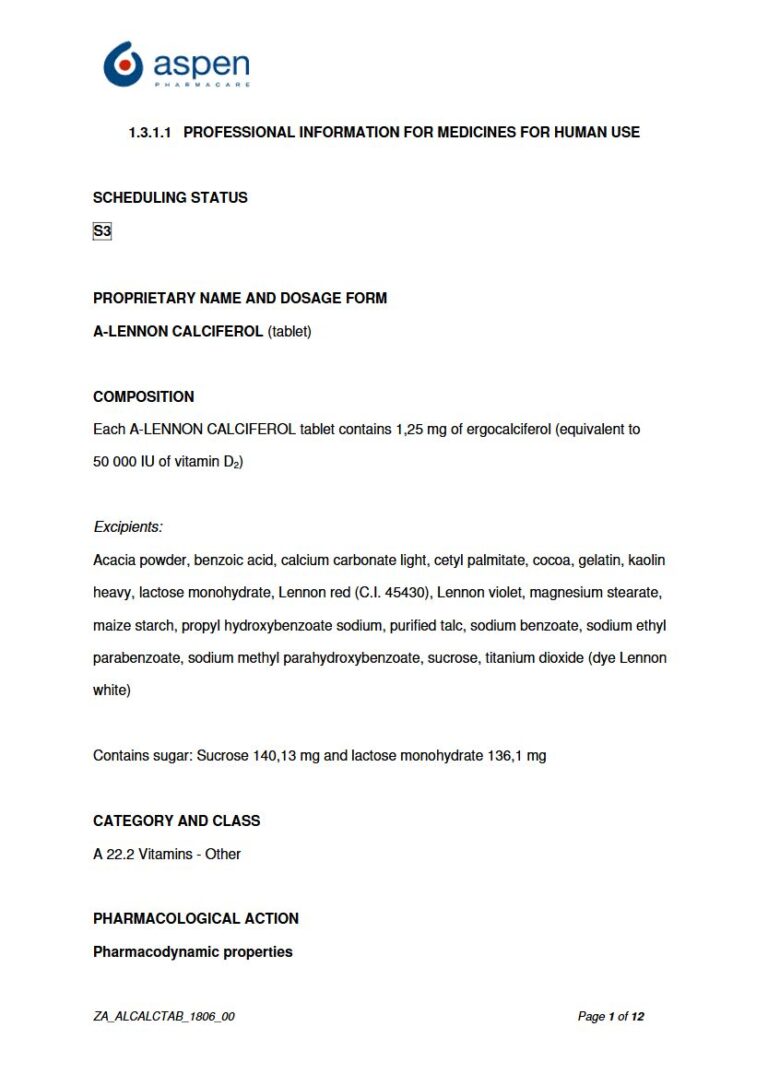
A-Lennon Calciferol 1,25 mg Tablet
PDF Leaflet Revision Date: 29 June 2018
Clinical Summary
Quick overview from the medicine insert
Indication
Indicated for rickets, osteomalacia, and hypoparathyroidism.
Dosage (summary)
1 tablet daily for rickets/osteomalacia; 1-4 tablets daily for hypoparathyroidism.
Special Populations
- Renal impairment
- Heart disease
Pregnancy & Breastfeeding
Contraindicated in pregnancy and lactation due to risk of hypercalcaemia.
Key Drug Interactions
- Barbiturates
- Anticonvulsants
- Digoxin
- Thiazide diuretics
- Rifampicin
- Isoniazid
Contraindications
- Hypersensitivity to calciferol
- Hypercalcaemia
- Nephrolithiasis
- Severe renal impairment
- Hypervitaminosis
Common side effects
- Hypercalcaemia
- Elevated serum creatinine
- Nausea
- Vomiting
- Fatigue
Counselling Points
- Take with adequate dietary calcium
- Avoid driving if drowsy
- Monitor for signs of hypercalcaemia
Serious warnings
- Risk of hypercalcaemia
- Monitor calcium levels
- Caution in renal impairment
Important Disclaimer
The A-Lennon Calciferol 1,25 mg Tablet professional information leaflet below is the property of Pharmacare and is provided on Medinsert exactly as issued, with no.. alterations or editorial changes. We make every effort to keep content current by updating documents as soon as new versions become available. Medinsert serves as a trusted access point for healthcare professionals, but does not replace official sources or clinical judgement. For more details, please read our full disclaimer. read more>>
 Healthcare Professionals Only
This content is for registered healthcare professionals
Sign in or create a free account to read the full package insert.
Free for HPCSA-registered professionals. Powered by Medinsert.
Clinical Particulars
Section 4 of the official insert — extracted exactly as issued, no alterations
4.1 Therapeutic indications
A-LENNON CALCIFEROL is indicated for:
- Rickets;
- osteomalacia;
- hypoparathyroidism.
4.2 Posology and method of administration
In the treatment of rickets and osteomalacia: One tablet daily (50 000 units). In the treatment of hypoparathyroidism: One to four tablets daily (50 000 to 200 000 units).
4.3 Contraindications
A-LENNON CALCIFEROL is contraindicated in:
- Patients with hypersensitivity to calciferol or to any of the excipients in A-LENNON CALCIFEROL (see COMPOSITION).
- Patients with hypercalcaemia and/or hypercalciuria.
- Patients with nephrolithiasis (renal calculi).
- Patients with severe renal impairment.
- Patients with hypervitaminosis.
- Pregnancy and lactation (see HUMAN REPRODUCTION).
4.4 Special warnings and precautions for use
Adequate dietary calcium is necessary for clinical response to A-LENNON CALCIFEROL therapy. The effects of A-LENNON CALCIFEROL may be reduced in patients taking barbiturates or anticonvulsants. Patients who have intestinal bypass surgery or have severe shortening or inflammation of the small intestine may fail to absorb vitamin D sufficiently; hepatic or biliary dysfunction also may seriously impair vitamin D absorption. Dietary supplementation with A-LENNON CALCIFEROL may be detrimental in persons already receiving an adequate intake through their diet and exposure to sunlight since the difference between therapeutic and toxic concentrations is relatively small. A-LENNON CALCIFEROL should be administered with caution in patients with mild to moderate renal impairment or heart disease, who might be at increased risk of organ damage if hypercalcaemia occurred. Because of the effect on serum calcium, A-LENNON CALCIFEROL should be avoided. Plasma phosphate concentrations should be controlled during A-LENNON CALCIFEROL therapy to reduce the risk of ectopic calcification. Adverse events are generally associated with excessive intake of A-LENNON CALCIFEROL leading to the development of hypercalcaemia. The symptoms of hypercalcaemia can include: Early: weakness, headache, somnolence, nausea, vomiting, dry mouth, constipation, diarrhoea, abdominal pain, fatigue, muscle weakness or pain, bone pain, metallic taste. Late: polyuria, polydipsia, anorexia, irritability, weight loss, nocturia, mild acidosis, reversible uraemia, generalised vascular calcification, nephrocalcinosis, conjunctivitis (calcific), pancreatitis, photophobia, rhinorrhoea, pruritus, hyperthermia, decreased libido, elevated blood urea nitrogen, albuminuria, hypercholesterolaemia, elevated AST and ALT, ectopic calcification, hypertension, cardiac dysrhythmias, overt psychosis (rare) (see SIDE EFFECTS and KNOWN SYMPTOMS OF OVERDOSE AND PARTICULARS OF ITS TREATMENTS). Should hyperglycaemia develop, A-LENNON CALCIFEROL should be discontinued immediately. A-LENNON CALCIFEROL should be prescribed with caution to patients suffering from sarcoidosis because of the risk of increased metabolism of vitamin D to its active form. These patients should be monitored with regard to the calcium content in serum and urine. The need for additional calcium supplementation should be considered for individual patients. Calcium supplements should be given under close medical supervision. All patients receiving doses of A-LENNON CALCIFEROL should have their plasma calcium and 25-hydroxycalciferol concentrations checked at initiation of treatment and whenever nausea and vomiting are present.
4.5 Interactions with other medicines
Magnesium-containing antacids: hypermagnesaemia may develop in patients on chronic renal dialysis. Digoxin: hypercalcaemia in patients on digoxin may precipitate cardiac dysrhythmias. Verapamil: atrial fibrillation has recurred when supplemental calcium and A-LENNON CALCIFEROL have induced hypercalcaemia. Anti-convulsants: A-LENNON CALCIFEROL requirements may be increased in patients taking anti-convulsants (e.g. carbamazepine, phenobarbitone, phenytoin and primidone) (see WARNINGS AND SPECIAL PRECAUTIONS). Thiazide diuretics: hypoparathyroid patients on A-LENNON CALCIFEROL may develop hypercalcaemia due to increased calciferol levels. Rifampicin: may reduce the effectiveness of A-LENNON CALCIFEROL due to hepatic enzyme induction. Isoniazid: may reduce the effectiveness of A-LENNON CALCIFEROL due to inhibition of the metabolic activation of calciferol. Glucocorticosteroids: can reduce the serum 25-hydroxycalciferol levels, requiring additional dose supplementation of A-LENNON CALCIFEROL. Medicines leading to fat malabsorption e.g. orlistat, liquid paraffin, cholestyramine, may impair the absorption of A-LENNON CALCIFEROL. Additional monitoring of serum calcium is recommended when therapy is combined with vitamin D analogues or metabolites. The cytotoxic medicine actinomycin and imidazole antifungal medicines interfere with vitamin D activity by inhibiting the conversion of 25-hydroxyvitamin D to 1,25-dihydroxyvitamin D by the kidney enzyme, 25-hydroxyvitamin D-1-hydroxylase. Phosphate infusions should not be administered to lower hypercalcaemia of hypervitaminosis D because of the dangers of metastatic calcification.
4.6 Fertility, pregnancy and lactation
Pregnancy: Hypercalcaemia during pregnancy may produce congenital disorders in the off-spring and neonatal hypoparathyroidism. A-LENNON CALCIFEROL must therefore not be used during pregnancy (see CONTRAINDICATIONS). Lactation: Women receiving therapeutic doses of A-LENNON CALCIFEROL must not breastfeed their infants as this may lead to the development of hypercalcaemia in the infant (see CONTRAINDICATIONS).
4.7 Effects on ability to drive and use machines
Since adverse reactions such as dizziness and drowsiness have been reported in patients receiving A-LENNON CALCIFEROL, patients should not drive, use machinery or perform any tasks that require concentration, until they are certain that A-LENNON CALCIFEROL does not adversely affect their ability to do so.
4.8 Undesirable effects
Metabolism and nutritional disorders: Frequent: Elevated serum creatinine levels. Less frequent: Hypercalcaemia, hypercalciuria. Frequency unknown: Anorexia, weight loss, mild acidosis, polydipsia. Psychiatric disorders: Frequency unknown: Mental disturbances, irritability, decrease libido, overt psychosis. Nervous system disorders: Frequency unknown: Headache, somnolence. Eye disorders: Frequency unknown: Conjunctivitis (calcific), photophobia. Ear and labyrinth disorders: Frequency unknown: Vertigo. Cardiac disorders: Frequency unknown: Changes in ECG measurements, cardiac dysrhythmias, hypertension. Vascular disorders: Frequency unknown: Generalised vascular calcification, hypertension. Respiratory, thoracic and mediastinal disorders: Frequency unknown: Rhinorrhoea. Gastrointestinal disorders: Frequency unknown: Nausea, vomiting, diarrhoea, constipation, abdominal pain, metallic taste, dry mouth, pancreatitis. Skin and subcutaneous disorders: Less frequent: Pruritus, rash, urticaria. Musculoskeletal, connective tissue and bone disorders: Frequency unknown: Muscle weakness or pain, joint pain, bone pain, ectopic calcification. Renal and urinary disorders: Frequency unknown: Kidney failure, nephrocalcinosis, renal calculi, polyuria, nocturia, albuminuria, reversible uraemia. General disorders and administration site conditions: Frequency unknown: Fatigue, weakness, hyperthermia. Investigations: Frequency unknown: Elevated blood urea nitrogen, elevated AST and ALT.
4.9 Overdose
A-LENNON CALCIFEROL is the most likely of all vitamins to cause overt toxicity. Infants and children are generally more susceptible to its toxic effects. Administration to patients in excess of their daily requirements can cause hypercalcaemia, hypercalciuria and hyperphosphataemia. Concomitant high intake of calcium and phosphate may lead to similar abnormalities. A-LENNON CALCIFEROL should be withdrawn if toxicity occurs. Adverse events are generally associated with excessive intake of A-LENNON CALCIFEROL leading to the development of hypercalcaemia (see WARNINGS AND SPECIAL PRECAUTIONS and SIDE EFFECTS). Treatment: Treatment of hypervitaminosis D consists of immediate withdrawal of A-LENNON CALCIFEROL, a low calcium diet, avoidance of sunlight administration of glucocorticoids, and vigorous fluid support. Severe cases may require hydration with intravenous saline together with symptomatic and supportive treatment as indicated by the patientu2019s clinical condition. Plasma calcium U & Eu2019s (urea and electrolytes) should be monitored. Phosphate infusion should not be administered to lower hypercalcaemia of hypervitaminosis D because dangers of metastatic calcification.
