
Cipralex 20 Mg/5 mg/10 mg/15 mg Tablets
PDF Leaflet Revision Date: 13 August 2024
Clinical Summary
Quick overview from the medicine insert
Indication
Treatment of major depressive episodes and anxiety disorders.
Dosage (summary)
Adults: 10 mg daily, max 20 mg. Elderly: lower initial/max dose.
Onset of Action / Duration
Onset: 2-4 weeks, Duration: several months.
Special Populations
- Elderly
- Renal impairment
- Hepatic impairment
Pregnancy & Breastfeeding
Not recommended during pregnancy; avoid breastfeeding.
Key Drug Interactions
- MAO inhibitors
- Pimozide
- Linezolid
- Serotonergic drugs
Contraindications
- Hypersensitivity to escitalopram
- Children < 18 years
- MAO inhibitors
Common side effects
- Nausea
- Insomnia
- Dizziness
- Sexual dysfunction
Counselling Points
- Monitor for suicidal thoughts
- Gradual dose tapering recommended
- Avoid abrupt discontinuation
Serious warnings
- Risk of suicidal thoughts
- QT prolongation
- Serotonin syndrome
Important Disclaimer
The Cipralex 20 Mg/5 mg/10 mg/15 mg Tablets professional information leaflet below is the property of H Lundbeck and is provided on Medinsert exactly as issued, with no.. alterations or editorial changes. We make every effort to keep content current by updating documents as soon as new versions become available. Medinsert serves as a trusted access point for healthcare professionals, but does not replace official sources or clinical judgement. For more details, please read our full disclaimer. read more>>
 Healthcare Professionals Only
This content is for registered healthcare professionals
Sign in or create a free account to read the full package insert.
Free for HPCSA-registered professionals. Powered by Medinsert.
Clinical Particulars
Section 4 of the official insert — extracted exactly as issued, no alterations
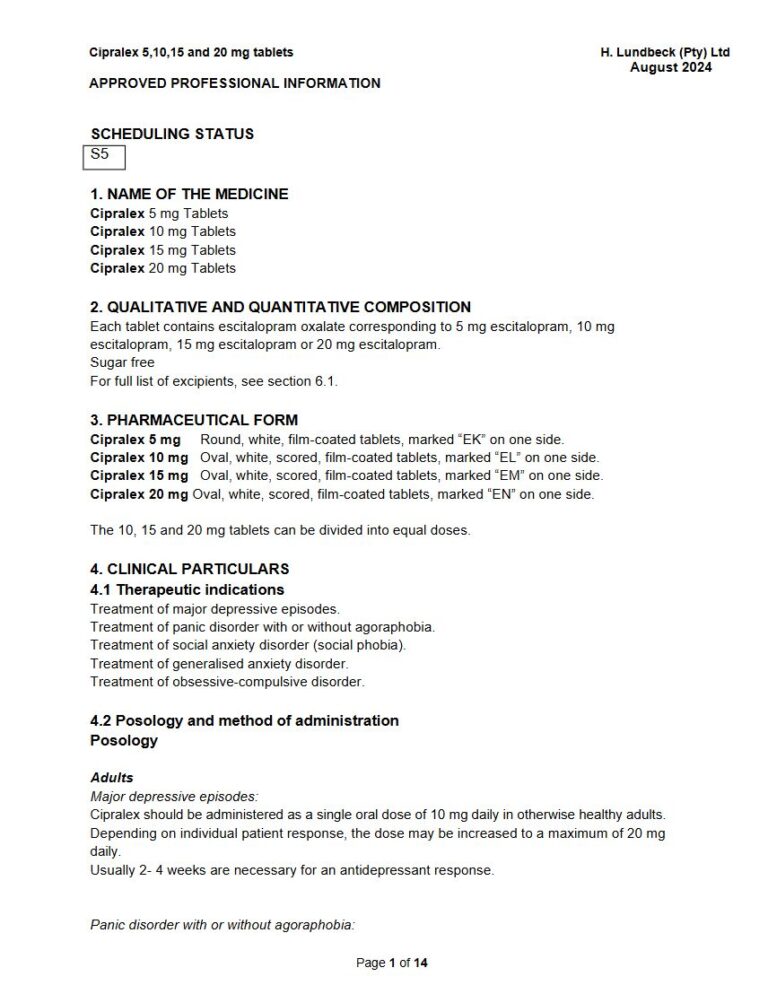
4.1 Therapeutic indications
Treatment of major depressive episodes.
Treatment of panic disorder with or without agoraphobia.
Treatment of social anxiety disorder (social phobia).
Treatment of generalised anxiety disorder.
Treatment of obsessive - compulsive disorder.
4.2 Posology and method of administration
Posology
Adults
Major depressive episodes: Cipralex should be administered as a single oral dose of 10 mg daily in otherwise healthy adults. Depending on individual patient response, the dose may be increased to a maximum of 20 mg daily. Usually 2 - 4 weeks are necessary for an antidepressant response.
Panic disorder with or without agoraphobia: A single oral dose of 5 mg is recommended for the first week before increasing the dose to 10 mg daily. The dose may be further increased, up to a maximum of 20 mg daily, dependent on individual patient response. Maximum effectiveness is reached after about 3 months. The treatment lasts several months.
Social anxiety disorder: Usual dosage is 10 mg once daily. The dose may be increased to a maximum of 20 mg daily depending on individual patient response. Usually 2 - 4 weeks are necessary to obtain symptom relief. Treatment for 3 months is recommended to consolidate response. Long - term treatment of responders for 6 months has been shown to prevent relapse and can be considered on an individual basis. Treatment benefits should be re - evaluated at regular intervals.
Generalised anxiety disorder: Recommended dosage is 10 mg once daily. Depending on individual patient response, the dose may be increased to a maximum of 20 mg daily. Long term treatment of responders has been studied for at least 6 months and can be considered on an individual basis to prevent relapse.
Obsessive - compulsive disorder: Usual dosage is 10 mg once daily. Depending on individual patient response, the dose may be increased to 20 mg daily. Long - term treatment of patients responding to a 16 - week open treatment phase has been studied for at least 24 weeks in patients receiving 10 or 20 mg/day. As OCD is a chronic disease, patients should be treated for a sufficient period to ensure that they are symptom free. This period may be several months or even longer.
Elderly patients (> 65 years of age): A longer half - life and a decreased clearance have been demonstrated in the elderly, therefore a lower initial and maximum dose should be considered.
Children and adolescents (< 18 years): Safety and efficacy have not been investigated in this population (see section 4.3).
Reduced renal function: Dosage adjustment is not necessary in patients with mild or moderate renal impairment. No information is available on the treatment of patients with severely reduced renal function (creatinine clearance < 30 ml/min).
Reduced hepatic function: Dosages should be halved to the lower end of the dose range in patients with hepatic insufficiency.
Withdrawal reactions: When stopping treatment with Cipralex the dose should be gradually reduced over a period of one or two weeks in order to avoid possible withdrawal reactions (see section 4.4).
Method of administration: Cipralex is administered as a single daily dose. Cipralex may be taken without regard to food intake.
4.3 Contraindications
Hypersensitivity to escitalopram, the active ingredient of Cipralex, or to any of the excipients as listed in section 6.1.
Children and adolescents under the age of 18 years.
Monoamine Oxidase Inhibitors - Cases of serious reactions have been reported in patients receiving an SSRI in combination with a monoamine oxidase inhibitor (MAOI), and in patients who have recently discontinued an SSRI and have been started on an MAOI (see section 4.5). Some cases presented with features resembling serotonin syndrome (see section 4.8). Cipralex should not be used in combination with an MAOI. Cipralex may be started 14 days after discontinuing treatment with an MAOI. At least 7 days should elapse after discontinuing Cipralex treatment before starting an MAOI.
Concomitant treatment with linezolid.
Concomitant treatment with pimozide as the combination may lead to clinically significant QT prolongation. Cipralex is contraindicated in patients with known QT interval prolongation or congenital long QT syndrome.
4.4 Special warnings and precautions for use
Safety and efficacy in children and adolescents under the age of 18 years have not been established (see section 4.3). Cipralex should not be used in the treatment of children and adolescents under the age of 18 years. Suicide related behaviours (suicide attempt, suicidal thoughts as well as suicidal ideation and self - harm), and hostility (predominantly aggression, oppositional behaviour and anger) were more frequently observed in clinical trials among children and adolescents treated with antidepressants including SSRIs such as Cipralex.
Mania u2013 Cipralex should be discontinued in any patient entering a manic phase. Cipralex should be used with caution in patients with a history of mania/hypomania.
Paradoxical anxiety - Some patients with panic disorder may experience increased anxiety symptoms at the start of treatment with antidepressants including Cipralex. This paradoxical reaction usually subsides within two weeks during continued treatment. A low starting dose is advised to reduce the likelihood of a paradoxical anxiogenic effect.
Seizures - Cipralex should be discontinued if a patient develops seizures for the first time, or if there is an increase in seizure frequency (in patients with a previous diagnosis of epilepsy). Cipralex should be avoided in patients with unstable epilepsy and patients with controlled epilepsy should be carefully monitored.
Diabetes mellitus - In patients with diabetes mellitus treatment with Cipralex may alter glycaemic control, possibly due to improvement of depressive symptoms. Insulin and/or oral hypoglycaemic dosage may need to be adjusted.
Suicide/thoughts or clinical worsening - Patients with depression may experience worsening of their depression and or the emergence of suicidal thoughts, ideation, self - harm and suicide (suicide - related events) whether or not they are taking antidepressant medicines. This risk may persist until significant remission occurs. As improvement may not occur during the first weeks or more of treatment, patients being treated with Cipralex should be closely monitored until such improvement occurs. It is general clinical experience that the risk of suicide may increase in the early stages of recovery. Other psychiatric conditions for which Cipralex is prescribed can also be associated with an increased risk of suicide - related events. In addition, these conditions may be co - morbid with major depressive disorder. The same precautions observed when treating patients with major depressive disorder should therefore be observed when treating patients with other psychiatric disorders. Patients with a history of suicide - related events, or those exhibiting a significant degree of suicidal ideation prior to commencement of treatment, are known to be at greater risk of suicidal thoughts or suicide attempts and should receive careful monitoring during treatment.
A meta - analysis of placebo controlled clinical trials of antidepressant medicines in adult patients with psychiatric disorders showed an increased risk of suicidal behaviour with antidepressants compared to placebo in patients less than 25 years old. Close supervision of patients and in particular those at high risk should accompany Cipralex especially in early treatment and following dose changes. Patients (and caregivers of patients) should be alerted about the need to monitor for any clinical worsening, suicidal behaviour or thoughts and unusual changes in behaviour and to seek medical advice immediately if these symptoms present.
The following symptoms have been reported in patients being treated with antidepressants such as Cipralex for major depressive disorder as well as for other indications, both psychiatric and non - psychiatric: anxiety, agitation, panic attacks, insomnia, irritability, hostility, aggressiveness, impulsivity, akathisia, hypomania and mania. Although a causal link between the emergence of such symptoms and either the worsening of depression and/or the emergence of suicidal impulses has not been established, consideration should be given to changing the therapeutic regimen, including possibly discontinuing Cipralex, in patients for whom such symptoms are severe, abrupt in onset, or were not part of the patientu2019s presenting symptoms. If the decision is made to discontinue treatment, Cipralex should be tapered (see section 4.2 and section 4.4).
Akathisia/psychomotor restlessness - The use of SSRIs/SNRIs has been associated with the development of akathisia, characterised by a subjectively unpleasant or distressing restlessness and need to move often accompanied by an inability to sit or stand still. This is most likely to occur within the first few weeks of treatment. In patients who develop these symptoms, increasing the dose may be detrimental and it may be necessary to review the use of Cipralex.
Hyponatraemia - Hyponatraemia, probably due to inappropriate antidiuretic hormone secretion (SIADH), has been reported with the use of SSRIs and generally resolves on discontinuation of therapy. Caution should be exercised in patients at risk, such as the elderly, or patients with cirrhosis or if Cipralex is used in combination with other medications which may cause hyponatraemia.
Haemorrhage - There have been reports of cutaneous bleeding abnormalities, such as ecchymoses and purpura, with Cipralex. SSRIs/SNRIs may increase the risk of postpartum haemorrhage (see sections 4.6, 4.8). Caution is advised in patients taking Cipralex, particularly in concomitant use with medicines known to affect platelet function (e.g. atypical antipsychotics and phenothiazines, most tricyclic antidepressants, aspirin and non - steroidal anti - inflammatory medicines (NSAIDs), as well as in patients with a history of bleeding disorders.
ECT (electroconvulsive therapy) u2013 There is limited published clinical experience of concurrent administration of Cipralex and ECT, therefore caution is advisable.
Monoamine oxidase inhibitor (MAOI) u2013 Cases of serious reactions have been reported in patients receiving an SSRI in combination with a monoamine oxidase inhibitor (MAOI), and in patients who have recently discontinued an SSRI and have been started on a MAOI. In some cases the patient developed serotonin syndrome (see section 4.8). Cipralex should not be used in combination with a MAOI (see section 4.3). Cipralex may be started 14 days after discontinuing treatment with an MAOI. At least 7 days should elapse after discontinuing Cipralex treatment before starting a MAOI. The combination of escitalopram with MAO - A inhibitors is contraindicated.
Serotonin syndrome - Caution is advisable if Cipralex is used concomitantly with medicinal products with serotonergic effects such as triptans (including sumatriptan), opioids (including tramadol), and tryptophan. Serotonin syndrome has been reported in patients using SSRIs concomitantly with serotonergic medicinal products. A combination of symptoms, such as agitation, tremor, myoclonus and hyperthermia may indicate the development of this condition. If this occurs treatment with the Cipralex and the serotonergic medicinal product should be discontinued immediately and symptomatic treatment initiated.
St. Johnu00b4s Wort - Concomitant use of SSRIs such as Cipralex and herbal remedies containing St. Johnu00b4s Wort (Hypericum perforatum) may result in an increased incidence of adverse reactions.
Discontinuation symptoms seen when stopping treatment: Discontinuation symptoms when stopping treatment are common, particularly if discontinuation is abrupt (see section 4.8).
4.5 Interactions with other medicines
Escitalopram, the active ingredient of Cipralex, has a low potential for clinically significant medicine interactions. In vitro studies have shown that the biotransformation of escitalopram to its demethylated metabolites depends on three parallel pathways (cytochrome P450 (CYP) 2 C19, 3A4 and 2D6). Escitalopram is a very weak inhibitor of isoenzyme CYP1A2, 2C9, 2C19, 2E1, and 3A, and weak inhibitor of 2D6.
Effects of other medicinal products on Cipralex in vivo: The pharmacokinetics of single doses of Cipralex was not changed by co - administration with a single dose of ritonavir (CYP3A4 inhibitor). Furthermore, co - administration with ketoconazole (potent CYP3A4 inhibitor) did not change the pharmacokinetics of racemic citalopram. Co - administration of racemic citalopram with cimetidine (potent CYP2D6, 3A4 and 1A2 inhibitor) resulted in increased plasma concentrations of the racemate (43 % increase in AUC, 39 % increase in Cmax). Thus, caution should be exercised at the upper end of the dose range of Cipralex when used concomitantly with high doses of cimetidine.
Monoamine Oxidase (MAO) Inhibitors: Co - administration with MAO inhibitors may cause serotonin syndrome (see section 4.3 and section 4.4). Co - administration with other serotonergic medicines e.g. opioids (including tramadol), and triptans (including sumatriptan) as well as other antidepressants with serotonergic properties may lead to an enhancement of serotonin associated effects, e.g. the serotonin syndrome. There have been reports of enhanced effects when Cipralex has been given with lithium or tryptophan and therefore concomitant use of Cipralex with these medicines should be undertaken with caution.
Effects of Cipralex on other medicinal products in vivo: Co - administration with a single dose of desipramine (a CYP2D6 substrate) resulted in a twofold increase in plasma levels of desipramine. Therefore, caution is advised when Cipralex and desipramine are co - administered. A similar increase in plasma levels of desipramine, after administration of imipramine, was seen when given together with racemic citalopram. Co - administration with a single dose of metoprolol 100 mg (a CYP2D6 substrate) resulted in a twofold increase in the Cmax and a 52 % increase of the AUC of metoprolol. However, the combination had no clinically significant effects on blood pressure and heart rate. The pharmacokinetics of ritonavir (CYP3A4 inhibitor) was not changed by co - administration with Cipralex.
Selegiline: The combination with selegiline (irreversible MAO - B inhibitor), is contraindicated due to the risk of developing serotonin syndrome. Racemic citalopram increased the AUC of selegiline by 29 %.
Pimozide: Co - administration of a single dose of pimozide 2 mg to subjects treated with racemic citalopram 40 mg/day for 11 days caused an increase in AUC and Cmax of pimozide. The co - administration of pimozide and citalopram resulted in a mean increase in the QT interval of approximately 10 msec. Due to the interaction noted at a low dose of pimozide, concomitant administration of citalopram and pimozide is contraindicated. Furthermore, pharmacokinetic interaction studies with racemic citalopram have demonstrated no clinically important interactions with carbamazepine (CYP3A4 substrate), triazolam (CYP3A4 substrate), theophylline (CYP1A2 substrate) (single dose), warfarin (CYP3A4 and CYP2C9 substrate), levomepromazine (CYP2D6 inhibitor), lithium and digoxin. However, prothrombin time was slightly increased after a single dose of 25 mg warfarin. The International Normalised Ratio (INR) needs to be carefully monitored in patients on the combination of warfarin and Cipralex.
When using Cipralex with the following medicines, caution should be exercised:
- Medicinal products lowering the seizure threshold: SSRIs such as Cipralex can lower the seizure threshold. Caution is advised when concomitantly using other medicinal products capable of lowering the seizure threshold (e.g. antidepressants (tricyclics, SSRIs) neuroleptics (phenothiazines, thioxanthenes, butyrophenones) mefloquine, bupropion, and tramadol).
- Flecainide, propafenone, metoprolol, desipramine, clomipramine, nortriptyline, risperidone, thioridazine, and haloperidol. The dosage of Cipralex may need to be adjusted.
- St Johnu2019s wort: Concomitant use of SSRIs and herbal remedies containing St. Johnu2019s Wort (Hypericum perforatum) may result in an increased incidence of adverse reactions (see section 4.4).
- Concomitant use of Non - Steroidal Anti - inflammatory Drugs (NSAIDs) may increase bleeding tendency (see section 4.4).
4.6 Fertility, pregnancy and lactation
Pregnancy: Cipralex should not be used during pregnancy. Limited clinical data are available regarding exposure to Cipralex during pregnancy. In reproductive toxicity studies performed in rats, embryo - fetotoxic effects (reduced foetal weight and minor delay in ossification) were observed with exposure to escitalopram, the active ingredient of Cipralex, but there was no effect on foetal viability and no increased incidence of malformations. If Cipralex is used until or shortly before birth, discontinuation effects in the newborn are possible. Using Cipralex in the third trimester may result in effects, including neurobehavioral disturbances, in the newborn infant. The following symptoms may occur in the newborn after maternal SSRI/SNRI use such as Cipralex in later stages of pregnancy: respiratory distress, cyanosis, apnoea, seizures, temperature instability, feeding difficulty, vomiting, hypoglycaemia, hypertonia, hypotonia, hyperreflexia, tremor, jitteriness, irritability, lethargy, constant crying, somnolence and difficulty sleeping. These symptoms could be due to either discontinuation effects or excess serotonergic activity. In a majority of instances, such complications begin immediately or soon (<24 hours) after delivery. Epidemiological data have suggested that the use of SSRIs such as Cipralex in pregnancy, particularly in late pregnancy may increase the risk of persistent pulmonary hypertension in the newborn (PPHN). Observational data indicate an increased risk (less than 2 - fold) of postpartum haemorrhage following SSRI/SNRI exposure within the month prior to birth (see sections 4.4, 4.8).
Lactation: Escitalopram is excreted in breastmilk and breastfeeding is not recommended during the treatment.
Fertility: Animal data have shown that some SSRIs may affect sperm quality. Human case reports with some SSRIs have shown that an effect on sperm quality is reversible. Impact on human fertility has not been observed so far.
4.7 Effects on ability to drive and use machines
Cipralex does not impair intellectual function or psychomotor performance. Nevertheless, patients who are depressed and require treatment may have an impaired ability to drive or operate machinery. They should be warned of the possibility and advised to avoid such tasks if so affected.
4.8 Undesirable effects
Adverse reactions observed with Cipralex are most frequent during the first one or two weeks of treatment and may decrease in intensity and frequency with continued treatment. Adverse reactions known for SSRIs and also reported for Cipralex in either placebo - controlled clinical studies or as spontaneous post - marketing events are listed below by system organ class and frequency. Frequencies are taken from clinical studies; they are not placebo - corrected. Frequencies are defined as: very common (u22651/10), common (u22651/100 to <1/10), uncommon (u22651/1000 to u22641/100), rare (u22651/10000 to u22641/1000), very rare (u22641/10000), or not known (cannot be estimated from the available data).
System organ class Frequency Undesirable effect
Blood and lymphatic system disorders Not known Thrombocytopenia
Immune system disorders Rare Angiodema, anaphylactic reaction
Endocrine disorders Not known Inappropriate ADH secretion, Hyperprolactinaemia
Metabolism and nutrition Common Decreased appetite, increased appetite, weight increased
Uncommon Weight decreased
Not known Hyponatraemia, anorexia
Psychiatric disorders Common Anxiety, restlessness, abnormal dreams
Female and male: libido decreased female: anorgasmia
Uncommon Bruxism, agitation, nervousness, panic attack, confusional state
Rare Aggression, depersonalisation, hallucination
Not known Mania, suicidal ideation, suicidal behaviour
Nervous system disorders Common Insomnia, somnolence, dizziness, paraesthesia, tremor
Uncommon Taste disturbance, sleep disorder, syncope
Rare Serotonin syndrome
Not known Dyskinesia, movement disorder, convulsion, psychomotor restlessness/akathisia
Eye disorders Uncommon Mydriasis, visual disturbance
Ear and labyrinth disorders Uncommon Tinnitus
Cardiac disorders Uncommon Tachycardia
Rare Bradycardia
Not known Electrocardiogram QT prolonged
Vascular disorders Not known Orthostatic hypotension
Respiratory, thoracic and mediastinal disorders Common Sinusitis, yawning
Uncommon Epistaxis
Gastrointestinal disorders Very common Nausea
Common Diarrhoea, constipation, vomiting, dry mouth
Uncommon Gastrointestinal haemorrhages (including rectal haemorrhage)
Hepatobiliary disorders Not known Hepatitis, liver function test abnormal
Skin and subcutaneous tissue disorders Common Sweating increased
Uncommon Urticaria, alopecia, rash, pruritus
Not known Ecchymosis, angioedemas
Musculoskeletal and connective tissue disorders Common Arthralgia, myalgia
Renal and urinary disorders Not known Urinary retention
Reproductive system and breast disorders Common Male: ejaculation disorder, impotence
Uncommon Female: metrorrhagia, menorrhagia
Not known Galactorrhoea, Female: postpartum haemorrhage
Male: priapism
General disorders and administrative site conditions Common Fatigue, pyrexia
Uncommon Oedema
Cases of suicidal ideation and suicidal behaviours have been reported during escitalopram therapy or early after treatment discontinuation (see section 4.4).
This event has been reported for the therapeutic class of SSRIs/SNRIs (see sections 4.4, 4.6).
Cases of QT - prolongation have been reported during the post - marketing period, predominantly in patients with pre - existing cardiac disease. QT - prolongation may lead to ventricular dysrhythmia and torsade de pointes. Epidemiological studies, mainly conducted in patients 50 years of age and older, show an increased risk of bone fractures in patients receiving SSRIs. The mechanism leading to this risk is unknown. The following symptoms, hostility, suicidal ideation and self - harm, have been reported in children being treated with antidepressants. After prolonged administration abrupt cessation of Cipralex may produce withdrawal reactions in some patients.
Discontinuation symptoms seen when stopping treatment: Discontinuation of SSRIs/SNRIs (particularly when abrupt) commonly leads to discontinuation symptoms. Dizziness, sensory disturbances (including paraesthesia and electric shock sensations), sleep disturbances (including insomnia and intense dreams), agitation or anxiety, nausea and/or vomiting, tremor, confusion, sweating, headache, diarrhoea, palpitations, emotional instability, irritability, and visual disturbances are the most commonly reported reactions. Generally, these events are mild to moderate and are self - limiting, however, in some patients they may be severe and/or prolonged. It is therefore advised that when Cipralex treatment is no longer required, gradual discontinuation by dose tapering should be carried out (see section 4.2 and 4.4).
4.9 Overdose
Symptoms and signs as described in the side effects section may occur. Treatment: There is no specific antidote. Treatment is supportive and symptomatic. The use of activated charcoal should be considered. Cardiac and vital signs monitoring are recommended along with general symptomatic supportive measures. ECG monitoring is advised in case of overdose in patients with congestive heart failure/bradydysrhythmias, in patients using concomitant medications that prolong the QT interval, or in patients with altered metabolism, e.g. liver impairment.
