
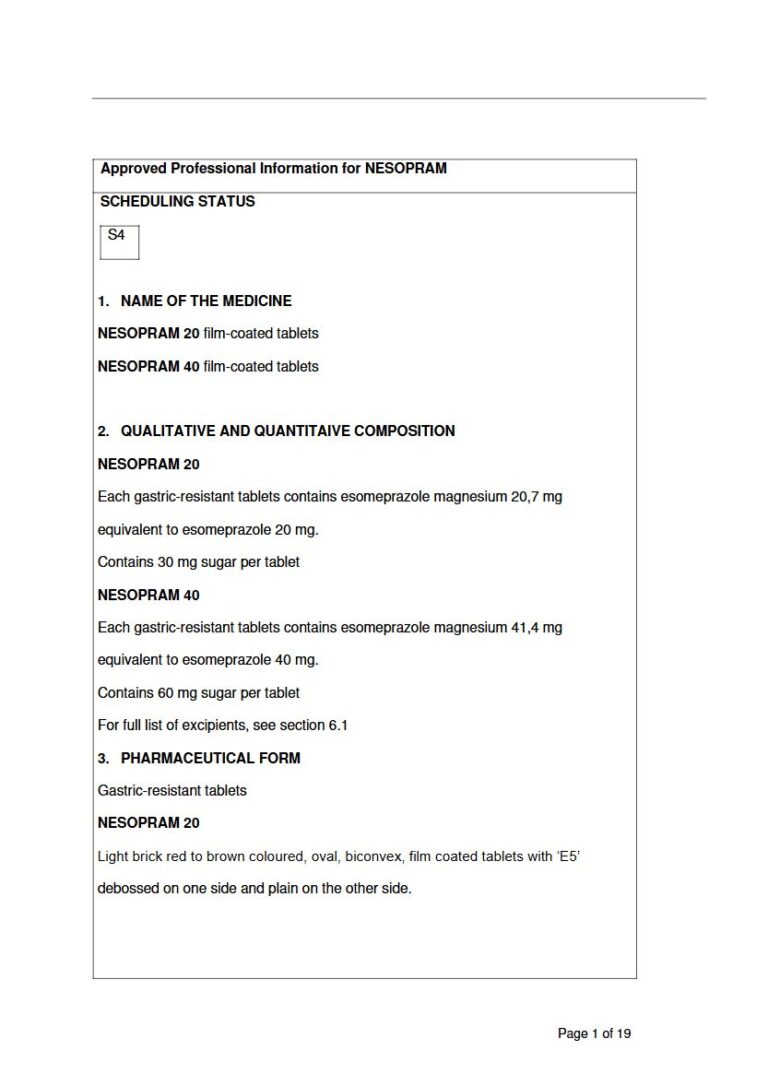
Nesopram 20 mg, 40mg FC tablets
PDF Leaflet Revision Date: 14 August 2022
Clinical Summary
Quick overview from the medicine insert
Indication
Treatment of gastric-oesophageal reflux disease and prevention of NSAID-associated ulcers.
Dosage (summary)
40 mg once daily for 4 weeks for erosive reflux; 20 mg once daily for maintenance.
Onset of Action / Duration
Onset: 1 hour, Duration: 24 hours
Special Populations
- Renal impairment
- Hepatic impairment
- Elderly
Pregnancy & Breastfeeding
Safety not established during pregnancy or breastfeeding.
Key Drug Interactions
- Clopidogrel
- Atazanavir
- Nelfinavir
- Methotrexate
- Tacrolimus
Contraindications
- Hypersensitivity to esomeprazole
- Co-administration with atazanavir and nelfinavir
Common side effects
- Headache
- Abdominal pain
- Diarrhoea
- Nausea
Counselling Points
- Take whole with liquid, do not chew
- Monitor for persistent symptoms
- Report any unusual skin reactions
Serious warnings
- Risk of Clostridium difficile diarrhoea
- Severe hypomagnesaemia
- Increased fracture risk
Important Disclaimer
The Nesopram 20 mg, 40mg FC tablets professional information leaflet below is the property of Ranbaxy Pharmaceuticals and is provided on Medinsert exactly as issued, with no.. alterations or editorial changes. We make every effort to keep content current by updating documents as soon as new versions become available. Medinsert serves as a trusted access point for healthcare professionals, but does not replace official sources or clinical judgement. For more details, please read our full disclaimer. read more>>
 Healthcare Professionals Only
This content is for registered healthcare professionals
Sign in or create a free account to read the full package insert.
Free for HPCSA-registered professionals. Powered by Medinsert.
Clinical Particulars
Section 4 of the official insert — extracted exactly as issued, no alterations
4.1 Therapeutic indications
Gastric-oesophageal Reflux Disease (GORD):
- treatment of erosive reflux oesophagitis
- long-term management of patients with healed oesophagitis to prevent relapse
- symptomatic treatment of gastric-oesophageal reflux disease (GORD).
Patients requiring continued NSAID therapy:
- prevention of gastric and duodenal ulcers associated with non-steroidal anti-inflammatory drug (NSAID) therapy in patients at risk.
In combination with appropriate antibacterial therapeutic regimens for the eradication of Helicobacter pylori:
- healing of Helicobacter pylori associated duodenal ulcer
- prevention of relapse of peptic ulcers in patients with Helicobacter pylori associated ulcer disease.
NESOPRAM has been used in pathological hypersecretory conditions including Zollinger-Ellison syndrome and idiopathic hypersecretion.
4.2 Posology and method of administration
Posology
Gastric-oesophageal Reflux Disease (GORD)
Erosive reflux oesophagitis: 40 mg once daily for 4 weeks. If symptom control has not been achieved after four weeks of treatment with the prescribed daily dose, further investigation is recommended.
Long-term management of patients with healed oesophagitis to prevent relapse: 20 mg once daily
Symptomatic treatment of gastric-oesophageal reflux disease (GORD): 20 mg once daily in patients without oesophagitis. If symptom control has not been achieved after 4 weeks, the patient should be further investigated. Once symptoms have resolved, subsequent symptom control can be achieved using an on demand regimen, taking 20 mg once daily, when needed.
Patients requiring continued NSAID therapy
Prevention of gastric and duodenal ulcers associated with NSAID therapy in patients at risk: 20 mg or 40 mg once daily.
In combination with appropriate antibacterial therapeutic regimens for the eradication of Helicobacter pylori
- healing of Helicobacter pylori associated duodenal ulcer
- prevention of relapse of peptic ulcers in patients with Helicobacter pylori associated ulcer disease: NESOPRAM 20 with 1 g amoxicillin and 500 mg clarithromycin, all twice daily for 7 days.
Pathological hypersecretory conditions including Zollinger-Ellison syndrome and idiopathic hypersecretion
The recommended initial dosage is NESOPRAM 40 mg twice daily. The dosage should then be individually adjusted and treatment continued as long as clinically indicated. Doses up to 120 mg twice daily have been administered.
Adolescents 12-18 years
Gastro-oesophageal Reflux Disease (GORD)
- Treatment of erosive reflux oesophagitis 40 mg once daily for 4 weeks. An additional 4 weeks treatment is recommended for patients in whom oesophagitis has not healed or who have persistent symptoms.
- Long-term management of patients with healed oesophagitis to prevent relapse 20 mg once daily.
- Symptomatic treatment of Gastro-oesophageal Reflux Disease (GORD) 20 mg once daily in patients without oesophagitis. If symptom control has not been achieved after 4 weeks, the patient should be further investigated. Once symptoms have resolved, subsequent symptom control can be achieved using 20 mg once daily under medical supervision.
Children
As a NESOPRAM 10 mg dosage form is not available, use in children younger than 12 years of age cannot be recommended.
Special populations
Impaired renal function
Dose adjustment is not required in patients with impaired renal function. Due to limited experience in patients with severe renal insufficiency, such patients should be treated with caution.
Impaired hepatic function
Dose adjustment is not required in patients with mild to moderate liver impairment. For patients with severe liver impairment, a maximum daily dose of 20 mg NESOPRAM should be used.
Elderly
Dose adjustment is not required in the elderly.
Method of administration
The tablets should be swallowed whole with liquid. The tablets should not be chewed or crushed. The tablets can also be dispersed in half a glass of non-carbonated water. No other liquids should be used. Stir until the tablets disintegrate and drink the liquid with the pellets immediately or within 30 minutes. Rinse the glass with half a glass of water and drink. The pellets must not be chewed or crushed.
For patients who cannot swallow, the tablets can be dispersed in non-carbonated water and administered through a gastric tube.
4.3 Contraindications
- Known hypersensitivity to esomeprazole, substituted benzimidazoles or any other constituents of NESOPRAM (see section 6.1).
- Co-administration with atazanavir and nelfinavir (see section 4.5)
4.4 Special warnings and precautions for use
NESOPRAM is not indicated for mild gastric-intestinal complaints such as nervous dyspepsia.
Prior to treatment or in the presence of any alarm symptom (e.g. significant unintentional weight loss, recurrent vomiting, dysphagia, haematemesis or melaena) and when gastric ulcer is suspected or present, the possibility of malignancy of gastric ulcer or a malignant disease of the oesophagus should be excluded as the treatment with NESOPRAM may alleviate the symptoms of malignant ulcers and can thus delay diagnosis.
Patients on long-term treatment (particularly those treated for more than a year) should be kept under regular surveillance.
Clostridium difficile associated diarrhoea: PPI therapy like esomeprazole as in NESOPRAM may be associated with an increased risk of Clostridium difficile associated diarrhoea, especially in hospitalised patients. Symptoms include watery diarrhoea, stomach pain and fever. This diagnosis should be considered for diarrhoea that does not improve. Patients should use the lowest dose and shortest duration of NESOPRAM therapy appropriate to the condition being treated.
Hypomagnesaemia
Severe hypomagnesaemia has been reported in patients treated with proton pump inhibitors (PPIs) like esomeprazole as in NESOPRAM for at least three months, and in most cases for a year. Serious manifestations of hypomagnesaemia such as fatigue, tetany, delirium, convulsions, dizziness and ventricular dysarrhythmia can occur but they may begin insidiously and be overlooked. In most affected patients, hypomagnesaemia improved after magnesium replacement and discontinuation of the PPI.
For patients expected to be on prolonged treatment or who take PPIs with digoxin or medicines that may cause hypomagnesaemia (e.g., diuretics), healthcare professionals should consider measuring magnesium levels before starting PPI treatment and periodically during treatment.
Risk of fracture
Proton pump inhibitors, especially if used in high doses and over long durations (> 1 year), may modestly increase the risk of hip, wrist and spine fracture, predominantly in the elderly or in presence of other recognised risk factors. Observational studies suggest that proton pump inhibitors may increase the overall risk of fracture by 10 u2013 40 %. Some of this increase may be due to other risk factors. Patients at risk of osteoporosis should receive care according to current clinical guidelines and they should have an adequate intake of vitamin D and calcium.
Subacute cutaneous lupus erythematosus (SCLE):
Proton pump inhibitors are associated with infrequent cases of SCLE. If lesions occur, especially in sun-exposed areas of the skin, and if accompanied by arthralgia, the patient should seek medical help promptly and the health care professional should consider stopping NESOPRAM SLCE after previous treatment with a proton pump inhibitor may increase the risk of SCLE with other proton pump inhibitors.
Helicobacter pylori eradication
When prescribing NESOPRAM for eradication of Helicobacter pylori possible interactions for all components in the triple therapy should be considered. Clarithromycin is a potent inhibitor of CYP3A4 and hence contra-indications and interactions for clarithromycin should be considered when the triple therapy is used in patients concurrently taking other medicines metabolised via CYP3A4 such as cisapride.
Gastrointestinal infections
Treatment with proton pump inhibitors may lead to slightly increased risk of gastrointestinal infections such as Salmonella and Campylobacter.
Renal failure
Interstitial nephritis may progress to chronic renal inflammation and renal failure as it is not necessarily reversed when treatment is discontinued.
Absorption of vitamin B12
NESOPRAM may reduce the absorption of vitamin B12 (cyanocobalamin) due to hypo- or achlorhydria. This should be considered in patients with reduced body stores or risk factors for reduced vitamin B12 absorption on long-term therapy.
Sucrose
NESOPRAM contains sucrose. Patients with rare hereditary conditions such as fructose intolerance, glucose-galactose mal-absorption or sucrase-isomaltase insufficiency should not take NESOPRAM. Sucrose may have an effect on the glycaemic control of patients with diabetes mellitus.
4.5 Interaction with other medicines and other forms of interaction
Effects of NESOPRAM on the pharmacokinetics of other medicines
Clopidogrel
Studies in healthy subjects have shown that concomitant use of esomeprazole and clopidogrel resulted in reduced plasma concentrations of the active metabolite of clopidogrel and a reduction in platelet inhibition. An increase in cardiovascular events has also been reported. Concomitant use of NESOPRAM and clopidogrel should be avoided
Atazanavir & nelfinavir
Esomeprazole decreases the concentration of atazanavir and nelfinavir. Co-administration of NESOPRAM and atazanavir or nelfinavir is contra-indicated (see section 4.3).
Methotrexate
When given together with PPIs in NESOPRAM methotrexate levels have been reported to increase in some patients. In high-dose methotrexate administration a temporary withdrawal of NESOPRAM may need to be considered.
Tacrolimus
Concomitant administration of esomeprazole as in NESOPRAM has been reported to increase the serum levels of tacrolimus. A reinforced monitoring of tacrolimus concentrations as well as renal function (creatinine clearance) should be performed, and dosage of tacrolimus adjusted if needed.
Medicines with pH dependent absorption
The decreased intragastric acidity during treatment with NESOPRAM, might increase or decrease the absorption of medicines if the mechanism of absorption is influenced by gastric acidity. The absorption of ketoconazole, itraconazole and erlotinib can decrease and the absorption of digoxin can increase during treatment with NESOPRAM. Caution should be exercised when NESOPRAM is given at high doses in elderly patients. Therapeutic monitoring of digoxin should be reinforced.
Medicines metabolised by CYP2C19
Esomeprazole inhibits CYP2C19, the major esomeprazole metabolising enzyme. Thus, when esomeprazole is combined with medicines metabolised by CYP2C19, such as diazepam, citalopram, imipramine, clomipramine, phenytoin etc., the plasma concentrations of these medicines may be increased and a dose reduction could be needed. This should be considered especially when prescribing NESOPRAM for on demand therapy.
Diazepam
Concomitant administration of 30 mg esomeprazole resulted in a 45 % decrease in clearance of the CYP2C19 substrate diazepam.
Phenytoin
Concomitant administration of 40 mg esomeprazole resulted in a 13 % increase in trough plasma levels of phenytoin in epileptic patients; dose adjustment was not required.
Voriconazole
Omeprazole (40 mg once daily) increased voriconazole (a CYP2C19 substrate) Cmax and AUC by 15 % and 41 %, respectively.
Cilostazol
Omeprazole as well as esomeprazole act as inhibitors of CYP2C19. Omeprazole, given in doses of 40 mg to healthy subjects in a cross-over study, increased Cmax and AUC for cilostazol by 18 % and 26 % respectively, and one of its active metabolites by 29 % and 69 % respectively.
Warfarin
Concomitant administration of 40 mg esomeprazole to warfarin-treated patients showed that, despite a slight elevation in the trough plasma concentration of the less potent R-isomer of warfarin, the coagulation times were within the accepted range. However, as with all patients receiving warfarin, monitoring is recommended during concomitant treatment with NESOPRAM.
Cisapride
In healthy volunteers, concomitant administration of 40 mg esomeprazole resulted in a 32 % increase in area under the plasma concentration-time curve (AUC) and a 31 % prolongation of elimination half-life (t1/2) but no significant increase in peak plasma levels of cisapride. This interaction did not alter the influence of cisapride on cardiac electrophysiology.
Effect of other medicines on the pharmacokinetics of esomeprazole:
Medicines which inhibit CYP2C19 and/or CYP3A4
Esomeprazole is metabolised by CYP2C19 and CYP3A4. Concomitant administration of esomeprazole and a CYP3A4 inhibitor, clarithromycin (500 mg twice daily), resulted in a doubling of the exposure (AUC) to esomeprazole. Dose adjustment of NESOPRAM is not required.
Medicines which induce CYP2C19 and/or CYP3A4
Medicines known to induce CYP2C19 or CYP3A4 or both (such as rifampicin and St John's wort) may lead to decreased esomeprazole serum levels by increasing the esomeprazole metabolism.
4.6 Fertility, pregnancy and lactation
Pregnancy
Safety during pregnancy has not been established.
Breastfeeding
Safety during breastfeeding has not been established.
Fertility
No available data
4.7 Effects on ability to drive and use machines
NESOPRAM may cause somnolence, dizziness and blurred vision. As concentration may be impaired, patients should be advised to exercise caution when driving or operating machinery (see section 4.8).
4.8 Undesirable effects
Summary of the safety profile
Headache, abdominal pain, diarrhoea and nausea are among those adverse reactions that have been most commonly reported in clinical trials (and also from post-marketing use). In addition, the safety profile is similar for different formulations, treatment indications, age groups and patient populations. No dose-related adverse reactions have been identified.
Tabulated list of adverse reactions
Table 1
System Organ Class
Frequent
Less Frequent
Frequency Unknown
Infections and infestations
Clostridium difficile associated diarrhoea.
Blood and the lymphatic system disorders
Agranulocytosis, leucopenia, thrombocytopenia, pancytopenia.
Immune system disorders
Hypersensitivity reactions e.g. angioedema, anaphylactic reaction.
Metabolism and nutrition disorders
Hyponatraemia. Hypomagnesaemia (see section 4.4) severe hypomagnesaemia can correlate with hypocalcaemia Hypomagnesaemia may also be associated with hypokalaemia.
Nervous system disorders
Headache
Dizziness, somnolence paraesthesia
Psychiatric disorders
Insomnia, reversible confusional state, agitation, hallucinations, depression, and aggression
Eye disorders
Blurred vision
Respiratory, thoracic and mediastinal disorders
Bronchospasm
Gastric-intestinal disorders
Abdominal pain, diarrhoea, flatulence, nausea / vomiting, constipation
Dry mouth, stomatitis, taste disturbances, gastric-intestinal candidiasis
Hepato-biliary disorders
Increased liver enzymes, hepatitis with or without jaundice.
Hepatic encephalopathy, hepatic failure
Skin and subcutaneous tissue disorders
Skin rashes
Dermatitis, pruritus, urticaria, alopecia, bullous eruption, erythema multiforme, Stevens-Johnson syndrome, toxic epidermal necrolysis, photosensitivity
Musculoskeletal, connective tissue and bone disorders
Arthralgia, myalgia, fracture of hip, wrist or spine or muscular weakness.
Renal and urinary disorders
Interstitial nephritis, renal failure
Reproductive system and breast disorders
Impotence, gynaecomastia
General disorders and administration site condition
Fatigue, increased sweating, malaise
Reporting of suspected adverse reactions:
Reporting suspected adverse reactions after authorisation of the medicine is important. It allows continued monitoring of the benefit/risk balance of the medicine. Health care providers are asked to report any suspected adverse reactions to SAHPRA via the u20186.04 Adverse Drug Reaction Reporting formu2019, found online under SAHPRAu2019s publications: https://www.sahpra.org.za/Publications/index/8
4.9 Overdose
No specific antidote is known. Esomeprazole is extensively plasma protein bound and is, therefore, not readily dialysable. As in any case of overdose, treatment should be symptomatic and general supportive measures should be utilised.
