
P&U Etoposide 100mg / 5ml Injection
PDF Leaflet Revision Date: 28 July 1999
Clinical Summary
Quick overview from the medicine insert
Indication
Treatment of testicular tumors and small-cell lung carcinoma.
Dosage (summary)
50 to 120 mg/mu00b2 daily for 5 days; 100 mg/mu00b2 on alternate days.
Onset of Action / Duration
Onset: Not specified, Duration: Terminal half-life ~8 hours.
Special Populations
- Severe hepatic dysfunction
- Children
Pregnancy & Breastfeeding
Contraindicated in pregnancy and lactation; potential fetal harm.
Key Drug Interactions
- Caution with other myelosuppressive agents
Contraindications
- Hypersensitivity to Etoposide
- Severe hepatic dysfunction
- Severe myelosuppression
- Acute infections
Common side effects
- Nausea
- Vomiting
- Leucopenia
- Thrombocytopenia
- Alopecia
Counselling Points
- Use effective contraception during treatment
- Monitor for signs of myelosuppression
- Avoid extravasation during administration
Serious warnings
- Myelosuppression
- Carcinogenicity
- Anaphylactic reactions
Important Disclaimer
The P&U Etoposide 100mg / 5ml Injection professional information leaflet below is the property of Pfizer and is provided on Medinsert exactly as issued, with no.. alterations or editorial changes. We make every effort to keep content current by updating documents as soon as new versions become available. Medinsert serves as a trusted access point for healthcare professionals, but does not replace official sources or clinical judgement. For more details, please read our full disclaimer. read more>>
 Healthcare Professionals Only
This content is for registered healthcare professionals
Sign in or create a free account to read the full package insert.
Free for HPCSA-registered professionals. Powered by Medinsert.
Clinical Particulars
Section 4 of the official insert — extracted exactly as issued, no alterations
4.1 Therapeutic indications
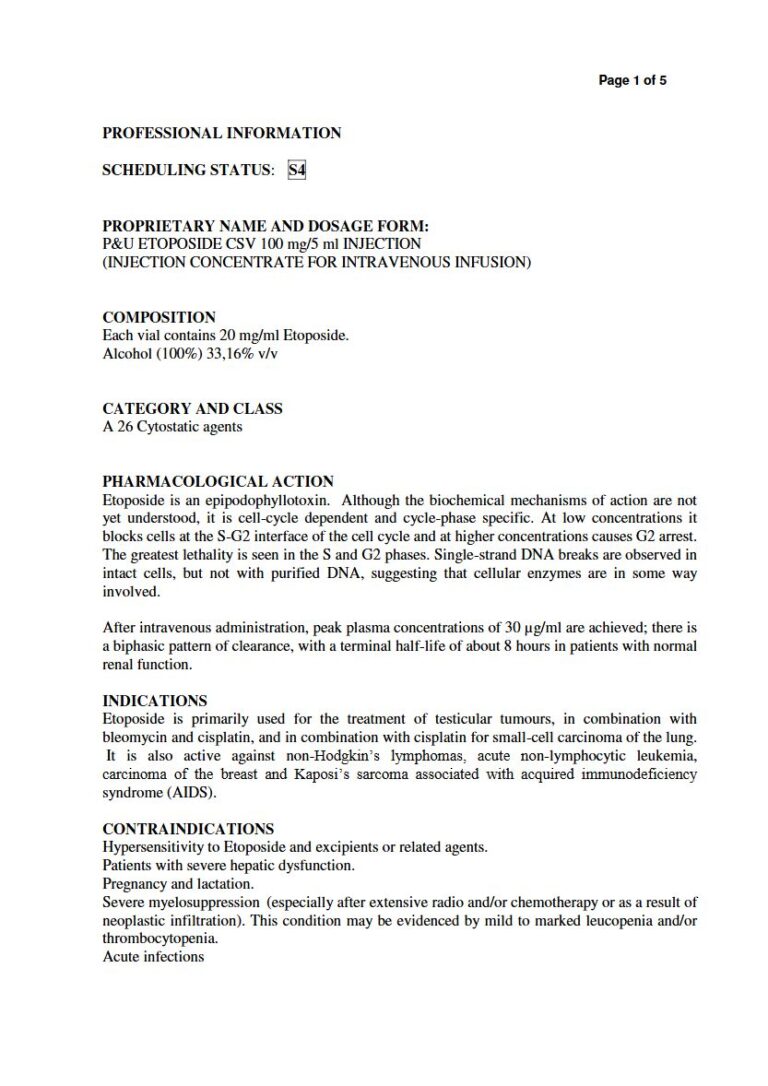
Etoposide is primarily used for the treatment of testicular tumours, in combination with bleomycin and cisplatin, and in combination with cisplatin for small-cell carcinoma of the lung. It is also active against non-Hodgkinu2019s lymphomas, acute non-lymphocytic leukemia, carcinoma of the breast and Kaposiu2019s sarcoma associated with acquired immunodeficiency syndrome (AIDS).
4.2 Posology and method of administration
FOR INTRAVENOUS USE ONLY
The prescriber should consult the current medical literature when choosing a specific dosage. The dose of Etoposide should be based on the clinical response and appearance or severity of toxicity. Do not administer the injection undiluted. Etoposide is given by slow intravenous infusion, over 30 to 60 minutes to avoid hypotension, in sodium chloride (0,9%) or glucose (5%) injection. Usual doses of 50 to 120 mg per m2 body surface are given daily for 5 days. Lower doses have been suggested for lung cancer. Alternatively, 100 mg per m2 has been given on alternate days up to a total of 300 mg per m2. Courses may be repeated after 3 - 4 weeks if the patientu2019s haematological profile is within acceptable limits. Dilution of Etoposide can be made with sodium chloride (0,9%) or glucose (5%) injection. Resultant concentrations should not be greater than 0,4 mg/ml since precipitation can occur. Discard any unused portions of the single dose vial after withdrawal of the required dose. It is recommended that the ETOPOSIDE multidose vial be used within 16 hours after first opening the container. Care must be taken to avoid extravasation, since severe pain and tissue damage may ensue. Special precautions should be taken for the safe handling and disposal of Etoposide. Guidelines for handling antineoplastic agents must be followed. Caution and proper disposal of needles, syringes, containers and unused medication, must be taken.
4.3 Contraindications
Hypersensitivity to Etoposide and excipients or related agents. Patients with severe hepatic dysfunction. Pregnancy and lactation. Severe myelosuppression (especially after extensive radio and/or chemotherapy or as a result of neoplastic infiltration). This condition may be evidenced by mild to marked leucopenia and/or thrombocytopenia. Acute infections.
4.4 Special warnings and precautions for use
ETOPOSIDE should only be administered by individuals experienced in the administration of etoposide chemotherapy. Appropriate management of therapy and complications is possible only when adequate diagnostic and treatment facilities are readily available. Patients being treated with etoposide must be monitored carefully and frequently for myelosuppression both during and after therapy. If radiotherapy and/or chemotherapy has been given prior to starting treatment, an adequate interval should be allowed to enable bone marrow to recover and circulating blood elements to return to acceptable levels. Blood counts including measurement of haemoglobin concentrations or haematocrit, leukocyte and platelet count, should be carried out routinely at the start of therapy and prior to each subsequent dose routinely to help predict the onset of bone marrow depression. Etoposide may also cause stomatitis which may be associated with considerable discomfort. Hypotension may occur temporarily with intravenous infusion periods of less than 30 minutes. Special care is necessary in debilitated patients. Liver and kidney function should be periodically monitored. Anaphylactic shock followed by chills, fever, tachycardia, bronchospasm, dyspnoea and hypotension may occur. Etoposide should be discontinued immediately and pressor agents, adrenocorticoids, antihistamines or volume expanders should be used. Bacterial infections should be brought under control before treatment with Etoposide commences. In all instances where Etoposide is considered for chemotherapy, the physician must evaluate the need and benefit of the medicine against the risk of adverse reactions. In cases where severe reactions occur, the medicine should be reduced in dosage or discontinued and appropriate corrective measures should be taken according to clinical judgement of the physician. Re-institution of ETOPOSIDE therapy should be carried out with caution, and with adequate consideration of the further need for the medicine and alertness as to the possible recurrence of toxicity. Dose limiting bone marrow suppression is the most significant toxic effect associated with etoposide therapy, predominantly manifesting as leucopenia, but also thrombocytopenia and sometimes anaemia. With leucopenia the nadir of the granulocyte count usually occurs 7 to 14 days after a dose with recovery usually complete by the 20th day. With thrombocytopenia, the nadir of the platelet count occurs 9 - 16 days after administration; recovery is usually complete by the 20th day.
4.5 Interactions with other medicines
See u201cSide effects and Special Precautionsu201d.
4.6 Fertility, pregnancy and lactation
Etoposide administration may lead to suppression of ovarian and testicular function resulting in amenorrhoea and the inhibition of spermatogenesis. Gynaecomastia has been reported.
4.7 Effects on ability to drive and use machines
Not specified in the document.
4.8 Undesirable effects
Cardiovascular: There have been reports of cardiotoxicity. Hypotension may occur temporarily with intravenous infusion periods of less than 30 minutes. Etoposide is an irritant or vesicant and produces local irritation; thrombophlebitis may occur at the site of injection. Extravasation may lead to ulceration and necrosis.
Neurotoxicity: Peripheral or central neuropathies have been reported and include transient cortical blindness.
Gastro-intestinal: Nausea and vomiting occurs frequently. Stomatitis, diarrhoea, anorexia, abdominal pain, intestinal ulceration and perforation, oesophagitis and mouth ulcers may occur. Wound healing may be delayed.
Hepatotoxicity: Cases of serious hepatic toxicity have been reported, usually in patients receiving higher than recommended doses of etoposide.
Nephrotoxicity: Other adverse effects include hyperuricaemia and acute renal failure due to uric acid nephropathy which may result from the lysis of large numbers of cells and the breakdown of nucleoproteins; nephro-toxicity may also occur.
Other: Other adverse reactions include alopecia. Reversible alopecia may occur in up to half of all patients. Use of higher than recommended doses has been associated with metabolic acidosis. Etoposide is an irritant or vesicant and produces local irritation and thrombophlebitis at the site of injection. Extravasation may lead to ulceration and necrosis. The following effects have been reported: hypersensitivity or anaphylactoid reactions; fever; rashes; skin and nail pigmentation (may be part of an Addisonu2019s syndrome); pruritus; urticaria; dysphagia; fatigue; somnolence; after-taste; hypertension and/or flushing; hyperphosphataemia and other disturbances of electrolyte balance. An apparent hypersensitivity-associated apnoea has been reported.
4.9 Overdose
See u201cSide effects and Special Precautionsu201d. Overdosage of etoposide is accompanied by severe myelosuppression and severe nausea and vomiting. Treatment is symptomatic and supportive.
