
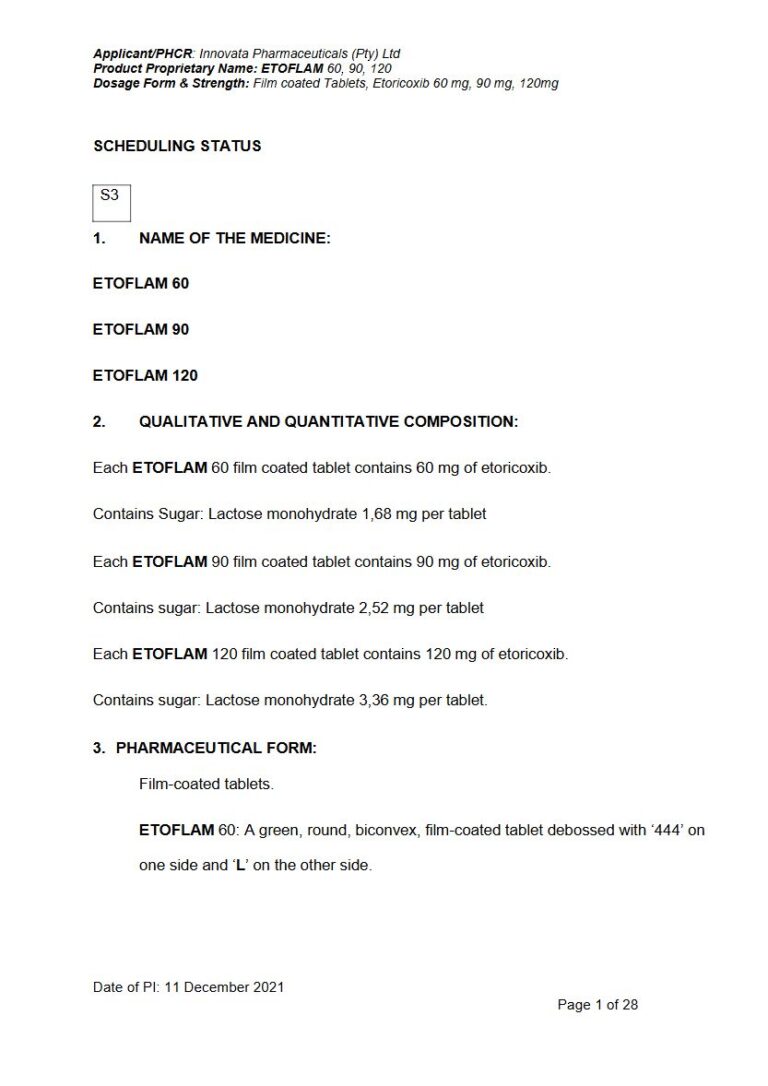
Etoflam 60. 90. 120 60 mg. 90 mg. 120mg FC tablets.
PDF Leaflet Revision Date: 11 December 2021
Clinical Summary
Quick overview from the medicine insert
Indication
Symptomatic relief of rheumatoid arthritis, ankylosing spondylitis, acute gouty arthritis, acute pain, primary dysmenorrhoea, and post-operative dental pain.
Dosage (summary)
90 mg once daily for RA and AS; 120 mg once daily for acute gout; 120 mg once daily for dysmenorrhoea; 90 mg once daily for dental pain.
Special Populations
- Elderly
- Hepatic impairment
- Renal impairment
Pregnancy & Breastfeeding
Contraindicated in pregnancy and lactation; may affect fetal development.
Key Drug Interactions
- Warfarin
- Lithium
- Digoxin
- Diuretics
- ACE inhibitors
Contraindications
- Hypersensitivity to etoricoxib
- Active peptic ulceration
- Severe hepatic insufficiency
- Severe renal impairment
- Uncontrolled hypertension
Common side effects
- Hypertension
- Dizziness
- Gastrointestinal disorders
- Oedema
- Palpitations
Counselling Points
- Monitor blood pressure
- Avoid in pregnancy
- Report any skin reactions
- Use the lowest effective dose for the shortest duration
Serious warnings
- Cardiovascular events
- Gastrointestinal complications
- Serious skin reactions
- Renal injury
Important Disclaimer
The Etoflam 60. 90. 120 60 mg. 90 mg. 120mg FC tablets. professional information leaflet below is the property of Innovata Pharmaceuticals and is provided on Medinsert exactly as issued, with no.. alterations or editorial changes. We make every effort to keep content current by updating documents as soon as new versions become available. Medinsert serves as a trusted access point for healthcare professionals, but does not replace official sources or clinical judgement. For more details, please read our full disclaimer. read more>>
 Healthcare Professionals Only
This content is for registered healthcare professionals
Sign in or create a free account to read the full package insert.
Free for HPCSA-registered professionals. Powered by Medinsert.
Clinical Particulars
Section 4 of the official insert — extracted exactly as issued, no alterations
4.1 Therapeutic Indications
ETOFLAM is indicated for:
- Symptomatic relief of rheumatoid arthritis (RA)
- Treatment of ankylosing spondylitis (AS)
- Treatment of acute gouty arthritis
- Short term relief of acute pain, treatment limited to a maximum period of 8 days
- Treatment of primary dysmenorrhoea
- Treatment of moderate to severe acute post-operative pain associated with dental surgery
The decision to prescribe ETOFLAM should be based on an assessment of the individual patientu2019s overall risks (see section 4.4).
4.2 Posology and method of administration
As the cardiovascular risks of ETOFLAM may increase with dose and duration of exposure, the lowest effective daily dose should be used, for the shortest possible duration of treatment.
Rheumatoid Arthritis (RA): The recommended dose is 90 mg once daily. In some patients, 60 mg once daily may provide adequate therapeutic benefit.
Ankylosing Spondylitis (AS): The recommended dose is 90 mg once daily. In some patients, 60 mg once daily may provide adequate therapeutic benefit.
Short term relief of Acute Pain: The recommended dose is 90 or 120 mg once daily, limited to a maximum of 8 days treatment.
Acute Gouty Arthritis: The recommended dose is 120 mg once daily, limited to a maximum of 8 days treatment.
Primary Dysmenorrhoea: The recommended dose is 120 mg once daily.
Post-operative Dental Pain: The recommended dose is 90 mg once daily.
Doses greater than those recommended for each indication have either not demonstrated additional efficacy or have not been studied. Therefore:
- The dose for RA should not exceed 90 mg daily.
- The dose for ankylosing spondylitis should not exceed 90 mg daily.
- The dose for acute gout should not exceed 120 mg daily.
- The dose for acute pain and primary dysmenorrhoea should not exceed 120 mg daily.
- The dose for post-operative acute dental surgery pain should not exceed 90 mg daily.
Special populations
Elderly: No dosage adjustment in ETOFLAM is necessary for the elderly although the elderly may be more susceptible to renal, gastrointestinal and cardiovascular adverse effects (see section 4.4 and 4.8).
Hepatic Impairment: In patients with mild hepatic insufficiency (Child-Pugh score 5 to 6), a dose of 60 mg once daily should not be exceeded. In patients with moderate hepatic insufficiency (Child-Pugh score 7 to 9), the dose should be reduced; a dose of 60 mg every other day should not be exceeded.
Clinical experience is limited particularly in patients with moderate dysfunction and caution is advised. There are no clinical or pharmacokinetic data in patients with severe hepatic insufficiency (Child Pugh score greater than 9), therefore is use is contra-indicated in these patients (see 4.3 and 5.2).
Renal Impairment: No dosage adjustment is necessary for patients with lesser degrees of renal insufficiency (creatinine clearance greater than or equal to 30 ml/min). The use of ETOFLAM in patients with creatinine clearance less than 30 ml/min is contraindicated (see section 4.3).
4.3 Contraindications
ETOFLAM is contraindicated in:
- Patients with known hypersensitivity to etoricoxib and or any of the excipients ETOFLAM
- Patients with active peptic ulceration or gastro-intestinal (GI) bleeding
- Patients with severe hepatic insufficiency (Child Pugh score greater than 9 or serum albumin less than 25 g/L)
- Patients with severe renal impairment (estimated creatinine clearance less than 30 ml/min)
- Patients who have developed signs of asthma, acute rhinitis, nasal polyps, angioedema or urticaria following the administration of aspirin or other non-steroidal anti-inflammatory drugs (NSAIDs) including COX-2 inhibitors.
- Patients with hypertension whose blood pressure has not been adequately controlled
- Pregnancy and lactation (see section 4.4 and 4.6)
- Children and adolescents under 16 years of age
- Patients with inflammatory bowel disease
- Patients with congestive heart failure (NYHA II u2013 IV)
- Heart failure, established ischaemic heart disease, peripheral arterial disease and/or cerebrovascular disease (stroke)
- Perioperative analgesia in the setting of coronary artery bypass surgery (CABG)
- Lithium: Patients who are receiving concomitant lithium therapy as this may increase plasma levels of lithium (see section 4.5)
- Digoxin: Patients who are at high risk of digoxin toxicity as concomitant use. ETOFLAM with digoxin may increase C max digoxin by approximately 33 %.
4.4 Special warnings and precautions for use
ETOFLAM may predispose to cardiovascular events, gastro-intestinal events or cutaneous reactions which may be fatal. Long-term administration of NSAIDs has resulted in renal papillary necrosis and other renal injury. Renal prostaglandins may play a compensatory role in the maintenance of renal perfusion. Therefore, under conditions of compromised renal perfusion, administration of ETOFLAM may cause a reduction in prostaglandin formation and secondarily, in renal blood flow and thereby impair renal function. Patients at greatest risk of this response are those with pre-existing significantly impaired renal function, uncompensated heart failure or cirrhosis. Monitoring of renal function in such patients should be considered.
Caution should be used when initiating treatment with ETOFLAM in patients with dehydration. It is advisable to rehydrate patients prior to starting therapy with ETOFLAM.
Fluid retention, oedema and hypertension have been observed in patients taking ETOFLAM. All Nonsteroidal Anti-inflammatory Drugs (NSAIDs), including etoricoxib, can be associated with new onset or recurrent congestive heart failure. Caution should be exercised in patients with a history of cardiac failure, left ventricular dysfunction, or hypertension and in patients with pre-existing oedema from any other reason. If there is clinical evidence of deterioration in the condition of these patients, appropriate measures including discontinuation of ETOFLAM should be taken.
ETOFLAM may be associated with more frequent and severe hypertension than some other NSAIDs and selective COX-2 inhibitors, particularly at high doses. Therefore, special attention should be paid to blood pressure monitoring during treatment with etoricoxib. If blood pressure rises significantly, alternative treatment should be considered.
The selective COX-2 inhibitor class medicines may be associated with an increased risk of thrombotic events (especially MI and stroke), relative to placebo and some NSAIDs. As the cardiovascular risks of selective COX-2 inhibitors may increase with dose and duration of exposure, the shortest duration possible and the lowest effective daily dose should be used. The patientu2019s need for symptomatic relief and response to therapy should be re-evaluated periodically.
Patients with significant risk factors for cardiovascular events (e.g. hypertension, hyperlipidaemia, diabetes mellitus, smoking) should only be treated with ETOFLAM after careful consideration. ETOFLAM is not a substitute for aspirin for cardiovascular prophylaxis because of its lack of effect on platelets. Because ETOFLAM does not inhibit platelet aggregation, antiplatelet therapies should not be discontinued and if indicated should be considered in patients at risk for or with a history of cardiovascular or other thrombotic events. There is no consistent evidence that concurrent use of aspirin mitigates the increased risk of serious cardiovascular thrombotic events associated with ETOFLAM. (see section 4.5)
Serious skin reactions, some of them fatal, including exfoliative dermatitis, Stevens-Johnson syndrome, and toxic epidermal necrolysis, have been reported in association with the use of NSAIDs and some selective COX-2 inhibitors during post-marketing surveillance (see section 4.8). These serious events may occur without warning. Patients appear to be at higher risk for these reactions early in the course of therapy: the onset of the reaction occurring in the majority of cases within the first month of treatment. Serious hypersensitivity reactions (such as anaphylaxis and angioedema) have been reported in patients receiving ETOFLAM (see section 4.8). Some selective COX-2 inhibitors have been associated with an increased risk of skin reactions in patients with a history of allergy to medicines. ETOFLAM should be discontinued at the first appearance of skin rash, mucosal lesions or any other sign of hypersensitivity.
When using ETOFLAM in the elderly and in patients with renal, hepatic or cardiac dysfunction, medically appropriate supervision should be maintained. If these patients deteriorate during treatment, appropriate measures should be taken, including discontinuation of therapy.
Gastro-intestinal effects: Upper gastro-intestinal complications [perforations, ulcers or bleedings (PUBs)], some of them resulting in fatal outcome, have occurred in patients treated with ETOFLAM. Caution is advised with treatment of patients most at risk of developing a gastro-intestinal complication with NSAIDs such as ETOFLAM; the elderly, patients using any other NSAID or acetylsalicylic acid concomitantly or patients with a prior history of gastro-intestinal disease such as ulceration and GI bleeding. There is a further increase in risk of gastro-intestinal adverse effects (gastro-intestinal ulceration or other gastro-intestinal complications) when ETOFLAM is taken concomitantly with aspirin (acetylsalicylic acid) (even at low doses).
Elevations of alanine aminotransferase (ALT) and/or aspartate aminotransferase (AST) (approximately three or more times the upper limit of normal) have been reported in approximately 1 % of patients in studies treated for up to one year with etoricoxib 60 mg and 90 mg daily. A patient with symptoms and/or signs suggesting liver impairment or in whom an abnormal liver function test has occurred, should be evaluated for persistently abnormal liver function tests. If persistently abnormal liver function tests (three times the upper limit of normal) are detected, ETOFLAM should be discontinued.
ETOFLAM may mask fever and other signs of inflammation or infection. The use of ETOFLAM is not recommended in women attempting to conceive.
Due to inhibition of prostaglandin synthesis, fluid retention and oedema have been observed in patients taking ETOFLAM; therefore, ETOFLAM should be used with caution in patients with compromised cardiac function and other conditions predisposing to or worsened by fluid retention. Patients with pre-existing congestive heart failure or hypertension should be closely monitored.
ETOFLAM should be used with caution or not at all in patients on warfarin. ETOFLAM inhibits platelet function and to some extent and has an irritant effect on the gastrointestinal tract, so increasing the risk of haemorrhage. ETOFLAM can increase the hypoprothrombinaemic effect of warfarin by an intrinsic effect on coagulation or by displacement of warfarin from plasma protein binding sites.
Drug Reaction with Eosinophilia and Systemic Symptoms (DRESS) has been reported in patients taking NSAIDs such as ETOFLAM. Some of these events have been fatal or life-threatening. DRESS typically, although not exclusively, presents with fever, rash, lymphadenopathy, and/or facial swelling. Other clinical manifestations may include hepatitis, nephritis, haematological abnormalities, myocarditis, or myositis. Sometimes symptoms of DRESS may resemble an acute viral infection. Eosinophilia is often present. Because this disorder is variable in its presentation, other organ systems not noted here may be involved. It is important to note that early manifestations of hypersensitivity, such as fever or lymphadenopathy, may be present even though rash is not evident. If such signs or symptoms are present, discontinue ETOFLAM and evaluate the patient immediately.
ETOFLAM contains lactose. Patients with rare hereditary conditions such as galactose intolerance, the Lapp lactase deficiency or galactose mal-absorption should not take ETOFLAM.
4.5 Interaction with other medicines and other forms of interaction
Ciclosporin and tacrolimus: Although this interaction has not been studied with ETOFLAM, co-administration of ciclosporin or tacrolimus with an NSAID may increase the nephrotoxic effect of ciclosporin or tacrolimus. Renal function should be monitored when ETOFLAM and either of these medicines is used in combination.
Warfarin: In patients stabilised on chronic warfarin therapy, the administration of ETOFLAM 120 mg daily was associated with an approximate 13 % increase in prothrombin time International Normalised Ratio (INR). Standard monitoring of INR values should be conducted when therapy with ETOFLAM is initiated or changed in patients receiving warfarin or similar medicines.
Rifampicin: Co-administration of ETOFLAM with rifampicin, a potent inducer of hepatic metabolism, produced a 65 % decrease in etoricoxib plasma area under the curve (AUC). This interaction should be considered when ETOFLAM is co-administered with rifampicin.
Methotrexate: Two studies investigated the effects of ETOFLAM 60, 90 or 120 mg administered once daily for seven days in patients receiving once-weekly methotrexate doses of 7.5 to 20 mg for rheumatoid arthritis. ETOFLAM at 60 and 90 mg had no effect on methotrexate plasma concentrations or renal clearance. In one study, ETOFLAM 120 mg had no effect, but in the other study, ETOFLAM 120 mg increased methotrexate plasma concentrations by 28% and reduced renal clearance of methotrexate by 13%. Methotrexate-related toxicity should be monitored when ETOFLAM at doses greater than 90 mg and methotrexate are administered concomitantly.
Diuretics, Angiotensin Converting Enzyme (ACE) inhibitors and Angiotensin Receptor Blockers (ARBs): Reports suggest that non-selective NSAIDs and COX-2 selective inhibitors such as ETOFLAM may diminish the antihypertensive effect of diuretics, ACE inhibitors and ARBs. This interaction should be given consideration in patients taking ETOFLAM concomitantly with these medicines. In some patients with compromised renal function (e.g. elderly patients or patients who are volume depleted, including those on diuretic therapy) who are being treated with non-steroidal anti-inflammatory drugs, including selective COX-2 inhibitors, the co-administration of ACE inhibitors of AIIAs may result in a further deterioration of renal function, including possible acute renal failure. These effects are usually reversible. Therefore, the combination should be administered with caution, especially in the elderly and in patients with impaired renal function. Patients should be adequately rehydrated and consideration should be given to monitoring renal function at initiation of concomitant administration and periodically thereafter.
Lithium: Reports suggest that NSAIDs and selective COX-2 inhibitors such as ETOFLAM may increase plasma lithium levels. Should lithium blood levels in patients taking ETOFLAM concomitantly with lithium increase, ETOFLAM should be withdrawn.
Aspirin: ETOFLAM can be used concomitantly with aspirin at doses used for cardiovascular prophylaxis (low dose aspirin). However, concomitant administration of low-dose aspirin with ETOFLAM increases the rate of GI ulceration or other complications compared to use of ETOFLAM alone. Concomitant administration of ETOFLAM with doses of aspirin above those for cardiovascular prophylaxis or with other NSAIDs should be avoided (see section 4.8).
Oral contraceptives: ETOFLAM 60 mg given concomitantly with an oral contraceptive containing 35 mcg ethinyl estradiol (EE) and 0.5 mg to 1 mg norethindrone for 21 days increased the steady state AUC 0-24hr of EE by 37 %. ETOFLAM 120 mg given with the same oral contraceptive concomitantly or separated by 12 hours increased the steady state AUC 0-24hr of EE by 50 % to 60 %. This increase in EE concentration should be considered when selecting an oral contraceptive for use with ETOFLAM. An increase in EE exposure can increase the incidence of adverse events associated with oral contraceptives (e.g. venous thromboembolic events in women at risk).
Furosemide: NSAIDs such as ETOFLAM reduce the natriuretic effect of furosemide and thiazides in patients. This response has been attributed to inhibition of renal prostaglandin synthesis.
Hormone Replacement Therapy: Administration of ETOFLAM 120 mg with hormone replacement therapy consisting of conjugated oestrogens for 28 days, increased the mean steady state AUC 0-24hr of unconjugated estrone (41 %), equilin (76 %), and 17-beta-estradiol (22 %). The effect of the recommended chronic doses of ETOFLAM (60 mg and 90 mg) has not been studied. The effects of ETOFLAM 120 mg on the exposure (AUC 0-24hr) to these estrogenic components of conjugated oestrogen were less than half of those observed when conjugated oestrogen was administered alone and the dose was increased from 0,625 mg to 1,25 mg). The clinical significance of these increases is unknown, and higher doses of conjugated oestrogen were not studied in combination with ETOFLAM. These increases in oestrogenic concentration should be taken into consideration when selecting post-menopausal hormone therapy for use with ETOFLAM because the increase in oestrogen exposure might increase the risk of adverse events associated with hormone replacement therapy (HRT).
Effects of ETOFLAM on medicines metabolised by sulfotransferases: ETOFLAM is an inhibitor of human sulfotransferases activity, particularly SULT1E1, and has been shown to increase the serum concentrations of ethinyl estradiol. While knowledge about effects of multiple sulfotransferases is presently limited and the clinical consequences for many medicines are still being examined. It may be prudent to exercise care when administering ETOFLAM concurrently with other medicines primarily metabolised by human sulfotransferases (e.g. oral salbutamol and minoxidil).
Digoxin: ETOFLAM 120 mg once daily for 10 days in healthy volunteers did not alter the steady-state plasma AUC 0 u2013 24h or renal elimination of digoxin. There was an increase in digoxin C max (approximately 33 %).
Other: In interaction studies, ETOFLAM did not have clinically important effects on the pharmacokinetics of prednisone/prednisolone. ETOFLAM 120 mg once daily for 10 days in healthy volunteers did not alter steady state plasma AUC 0-24hr or renal elimination of digoxin. There was an increase in digoxin C max (approximately 33 %). Antacids did not have clinically important effects on the pharmacokinetics of ETOFLAM. Ketoconazole, a potent inhibitor of CYP3A4, dosed at 400 mg once a day for 11 days to healthy volunteers did not have any clinically important effect on the single-dose.
4.6 Fertility, pregnancy, and lactation
Pregnancy: Safety in pregnancy and lactation has not been established, ETOFLAM is contraindicated in pregnancy (see section 4.3). The use of non-steroidal anti-inflammatory drugs such as ETOFLAM during the third trimester of pregnancy, may result in premature closure of the foetal ductus arteriosus in utero, and possibly, in persistent pulmonary hypertension of the new-born. The onset of labour may be delayed and its duration increased. Regular use of non-steroidal inflammatory drugs may result in:
First trimester: Inhibition of prostaglandin synthesis may adversely affect the pregnancy and/or the embryo/foetal development. Data from epidemiological studies raise concern about an increased risk of miscarriage and of cardiac malformation and gastroschisis after use of a prostaglandin synthesis inhibitor in early pregnancy. The absolute risk for cardiovascular malformation was increased from less than 1 %, up to approximately 1,5 %. In animals, administration of a prostaglandin synthesis inhibitor has been shown to result in increased pre- and post-implantation loss and embryo-foetal lethality. In addition, increased incidences of various malformations including cardiovascular, have been reported in animals given a prostaglandin synthesis inhibitor during the organogenetic period.
Second and Third trimester: During the third trimester of pregnancy, prostaglandin synthesis inhibitors, may expose the foetus to: cardiopulmonary toxicity (with premature closure of the ductus arteriosus and pulmonary hypertension); renal dysfunction, which may progress to renal failure with oligo-hydroamniosis. At the end of pregnancy, the mother and the neonate may be exposed to: possible prolongation of bleeding time, an anti-aggregating effect which may occur even at very low doses; inhibition of uterine contractions resulting in delayed or prolonged labour.
Breastfeeding: ETOFLAM is contraindicated in lactation (see 4.3). ETOFLAM is excreted in milk of lactating rats. Women taking ETOFLAM should not breastfeed their infants.
Fertility: The effects of ETOFLAM in fertility are not known. The use of ETOFLAM is not recommended in women attempting to conceive.
Women of Childbearing Potential: ETOFLAM can increase the incidence of adverse events associated with oral contraceptives (e.g. venous thromboembolic events in women at risk).
4.7 Effects on the ability to drive and use machines
Patients who experience dizziness, vertigo or somnolence while taking ETOFLAM should refrain from driving or operating machinery.
4.8 Undesirable effects
Infections and infestations
Frequent: post-dental extraction alveolar osteitis (dry socket)
Less frequent: gastro-enteritis, upper respiratory infection, urinary tract infection
Blood and lymphatic system disorders
Less frequent: anaemia, leucopenia
Frequency unknown: thrombocytopaenia
Immune system disorder
Frequency unknown: hypersensitivity reactions, including angioedema, anaphylactic/anaphylactoid reactions including shock.
Metabolism and nutrition disorders
Frequent: oedema/fluid retention
Less Frequent: appetite increase or decrease, weight gain
Psychiatric disorders
Less Frequent: anxiety, depression, mental acuity decreased.
Frequency unknown: confusion, hallucinations and restlessness.
Nervous system disorder
Frequent: dizziness, headache
Less Frequent: insomnia, paraesthesia/hypaesthesia
Frequency unknown: dysgeusia, somnolence
Eye disorders
Less Frequent: conjunctivitis
Frequency unknown: blurred vision
Ear and labyrinth disorders
Less Frequent: tinnitus, vertigo
Cardiac disorders
Frequent: palpitations
Less Frequent: atrial fibrillation, congestive cardiac failure, non-specific ECG changes, myocardial infarction, angina pectoris
Frequency unknown: dysrhythmia, tachycardia and cardiovascular thrombotic events
Vascular disorders
Frequent: hypertension.
Less Frequent: flushing, cerebrovascular accident, transient ischaemic attack, vasculitis
Frequency unknown: aggravated hypertension, hypertensive crisis, peripheral oedema.
Respiratory, thoracic and mediastinal disorders
Less Frequent: cough, dyspnoea, epistaxis
Frequency unknown: bronchospasm
Gastrointestinal disorders
Frequent: gastro-intestinal disorders (e.g. abdominal pain, flatulence, heartburn), diarrhoea, dyspepsia, epigastric discomfort, nausea
Less Frequent: abdominal distention, acid reflux, bowel movement pattern change, constipation, dry mouth, gastroduodenal ulcer, irritable bowel syndrome, vomiting, oesophagitis, oral ulcer and pancreatitis
Frequency unknown: peptic ulcers including gastro-intestinal perforation and bleeding (mainly in the elderly)
Hepatobiliary disorders
Frequent: increased ALT, increased AST.
Less Frequent: hepatitis, jaundice, hepatic failure
Skin and subcutaneous tissue disorders
Frequent: ecchymosis
Less Frequent: facial oedema, pruritus, rash, erythema
Frequency unknown: urticarial, Stevens-Johnson syndrome, toxic epidermal necrolysis, fixed drug eruption, drug rash with eosinophilia and systemic symptoms (DRESS) (see section 4.4)
Musculoskeletal, connective tissue and bone disorders
Less Frequent: muscle cramp/spasms, musculoskeletal pain/stiffness
Renal and urinary disorders
Less Frequent: proteinuria, increased serum creatinine, renal insufficiency, including renal failure, may be reversible upon discontinuation of treatment (see section 5.2), nephrotoxicity including interstitial nephritis and nephrotic syndrome associated with NSAIDs such as ETOFLAM.
General disorders and administration site conditions
Frequent: asthenia/fatigue, flu-like disease
Less Frequent: chest pain
Investigations
Less Frequent: blood urea increased, creatine phosphokinase increased, haematocrit decreased, haemoglobin decreased, hyperkalaemia, leukocytes decreased, platelets decreased, serum creatinine increased, uric acid increased, blood sodium decreased
The following serious undesirable effects have been reported in association with the use of NSAIDs and cannot be ruled out of ETOFLAM: Nephrotoxicity including interstitial nephritis and nephrotic syndrome; hepatotoxicity.
4.9 Overdose
The most frequently observed adverse experiences were consistent with the safety profile for etoricoxib (e.g. gastro-intestinal events, renovascular events). In the event of overdose, it is reasonable to employ the usual supportive measures, e.g. remove unabsorbed material from the gastro-intestinal tract, employ clinical monitoring, and institute supportive therapy, if required. ETOFLAM is not dialysable by haemodialysis; it is not known whether ETOFLAM is dialysable by peritoneal dialysis.
