
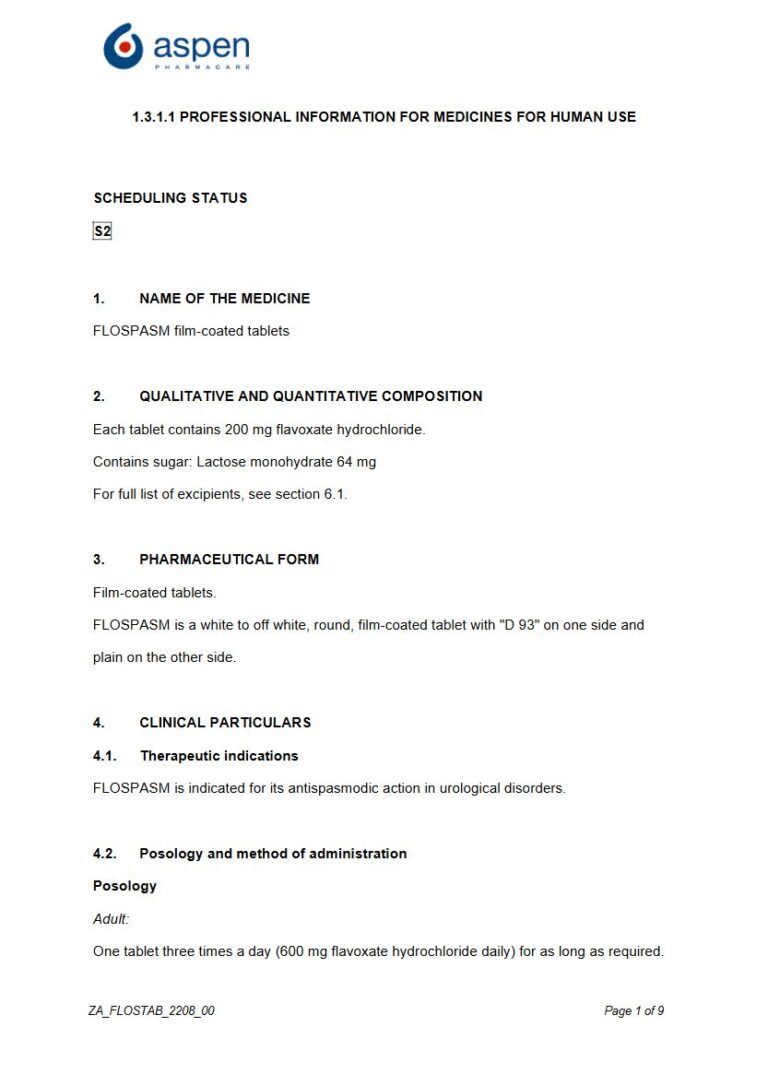
Flospasm 200 mg FC tablets.
PDF Leaflet Revision Date: 10 August 2022
Clinical Summary
Quick overview from the medicine insert
Indication
Antispasmodic action in urological disorders.
Dosage (summary)
One tablet three times a day (600 mg daily) for adults.
Special Populations
- Renal impairment
- Elderly
- Children under 12 years
Pregnancy & Breastfeeding
Not recommended during pregnancy or breastfeeding.
Contraindications
- Hypersensitivity to flavoxate
- Gastrointestinal obstruction
- Gastrointestinal haemorrhage
- Obstructive uropathies
- Glaucoma
- Myasthenia gravis
- Children under 12 years
Common side effects
- Drowsiness
- Nausea
- Blurred vision
- Fatigue
Counselling Points
- Take after meals to prevent nausea.
- Avoid driving or operating machinery if drowsy.
Serious warnings
- Caution in renal impairment
- Drowsiness may affect ability to drive
Important Disclaimer
The Flospasm 200 mg FC tablets. professional information leaflet below is the property of Pharmacare and is provided on Medinsert exactly as issued, with no.. alterations or editorial changes. We make every effort to keep content current by updating documents as soon as new versions become available. Medinsert serves as a trusted access point for healthcare professionals, but does not replace official sources or clinical judgement. For more details, please read our full disclaimer. read more>>
 Healthcare Professionals Only
This content is for registered healthcare professionals
Sign in or create a free account to read the full package insert.
Free for HPCSA-registered professionals. Powered by Medinsert.
Clinical Particulars
Section 4 of the official insert — extracted exactly as issued, no alterations
4.1. Therapeutic indications
FLOSPASM is indicated for its antispasmodic action in urological disorders.
4.2. Posology and method of administration
Posology
Adult: One tablet three times a day (600 mg flavoxate hydrochloride daily) for as long as required.
Paediatric population
FLOSPASM is not recommended for use in children (see section 4.3).
Method of administration
Oral administration. FLOSPASM should be taken after a meal in order to prevent nausea.
4.3. Contraindications
FLOSPASM is contraindicated in:
- Patients with hypersensitivity to flavoxate hydrochloride or to any excipients in FLOSPASM (see section 6.1).
- Patients with pyloric or duodenal obstruction, obstructive intestinal lesions, ileus, achalasia or other gastrointestinal obstructive conditions.
- Patients with gastrointestinal haemorrhage.
- Patients with obstructive uropathies of the lower urinary tract or urinary retention.
- Patients with glaucoma
- Patients with myasthenia gravis.
- Children under 12 years of age.
- Pregnancy and lactation (see section 4.6).
4.4. Special warnings and precautions for use
Renal impairment
Since the renal clearance of the active metabolite accounts more than 50 % of the dose, renal impairment may significantly affect the product kinetics. Caution is therefore required in patients with renal impairment (see section 4.3).
Glaucoma
FLOSPASM is contraindicated in patients with suspected glaucoma, especially narrow angle glaucoma (see section 4.3).
Urinary tract disorders
FLOSPASM should be used with caution in patients with serious, uncontrolled, obstructive disorders of the lower urinary tract (see section 4.3).
Drowsiness
If a patient experiences drowsiness, the time between administration of doses should be extended.
Paediatric population
The use in children below the age of 12 years is contraindicated (see sections 4.2 and 4.3).
Excipients
Patients with rare hereditary problems of galactose intolerance, total lactase deficiency or glucose-galactose malabsorption should not take FLOSPASM.
4.5. Interaction with other medicines and other forms of interaction
No interaction studies have been performed.
4.6. Fertility, pregnancy and lactation
Safety in pregnancy and lactation has not been established (see section 4.3).
Pregnancy
There are no or a limited amount of data for the use of flavoxate in pregnant woman. Animal studies do not indicate direct or indirect harmful effects with respect to reproductive toxicity. FLOSPASM should not be used during pregnancy (see section 4.3).
Breastfeeding
It is unknown whether flavoxate (metabolites), as contained in FLOSPASM, is excreted in human milk. A risk to the suckling child cannot be excluded. FLOSPASM should not be used during breastfeeding (see section 4.3).
Fertility
There are no data on the effect of flavoxate, as contained in FLOSPASM, on human fertility. Flavoxate has no effect on animal fertility.
4.7. Effects on ability to drive and use machines
Since adverse reactions such as drowsiness, somnolence, vertigo and blurred vision have been reported in patients receiving FLOSPASM, patients should not drive, use machinery or perform any tasks that require concentration, until they are certain that FLOSPASM does not adversely affect their ability to do so (see sections 4.4 and 4.8).
4.8. Undesirable effects
a. Tabulated list of adverse reactions for FLOSPASM
System organ class Frequent Less frequent Frequency unknown
- Blood and lymphatic disorders Eosinophilia, leukopenia
- Immune system disorders Angioedema Hypersensitivity, anaphylactic reaction, anaphylactic shock
- Psychiatric disorders Mental confusion (especially in the elderly), nervousness
- Nervous system disorders Somnolence, drowsiness, dizziness, headache
- Eye disorders Visual impairment, blurred vision, disturbances in eye accommodation, increased ocular tension Glaucoma
- Ear and labyrinth disorders Vertigo
- Cardiac disorders Palpitations, tachycardia
- Gastrointestinal disorders Nausea Vomiting, dry mouth, dyspepsia, diarrhoea, dysphagia
- Hepatobiliary disorders Jaundice, liver disorder, abnormal hepatic enzyme
- Skin and subcutaneous tissue disorders Urticaria and other dermatoses, rash, pruritus, Erythema
- Renal and urinary disorders Urinary retention, dysuria
- General disorders and administration site conditions Fatigue, hyperpyrexia
Reporting of suspected adverse reactions
Reporting suspected adverse reactions after authorisation of the medicine is important. It allows continued monitoring of the benefit/risk balance of the medicine. Healthcare providers are asked to report any suspected adverse reactions to: SAHPRA: https://www.sahpra.org.za/health-products-vigilance/
Aspen Pharmacare: E-mail: [email protected] Tel: 0800 118 088
4.9. Overdose
Symptoms
The most likely symptoms of overdose are blurred vision, dry mouth, drowsiness and diarrhoea or constipation.
Treatment
Treatment of overdosage is symptomatic and supportive.
