
Tractinfect 3 G Oral Solution
PDF Leaflet Revision Date: 17 October 2023
Clinical Summary
Quick overview from the medicine insert
Indication
Treatment of acute uncomplicated lower urinary tract infections in women and prophylaxis in men.
Dosage (summary)
Single 3 g dose for women; two doses of 3 g for men before and after procedures.
Special Populations
- Elderly
- Renal impairment
Pregnancy & Breastfeeding
Not established for pregnancy; contraindicated in lactation.
Key Drug Interactions
- Metoclopramide
- Food may delay absorption
Contraindications
- Hypersensitivity to fosfomycin
- Severe renal insufficiency
- Patients undergoing haemodialysis
Common side effects
- Anaphylactic shock
- Headache
- Dizziness
- Diarrhoea
- Nausea
Counselling Points
- Take on an empty stomach
- Report severe diarrhoea
- Avoid driving if affected
Serious warnings
- Serious hypersensitivity reactions
- Pseudomembranous colitis risk
Important Disclaimer
The Tractinfect 3 G Oral Solution professional information leaflet below is the property of Pharmacare and is provided on Medinsert exactly as issued, with no.. alterations or editorial changes. We make every effort to keep content current by updating documents as soon as new versions become available. Medinsert serves as a trusted access point for healthcare professionals, but does not replace official sources or clinical judgement. For more details, please read our full disclaimer. read more>>
 Healthcare Professionals Only
This content is for registered healthcare professionals
Sign in or create a free account to read the full package insert.
Free for HPCSA-registered professionals. Powered by Medinsert.
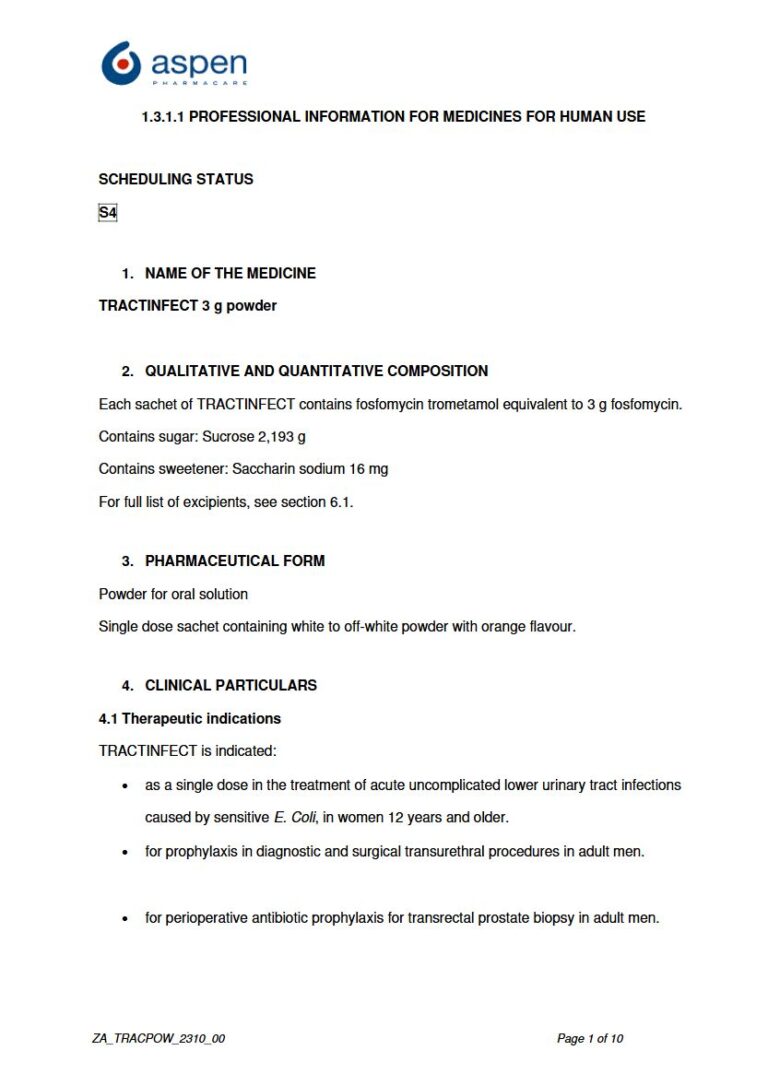
Clinical Particulars
Section 4 of the official insert — extracted exactly as issued, no alterations
4.1 Therapeutic indications
TRACTINFECT is indicated:
- as a single dose in the treatment of acute uncomplicated lower urinary tract infections caused by sensitive E. Coli, in women 12 years and older.
- for prophylaxis in diagnostic and surgical transurethral procedures in adult men.
- for perioperative antibiotic prophylaxis for transrectal prostate biopsy in adult men.
4.2 Posology and method of administration
Posology
Adults
The recommended dose for uncomplicated urinary tract infections in women, including the elderly up to seventy-five years, is a single 3 g dose. The recommended dose for prophylaxis prior to transurethral surgical and diagnostic procedures and for perioperative antibiotic prophylaxis for transrectal prostate biopsy in adult men, including the elderly, is two doses of 3 g. The first dose should be taken three hours before surgery or procedure. The second dose should be taken twenty-four hours after surgery or procedure.
Paediatric population
TRACTINFECT in a dose of 3 g is not suitable for children under the age of 12 years.
Method of administration
For oral administration. TRACTINFECT should be taken on an empty stomach, either 1 hour before or at least 2 hours after meals and preferably before bedtime after emptying the bladder. For instructions on reconstitution of the medicine before administration, see section 6.6. Appearance of the product dissolved in water: clear to slightly opalescent, white solution, orange flavoured, free from undissolved particles.
4.3 Contraindications
TRACTINFECT is contraindicated in:
- Patients with hypersensitivity to fosfomycin trometamol or to any excipients in TRACTINFECT (see section 6.1).
- Severe renal insufficiency (creatinine clearance < 10 mL/min).
- Patients undergoing haemodialysis.
4.4 Special warnings and precautions for use
Prescribers must adhere to the principles of antibiotic stewardship.
Hypersensitivity reactions
Serious and occasionally fatal hypersensitivity reactions, including anaphylaxis and anaphylactic shock, may occur during treatment with TRACTINFECT (see sections 4.3 and 4.8). If such reactions occur, treatment with TRACTINFECT must be discontinued immediately and adequate emergency measures must be initiated.
Elderly and patients with renal impairment
Fosfomycin trometamol, as contained in TRACTINFECT, is principally excreted by the kidney. Caution should be exercised in administering this antibiotic to patients with impaired renal function (see sections 4.3 and 5.2).
Pseudomembranous colitis
Antibiotic associated colitis (including pseudomembranous colitis) has been reported in association with the use of broad-spectrum antibiotics including TRACTINFECT. It is important to consider this diagnosis in patients who develop serious diarrhoea during or after the use of TRACTINFECT. In this situation adequate therapeutic measures should be initiated immediately. Medicines inhibiting peristalsis are contraindicated in this situation.
Persistent infections and male patients
In case of persistent infections, a thorough examination and a re-evaluation of the diagnosis is recommended as this is often due to complicated urinary tract infections or the prevalence of resistant pathogens (e.g. Staphylococcus saprophyticus, see section 5.1). In general, urinary tract infections in male patients have to be considered as complicated UTIs for which this medicinal product is not indicated (see section 4.1).
Paediatric population
Safety and efficacy in children under the age of 12 years has not yet been established.
Sucrose intolerance
TRACTINFECT contains sucrose. Patients with rare hereditary problems of fructose intolerance, glucose-galactose malabsorption or sucrase-isomaltase insufficiency should not take TRACTINFECT.
4.5 Interaction with other medicines and other forms of interaction
Metoclopramide
Concomitant administration of metoclopramide has been shown to lower serum and urinary concentrations and should be avoided. Other medicinal products that increase gastrointestinal motility may produce similar effects.
Food effect
Food may delay the absorption of TRACTINFECT, with consequent slight decrease in peak plasma levels and urinary concentrations. It is therefore preferable to take the medicinal product on an empty stomach or about 2 to 3 hours after meals.
Specific problems concerning the alteration in INR
Studies indicate increased oral anticoagulant activity have been reported in patients receiving antibiotic therapy. Risk factors include severe infection or inflammation, age and poor general health. Under these circumstances, it is difficult to determinate whether the alteration in INR is due to the infectious disease or its treatment. However, certain classes of antibiotics are more often involved and in particular: fluoroquinolones, macrolides, cyclins, cotrimoxazole and certain cephalosporins.
4.6 Fertility, pregnancy and lactation
The safety and efficacy of single dose therapy has not been established for TRACTINFECT in pregnancy. TRACTINFECT should not be given to lactating women.
Pregnancy
No evidence in animals or humans has been found to indicate adverse effects of TRACTINFECT in pregnancy.
Breastfeeding
Fosfomycin, as contained in TRACTINFECT, has been shown to cross into breast milk.
Fertility
No clinical data are available; hence the potential risk for humans is unknown.
4.7 Effects on ability to drive and use machines
TRACTINFECT has moderate influence on the ability to drive and operate machinery. No studies on the effect on the ability to drive and use machines have been performed. However, there are some side effects such as dizziness and fatigue associated with this product that may affect some patients' ability to drive or use machinery (see section 4.8).
Patients should not drive, use machinery or perform any tasks that require concentration until they are certain that TRACTINFECT do not adversely affect their ability to do so safely (see section 4.8).
4.8 Undesirable effects
a) Tabulated list of adverse reactions
System organ class
- Frequent
- Less frequent
- Frequency unknown (cannot be established from the available data)
Immune system disorders
- Anaphylactic shock, allergic reaction
Nervous system disorders
- Headache, dizziness
- Paraesthesia
Cardiac disorders
- Tachycardia
Vascular disorders
- Hypotension
Respiratory, thoracic and mediastinal disorders
- Pharyngitis, rhinitis
- Asthma
Gastrointestinal disorders
- Diarrhoea, nausea, abdominal pain, dyspepsia
- Vomiting
- Pseudomembranous colitis
Skin and subcutaneous tissue disorders
- Skin rash
- Urticaria, pruritus, itching
- Angioedema
Musculoskeletal and connective tissue disorders
- Back pain
Reproductive system and breast disorders
- Vaginitis, dysmenorrhea, vulvovaginitis
General disorders and administrative site conditions
- Pain (non-localised), asthenia
- Fatigue
Reporting of suspected adverse reactions
Reporting suspected adverse reactions after authorisation of the medicine is important. It allows continued monitoring of the benefit/risk balance of the medicine. Healthcare providers are asked to report any suspected adverse reactions to:
SAHPRA via the u201c6.04 Adverse Drug Reactions Reporting Formu201d, found online under SAHPRAu2019s publications: https://www.sahpra.org.za/Publications/Index/8
Aspen Pharmacare: E-mail: [email protected] Tel: 0800 118 088
4.9 Overdose
Symptoms
The following events have been observed those who have taken fosfomycin in overdose: vestibular loss, impaired hearing, metallic taste and general decline in taste perception.
Treatment
In the event of overdose, treatment should be symptomatic and supportive. Urinary elimination of the medicine can be accelerated through adequate administration of oral fluids.
