
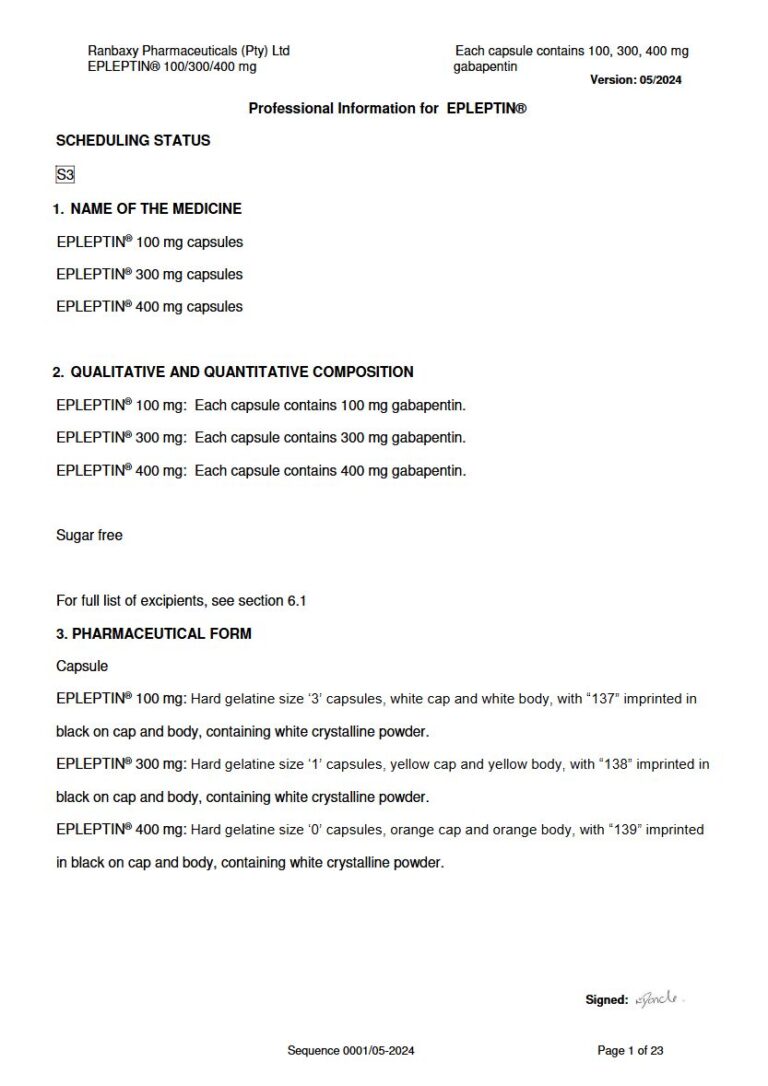
Epleptin 100, 300, 400 mg Capsule
PDF Leaflet Revision Date: 09 September 2024
Clinical Summary
Quick overview from the medicine insert
Indication
Adjunctive therapy for seizure control in epilepsy.
Dosage (summary)
900-1800 mg/day in three divided doses for adults and children over 12.
Special Populations
- Elderly
- Renal impairment
Pregnancy & Breastfeeding
Contraindicated in pregnancy and lactation.
Key Drug Interactions
- CNS depressants
- Opioids
- Antacids
Contraindications
- Hypersensitivity to gabapentin
- Severe renal impairment
- Children under 12
Common side effects
- Somnolence
- Dizziness
- Ataxia
- Nausea
Counselling Points
- Monitor for signs of suicidal thoughts
- Avoid abrupt discontinuation
- Use caution when driving or operating machinery
Serious warnings
- Risk of suicidal ideation
- Abrupt withdrawal may precipitate seizures
- Severe hypersensitivity reactions
Important Disclaimer
The Epleptin 100, 300, 400 mg Capsule professional information leaflet below is the property of Ranbaxy Pharmaceuticals and is provided on Medinsert exactly as issued, with no.. alterations or editorial changes. We make every effort to keep content current by updating documents as soon as new versions become available. Medinsert serves as a trusted access point for healthcare professionals, but does not replace official sources or clinical judgement. For more details, please read our full disclaimer. read more>>
 Healthcare Professionals Only
This content is for registered healthcare professionals
Sign in or create a free account to read the full package insert.
Free for HPCSA-registered professionals. Powered by Medinsert.
Clinical Particulars
Section 4 of the official insert — extracted exactly as issued, no alterations
4.1. Therapeutic indications
EPLEPTIN u00ae is indicated:
- As an adjunctive to therapy with standard anti-epileptic medicine in patients who have not achieved adequate seizure control with these medicines used alone or in combination.
- In controlling both simple and complex partial seizures with or without secondarily generalised tonic clonic seizures in adults and children over 12 years of age.
4.2. Posology and method of administration
General: When in the judgment of the clinician there is a need for dose reduction, discontinuation, or substitution of alternative anticonvulsant medication, this should be done gradually over a minimum of one week.
Posology
Epilepsy:
Adults and children over 12 years
Usual effective dose: 900 u2013 1 800 mg/day in three divided doses with not more than 12 hours between doses.
Since titration to an effective dose can progress rapidly, this may be accomplished in as few as three days using one of the following approaches: Therapy should be initiated by titrating the dose as described in TABLE 1. Thereafter, the dose can be increased in three equally divided doses up to a maximum dose of 1 800 mg/day.
Table 1: Dosing chart u2013 initial titration
| Dose | Day 1 | Day 2 | Day 3 |
|---|---|---|---|
| 900 mg | 300 mg OD a | 300 mg BD b | 300 mg TDS c |
a OD = once a day
b BD = two times a day
c TDS = three times a day
Special populations
Paediatric use: Epilepsy: Safety and efficacy in children under 12 years have not been reported.
Elderly: No significant changes in the adverse event profile have been reported in the elderly (i.e. over 65 years of age), an increased incidence of certain adverse events cannot be excluded. Elderly patients should be carefully monitored for adverse events. Elderly patients may require dosage adjustment because of declining renal function with age. Adjust according to creatinine clearance as in table 2 below.
4. Compromised renal function: The elimination of gabapentin as contained in EPLEPTIN u00ae is decreased in patients with impaired renal function. This patient population has not been fully examined but the following guidelines are based on information derived from single doses in non-epileptic patients. For patients with compromised renal function or those undergoing haemodialysis the following maintenance dosage regimen is recommended:
Table 2 : Creatinine clearance u2013 dosing chart
| Renal function creatinine clearance (ml per minute) | Total daily dose (mg/day) | Dose regimen (mg) |
|---|---|---|
| > 60 | 1 200 | 400 three times a day |
| >30 - 60 | 600 | 300 two times a day |
| 15 - 30 | 300 | 300 once a day |
| < 15 | 150 | 300 once every other day |
| Haemodialysis a | - | 200 - 300 b |
a Loading dose of 300 to 400 mg
b Maintenance dose of 200 to 300 mg gabapentin following each 4 hours of haemodialysis
Gabapentin plasma concentrations need not to be monitored to optimise EPLEPTIN u00ae therapy. EPLEPTIN u00ae may be used as adjunct with phenobarbital, phenytoin, valproic acid and carbamazepine without any alteration of the plasma concentrations or serum concentrations of gabapentin or the other anti-epileptic medicines. Withdrawal of EPLEPTIN u00ae therapy, or the addition of another medicine to the treatment, should be done gradually over a minimum of one week.
Method of administration
EPLEPTIN u00ae may be given orally with or without food.
4.3. Contraindications
- Hypersensitivity to gabapentin or any of the other ingredients of EPLEPTIN u00ae (see section 6.1).
- Safety and efficacy have not been established in children under 12 years.
- Pregnancy and lactation (see section 4.6).
- Severe impaired renal function.
4.4. Special warnings and precautions for use
EPLEPTIN u00ae should be used with caution in patients with a history of psychotic illness. It should also be used with caution in renal impairment. See table for dosage guidelines in renal impairment and haemodialysis (see section 4.2).
Abrupt withdrawal of EPLEPTIN u00ae in epileptic patients may precipitate status epilepticus. Should it be required to reduce the dosage, discontinue the treatment or substitute with another anticonvulsant medicine, it should be done gradually over a minimum of one week.
As with other antiepileptic medicinal products, some patients may experience an increase in seizure frequency or the onset of new types of seizures with gabapentin. As with other anti-epileptics, attempts to withdraw concomitant anti-epileptics in treatment refractive patients on more than one anti-epileptic, in order to reach gabapentin monotherapy have a low success rate.
EPLEPTIN u00ae is not generally considered effective in the treatment of absence seizures and may aggravate these seizures in some patients. Therefore, gabapentin should be used with caution in patients with mixed seizures including absences.
Do not allow more than 12 hours between EPLEPTIN u00ae doses to prevent breakthrough convulsions.
Suicidal ideation and behaviour: Suicidal ideation and behaviour have been reported in patients treated with gabapentinoids, such as EPLEPTIN u00ae, in several indications. A meta-analysis of randomised placebo-controlled trials of anti-epileptic medicines has also shown a small increased risk of suicidal ideation and behaviour. The mechanism of this risk is not known, and the available data do not exclude the possibility of an increased risk for gabapentinoids. Cases of suicidal ideation and behaviour have been reported in patients treated with gabapentin in the post-marketing experience (see section 4.8).
Therefore, patients should be monitored for signs of suicidal ideation and behaviours and appropriate treatment should be considered. Patients and caregivers should be advised to seek medical advice should signs of suicidal ideation or behaviour emerge.
Patients who require concomitant treatment with morphine may experience increases in EPLEPTIN u00ae concentrations (see section 4.5). Patients should be carefully observed for signs of CNS depression, such as somnolence, and the dose of EPLEPTIN u00ae should be reduced appropriately (see section 4.5).
Drug Rash with Eosinophilia and Systemic Symptoms (DRESS): Severe, life-threatening, systemic hypersensitivity reactions such as drug rash with eosinophilia and systemic symptoms (DRESS) have been reported in patients taking anti-epileptic drugs including EPLEPTIN u00ae. It is important to note that early manifestations of hypersensitivity, such as fever or lymphadenopathy, may be present even though rash is not evident. If such signs or symptoms are present, the patient should be evaluated immediately. EPLEPTIN u00ae should be discontinued if an alternative etiology for the signs or symptoms cannot be established.
Severe cutaneous adverse reactions (SCARs) including Stevens-Johnson syndrome (SJS), toxic epidermal necrolysis (TEN) and Drug rash with eosinophilia and systemic symptoms (DRESS), which can be life-threatening or fatal, have been reported in association with gabapentin treatment. At the time of prescription patients should be advised of the signs and symptoms and monitored closely for skin reactions. If signs and symptoms suggestive of these reactions appear, EPLEPTIN u00ae should be withdrawn immediately and an alternative treatment considered (as appropriate). If the patient has developed a serious reaction such as SJS, TEN or DRESS with the use of gabapentin, treatment with EPLEPTIN u00ae must not be restarted in this patient at any time.
Anaphylaxis: Gabapentin can cause anaphylaxis. Signs and symptoms in reported cases have included difficulty breathing, swelling of the lips, throat, and tongue, and hypotension requiring emergency treatment. Patients should be instructed to discontinue gabapentin and seek immediate medical care should they experience signs or symptoms of anaphylaxis (see section 4.8).
Acute pancreatitis: If a patient develops acute pancreatitis under treatment with gabapentin, discontinuation of gabapentin should be considered (see section 4.8).
Seizures: Although there is no evidence of rebound seizures with gabapentin, abrupt withdrawal of anticonvulsants in epileptic patients may precipitate status epilepticus (see section 4.2). As with other antiepileptic medicinal products, some patients may experience an increase in seizure frequency or the onset of new types of seizures with gabapentin. As with other anti-epileptics, attempts to withdraw concomitant anti-epileptics in treatment refractive patients on more than one anti-epileptic, in order to reach gabapentin monotherapy have a low success rate. Gabapentin is not considered effective against primary generalized seizures such as absences and may aggravate these seizures in some patients. Therefore, gabapentin should be used with caution in patients with mixed seizures including absences.
Gabapentin treatment has been associated with dizziness and somnolence, which could increase the occurrence of gabapentin, or concomitant treatment with CNS depressants including opioids, should be reduced appropriately (see section 4.5).
Concomitant use with opioids and other CNS depressants: Patients who require concomitant treatment with central nervous system (CNS) depressants, including opioids, should be carefully observed for signs of CNS depression, such as somnolence, sedation, and respiratory depression. Patients who use gabapentin and morphine concomitantly may experience increases in gabapentin concentrations. The dose of gabapentin, or concomitant treatment with CNS depressants including opioids, should be reduced appropriately (see section 4.5). Caution is advised when prescribing EPLEPTIN u00ae concomitantly with opioids due to risk of CNS depression. Co-prescription of opioids and gabapentin has been reported to be associated with an increased risk for opioid-related death compared to opioid prescription use alone (adjusted odds ratio [aOR], 1.49 [95 % CI, 1.18 to 1.88, p<0.001]).
Respiratory depression: Gabapentin has been reported to be associated with severe respiratory depression. Patients with compromised respiratory function, respiratory or neurological disease, renal impairment, concomitant use of CNS depressants and the elderly might be at higher risk of experiencing this severe adverse reaction. Dose adjustments might be necessary in these patients.
Elderly (over 65 years of age): No systematic studies in patients 65 years or older have been reported with gabapentin. Somnolence, peripheral oedema and asthenia have been reported in a somewhat higher percentage in patients with neuropathic pain aged 65 years or above, than in younger patients. Apart from these reported findings, clinical investigations in this age group do not indicate an adverse event profile different from that reported in younger patients.
Paediatric population: The effects of long-term (greater than 36 weeks) gabapentin therapy on learning, intelligence, and development in children and adolescents have not been adequately reported. The benefits of prolonged therapy must therefore be weighed against the potential risks of such therapy.
Misuse, abuse potential or dependence: Gabapentin as contained in EPLEPTIN u00ae can cause drug dependence, which may occur at therapeutic doses. Cases of misuse, abuse and dependence have been reported. Patients with a history of substance abuse may be at higher risk for gabapentin misuse, abuse and dependence, and gabapentin should be used with caution in such patients. Before prescribing gabapentin, the patient's risk of misuse, abuse or dependence should be carefully evaluated. Caution should be exercised in patients with a history of substance abuse and the patient should be monitored for symptoms of EPLEPTIN u00ae misuse, abuse or dependence (development of tolerance, dose escalation, and intentional overdose, drug-seeking behaviour have been reported).
Withdrawal symptoms: After discontinuation of short-term and long-term treatment with EPLEPTIN u00ae, withdrawal symptoms have been observed. Withdrawal symptoms may occur shortly after discontinuation, usually within 48 hours. Most frequently reported symptoms include anxiety, insomnia, nausea, pains, sweating, tremor, headache, depression, feeling abnormal, dizziness, and malaise. The occurrence of withdrawal symptoms following discontinuation of EPLEPTIN u00ae may indicate drug dependence (see section 4.8). The patient should be informed about this at the start of the treatment. If gabapentin should be discontinued, it is recommended this should be done gradually over a minimum of 1 week independent of the indication (see section 4.2).
4.5. Interaction with other medicines and other forms of interaction
There are spontaneous and literature case reports of respiratory depression, sedation, and death associated with gabapentin when co-administered with CNS depressants, including opioids. In some of these reports, the authors considered the combination of gabapentin with opioids to be a particular concern in frail patients, in the elderly, inpatients with serious underlying respiratory disease, with polypharmacy, and in those with substance abuse disorders.
There is no interaction between EPLEPTIN u00ae, phenobarbitone, phenytoin, valproic acid, carbamazepine or carbamazepine-10, 11-epoxide. Gabapentin as in EPLEPTIN u00ae, steady-state pharmacokinetics are reported to be similar for healthy subjects and patients with epilepsy receiving anti-epileptic agents.
Co-administration of EPLEPTIN u00ae with oral contraceptives, containing norethindrone and/or ethinyl oestradiol, does not influence the steady-state plasma concentrations of either component.
Concomitant use of EPLEPTIN u00ae with a magnesium- and aluminium-containing antacid reduces gabapentin bioavailability by approximately 20 %. It is recommended that gabapentin be taken about two hours following antacid administration.
Concurrent use of EPLEPTIN u00ae with alcohol and other CNS depressants may increase the CNS depressant effects.
False positive tests for proteinuria may occur with Ames Multistix-SG. Renal excretion of gabapentin is unaltered by probenecid. A slight decrease in renal excretion of gabapentin has been reported when it is co-administered with cimetidine is not expected to be of clinical importance.
Morphine: In a reported study involving healthy volunteers, when a 60 mg controlled-release morphine capsule was administered 2 hours prior to a 600 mg gabapentin capsule, the mean gabapentin AUC increased by 44 % compared to gabapentin administered without morphine. The clinical significance of such changes has not been defined. Morphine pharmacokinetic parameter values have not been reported to be affected by administration of gabapentin 2 hours after morphine. The reported opioid-mediated side effects associated with morphine plus gabapentin in the volunteers did not differ significantly from morphine plus placebo. The magnitude of interaction at other doses is not known (see section 4.4).
Patients who require concomitant treatment with morphine may experience increases in EPLEPTIN u00ae concentrations. Patients should be carefully observed for signs of CNS depression, such as somnolence, and the dose of EPLEPTIN u00ae should be reduced appropriately (see section 4.4).
Laboratory tests: False positive readings may be obtained in the semi-quantitative determination of total urine protein by dipstick tests. It is therefore recommended to verify such a positive dipstick test result by methods based on a different analytical principle such as the Biuret method, turbidimetric or dye-binding methods, or to use these alternative methods from the beginning.
4.6. Fertility, pregnancy and lactation
Pregnancy: EPLEPTIN u00ae is contraindicated in Pregnancy (see section 4.3). Risk related to epilepsy and antiepileptic medicinal products in general: The risk of birth defects is reported to be increased by a factor of 2 u2013 3 in the offspring of mothers treated with an antiepileptic medicinal product. Most frequently reported are cleft lip, cardiovascular malformations and neural tube defects. Multiple antiepileptic drug therapy may be associated with a higher risk of congenital malformations than monotherapy, therefore it is important that monotherapy is practiced whenever possible. Specialist advice should be given to women who are likely to become pregnant or who are of childbearing potential and the need for antiepileptic treatment should be reviewed when a woman is planning to become pregnant. No sudden discontinuation of antiepileptic therapy should be undertaken as this may lead to breakthrough seizures, which could have serious consequences for both mother and child. Developmental delay in children of mothers with epilepsy has been reported rarely. It is not possible to differentiate if the developmental delay is caused by genetic, social factors, maternal epilepsy or the antiepileptic therapy. Neonatal withdrawal syndrome has been reported in newborns exposed in utero to gabapentin. Co-exposure to gabapentin and opioids during pregnancy may increase the risk of neonatal withdrawal syndrome. Newborns should be monitored carefully. Risk related to gabapentin: Gabapentin crosses the human placenta.
Breast-feeding: EPLEPTIN u00ae is contraindicated in Pregnancy and lactation (see section 4.3). EPLEPTIN u00ae is excreted in human milk. Because the effect on the nursing infant is unknown, EPLEPTIN u00ae should not be used in breastfeeding mothers.
Fertility: There is no reported effect on fertility in animals (see section 5.3).
4.7 Effects on ability to drive and use machines
Special care should be taken by patients driving, operating machinery or performing any hazardous tasks. EPLEPTIN u00ae frequently causes dizziness and somnolence. Head and body injuries and road traffic incidents have also been reported with EPLEPTIN u00ae. Therefore, patients are advised not to drive, operate complex machinery or engage in other potentially hazardous activities until it is known whether EPLEPTIN u00ae affects their ability to perform these activities.
4.8. Undesirable effects
The following side effects have been reported: The most frequent clinical adverse events reported were: somnolence, dizziness, ataxia, headache, nystagmus, tremor, fatigue, diplopia, nausea and/or vomiting and rhinitis.
From data drawn from reported studies, adverse events are listed in descending order of frequency both by bodily system and by associated adverse events:
MedDRA System Organ Class Frequency Undesirable effect
Infections and infestations Frequent Viral infection, respiratory infection, pneumonia, urinary tract infection, infection, otitis media
Blood and lymphatic system disorders Frequent Leukopenia, purpura, white blood cells decreased
Metabolism and nutrition disorders Frequent Increased appetite resulting in weight gain, anorexia Less frequent Hyperglycaemia (most often observed in patients with diabetes), hypoglycaemia (most often observed in patients with diabetes), hyponatraemia
Psychiatric disorders Frequent Confusion, depression, emotional lability, nervousness, thinking abnormal, hostility, anxiety Less frequent Suicidal ideation and behaviour, agitation, drug dependence
Nervous system disorders Frequent Fatigue, ataxia, dizziness, somnolence, amnesia, coordination abnormal, dysarthria, insomnia, headache, nystagmus, tremor, vertigo convulsions, hyperkinesias, sensations such as paresthesia, hypaesthesia, increased, decreased, or absent reflexes Less frequent Headache, dysarthria, amnesia, confusion, insomnia, twitching, abnormal coordination, paraesthesia, nervousness, hypokinesia, mental impairment, loss of consciousness, other movement disorders (e.g. choreoathetosis, dyskinesia, dystonia)
Eye disorders Frequent Amblyopia, diplopia, nystagmus
Ear and labyrinth disorders Frequent Vertigo
Vascular disorders Frequent Peripheral oedema Vasodilation, hypertension
Respiratory, thoracic and mediastinal disorders Frequent Coughing, pharyngitis, rhinitis, respiratory tract infection, dyspnoea, bronchitis Less frequent Respiratory depression
Gastrointestinal disorders Frequent Abdominal pain, constipation, dental abnormalities, diarrhoea, dyspepsia, mouth or throat dry, nausea and/or vomiting, gingivitis, flatulence Less frequent Dysphagia
Skin and subcutaneous tissue disorders Frequent Acne, pruritus, rash, maculopapular rash, facial oedema, purpura most often described as bruises resulting from physical trauma
Musculoskeletal and connective tissue disorders Frequent Back pain, myalgia, twitching, fracture, arthralgia
Reproductive system and breast disorders Frequent Impotence
General disorders and administration site conditions Frequent Fatigue, fever, peripheral oedema, abnormal gait, asthenia, pain, malaise, flu syndrome Less frequent Generalized oedema
Investigations Frequent WBC (white blood cell count) decreased, weight increase Less frequent Elevated liver function tests SGOT (AST), SGPT (ALT) and bilirubin
Injury, poisoning and procedural complications Frequent Abrasion, fracture, accidental injury Less frequent Fall
Some of these could represent seizure-related deaths in which the seizure was not observed e.g. at night. This represents an incidence of 0,0038 deaths per patient-year. Although this rate exceeds that expected in a healthy population matched for age and sex, it is within the range of estimates for the incidence of sudden unexplained deaths in patients with epilepsy not receiving EPLEPTIN u00ae (ranging from 0,0005 for the general population of epileptics, to 0,003 for a clinical trial population similar to that in the EPLEPTIN u00ae program, to 0,005 for patients with refractory epilepsy). Consequently, whether these figures are reassuring or raise further concern depends on comparability of the populations reported upon to the EPLEPTIN u00ae cohort and the accuracy of the estimates provided.
Post-marketing experience: The following cases have been reported: MedDRA System Organ Class Frequency Undesirable effect
Blood and lymphatic system disorders Frequency unknown Thrombocytopenia
Immune system disorders Frequency unknown Allergic reaction including urticaria, anaphylactic, anaphylactoid reaction and hypersensitivity including systemic reactions with eosinophilia, fever, rash, hepatitis, lymphadenopathy, and systemic DRESS symptoms. (see section 4.4)
Metabolism and nutrition disorders Frequency unknown Hyponatraemia
Psychiatric disorders Frequency unknown Hallucinations
Nervous system disorders Frequency unknown Movement disorders such as choreoathetosis, dyskinesia, and dystonia, spastic torticollis and myoclonus
Ear and labyrinth disorders Frequency unknown Tinnitus
Cardiac disorders Frequency unknown Palpitation, chest pain
Gastrointestinal disorders Frequency unknown Pancreatitis
Hepatobiliary disorders Frequency unknown Hepatitis, jaundice
Skin and subcutaneous tissue disorders Frequency unknown Alopecia, angioedema, erythema multiforme, Stevens-Johnson syndrome, drug rash with eosinophilia and systemic symptoms (see section 4.4) Less frequent Toxic epidermal necrolysis (TEN) (see section 4.4)
Musculoskeletal and connective tissue disorders Frequency unknown Rhabdomyolysis, myoclonus
Renal and urinary disorders Frequency unknown Acute kidney failure, urinary incontinence
Reproductive system and breast disorders Frequency unknown Breast hypertrophy, gynaecomastia, sexual dysfunction (including changes in libido, ejaculation disorders and anorgasmia)
General disorders and administration site conditions Frequency unknown Adverse events following the abrupt discontinuation of gabapentin have also been reported. The most frequently reported events were anxiety, insomnia, nausea, and sweating, sudden unexplained deaths, depression, headache, pain, tremor, agitation, panic attacks, diarrhoea, dizziness, tachycardia, confusion and generalized oedema
Investigations Frequent Blood glucose fluctuations in patients with diabetes, elevated liver function tests (LFTs), increased blood creatine phosphokinase c. Description of selected adverse reactions in patients on haemodialysis due to end-stage renal failure, myopathy with elevated creatine kinase levels has been reported. Aggressive behaviour and hyperkinesias were reported in children.
4.9. Overdose
No specific information is available on the treatment of overdose with gabapentin, although haemodialysis has been reported to be effective in eliminating gabapentin. Treatment is symptomatic and supportive, consistent with established medical care.
Overdoses of gabapentin up to 49 g ingested at one time have been reported in four people, all of whom recovered fully. Symptoms of overdose include dizziness, double vision, slurred speech, drowsiness, lethargy and mild diarrhoea (see section 4.8). Treatment is symptomatic and supportive. Haemodialysis has been shown to be effective in eliminating EPLEPTIN u00ae and may be indicated in patients with renal impairment. Reduced absorption of EPLEPTIN u00ae at higher doses may limit absorption and hence minimise toxicity at the time of overdosing. In patients with renal impairment, haemodialysis may be indicated.
