
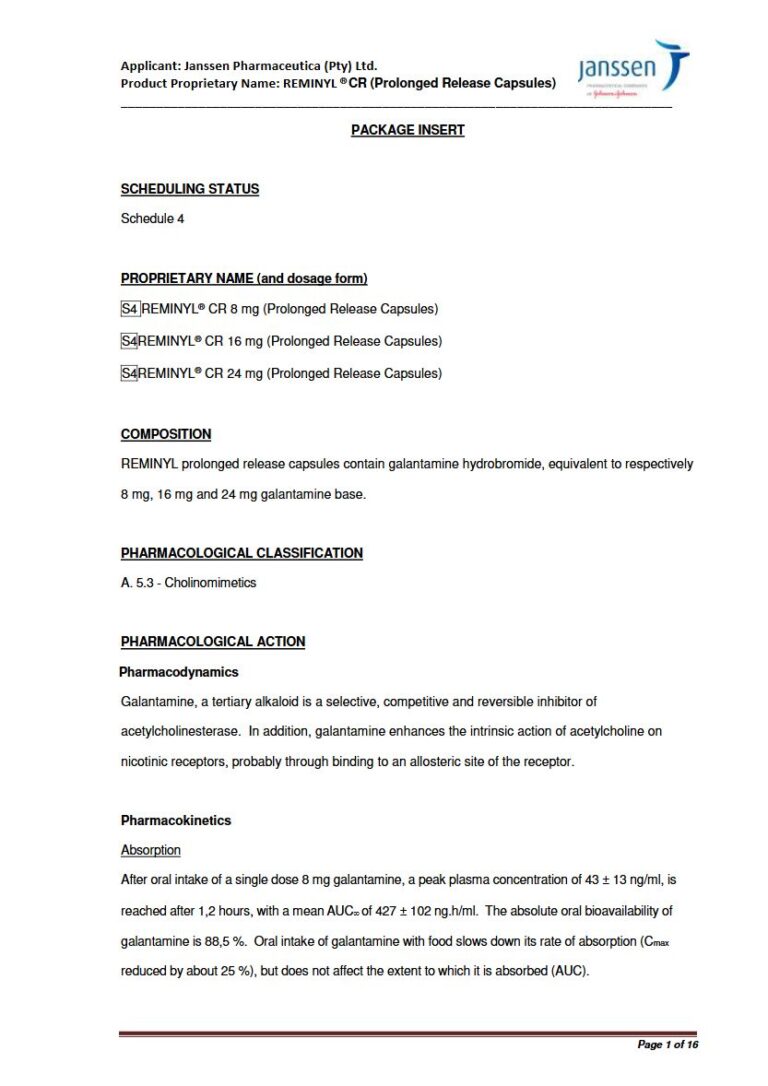
Reminyl 8mg. 16mg. 24mg Capsule
PDF Leaflet Revision Date: Feb 2012
Clinical Summary
Quick overview from the medicine insert
Indication
Symptomatic treatment of mild to moderately severe dementia of the Alzheimer type.
Dosage (summary)
Starting dose: 8 mg/day for 4 weeks; Maintenance: 16 mg/day, may increase to 24 mg/day.
Onset of Action / Duration
Onset: 1.2 hours, Duration: 7-8 hours
Special Populations
- Moderate hepatic impairment
- Severe hepatic impairment
- Moderate renal impairment
- Severe renal impairment
Pregnancy & Breastfeeding
Not recommended during pregnancy; unknown if excreted in breast milk.
Key Drug Interactions
- CYP2D6 inhibitors
- CYP3A4 inhibitors
- Anticholinergic medications
Contraindications
- Hypersensitivity to galantamine
- Severe hepatic impairment
- Severe renal impairment
- Urinary outflow obstruction
Common side effects
- Nausea
- Vomiting
- Dizziness
- Fatigue
- Bradycardia
Counselling Points
- Take with food
- Monitor for gastrointestinal symptoms
- Avoid abrupt discontinuation
Serious warnings
- Monitor weight loss
- Caution in bradycardia
- Risk of seizures in epilepsy
Important Disclaimer
The Reminyl 8mg. 16mg. 24mg Capsule professional information leaflet below is the property of Janssen Phamaceutica and is provided on Medinsert exactly as issued, with no.. alterations or editorial changes. We make every effort to keep content current by updating documents as soon as new versions become available. Medinsert serves as a trusted access point for healthcare professionals, but does not replace official sources or clinical judgement. For more details, please read our full disclaimer. read more>>
 Healthcare Professionals Only
This content is for registered healthcare professionals
Sign in or create a free account to read the full package insert.
Free for HPCSA-registered professionals. Powered by Medinsert.
Clinical Particulars
Section 4 of the official insert — extracted exactly as issued, no alterations
4.1 Therapeutic indications
REMINYL is indicated for the symptomatic treatment of mild to moderately severe dementia of the Alzheimer type. Efficacy data beyond 6 months has not been established (see Warnings).
4.2 Posology and method of administration
Adults Prolonged Release Capsules
Administration: REMINYL prolonged release capsules should be administered once daily in the morning, preferably with food.
Starting dose: The recommended starting dose is 8 mg/day for 4 weeks.
Maintenance dose:
- The initial maintenance dose is 16 mg/day and patients should be maintained on 16 mg/day for at least 4 weeks.
- An increase to the maintenance dose of 24 mg/day should be considered after appropriate assessment including evaluation of clinical benefit and tolerability.
- In individual patients not showing an increased response or not tolerating 24 mg/day, a dose reduction to 16 mg/day should be considered.
- Maintenance treatment can be continued for as long as therapeutic benefit for the patient exists. Therefore, the clinical benefit of galantamine should be reassessed on a regular basis. Discontinuation should be considered when evidence of a therapeutic effect is no longer present.
- There is no rebound effect after abrupt discontinuation of treatment (e.g.in preparation for surgery).
Children: Use of REMINYL in children is not recommended. No data on the use of REMINYL in paediatric patients are available.
Hepatic and renal impairment: REMINYL plasma levels may be increased in patients with moderate to severe hepatic or renal impairment. In patients with moderately impaired hepatic function, based on pharmacokinetic modeling, dosing should begin with 4 mg once daily with immediate release tablets, preferably taken in the morning for at least one week. For prolonged release capsules, based on pharmacokinetic modeling, dosing should begin with 8 mg every other day for at least one week, preferably taken in the morning. Thereafter, patients should proceed with 4 mg twice daily for immediate release tablets or 8 mg once daily for prolonged release capsules at least four weeks. In these patients total daily doses should not exceed 16 mg. In patients with severe hepatic impairment (CHILD- score greater than 9), the use of REMINYL is contraindicated. For patients with a creatinine clearance greater than 9 ml/min, no dosage adjustment is required. In patients, with severe renal impairment (creatinine clearance less than 9 ml/min), the use of REMINYL is contraindicated.
Concomitant treatment: In patients treated with potent CYP2D6 or CYP3A4 inhibitors, dose reductions can be considered. (See INTERACTIONS).
4.3 Contraindications
REMINYL should not be administered to patients with a known hypersensitivity to galantamine hydrobromide or to any excipients used in the formulations. Severe impaired hepatic and renal function, as safety has not been demonstrated. The use of REMINYL is not recommended in patients with urinary outflow obstruction or recovering from bladder surgery. Patients with rare hereditary problems of galactose intolerance, the Lapp lactase deficiency of glucose-galactose malabsorption, should not take this medicine.
4.4 Special warnings and precautions for use
REMINYL is indicated for patients with mild to moderately severe dementia of the Alzheimeru2019s type. The benefit of REMINYL in patients with other types of dementia or other types of memory impairment has not been demonstrated. Treatment with cholinesterase inhibitors, including REMINYL, has been associated with weight loss in patients with Alzheimeru2019s disease. During therapy patientu2019s weight should be monitored.
REMINYL should be given with caution in the following conditions:
Cardiovascular conditions
- Bradycardia: The potential for this action may be particularly important to patients with u2018u201dsick sinus syndromeu201d or other supraventricular cardiac conduction disturbances or who use medicines that significantly reduce the heart rate concomitantly such as digoxin and beta blockers. In clinical trials, use of REMINYL has been associated with syncope and rarely with bradycardia.
Gastro-intestinal conditions
- Patients at increased risk of developing peptic ulcers, e.g. those with a history of ulcer disease or those predisposed to these conditions, including those receiving concurrent nonsteroidal anti-inflammatory drugs (NSAIDS), should be monitored for symptoms. The use of REMINYL is not recommended in patients with gastro-intestinal obstruction or recovering from gastro-intestinal surgery.
Neurological conditions
- Epilepsy: cholinomimetics are believed to lower the threshold for seizures in sensitive patients.
Pulmonary conditions
- Because of their cholinomimetic actions, REMINYL should be prescribed with care for patients with a history of asthma or chronic, obstructive bronchitis.
Safety in Subjects with Mild Cognitive Impairment (MCI): REMINYL is not indicated for individuals with mild cognitive impairment (MCI), i.e., those who demonstrate isolated memory impairment greater than expected for their age and education, but do not meet criteria for Alzheimeru2019s disease. Two, 2-year controlled trials in subjects with MCI treated with REMINYL or placebo did not meet dual primary efficacy outcomes. Although mortality in both treatment arms was low, more deaths were initially recorded in subjects randomized to REMINYL than to placebo, but the incidence of serious adverse events was identical between treatment groups. The deaths were due to various causes that are not unexpected in an elderly population. When data retrieved from the large proportion of patients who discontinued prior to completion of the double-blind period was included, there was no evidence of a statistically significant increasing risk of death in REMINYL-treated subjects over time. More subjects from the placebo than the REMINYL group discontinued prior to death, which may account for the difference in mortality initially recorded.
4.5 Interactions with other medicines
Interactions with other medicaments and other forms of interactions:
Pharmacodynamic interactions: Because of its mechanism of action, REMINYL should not be given concomitantly with other cholinomimetics. REMINYL antagonises the effect of anticholinergic medication. As expected with cholinomimetics, a pharmacodynamic interaction is possible with medicines that significantly reduce the heart rate e.g. digoxin and beta blockers (See WARNINGS).
REMINYL as a cholinomimetic, is likely to exaggerate succinylcholine-type muscle relaxation during anaesthesia.
Pharmacokinetic interactions: Based on in-vitro studies, CYP2D6 and CYP3A4 were the major enzymes involved in the metabolism of REMINYL. Inhibition of gastric acid secretion will not impair the absorption of REMINYL. Other medicines affecting the metabolism of REMINYL: Drugs that are potent inhibitors for CYP2D6 or CYP3A4 may increase the AUC of REMINYL. Multiple dose pharmacokinetic studies demonstrated that the AUC of REMINYL increased 30 u2013 40 %, respectively, during co-administration of ketoconazole and paroxetine. As co-administered with erythromycin, another CYP3A4 inhibitor, the REMINYL AUC only increased approximately 10 %. Population PK analysis for patients with Alzheimeru2019s disease showed that the clearance of REMINYL was decreased about 25-33 % by concurrent administration of amitriptyline, fluoxetine, fluvoxamine, paroxetine and quinidine, known inhibitors of CYP2D6. Therefore, during initiation of treatment with potent inhibitors of CYP2D6 or CYP3A4 patients may experience an increased incidence of cholinergic side effects, predominantly nausea and vomiting. Under these circumstances, based on tolerability, a reduction of the REMINYL maintenance dose can be considered. Memantine, an N-methyl-D-aspartate (NMDA) receptor antagonist, at a dose of 10 mg/daily for 2 days followed by 10 mg BID for 12 days had no effect on the pharmacokinetics of REMINYL 16 mg/day at steady state.
Effect of REMINYL on the metabolism of other medicines: Therapeutic doses of REMINYL (12 mg b.i.d) had no effect on the kinetics of digoxin and warfarin. REMINYL did not affect the increased prothrombin time induced by warfarin.
In vitro studies indicated that the inhibition potential of REMINYL with respect to the major forms of human cytochrome P450 is very low.
4.6 Fertility, pregnancy and lactation
No studies are available on the use of REMINYL in pregnant women. REMINYL should not be used during pregnancy. It is not known whether REMINYL is excreted in human breast milk and there are no studies in lactating women.
4.7 Effects on ability to drive and use machines
Alzheimeru2019s disease may cause gradual impairment of driving performance or compromise the ability to use machinery. Furthermore, like other cholinomimetics, REMINYL may cause dizziness and somnolence, which could affect the ability to drive or use machines, especially during the first weeks after initiation of treatment.
4.8 Undesirable effects
Side-effects: Clinical Trial Data
The specific adverse events data described in this section are based on studies of the immediate-release tablet formulation. In clinical trials, the safety profile of once-daily treatment with REMINYL CR (prolonged release capsules) was similar to that seen with tablets. In the controlled trials, the majority of the adverse events occurred during the dose-escalation period. The most frequently reported adverse event was nausea and vomiting, which lasted 5 - 7 days. Administration of REMINYL with food, the use of anti-emetic medication, and ensuring adequate fluid intake may reduce the impact of these events.
All adverse events reported in clinical trials are listed below in Table 1, using the following reporting frequencies: common (u2265 1/100 to <1/10), uncommon (u2265 1/1000 to u2264 1/100).
Table 1. Adverse Drug Reactions Reported in Clinical Trials
System/Organ Class Adverse Events reported by u2265 1 % (u2265 1/100) of REMINYL-treated subjects Adverse Events reported by < 1 % (< 1/100) of REMINYL-treated subjects
Body as a Whole u2013 General Disorders Fatigue Syncope Asthenia Malaise Fall Injury Back pain Chest pain Fever
Central & Peripheral Nervous system Dizziness Headache Dysgeusia Hypersomnia Tremor Lethargy Paresthesia Vertigo Hypertonia Convulsions Involuntary muscle contractions Ataxia Hypokinesia Hyperkinesia Apraxia Aphasia Leg cramps Tinnitus Transient ischaemic attack Cerebrovascular accident
Gastrointestinal System Disorders Nausea Vomiting Diarrhoea Abdominal pain Abdominal pain upper Dyspepsia Stomach discomfort Abdominal discomfort Constipation Flatulence Retching Gastritis Melaena Dysphagia Rectal haemorrhage Dry mouth Saliva increased Diverticulitis Gastroenteritis Hiccup Oesophageal perforation
Cardiac Disorders Bradycardia Atrioventricular block first degree Palpitations Sinus bradycardia Supraventricular extrasystoles Cardiac failure Myocardial ischemia or infarction Atrial dysrhythmias Atrial fibrillation Supraventricular tachycardias, QT prolonged Bundle branch block T-wave inversion, Ventricular tachycardia Severe bradycardia
Metabolic and Nutritional Disorders Decreased appetite Weight decreased Dehydration Hyperglycaemia Alkaline phosphate increased
Musculoskeletal and Connective Tissue Disorders Muscle spasms Muscular weakness
Psychiatric Disorders Anorexia Depression Insomnia Somnolence Hallucination Agitation Confusion Apathy Paroniria Paranoid reaction Libido increased Delirium Suicidal ideation Suicide Anxiety
Respiratory System Disorder Rhinitis Upper respiratory tract infection Bronchitis Coughing
Skin and Sub- cutaneous Tissue Disorders Hyperhydrosis
Urinary system Disorders Urinary tract infection Haematuria Urinary incontinence Micturition frequency Cystitis Urinary retention Nocturia Renal calculi
Vascular and Blood cell Disorders Anaemia Peripheral oedema Hypertension Flushing Hypotension Postural hypotension Dependent oedema Purpura Epistaxis Thrombocytopenia
Post-marketing Experience
Table 2 includes adverse events from post-approval controlled and uncontrolled clinical trials and post-marketing experience observed in patients treated with REMINYL. These adverse events may or may not be causally related to the medicine.
Table 2. Adverse Reactions Identified During Postmarketing Experience with REMINYL
Immune System Disorders Hypersensitivity
Body as a Whole u2013 General Disorders Dehydration (including rare, severe cases leading to renal insufficiency and renal failure).
Psychiatric Disorders Aggression, hallucination, hallucination visual, hallucination auditory.
Gastrointestinal System Disorders Upper and lower GI bleeding, stomach discomfort, abdominal discomfort.
Hepatobiliary Disorders Elevated liver enzymes, hepatitis.
Metabolic & Nutritional Disorders Hypokalemia.
Nervous System Disorders Lethargy, dysgeusia, hypersomnia.
Ear and Labyrinth Disorders Tinnitus.
Eye disorders Vision blurred.
Vascular Disorders Hypertension.
4.9 Overdose
Symptoms: Signs and symptoms of significant overdosing of REMINYL are predicted to be similar to those of overdosing of other cholinomimetics. These effects generally involve the central nervous system, the parasympathetic nervous system, and the neuromuscular junction. In addition to muscle weakness or fasciculations, some or all of the signs of a cholinergic crisis may develop: severe nausea, vomiting, gastro-intestinal cramping, salivation, lacrimation, urination, defecation, sweating, bradycardia, hypotension, collapse and convulsions. Increasing muscle weakness together with tracheal hypersecretions and bronchospasm, may lead to vital airway compromise. There have been post-marketing reports of Torsade de Pointes, QT prolongation; bradycardia, ventricular tachycardia and loss of consciousness in association with inadvertent overdoses of galantamine. In one case where the dose was known, eight 4 mg tablets (32 mg total) were ingested on a single day. Two additional cases of accidental ingestion of 32 mg (nausea, vomiting, and dry mouth; nausea, vomiting, and substernal chest pain) and one of 40 mg (vomiting) resulted in brief hospitalisations for observation with full recovery. One patient, who was prescribed 24 mg/day and had a history of hallucinations over the previous two years, mistakenly received 24 mg twice daily for 34 days and developed hallucinations requiring hospitalisation. Another patient, who was prescribed 16 mg/day of oral solution, inadvertently ingested 160 mg (40 ml) and experienced sweating, vomiting, bradycardia, and near-syncope one hour later, which necessitated hospital treatment. His symptoms resolved within 24 hours.
Treatment: As in any case of overdose, general supportive measures should be used. In severe cases, anticholinergics such as atropine can be used as a general antidote for cholinomimetics. An initial dose of 0,5 to 1,0 mg i.v. is recommended, with subsequent doses based on the clinical response. Because strategies for the management of overdose are continually evolving, it is advisable to contact a poison control centre to determine the latest recommendations for the management of an overdose.
