
Spalgem 200 Mg/1000 Mg Injection
PDF Leaflet Revision Date: 24 January 2023
Clinical Summary
Quick overview from the medicine insert
Indication
Treatment of various cancers including non-small cell lung cancer and pancreatic cancer.
Dosage (summary)
1,000 mg/mu00b2 IV infusion weekly for non-small cell lung cancer; 1,250 mg/mu00b2 for bladder cancer.
Special Populations
- Hepatic impairment
- Renal impairment
- Elderly patients
Pregnancy & Breastfeeding
Not established; avoid in pregnancy and breastfeeding.
Key Drug Interactions
- Cisplatin
- Paclitaxel
- Radiotherapy
Contraindications
- Hypersensitivity to gemcitabine
Common side effects
- Nausea
- Vomiting
- Leucopenia
- Thrombocytopenia
- Fatigue
Counselling Points
- Monitor for signs of myelosuppression
- Avoid live vaccines
- Caution with driving due to somnolence
Serious warnings
- Myelosuppression
- Capillary leak syndrome
- Posterior reversible encephalopathy syndrome
Important Disclaimer
The Spalgem 200 Mg/1000 Mg Injection professional information leaflet below is the property of Ruby Pharmaceuticals and is provided on Medinsert exactly as issued, with no.. alterations or editorial changes. We make every effort to keep content current by updating documents as soon as new versions become available. Medinsert serves as a trusted access point for healthcare professionals, but does not replace official sources or clinical judgement. For more details, please read our full disclaimer. read more>>
 Healthcare Professionals Only
This content is for registered healthcare professionals
Sign in or create a free account to read the full package insert.
Free for HPCSA-registered professionals. Powered by Medinsert.
Clinical Particulars
Section 4 of the official insert — extracted exactly as issued, no alterations
4.1 Therapeutic indications
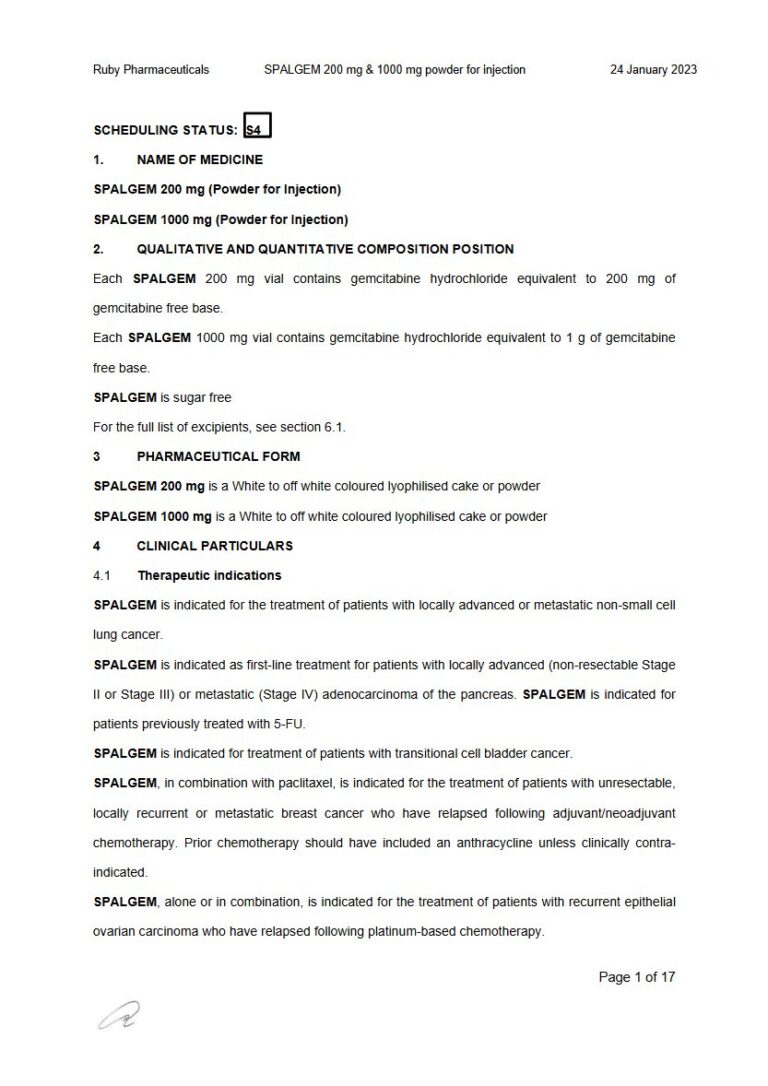
SPALGEM is indicated for the treatment of patients with locally advanced or metastatic non-small cell lung cancer. SPALGEM is indicated as first-line treatment for patients with locally advanced (non-resectable Stage II or Stage III) or metastatic (Stage IV) adenocarcinoma of the pancreas. SPALGEM is indicated for patients previously treated with 5-FU. SPALGEM is indicated for treatment of patients with transitional cell bladder cancer. SPALGEM, in combination with paclitaxel, is indicated for the treatment of patients with unresectable, locally recurrent or metastatic breast cancer who have relapsed following adjuvant/neoadjuvant chemotherapy. Prior chemotherapy should have included an anthracycline unless clinically contra-indicated. SPALGEM, alone or in combination, is indicated for the treatment of patients with recurrent epithelial ovarian carcinoma who have relapsed following platinum-based chemotherapy.
4.2 Posology and method of administration
Posology
Non-small cell lung cancer: Adults: The recommended monochemotherapy dosage is 1 000 mg/mu00b2, given by 30 minute intravenous infusion. This should be repeated once weekly for three weeks, followed by a one week rest period. This four week cycle is then repeated. Dosage reduction with each cycle or within a cycle may be applied based upon the amount of toxicity experienced by the patient.
SPALGEM may be used in combination with cisplatin using either a three week or a four week schedule. One of the following regimens is suggested:
3 week schedule: SPALGEM 1 250 mg/mu00b2, given by 30 minute intravenous infusion on days 1 and 8 of every 21 day cycle and cisplatin 100 mg/mu00b2 on day 1. Dosage reduction with each cycle or within a cycle may be applied based upon the amount of toxicity experienced by the patient.
4 week schedule: SPALGEM 1 000 mg/mu00b2 on days 1, 8 and 15 of every 28 day cycle and cisplatin 100 mg/mu00b2 on either day 1, 2 or 15 of therapy. Dose reduction with each cycle or within a cycle may be applied based upon the amount of toxicity experienced by the patient.
Pancreatic cancer: Adults: The recommended dose of SPALGEM is 1 000 mg/mu00b2, given by 30 minute intravenous infusion. This should be repeated once weekly for up to 7 weeks followed by a week of rest. Subsequent cycles should consist of injections once weekly for 3 consecutive weeks out of every 4 weeks. Dosage reduction with each cycle or within a cycle may be applied based upon the amount of toxicity experienced by the patient.
Bladder cancer: Adults: The recommended monochemotherapy dosage of SPALGEM is 1 250 mg/mu00b2, given by 30 minute intravenous infusion. The dose should be given on days 1, 8 and 15 of each 28 day cycle. This four week cycle is then repeated. Dosage reduction with each cycle or within a cycle may be applied based upon the amount of toxicity experienced by the patient.
SPALGEM may be used in combination with cisplatin. The recommended dose of SPALGEM is 1 000 mg/mu00b2, given by 30 minute infusion. The dose should be given on days 1, 8 and 15 of each 28 day cycle in combination with cisplatin. Cisplatin is given at a recommended dose of 70 mg/mu00b2 on day 1 following SPALGEM or day 2 of each 28 day cycle. This four week cycle is then repeated. Dosage reduction with each cycle or within a cycle may be applied based upon the amount of toxicity experienced by the patient. A clinical trial showed more myelosuppression when cisplatin was used in doses of 100 mg/mu00b2.
Breast cancer: Adults: SPALGEM in combination with paclitaxel is recommended using paclitaxel (175 mg/mu00b2) administered on day 1 over approximately 3 hours as an intravenous infusion, followed by SPALGEM (1 250 mg/mu00b2) as a 30 minute intravenous infusion on days 1 and 8 of each 21 day cycle. Dose reduction with each cycle or within a cycle may be applied based upon the amount of toxicity experienced by the patient. Patients should have an absolute granulocyte count of at least 1 500 (x 106/L) prior to initiation of SPALGEM + paclitaxel combination.
Ovarian Cancer: Single medicine use: Adults: The recommended dose of SPALGEM is 800 to 1 250 mg/mu00b2, given by a 30 minute intravenous infusion. The dose should be given on days 1, 8 and 15 of each 28 day cycle. This four week cycle is then repeated. Dosage reduction with each cycle or within a cycle may be applied based upon the amount of toxicity experienced by the patient.
Combination use: Adults: SPALGEM in combination with carboplatin is recommended using SPALGEM 1 000 mg/mu00b2 administered on days 1 and 8 of each 21 day cycle as a 30 minute intravenous infusion. After SPALGEM, carboplatin will be given on day 1 consistent with a target AUC of 4,0 g/ml/min. Dosage reduction with each cycle or within a cycle may be applied based upon the amount of toxicity experienced by the patient.
Patients receiving SPALGEM should be monitored prior to each dose for platelet, leucocyte and granulocyte counts and, if necessary, the dose of SPALGEM may be either reduced or withheld in the presence of haematological toxicity, according to the following scale:
Absolute granulocyte count (x 106/L)
Platelet count (x 106/L)
% of full dose
>1 000
>100 000
100
<500
50 000 - 100 000
75
hold
Special populations
Patients with hepatic or renal impairment: SPALGEM should be used with caution in patients with hepatic insufficiency or with impaired renal function as no studies have been done in patients with significant renal or hepatic impairment. There is insufficient information from clinical studies to allow clear dose recommendation for this patient population. Periodic physical examination and checks of renal and hepatic function should be made to detect non-haematologic toxicity. Dosage reduction with each cycle or within a cycle may be applied based upon the amount of toxicity experienced by the patient. Doses should be withheld until toxicity has resolved in the opinion of the medical practitioner.
Elderly patients: SPALGEM has been well tolerated in patients over the age of 65. There is no evidence to suggest that dose adjustments are necessary in the elderly, although SPALGEM clearance and half-life are affected by age.
Method of administration
SPALGEM is for intravenous use only. SPALGEM is well tolerated during the infusion, with only a few cases of injection site reaction reported. SPALGEM can be easily administered on an outpatient basis. Information on instructions for preparation and reconstitution, see section 6.6.
4.3 Contraindications
SPALGEM is contra-indicated in those patients with a known hypersensitivity to gemcitabine or any of the excipients of SPALGEM listed in section 6.1.
Pregnancy and lactation: The safety of SPALGEM in human pregnancy and lactation has not been established.
Usage in children: Safety and effectiveness in children have not been established.
4.4 Special warnings and precautions for use
Prolongation of the infusion time and increased dosing frequency have been shown to increase toxicity. SPALGEM can suppress bone marrow function as manifested by leucopoenia, thrombocytopenia and anaemia. Myelosuppression is usually mild to moderate and is more pronounced for the granulocyte count. Peripheral blood counts may continue to deteriorate after SPALGEM administration has been stopped. In patients with impaired bone marrow function, the treatment should be started with caution. The risk of cumulative bone-marrow suppression must be considered when SPALGEM treatment is given together with other chemotherapy medicines.
Hepatic insufficiency: Administration of SPALGEM in patients with concurrent liver metastases or a pre-existing medical history of hepatitis, alcoholism or liver cirrhosis may lead to exacerbation of the underlying hepatic insufficiency. Laboratory evaluation of renal and hepatic function (including virological tests) should be performed periodically. SPALGEM should be used with caution in patients with hepatic insufficiency or with impaired renal function as there is insufficient information from clinical studies to allow clear dose recommendation for this patient population (see section 4.2).
Concomitant radiotherapy: Concomitant radiotherapy (given together or u22647 days apart): Toxicity has been reported (see section 4.5 for details and recommendations for use).
Live vaccinations: Yellow fever vaccine and other live attenuated vaccines are not recommended in patients treated with SPALGEM (see section 4.5).
Cardiovascular: Due to the risk of cardiac and/or vascular disorders with SPALGEM, particular caution must be exercised with patients presenting a history of cardiovascular events.
Capillary leak syndrome (CLS): Capillary leak syndrome has been reported in patients receiving SPALGEM as single medicine or in combination with chemotherapeutic medicines. The condition is usually treatable if recognised early and managed appropriately, but fatal cases have been reported. The condition involves systemic capillary hyperpermeability during which fluid and proteins from the intravascular space leak into the interstitium. The clinical features include generalised oedema, weight gain, hypoalbuminaemia, severe hypotension, acute renal impairment and pulmonary oedema. SPALGEM should be discontinued and supportive measures implemented if capillary leak syndrome develops during therapy. Capillary leak syndrome can occur in later cycles and has been associated in the literature with adult respiratory distress syndrome.
Posterior reversible encephalopathy syndrome (PRES): Reports of posterior reversible encephalopathy syndrome (PRES) with potentially severe consequences have been reported in patients receiving SPALGEM as single medicine or in combination with other chemotherapeutic medicines. Acute hypertension and seizure activity were reported in most gemcitabine patients experiencing PRES, but other symptoms such as headache, lethargy, confusion and blindness could also be present. Diagnosis is optimally confirmed by magnetic resonance imaging (MRI). PRES was typically reversible with appropriate supportive measures. SPALGEM should be permanently discontinued and supportive measures implemented, including blood pressure control and antiseizure therapy, if PRES develops during therapy.
Pulmonary: Pulmonary effects, sometimes severe (such as pulmonary oedema, interstitial pneumonitis or adult respiratory distress syndrome (ARDS)) have been reported in association with SPALGEM therapy. The aetiology of these effects is unknown. If such effects develop, consideration should be made to discontinuing SPALGEM therapy. Early use of supportive care measure may help ameliorate the condition.
Renal: Haemolytic uraemic syndrome: Clinical findings consistent with the haemolytic uraemic syndrome (HUS) were rarely reported in patients receiving gemcitabine (see section 4.8). SPALGEM should be discontinued at the first signs of any evidence of microangiopathic haemolytic anaemia, such as rapidly falling haemoglobin with concomitant thrombocytopaenia, elevation of serum bilirubin, serum creatinine, blood urea nitrogen, or LDH. Renal failure may not be reversible with discontinuation of therapy and dialysis may be required.
4.5 Interaction with other medicines and other forms of interaction
RADIOTHERAPY: CONCURRENT (GIVEN TOGETHER OR u2264 7 DAYS APART) - TOXICITY ASSOCIATED WITH THIS MULTIMODALITY THERAPY IS DEPENDENT ON MANY DIFFERENT FACTORS, INCLUDING DOSE OF SPALGEM, FREQUENCY OF SPALGEM ADMINISTRATION, DOSE OF RADIATION, RADIOTHERAPY PLANNING TECHNIQUE, THE TARGET TISSUE, AND TARGET VOLUME. PRE-CLINICAL AND CLINICAL STUDIES HAVE SHOWN THAT GEMCITABINE HAS RADIOSENSITIZING ACTIVITY. IN A SINGLE TRIAL, WHEN GEMCITABINE AT A DOSE OF 1 000 mg/mu00b2 WAS ADMINISTERED CONCURRENTLY FOR UP TO 6 CONSECUTIVE WEEKS WITH THERAPEUTIC THORACIC RADIATION TO PATIENTS WITH NON-SMALL CELL LUNG CANCER, SIGNIFICANT TOXICITY IN THE FORM OF SEVERE AND POTENTIALLY LIFE THREATENING MUCOSITIS, ESPECIALLY ESOPHAGITIS, AND PNEUMONITIS WAS OBSERVED, PARTICULARLY IN PATIENTS RECEIVING LARGE VOLUMES OF RADIOTHERAPY (MEDIAN TREATMENT VOLUMES 4 795 cmu00b3). THE OPTIMUM REGIMEN FOR SAFE ADMINISTRATION OF SPALGEM WITH THERAPEUTIC DOSES OF RADIATION HAS NOT YET BEEN DETERMINED IN ALL TUMOUR TYPES. RADIATION INJURY HAS BEEN REPORTED ON TARGETED TISSUES (e.g. ESOPHAGITIS, COLITIS, AND PNEUMONITIS) IN ASSOCIATION WITH BOTH CONCURRENT AND NON-CONCURRENT USE OF SPALGEM.
Others: Yellow fever and other live attenuated vaccines are not recommended due to the risk of systemic, possibly fatal, disease, particularly in immunosuppressed patients.
4.6 Fertility, pregnancy and lactation
Pregnancy: SPALGEM should not be used during pregnancy as safety has not been established (see section 4.3). There are no adequate data from the use of gemcitabine in pregnant women. Studies in animals have shown reproductive toxicity. Women should be advised not to become pregnant during treatment with SPALGEM and to warn their attending medical practitioner immediately, should this occur after all.
Breast-feeding: SPALGEM should not be used during breastfeeding as safety has not been established (see section 4.3). It is not known whether gemcitabine is excreted in human milk and adverse effects on the suckling child cannot be excluded. Breast-feeding must be discontinued during SPALGEM therapy.
Fertility: In fertility studies gemcitabine caused hypospermatogenesis in male mice. Therefore, men being treated with gemcitabine are advised not to father a child during and up to 6 months after treatment and to seek further advice regarding cryoconservation of sperm prior to treatment because of the possibility of infertility due to therapy with SPALGEM.
4.7 Effects on ability to drive and use machines
SPALGEM has been reported to cause mild to moderate somnolence. Patients should be cautioned against driving or operating machinery until it is established that they do not become somnolent.
4.8 Undesirable effects
The most frequently reported adverse drug reactions associated with Gemcitabine treatment include: nausea with or without vomiting, raised liver transaminases (AST/ALT) and alkaline phosphatase, reported in approximately 60% of patients; proteinuria and haematuria reported in approximately 50% patients; dyspnoea reported in 10-40% of patients (highest incidence in lung cancer patients); allergic skin rashes occur in approximately 25% of patients and are associated with itching in 10% of patients. The frequency and severity of the adverse reactions are affected by the dose, infusion rate and intervals between doses (see section 4.4). Dose-limiting adverse reactions are reductions in thrombocyte, leucocyte and granulocyte counts (see section 4.2). The following table of undesirable effects and frequencies is based on data from clinical trials. Within each frequency grouping, undesirable effects are presented in order of decreasing seriousness.
System Organ Class Frequency grouping
Blood and lymphatic system disorders Frequent Leucopaenia. Neutropaenia. Bone-marrow suppression u2022 Thrombocytopaenia u2022 Anaemia u2022 Febrile neutropaenia Less frequent u2022 Thrombocytosis u2022 Thrombotic microangiopathy Infections and infestations Frequent u2022 Infections Frequency unknown u2022 Sepsis Immune system disorders Less frequent u2022 Anaphylactoid reaction Metabolism and nutrition disorders Frequent u2022 Anorexia Nervous system disorders Frequent u2022 Headache u2022 Insomnia u2022 Somnolence Less frequent u2022 Posterior reversible encephalopathy syndrome Frequency unknown Cerebrovascular accident Cardiac disorders Less frequent u2022 Myocardial infarct Frequency unknown Dysrythmias, predominantly supraventricular in nature Heart failure Vascular disorders Less frequent u2022 Hypotension u2022 Capillary leak syndrome Frequency unknown Clinical signs of peripheral vasculitis and gangrene Respiratory, thoracic and mediastinal disorders Frequent u2022 Dyspnoea u2022 Cough u2022 Rhinitis Less frequent u2022 Interstitial pneumonitis u2022 Bronchospasm Frequency unknown Pulmonary oedema Adult respiratory distress syndrome Gastrointestinal disorders Frequent u2022 Vomiting u2022 Nausea u2022 Diarrhoea u2022 Stomatitis and ulceration of the mouth u2022 Constipation Frequency unknown Ischaemic colitis Hepatobiliary disorders Frequent u2022 Elevation of liver transaminases (AST and ALT) and alkaline phosphatase u2022 Increased bilirubin Less frequent u2022 Increased gamma-glutamyl transferase (GGT) Frequency unknown Serious hepatotoxicity, including liver failure and death Skin and subcutaneous tissue disorders Frequent u2022 Allergic skin rash frequently associated with pruritus u2022 Alopecia u2022 Itching u2022 Sweating Less frequent u2022 Ulceration u2022 Vesicle and sore formation u2022 Scaling u2022 Severe skin reactions, including desquamation and bullous skin eruptions u2022 Pseudocellulitis Frequency unknown Lyell's Syndrome, Steven-Johnson Syndrome Musculoskeletal and connective tissue disorders Frequent u2022 Back pain u2022 Myalgia Renal and urinary disorders Frequent u2022 Haematuria u2022 Mild proteinuria Frequency unknown Renal failure Haemolytic uraemic syndrome General disorders and Administration site conditions Frequent u2022 Influenza-like symptoms - the most common symptoms are fever, headache, chills, myalgia, asthenia and anorexia. Cough, rhinitis, malaise, perspiration and sleeping difficulties. u2022 Oedema/peripheral oedema including facial oedema. u2022 Fever u2022 Asthenia u2022 Chills Less frequent u2022 Injection site reactions-mainly mild in nature Injury, poisoning, and procedural Frequency unknown Complications Radiation toxicity Radiation recall Combination use in breast cancer The frequency of grade 3 and 4 haematological toxicities, particularly neutropaenia, increases when gemcitabine is used in combination with paclitaxel. However, the increase in these adverse reactions is not associated with an increased incidence of infections or haemorrhagic events. Fatigue and febrile neutropaenia occur more frequently when gemcitabine is used in combination with paclitaxel. Fatigue, which is not associated with anaemia, usually resolves after the first cycle.
Reporting of suspected adverse reactions: Reporting suspected adverse reactions after authorisation of the medicinal product is important. It allows continued monitoring of the benefit/risk balance of the medicinal product. Healthcare professionals are asked to report any suspected adverse reactions to SAHPRA via the u201c6.04 Adverse Drug Reaction Reporting Formu201d, found online under SAHPRAu2019s publications: https://www.sahpra.org.za/Publications/Index/8
4.9 Overdose
There is no antidote for overdosage of SPALGEM. In the event of suspected overdose, the patient should be monitored with appropriate blood counts and should receive supportive therapy, as necessary.
