
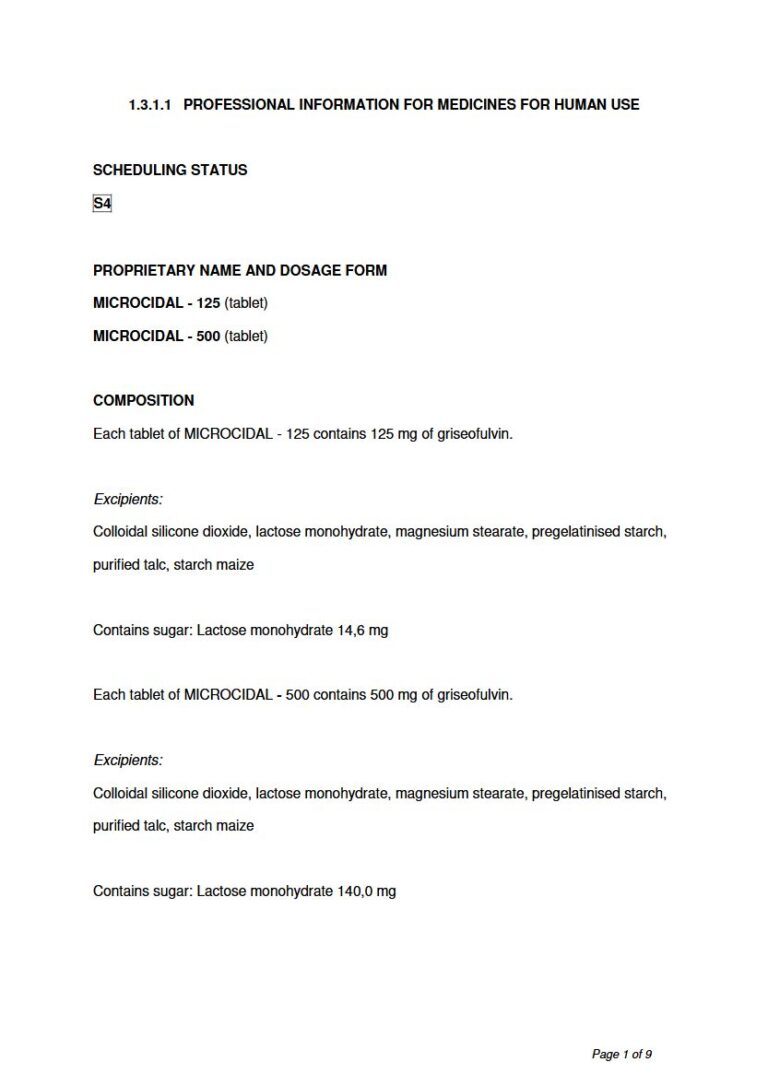
Microcidal 125mg. 500mg Tablet
PDF Leaflet Revision Date: 16 May 1978
Clinical Summary
Quick overview from the medicine insert
Indication
Mycotic diseases of skin, hair, and nails.
Dosage (summary)
Adults: 500 mg to 1 g daily; up to 2 g for severe infections.
Onset of Action / Duration
Onset: 4 hours, Duration: variable.
Special Populations
- Liver failure
- Porphyria
Pregnancy & Breastfeeding
Contraindicated in pregnancy; embryo toxic and teratogenic.
Key Drug Interactions
- Phenobarbitone decreases absorption
- May reduce plasma concentrations of salicylate
Contraindications
- Porphyria
- Liver failure
- Pregnancy
- Hypersensitivity
Common side effects
- Headache
- Skin rashes
- Gastrointestinal disturbances
Counselling Points
- Take with fatty meals to enhance absorption
- Monitor for signs of liver toxicity
Serious warnings
- Men should not father children within 6 months of treatment
- Caution in systemic lupus erythematosus
Important Disclaimer
The Microcidal 125mg. 500mg Tablet professional information leaflet below is the property of Pharmacare and is provided on Medinsert exactly as issued, with no.. alterations or editorial changes. We make every effort to keep content current by updating documents as soon as new versions become available. Medinsert serves as a trusted access point for healthcare professionals, but does not replace official sources or clinical judgement. For more details, please read our full disclaimer. read more>>
 Healthcare Professionals Only
This content is for registered healthcare professionals
Sign in or create a free account to read the full package insert.
Free for HPCSA-registered professionals. Powered by Medinsert.
Clinical Particulars
Section 4 of the official insert — extracted exactly as issued, no alterations
4.1 Therapeutic indications
Mycotic diseases of the skin, hair and nails due to Microsporum, Trichophyton or Epidermophyton, respond to MICROCIDAL therapy. It must be stressed that, since other fungal diseases are not affected by the medicine, careful mycological study with identification of the responsible organism is the only basis on which therapy can be selected accurately. Also infections of the scalp (tinea capitis) caused by M.canis, M.audouini, T.schoenleinii, and T.verrucosum; u201cringwormu201d of the glabrous skin: tinea cruris and tinea corporis caused by M.canis, T.rubrum, T.verrucosum and E.floccosum; and tinea of the hands (T.rubrum, T. mentagrophytes) and beard (Trichophyton species) are readily treatable with MICROCIDAL. MICROCIDAL also is highly effective in u201cathleteu2019s footu201d or epidermophytosis involving the skin and nails, the vesicular form of which is most commonly due to T.mentagrophytes and the hyperkeratotic type of T.rubrum, Trichophyton rubrum and T.mentagrophytes infections may require higher-than-conventional doses.
4.2 Posology and method of administration
Adults: 500 mg to 1 g per 24 hours. Doses of 1,5 g to 2,0 g per 24 hours may be used for short periods in severe or extensive infections. Children: 10 mg/kg per 24 hours. Take with or after meals, especially fatty meals, in order to minimize possible gastrointestinal irritation and to increase absorption. Best results are obtained when the daily dose is divided and given at 6-hour intervals. Treatment must be continued until infected tissue is replaced by normal hair, skin or nails, which required 2 to 6 months for skin and hair infections, 6 to 9 months for fingernails, and at least a year for toenails.
4.3 Contraindications
- Porphyria. It may precipitate an acute attack.
- Liver failure.
- Pregnancy. MICROCIDAL crosses the placenta and it has been shown to be embryo toxic and teratogenic in rats.
- Hypersensitivity to MICROCIDAL.
4.4 Special warnings and precautions for use
Men receiving MICROCIDAL should not father children within six months of treatment. The warning is based on data from in vitro studies using mammalian cells which demonstrated aneuploidy. Use with extreme caution in patients with systemic lupus erythematosus, as MICROCIDAL may precipitate or aggravate it.
4.5 Interactions with other medicines
- Phenobarbitone has been reported to decrease the gastrointestinal absorption of MICROCIDAL.
- MICROCIDAL may increase the rate of metabolism and diminish the side effects of some drugs such as coumarin anticoagulants and oral contraceptives.
- MICROCIDAL has also been reported to reduce the plasma concentrations of salicylate in patients taking aspirin.
- Since MICROCIDAL is derived from a species of Penicillium, it is theoretically possible that patients intolerant to penicillins or penicillamine may be intolerant of MICROCIDAL also. However, cross-sensitivity between MICROCIDAL and penicillins or penicillamine has not been clinically substantiated. In addition, penicillin-sensitive patients have received MICROCIDAL without difficulty.
- MICROCIDAL has been reported to enhance the effects of alcohol.
4.6 Fertility, pregnancy and lactation
The safety of MICROCIDAL in pregnancy and lactation has not been established (see CONTRAINDICATIONS). MICROCIDAL crosses the placenta and it has been shown to be embryo toxic and teratogenic in rats. Men receiving MICROCIDAL should not father children within six months of treatment. The warning is based on data from in vitro studies using mammalian cells which demonstrated aneuploidy. Use of an alternate or additional means of contraception if taking oestrogen-containing oral contraceptives concurrently with MICROCIDAL and for one month after stopping MICROCIDAL therapy is advisable.
4.7 Effects on ability to drive and use machines
MICROCIDAL may impair the ability to drive or operate machinery (see INTERACTIONS).
4.8 Undesirable effects
Side effects are usually mild and transient. They consist of headache, skin rashes, dryness of the mouth, an altered sensation of taste, and gastrointestinal disturbances. Angioedema, erythema multiform, toxic epidermal necrolysis, proteinuria, leucopenia and other blood dyscrasias, candidiasis, paraesthesia, photosensitisation, and severe headache have been reported occasionally. Depression, confusion, dizziness, insomnia, and fatigue have also been reported. Reports of hepatotoxicity have been attributed to MICROCIDAL. Oral thrush, granulocytopenia or leucopenia and peripheral neuritis can also occur less frequently.
4.9 Overdose
Symptoms: The symptoms of overdosage are those stated under side effects above and in these cases the dosage should be reduced or the medicine discontinued. Treatment: Treatment is supportive and symptomatic.
