
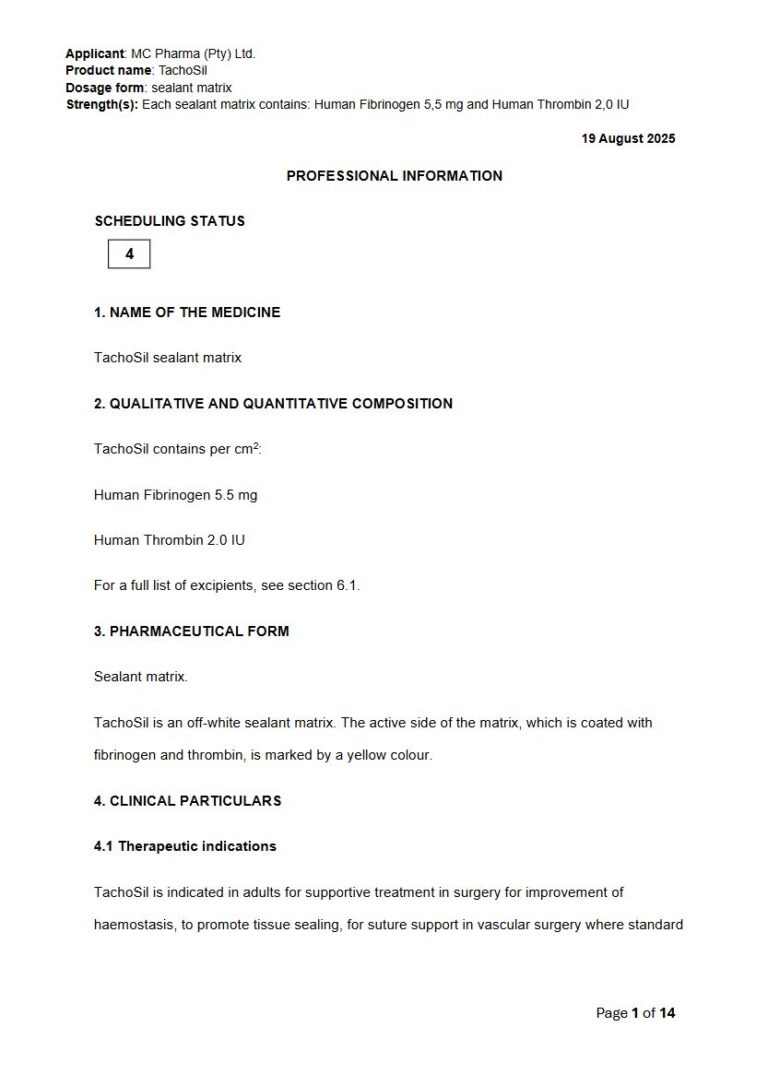
Tachosi 5,5 mg & 2,0 IU Sealant matrix
PDF Leaflet Revision Date: 19 August 2025
Clinical Summary
Quick overview from the medicine insert
Indication
Supportive treatment in surgery for haemostasis and tissue sealing.
Dosage (summary)
1-3 units applied based on wound size; up to 10 units reported.
Special Populations
- Not recommended for children under 18
Pregnancy & Breastfeeding
Safety in pregnancy and breastfeeding not established.
Key Drug Interactions
- Avoid exposure to alcohol, iodine, heavy metals
Contraindications
- Intravascular application
- Hypersensitivity to components
Common side effects
- Hypersensitivity reactions
- Thromboembolic complications
- Adhesions
Counselling Points
- Use only in sterile conditions
- Document product name and batch number
- Clean surrounding tissues to prevent adhesions
Serious warnings
- Life-threatening thromboembolic complications if used intravascularly
- Risk of allergic reactions
Important Disclaimer
The Tachosi 5,5 mg & 2,0 IU Sealant matrix professional information leaflet below is the property of Mc Pharma and is provided on Medinsert exactly as issued, with no.. alterations or editorial changes. We make every effort to keep content current by updating documents as soon as new versions become available. Medinsert serves as a trusted access point for healthcare professionals, but does not replace official sources or clinical judgement. For more details, please read our full disclaimer. read more>>
 Healthcare Professionals Only
This content is for registered healthcare professionals
Sign in or create a free account to read the full package insert.
Free for HPCSA-registered professionals. Powered by Medinsert.
Clinical Particulars
Section 4 of the official insert — extracted exactly as issued, no alterations
4.1 Therapeutic indications
TachoSil is indicated in adults for supportive treatment in surgery for improvement of haemostasis, to promote tissue sealing, for suture support in vascular surgery where standard techniques are insufficient and for supportive sealing of the dura mater to prevent postoperative cerebrospinal leakage following neurological surgery (see section 5.1).
4.2 Posology and method of administration
Posology
The use of TachoSil is restricted to medical personnel experienced in appropriate type of surgery. The quantity of TachoSil to be applied should always be oriented towards the underlying clinical need for the patient. The quantity of TachoSil to be applied is governed by the size of the wound area. Application of TachoSil must be individualised. In clinical trials, the dosages ranged from 1 - 3 units (9.5 cm x 4.8 cm); while application of up to 10 units has been reported. For smaller wounds, e.g. in minimally invasive surgery, the smaller size matrices (4.8 cm x 4.8 cm or 3.0 cm x 2.5 cm) or the pre-rolled matrix (based on a matrix of 4.8 cm x 4.8 cm) is recommended.
Paediatric population
TachoSil is not recommended for use in children below age 18 years due to insufficient data on safety and efficacy.
Method of administration
For epilesional use only. Do not use intravascularly. See section 6.6 for more detailed instructions.
4.3 Contraindications
TachoSil must not be applied intravascularly. Hypersensitivity to the active substances or to any of the excipients listed in section 6.1.
4.4 Special warnings and precautions for use
For epilesional use only. Do not use intravascularly. Life threatening thromboembolic complications may occur if the preparation is applied intravascularly. The use of TachoSil in gastrointestinal anastomoses surgery has not been studied. It is not known whether recent radiation therapy affects the efficacy of TachoSil when used for dura mater sealing. Owing to its protein content, allergic type hypersensitivity reactions are possible. Signs of hypersensitivity reactions include hives, generalised urticaria, tightness of the chest, wheezing, hypotension and anaphylaxis. If these symptoms occur, the administration has to be discontinued immediately. To prevent the development of tissue adhesions at undesired sites, ensure tissue areas outside the desired application area are adequately cleansed before administration of TachoSil (see section 6.6). Events of adhesions to gastrointestinal tissues leading to gastrointestinal obstruction have been reported with use in abdominal surgery carried out in proximity to the bowel. In case of shock, the appropriate treatment should be provided. Standard measures to prevent infections resulting from the use of medicinal products prepared from human blood or plasma such as TachoSil include selection of donors, screening of individual donations and plasma pools for specific markers of infection and the inclusion of effective manufacturing steps for the inactivation/removal of viruses. Despite this, when medicinal products prepared from human blood or plasma such as TachoSil are administered, the possibility of transmitting infective agents cannot be totally excluded. This also applies to unknown or emerging viruses and other pathogens. The measures taken are considered effective for enveloped viruses such as HIV, HBV and HCV and for the non-enveloped virus HAV. But these measures may be of limited value against non-enveloped viruses such as parvovirus B19. Parvovirus B19 infection may be serious for pregnant women (foetal infection) and for individuals with immunodeficiency or increased erythropoiesis (e.g. haemolytic anaemia). Two subjects have been re-exposed in a clinical trial and have not reported any immune-mediated adverse events; however, their antibody status to collagen or fibrinogen is unknown. It is strongly recommended that every time TachoSil is administered to a patient, the name and batch number of the product are recorded in order to maintain a link between the patient and the batch of the product.
4.5 Interaction with other medicines and other forms of interaction
No formal interaction studies have been performed. Similar to comparable products or thrombin solutions, the sealant may be denatured after exposure to solutions containing alcohol, iodine or heavy metals (e.g. antiseptic solutions). Such substances should be removed to the greatest possible extent before applying the sealant.
4.6 Fertility, pregnancy and lactation
The safety of TachoSil for use in human pregnancy or breastfeeding has not been established in controlled clinical trials. Experimental animal studies are insufficient to assess the safety with respect to reproduction, development of the embryo or foetus, the course of gestation and peri- and postnatal development.
4.7 Effects on ability to drive and use machines
Not relevant.
4.8 Undesirable effects
Hypersensitivity or allergic reactions (which may include angioedema, burning and stinging at the application site, bronchospasm, chills, flushing, generalised urticaria, headache, hives, hypotension, lethargy, nausea, restlessness, tachycardia, tightness of the chest, tingling, vomiting, wheezing) may occur in rare cases in patients treated with fibrin sealants/haemostatics. In isolated cases, these reactions may progress to severe anaphylaxis. Such reactions may especially be seen, if the preparation is applied repeatedly, or administered to patients known to be hypersensitive to constituents of the product. Immunogenicity: Antibodies against components of fibrin sealant/haemostatic products may occur. However, in a clinical trial with TachoSil in hepatic surgery, 26 % of the 96 patients treated with TachoSil developed antibodies to equine collagen. One patient developed antibodies to human fibrinogen. There were no adverse events attributable to the development of human fibrinogen or equine collagen antibodies. There is no clinical data available regarding re-exposure to TachoSil. Thromboembolic complications may occur if the preparation is applied intravascularly (see section 4.4). For viral safety see section 4.4.
4.9 Overdose
No case of overdose has been reported.
