
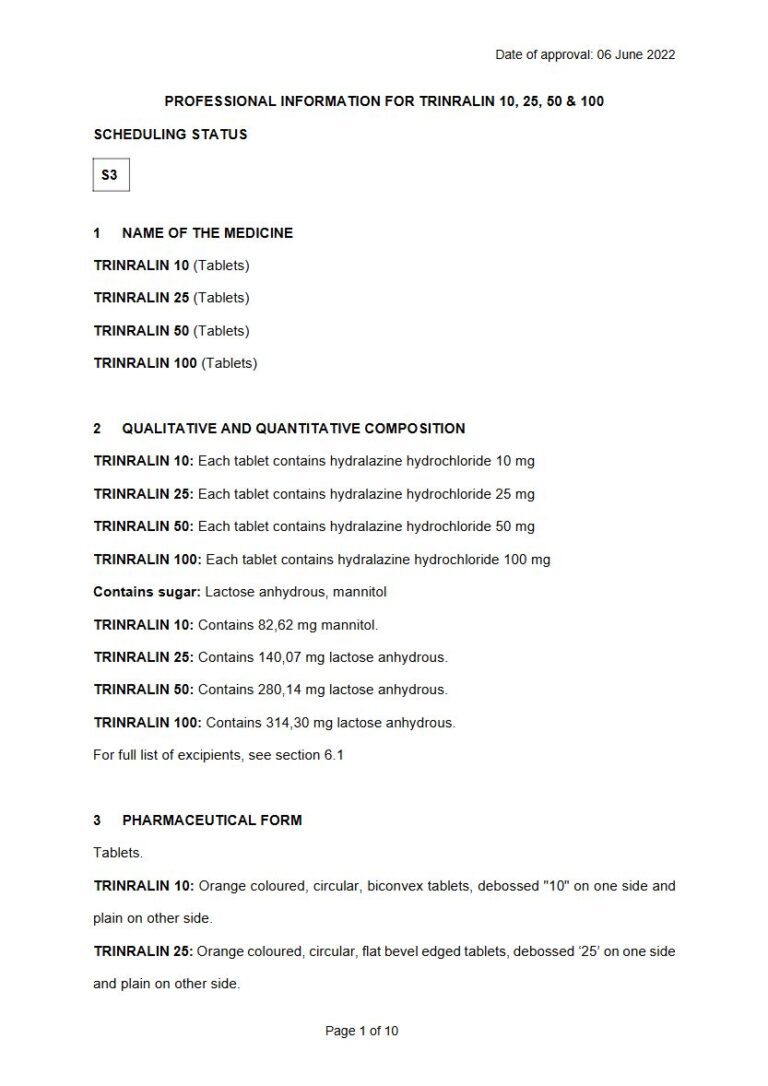
Trinralin 10 10 mg Tablets
PDF Leaflet Revision Date: 06 June 2022
Clinical Summary
Quick overview from the medicine insert
Indication
Treatment of hypertension.
Dosage (summary)
100-200 mg/day, starting with 10-20 mg 2-4 times daily, max 300 mg/day.
Special Populations
- Slow acetylators
- Elderly
Pregnancy & Breastfeeding
Safety during pregnancy and lactation not established.
Key Drug Interactions
- Other antihypertensives
- Anaesthetics
- Tricyclic antidepressants
Contraindications
- Hypersensitivity to hydralazine
- Tachycardia
Common side effects
- Headache
- Nausea
- Palpitations
- Tachycardia
Counselling Points
- Monitor for hypotension
- Report any unusual symptoms
- Avoid alcohol
Serious warnings
- Risk of lupus-like syndrome
- Caution in coronary artery disease
Important Disclaimer
The Trinralin 10 10 mg Tablets professional information leaflet below is the property of Strides Pharma Sa and is provided on Medinsert exactly as issued, with no.. alterations or editorial changes. We make every effort to keep content current by updating documents as soon as new versions become available. Medinsert serves as a trusted access point for healthcare professionals, but does not replace official sources or clinical judgement. For more details, please read our full disclaimer. read more>>
 Healthcare Professionals Only
This content is for registered healthcare professionals
Sign in or create a free account to read the full package insert.
Free for HPCSA-registered professionals. Powered by Medinsert.
Clinical Particulars
Section 4 of the official insert — extracted exactly as issued, no alterations
4.1 Therapeutic indications
TRINRALIN is indicated for the treatment of hypertension.
4.2 Posology and method of administration
Posology
The usual oral dose is 100 mg to 200 mg per day, starting with 10 mg or 20 mg two to four times daily. This is increased gradually until the desired effect is obtained or unacceptable side effects develop. The dose should not exceed 300 mg per day.
Special populations
Reduced doses of hydralazine should be given to patients who are slow acetylators. Hypotension may occur during anaesthesia in patients being treated with hydralazine.
Paediatric population
No data are available.
Method of administration
TRINRALIN is for oral use.
4.3 Contraindications
TRINRALIN is contraindicated in:
u2022 Hypersensitivity to hydralazine or to any of the excipients of TRINRALIN (see section 6.1).
u2022 Patients with tachycardia.
u2022 Used with caution in patients with a history of coronary disease.
4.4 Special warnings and precautions for use
Chronic administration of hydralazine, particularly in doses of 400 mg or more per day, can produce an acute rheumatoid state. A syndrome indistinguishable from disseminated lupus erythematosus, including glomerulonephritis, may develop. The symptoms regress after hydralazine is discontinued but relatively long-term treatment with adrenocorticosteroids (steroids) may be required.
Reduced doses of hydralazine should be given to patients who are slow acetylators and women.
Myocardial stimulation produced by hydralazine can cause anginal attacks and ECG changes of myocardial ischemia. Hydralazine must be used with caution in patients with suspected coronary artery disease.
The u201chyperdynamicu201d circulation caused by hydralazine may accentuate specific cardiovascular inadequacies. For example, hydralazine may increase pulmonary artery pressure in patients with mitral valvular disease.
Postural hypotension may result from hydralazine but is less common than with ganglionic blocking medicines. It should be used with caution in patients with cerebral vascular accidents.
In hypertensive patients with normal kidneys who are treated with hydralazine, there is evidence of increased renal blood flow and a maintenance of glomerular filtration rate. Hydralazine should be used with caution in patients with advanced renal damage.
Hypotension may occur during anaesthesia in patients being treated with hydralazine.
Adrenaline should not be given to antagonise the hypotensive effects of hydralazine since it enhances the cardiac-accelerating effects.
Caution should be observed if hydralazine is administered concurrently with monoamine oxidase inhibitors or tricyclic antidepressants (see section 4.5).
4.5 Interaction with other medicines and other forms of interaction
The following medicine enhance the hypotensive effects of hydralazine:
u2022 Other antihypertensives (diuretics, ACE inhibitors, calcium channel blockers, vasodilators)
u2022 Anaesthetics
u2022 Tricyclic antidepressants
u2022 Major tranquillisers
u2022 Nitrates or drugs exerting central depressant actions (including alcohol)
MAO inhibitors and tricyclic antidepressants should be used with caution in patients receiving hydralazine.
When other potent parenteral antihypertensive medicines, such as diazoxide, are used in combination with hydralazine, patients should be continuously observed for several hours for any excessive fall in blood pressure. Profound hypotensive episodes may occur when diazoxide injection and hydralazine are used concomitantly.
4.6 Fertility, pregnancy and lactation
The safety of hydralazine for use during pregnancy and lactation have not been established.
4.7 Effects on ability to drive and use machines
TRINRALIN has no or negligible influence on the ability to drive and use machines. However, undesirable effects may occur (e.g. allergic reaction, dizziness, convulsions), which may influence the ability to drive and use machines (see section 4.8).
4.8 Undesirable effects
a. Summary of the safety profile
Adverse reactions with hydralazine are usually reversible when dosage is reduced. However, in some cases it may be necessary to discontinue use. Common side effects are headache, anorexia, nausea, vomiting, diarrhoea, palpitations, tachycardia, angina pectoris.
b. Tabulated summary of adverse reactions
4.9 Overdose
Symptoms: Tachycardia, palpitations, severe headache. anorexia, nausea, vomiting, postural hypotension, lacrimation, nasal congestion and peripheral neuritis.
Treatment for tachycardia and relative hypovolaemia may be indicated.
