
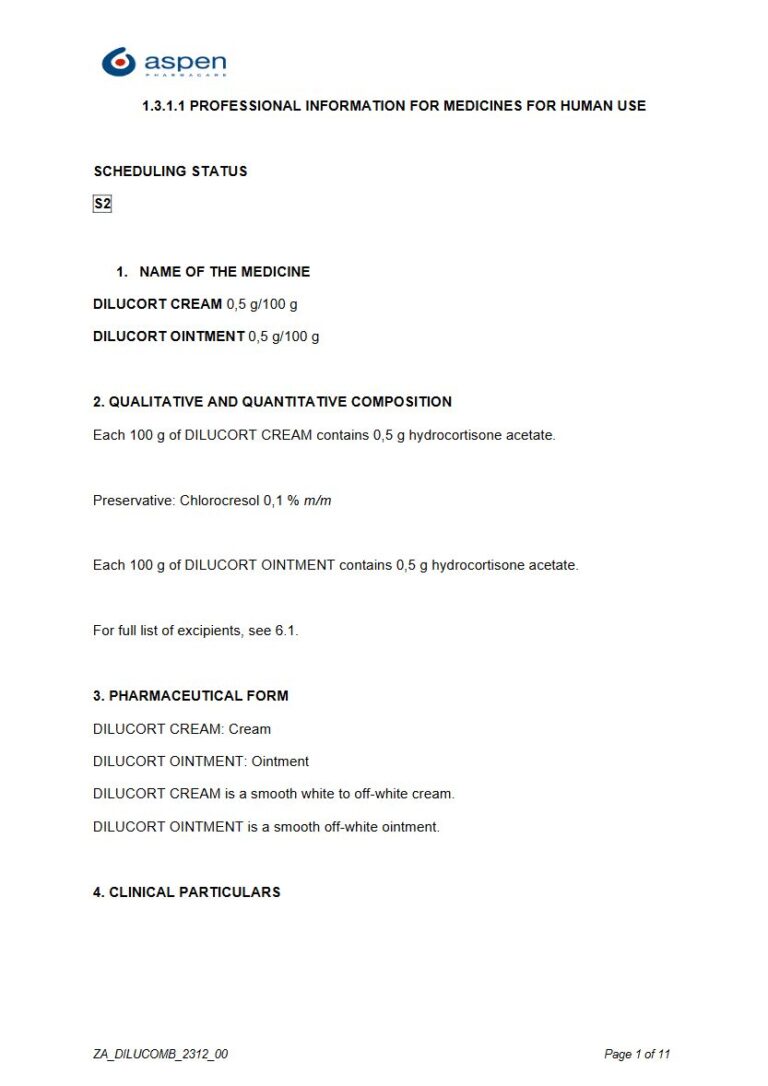
Dilucort 0,5 g/100 g Cream
PDF Leaflet Revision Date: 04 December 2023
Clinical Summary
Quick overview from the medicine insert
Indication
Temporary relief of itching from minor skin irritations.
Dosage (summary)
Apply to affected area up to 4 times daily until improvement.
Special Populations
- Children under 2 years
- Elderly
Pregnancy & Breastfeeding
Contraindicated in pregnancy; safety in lactation not established.
Contraindications
- Hypersensitivity to hydrocortisone acetate
- Vaginal discharge
- Cosmetic use
- Nappy rash
- Anal itching with bleeding
- Children under 12 for genital use
- Longer than 7 days use
- Bacterial, fungal, or viral skin infections
Common side effects
- Blurred vision
- Skin atrophy
- Redness
- Burning sensation
- Itching
Counselling Points
- Do not use for cosmetic purposes
- Avoid contact with eyes
- Consult doctor if symptoms persist after 7 days
- Discontinue if hypersensitivity occurs
Serious warnings
- Avoid use on face for long periods
- Risk of systemic absorption
- Visual disturbances possible
- Caution in psoriasis
Important Disclaimer
The Dilucort 0,5 g/100 g Cream professional information leaflet below is the property of Pharmacare and is provided on Medinsert exactly as issued, with no.. alterations or editorial changes. We make every effort to keep content current by updating documents as soon as new versions become available. Medinsert serves as a trusted access point for healthcare professionals, but does not replace official sources or clinical judgement. For more details, please read our full disclaimer. read more>>
 Healthcare Professionals Only
This content is for registered healthcare professionals
Sign in or create a free account to read the full package insert.
Free for HPCSA-registered professionals. Powered by Medinsert.
Clinical Particulars
Section 4 of the official insert — extracted exactly as issued, no alterations
4.1 Therapeutic indications
DILUCORT is indicated for:
- The temporary relief of itching associated with minor skin irritations due to eczema, insect bites, poison plants, soaps, detergents, cosmetics, jewellery, seborrhoeic dermatitis.
- The relief of external genital and anal itching.
Other uses for the medicine should be only under the advice and supervision of a doctor.
4.2. Posology and method of administration
Posology
DILUCORT should be applied to the affected area up to four times a day until improvement occurs, then the frequency of application may be reduced. DILUCORT should be massaged gently and thoroughly into the skin.
Method of administration
For topical application
Paediatric population
The safety and efficacy of DILUCORT in children under the age of 2 years has not yet been established (see section 4.3).
4.3. Contraindications
DILUCORT is contraindicated in:
- Patients with hypersensitivity to hydrocortisone acetate or to any of the excipients in DILUCORT (see section 6.1).
- The presence of vaginal discharge. Consult a doctor.
- Use for cosmetic purposes.
- Nappy rash.
- The event of external anal itching accompanied by bleeding. Consult a doctor immediately.
- Application into the rectum by using fingers or any mechanical device or applicator.
- Indications pertaining to the genital and anal use in children under the age of 12 years. Consult a doctor.
- Usage for longer than 7 days.
- Use in the presence of skin lesions caused by bacterial (impetigo), fungal (candidiasis, tinea) or viral (e.g. herpes simplex, vaccinia or varicella) infections.
- Rosacea, acne, peri-oral dermatitis, tuberculosis of the skin and varicose ulcers.
- Children under the age of 2 years.
- Use exceeding the recommended dose.
- Use during pregnancy as corticosteroids have been shown to be teratogenic in animals following dermal application. As these medicines are absorbed percutaneously, teratogenicity following topical application cannot be excluded (see section 4.6).
4.4 Special warnings and precautions for use
General topical corticosteroid warnings
DILUCORT should not be used for cosmetic purposes. For external use only.
Facial dermatoses and atrophic skin changes
DILUCORT should be used with particular caution in facial dermatoses, and only for short periods. A steroid rosacea-like facies may be produced. Long-term treatment, with topical corticosteroids should be avoided as far as possible as this may cause atrophic changes in the skin. These changes are particularly likely to occur on the face and when occlusive dressings are used. DILUCORT should be used with caution near the eyes. Contact with the eyes should be avoided. If the condition worsens, or if symptoms persist for more than 7 days or clears up and occurs again within a few days, stop use of this medicine and consult a doctor.
Systemic absorption
Systemic absorption of topically applied corticosteroids may occur, particularly under the following conditions: when large quantities are used; or when application is made to wide areas of the body; or to damaged skin; and when the occlusive dressing technique is applied.
Visual disturbance
Visual disturbance may be reported with systemic and topical corticosteroid, as contained in DILUCORT, use. If a patient presents with symptoms such as blurred vision or other visual disturbances, the patient should be considered for referral to an ophthalmologist for evaluation of possible causes which may include cataract, glaucoma or rare diseases such as central serous chorioretinopathy (CSCR) which have been reported after use of systemic and topical corticosteroids.
Psoriasis
Topical corticosteroids, as in DILUCORT may be hazardous in psoriasis for reasons including rebound relapses following development tolerance, the risk of generalised pustular psoriasis and local and systemic toxicity due to impaired barrier function of the skin; careful patient supervision is important.
Withdrawal syndrome
Long term continuous or inappropriate use of topical steroids, such as DILUCORT, can result in the development of rebound flares after stopping treatment (topical steroid withdrawal syndrome). A severe form of rebound flare can develop which takes the form of a dermatitis with intense redness, stinging and burning that can spread beyond the initial treatment area. It is more likely to occur when delicate skin sites such as the face and flexures are treated. Should there be a reoccurrence of the condition within days to weeks after successful treatment a withdrawal reaction should be suspected. Reapplication should be with caution and specialist advice is recommended in these cases or other treatment options should be considered.
Secondary microbial infection
If a secondary microbial skin infection is present, suitable concomitant antimicrobial therapy should be instituted. Any spread of infection requires withdrawal of topical corticosteroid therapy, and systemic administration of antimicrobial agents.
Paediatric population
There is no experience with DILUCORT and children under the age of 2 years (see sections 4.2 and 4.3). DILUCORT should not be used to treat nappy rash (see section 4.3).
Excipients
DILUCORT CREAM contains chlorocresol 0,1 % m/m which may cause allergic reactions. Treatment with DILUCORT CREAM should be discontinued if this occurs (see section 6.1).
4.5. Interactions with other medicines and other forms of interaction
Not known.
4.6. Fertility, pregnancy and lactation
The use of DILUCORT is contraindicated in pregnancy (see section 4.3.).
Pregnancy
Corticosteroids have been shown to have teratogenic effects in animals, including cleft palate and intra-uterine growth retardation, following dermal application. As these medicines are absorbed percutaneously, teratogenicity following topical application cannot be excluded. Therefore, DILUCORT should not be used during pregnancy (see section 4.3).
Breastfeeding
Safety in lactation has not been established and therefore the use during lactation is not recommended. DILUCORT should not be applied to the chest area.
Fertility
There are no data available regarding DILUCORT and fertility.
4.7. Effects on ability to drive and use machines
Due to undesirable effects such as blurred vision DILUCORT has minor influence on the ability to drive or operate machinery. Patients should not drive, use machinery or perform any tasks that require concentration until they are certain that DILUCORT does not adversely affect their ability to do so safely (see section 4.4 and 4.8).
4.8. Undesirable effects
a) Tabulated list of adverse events
System organ class
Less frequent
Frequency unknown (cannot be estimated from the available data)
Endocrine disorders
Depression of the hypothalamic-pituitary-adrenal axis, suppression of the adrenal gland, retarded growth, Cushingoid state.
Nervous system disorders
Benign intracranial hypertension
Eye disorders
Blurred vision
Skin and subcutaneous tissue disorders
atrophic changes in the skin, thinning, loss of elasticity, dilation of superficial blood vessels, telangiectasiae and ecchymoses.
Withdrawal reactions
- redness of the skin which may extend to areas beyond the initial affected area, burning or stinging sensation, itch, skin peeling, oozing pustules
Skin pigmentation changes, hypertrichosis
b) Description of selected adverse reactions
Treatment with hydrocortisone, as in DILUCORT, is usually well tolerated but treatment should be stopped immediately if symptoms of hypersensitivity occur including allergic contact dermatitis or worsening of the original condition.
Endocrine disorders
Depression of the hypothalamic-pituitary-adrenal axis with consequent suppression of the adrenal gland may occur. These effects are most likely to be severe in children.
Reporting of suspected adverse reactions
Reporting suspected adverse reactions after authorisation of the medicine is important. It allows continued monitoring of the benefit/risk balance of the medicine. Healthcare providers are asked to report any suspected adverse reactions to: SAHPRA: https://www.sahpra.org.za/Publications/Index/8 Aspen Pharmacare: E-mail: [email protected] Tel: 0800 118 088/+ 27 (0)11 239 - 6200
4.9 Overdose
Symptoms
See section 4.8 undesirable effects. Acute overdosage is very unlikely to occur. In the case of chronic overdosage or misuse the features of hypercorticism may appear and in this situation topical steroids should be discontinued.
Treatment
Treatment is supportive and symptomatic.
