
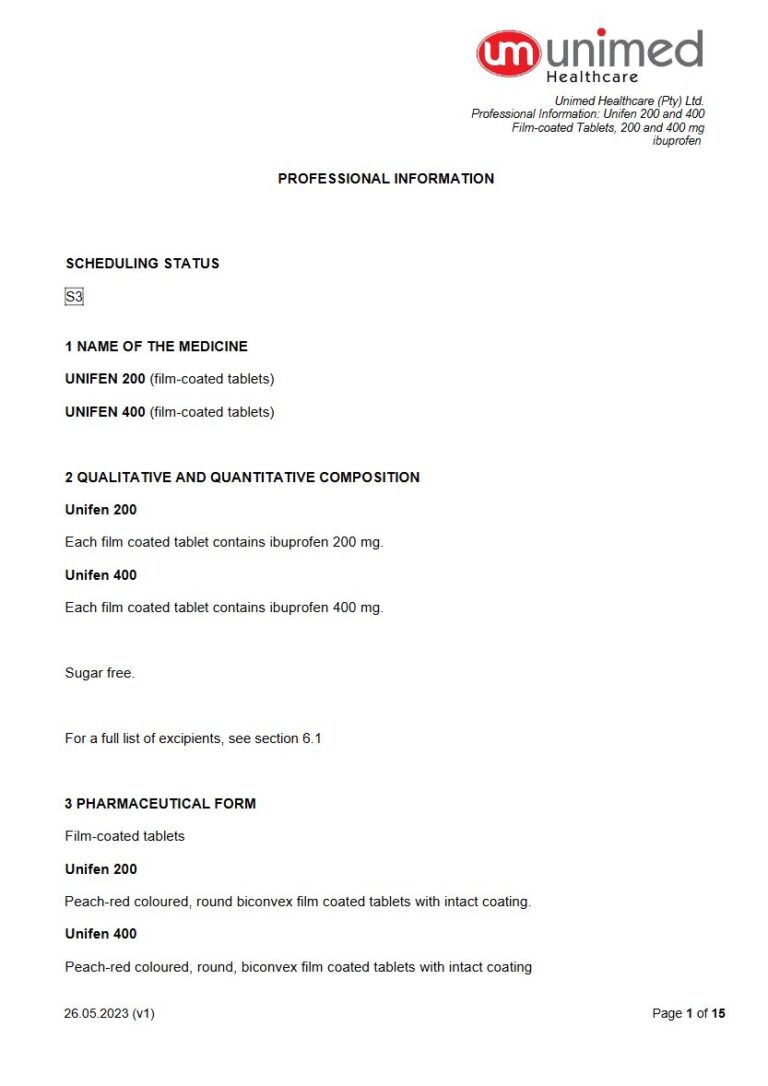
Unifen 200 And 400 200 and 400 mg FC Tablets
PDF Leaflet Revision Date: 26 May 2023
Clinical Summary
Quick overview from the medicine insert
Indication
Treatment of various inflammatory and pain conditions.
Dosage (summary)
Adults: 600 mg every 6-8 hours, max 2400 mg/day.
Special Populations
- Elderly
- Renal impairment
- Hepatic impairment
Pregnancy & Breastfeeding
Avoid in late pregnancy; safety in lactation not established.
Key Drug Interactions
- Warfarin
- Methotrexate
- Diuretics
- ACE inhibitors
Contraindications
- Hypersensitivity to ibuprofen
- Heart failure
- Peptic ulcer disease
- Renal failure
- Children under 12
Common side effects
- Nausea
- Dizziness
- Drowsiness
- Gastrointestinal bleeding
Counselling Points
- Take with food to minimize GI side effects
- Monitor for allergic reactions
- Avoid alcohol
Serious warnings
- Risk of serious skin reactions
- Gastrointestinal bleeding
- Fluid retention in heart failure
Important Disclaimer
The Unifen 200 And 400 200 and 400 mg FC Tablets professional information leaflet below is the property of Unimed Healthcare and is provided on Medinsert exactly as issued, with no.. alterations or editorial changes. We make every effort to keep content current by updating documents as soon as new versions become available. Medinsert serves as a trusted access point for healthcare professionals, but does not replace official sources or clinical judgement. For more details, please read our full disclaimer. read more>>
 Healthcare Professionals Only
This content is for registered healthcare professionals
Sign in or create a free account to read the full package insert.
Free for HPCSA-registered professionals. Powered by Medinsert.
Clinical Particulars
Section 4 of the official insert — extracted exactly as issued, no alterations
4.1 Therapeutic indications
Unifen is indicated for the treatment of:
- Rheumatoid arthritis
- Idiopathic juvenile arthritis (Stillu2019s disease)
- Ankylosing spondylitis
- Osteo-arthritis
- Acute gouty arthritis
- Non-articular rheumatism including fibrositis
- Non-rheumatic inflammatory conditions such as frozen shoulder (capsulitis), bursitis, tendonitis, tenosynovitis and low back pain.
- Relief of mild to moderate pain such as dysmenorrhoea, dental, post-episiotomy and post-partum pain.
- Soft tissue injuries such as sprains and strains.
- Pyrexia
4.2 Posology and method of administration
Posology
Use the lowest effective dose for the shortest possible duration of treatment.
Adults: The recommended dosage of Unifen is 600 mg 6-8 hourly. The total daily dose of Unifen should not exceed 2 400 mg.
Paediatric population
This formulation is not suitable for children under the age of 12 years.
Method of administration
For oral use
To minimize gastrointestinal side-effects or if gastrointestinal disturbances occur, UNIFEN should be given with food or milk.
4.3 Contraindications
- Hypersensitivity (allergy) to ibuprofen or to any of the excipients of Unifen listed in section 6.1.
- Heart failure.
- Peptic ulcer disease or gastrointestinal bleeding.
- History of gastrointestinal bleeding, ulceration or perforation (PUBs) related to previous NSAIDs.
- Active or history of recurrent ulcer/haemorrhage/perforations.
- Patients sensitive to aspirin or another nonsteroidal anti-inflammatory medicine.
- History of severe allergic reaction such as anaphylaxis or angioedema, induced by aspirin or other NSAIDs. Because of the possibility of cross-sensitivity due to structural relationships which exists among non-steroidal anti-inflammatory medicines, acute allergic reactions are likely to occur in patients who have exhibited allergic reactions to these compounds.
- UNIFEN is contraindicated in patients with renal failure.
- Aspirin-induced nasal polyps associated with bronchospasm.
- Children under the age of 12 years.
- The use of UNIFEN around 20 weeks gestation or later in pregnancy may cause a rare but serious foetal renal dysfunction leading to oligohydramnios and, in some cases, neonatal renal impairment. (see Section 4.4 and 4.6)
- Third trimester of pregnancy and during labour (See section 4.6)
- Safety in lactation has not been established.
4.4 Special warnings and precautions for use
The antipyretic, analgesic and anti-inflammatory action of ibuprofen may mask symptoms of the occurrence or worsening of infection. Caution is required in patients with a history of hypertension and/or heart failure as fluid retention and oedema have been reported in association with Unifen therapy. In view of UNIFENu2019s inherent potential to cause fluid retention, heart failure may be precipitated in some compromised patients.
Elderly: The elderly have an increased frequency of adverse reactions to NSAIDs, especially gastrointestinal bleeding and perforation (PUBs) which may be fatal. The risk of gastrointestinal bleeding or perforation (PUBs) is higher with increasing doses of Unifen, in patients with a history of ulcers, and the elderly. When gastrointestinal bleeding or ulceration occurs in patients receiving Unifen, treatment with Unifen should be stopped.
Unifen should be given with caution to patients with a history of gastrointestinal disease (e.g. ulcerative colitis, Crohnu2019s disease, hiatus hernia, gastro-oesophageal reflux disease, angiodysplasia) as the condition may be exacerbated.
Serious skin reactions, some of them fatal, including exfoliative dermatitis, Stevens Johnson syndrome, and toxic epidermal necrolyis have been reported. Unifen should be discontinued at the first appearance of skin rash, mucosal lesions, or any other sign of hypersensitivity.
The use of UNIFEN around 20 weeks gestation or later in pregnancy may cause fetal renal dysfunction leading to oligohydramnios and, in some cases, neonatal renal impairment. Complications of prolonged oligohydramnios include limb contractures and delayed lung maturation, which may require invasive procedures such as exchange transfusion or dialysis. If NSAID treatment is determined necessary, limit use to the lowest effective dose and shortest duration possible. Regular use of NSAIDs during the third trimester of pregnancy may result in premature closure of the fetal ductus arteriosus in utero and possibly in persistent pulmonary hypertension of the new born. The onset of labour may be delayed and its duration increased. Consider ultrasound monitoring of amniotic fluid if NSAID treatment extends beyond 48 hours. Discontinue the NSAID if oligohydramnios occurs (see Section 4.3 and 4.6).
Risk benefit should be considered when the following medical conditions exist:
- Unifen should be given with care to the elderly, to patients with asthma or bronchospasm, bleeding disorders, cardiovascular disease, a history of peptic ulceration and in liver or renal impairment.
- Patients with congestive cardiac failure, cirrhosis, diuretic-induced volume depletion, or renal insufficiency require local synthesis of vasodilating prostaglandins to maintain renal perfusion, and therefore these patients are at greater risk of developing renal dysfunction due to inhibition of renal prostaglandin synthesis.
- Because of the possibility of cross-sensitivity due to structural relationships which exists among non-steroidal anti-inflammatory medicines, acute allergic reactions are likely to occur in patients who have exhibited allergic reactions to these compounds.
- Serious interactions have been reported after the use of high dose methotrexate with ibuprofen.
- Patients receiving warfarin and other anti-coagulants. Patients who are sensitive to aspirin or other NSAIDs should generally not be given ibuprofen.
- Unifen should be discontinued in patients who experience blurred or diminished vision, or changes in colour vision.
- Patients with collagen disease may be at risk of developing aseptic meningitis.
- Drug Reaction with Eosinophillia and Systemic Symptoms (DRESS) has been reported in patients taking NSAIDs such as UNIFEN. Some of these events have been fatal or life-threatening. DRESS typically, although not exclusively, presents with fever, rash, lymphadenopathy, and/or facial swelling. Other clinical manifestations may include hepatitis, nephritis, haematological abnormalities, myocarditis, or myositis. Sometimes symptoms of DRESS may resemble an acute viral infection. Eosinophillia is often present. Because this disorder is variable in its presentation, other organ systems not noted here may be involved. It is important to note that early manifestations of hypersensitivity, such as fever or lymphadenopathy, may be present even though rash is not evident. If such signs or symptoms are present, discontinue UNIFEN and evaluate the patient immediately.
- Mild reactions such as allergic rhinitis, urticaria or skin rash induced by aspirin or other NSAIDs.
- Anaemia
- Stomatitis
- System lupus erythematosus
- Renal Tubular Acidosis
- Severe hypokalaemia and renal tubular acidosis have been reported due to prolonged use of NSAIDs at higher than recommended doses. Presenting signs and symptoms included generalised weakness. NSAID induced renal tubular acidosis should be considered in patients with unexplained hypokalaemia and metabolic acidosis.
4.5 Interaction with other medicines and other forms of interaction
- Anti-hypertensives, beta-blockers and diuretics: UNIFEN may reduce the effect of anti-hypertensives, such as ACE inhibitors, beta-blockers and diuretics.
- NSAIDs - use of two or more NSAIDs concomitantly could result in an increase in side effects.
- Corticosteroids: increased risk of gastrointestinal ulceration, perforation or bleeding (PUBs).
- Anti-coagulants - Unifen may enhance the effects of anti-coagulants such as warfarin and the possibility of gastrointestinal bleeding.
- Anti-platelet agents and selective serotonin reuptake inhibitors (SSRIs) - increased risk of gastrointestinal bleeding.
- Diuretics can also increase the risk of nephrotoxicity of UNIFEN.
- Digoxin u2013 Increase in serum digoxin concentrations. More frequent monitoring is mandatory and may exacerbate cardiac failure and reduce GFR.
- Lithium u2013 Increase in the steady-state concentration of lithium. More frequent monitoring is mandatory.
- Immunosuppressive medicines e.g. ciclosporin u2013 Increased risk of nephrotoxicity.
- Mifepristone: A decrease in the efficacy of the medicinal product can theoretically occur due to the antiprostaglandin properties of UNIFEN. Limited evidence suggests that coadministration of UNIFEN on the day of prostaglandin administration does not adversely influence the effects of mifepristone or the prostaglandin on cervical ripening or uterine contractility and does not reduce the clinical efficacy of medicinal termination of pregnancy.
- Quinolone antibiotics: Patients taking UNIFEN and quinolones may have an increased risk of developing convulsions.
- Aminoglycosides: UNIFEN may decrease the excretion of aminoglycosides.
- Herbal extracts: Ginkgo biloba may potentiate the risk of bleeding with UNIFEN.
- Alcohol, corticosteroids, clopidogrel, ticlopidine, bisphosphonates, pentoxifylline u2013 Increased risk of gastrointestinal bleeding and ulceration.
- Antidiabetic agents u2013 Hypoglycaemic effects of these medicines may be increased.
- Methotrexate u2013 Increased and prolonged methotrexate plasma concentration and an increased risk of methotrexate toxicity. More frequent monitoring is mandatory.
- Bone marrow depressants u2013 The leucopenic and/or thrombocytopenic effects of these medicines may be increased.
4.6 Fertility, pregnancy and lactation
- Pregnant women should not use UNIFEN at 20 weeks or later unless specifically advised to do so by a health care professional because it may cause fetal renal dysfunction leading to oligohydramnios and, in some cases, neonatal renal impairment.
- Additionally it should be avoided at 30 weeks and later in pregnancy because of the additional risk of premature closure of the fetal ductus arteriosus (see Section 4.3 and 4.4).
- Breastfeeding: Safety and efficacy in lactation have not been established (see section 4.3).
4.7 Effects on ability to drive and use machines
Undesirable effects such as dizziness, drowsiness, fatigue and visual disturbances are possible after taking UNIFEN. If affected, patients should not drive or operate machinery.
4.8 Undesirable effects
The frequency of adverse reactions reported with UNIFEN are summarised in Table 1 as per the MedDRA system organ classification (SOC).
Table 1: Tabulated list of adverse reactions
System Organ Class Frequency Adverse effect
Blood and lymphatic system disorders Less frequent Agranulocytosis, thrombocytopenia, anaemias, neutropenia, eosinophilia.
Immune system disorders Less frequent Aseptic meningitis, angioedema, anaphylaxis, fever, rashes, exacerbation of asthma and bronchospasm
Metabolism and nutrition disorders Frequency not known Hypokalaemia
Psychiatric disorders Frequent Depression
Nervous system disorders Frequent Dizziness, nervousness, tinnitus, drowsiness, insomnia. Less frequent Headache, Eye disorders Less frequent Blurred vision Frequency not known Visual impairment, changes in visual colour perception and other toxic amblyopia.
Cardiac disorders Less frequent Tachycardia, flushing, Frequency not known increase in blood pressure / hypertension, oedema, cardiac failure.
Gastrointestinal disorders Frequent Nausea, abdominal cramps and pain. Vomiting, diarrhoea, flatulence, constipation, dyspepsia, peptic ulcers, perforation or gastro-intestinal bleeding (sometimes fatal), melaena, haematemesis, gastritis, ulcerative stomatitis, exacerbation of colitis and Crohnu2019s disease. Less frequent Abdominal discomfort or pain, gastro-intestinal ulcers, sometimes with bleeding.
Hepato-biliary disorders Less frequent Hepatitis. Hepatotoxicity, abnormalities in liver function tests
Skin and subcutaneous tissue disorders Less frequent Allergic dermatitis, erythema multiforme Frequency not known Bullous reactions including Stevens Johnson syndrome and toxic epidermal necrolysis. Drug reaction with Eosinophillia and Systemic Symptoms (DRESS) (see section 4.4)
Renal and urinary disorders Less frequent Oedema, impairment of renal function, cystitis, haematuria, acute reversible renal impairment, interstitial nephritis and nephrotic syndrome. Frequency not known Renal tubular acidosis
Renal tubular acidosis and hypokalaemia have been reported in the post-marketing setting typically following prolonged use of higher than recommended doses.
4.9 Overdose
The most likely symptoms of overdosage are epigastric pain and nausea. Electrolytes may be corrected by intravenous infusions if necessary. There is no specific antidote for Unifen. Treatment is symptomatic and supportive. Prolonged use at higher than recommended doses may result in severe hypokalaemia and renal tubular acidosis. Symptoms may include reduced level of consciousness and generalised weakness (see section 4.4 and 4.8).
