
Coronavac 600,0 SU SUSPENSION FOR INJECTION
PDF Leaflet Revision Date: 09 June 2023
Clinical Summary
Quick overview from the medicine insert
Indication
Active immunisation to prevent COVID-19 in individuals 3 to 59 years.
Dosage (summary)
Adults: 2 doses of 0.5 ml each, 14-28 days apart.
Onset of Action / Duration
Onset: 14 days after first dose, Duration: Unknown.
Special Populations
- Immunocompromised individuals
- Severe neurological conditions
- Thrombocytopenia
- Coagulation disorders
Pregnancy & Breastfeeding
Limited data; safety during pregnancy and lactation not established.
Key Drug Interactions
- No interaction studies performed
- Concomitant administration with other vaccines not studied
Contraindications
- Hypersensitivity to inactivated SARS-CoV-2 virus or excipients
Common side effects
- Injection-site pain
- Headache
- Fatigue
- Muscle pain
- Diarrhoea
- Nausea
Counselling Points
- Record vaccine name and batch number
- Avoid mixing with other vaccines
- Report any adverse reactions
Serious warnings
- Anaphylaxis risk
- Monitor for 15 mins post-injection
- Caution in severe neurological disorders
Important Disclaimer
The Coronavac 600,0 SU SUSPENSION FOR INJECTION professional information leaflet below is the property of Curanto Pharma and is provided on Medinsert exactly as issued, with no.. alterations or editorial changes. We make every effort to keep content current by updating documents as soon as new versions become available. Medinsert serves as a trusted access point for healthcare professionals, but does not replace official sources or clinical judgement. For more details, please read our full disclaimer. read more>>
 Healthcare Professionals Only
This content is for registered healthcare professionals
Sign in or create a free account to read the full package insert.
Free for HPCSA-registered professionals. Powered by Medinsert.
Clinical Particulars
Section 4 of the official insert — extracted exactly as issued, no alterations
4.1 Therapeutic indications
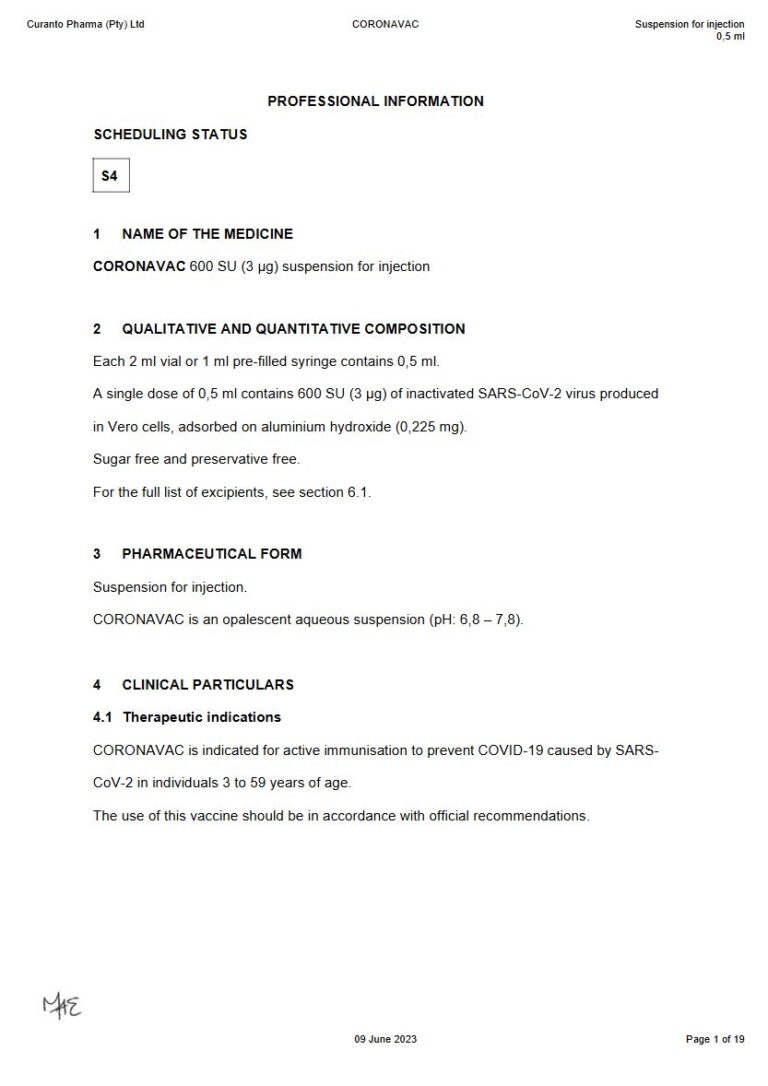
CORONAVAC is indicated for active immunisation to prevent COVID-19 caused by SARS-CoV-2 in individuals 3 to 59 years of age. The use of this vaccine should be in accordance with official recommendations.
4.2 Posology and method of administration
Posology
Adults 18 to 59 years of age
CORONAVAC is administered as a course of two doses of 0,5 ml each.
- Dose 1: at the start date
- Dose 2: 14 to 28 days after first dose.
If the second dose is inadvertently administered earlier than 2 weeks after the first, the dose does not need to be repeated. If the second dose is inadvertently delayed beyond 4 weeks, it should be given at the earliest possible opportunity. It is recommended that all vaccinated individuals receive two doses. According to the current recommendation, the same product should be used for both doses. (see section 5.1).
Paediatric population and adolescents aged 3 to 17 years
The dosage and administration interval for the paediatric and adolescent population is the same as for the individuals aged 18-59 years.
Method of administration
CORONAVAC is for intramuscular injection only, preferably in the deltoid muscle of the upper arm. Do not inject the vaccine intravascularly, intravenously, subcutaneously or intradermally. The vaccine should not be mixed in the same syringe with any other vaccines or medicines. For precautions to be taken before administering the vaccine, see section 4.4. For instructions on handling and disposal of the vaccine, see section 6.6.
4.3 Contraindications
Hypersensitivity to inactivated SARS-CoV-2 virus or to any of the excipients of CORONAVAC listed in section 6.1.
4.4 Special warnings and precautions for use
Traceability
In order to improve the traceability of biological medicines, the name and the batch number of the administered vaccine should be clearly recorded, as per the prescribed instructions.
Hypersensitivity and anaphylaxis
Appropriate medical treatment and supervision should always be readily available for immediate use in case of anaphylactic reaction following the administration of the vaccine. Individuals shall be observed for at least 15 minutes on site after injection. A second dose of the vaccine should not be given to those who have experienced anaphylaxis to the first dose of CORONAVAC.
Anxiety-related reactions
Anxiety-related reactions, including vasovagal reactions (syncope), hyperventilation or stress related reactions may occur in association with vaccination as a psychogenic response to the needle injection. It is important that precautions are in place to avoid injury from fainting.
Concurrent illness
Vaccination should be postponed in individuals suffering from an acute severe febrile illness or acute infection. However, the presence of a minor infection and/or low-grade fever should not delay vaccination.
Neurological disorders
In patients with severe neurological conditions (such as transverse myelitis, Guillain-Barru00e9 syndrome, demyelinating diseases, etc.) CORONAVAC should be used with caution.
Thrombocytopenia and coagulation disorders
The vaccine should be given with caution in individuals receiving anticoagulant therapy or those with thrombocytopenia or any coagulation disorder (such as haemophilia) because bleeding or bruising may occur following an intramuscular administration in these individuals.
Immunocompromised individuals
The efficacy, safety and immunogenicity of the vaccine has been evaluated in a limited number of individuals living with HIV in China and Brazil. The efficacy of the vaccine may be lower in these individuals.
Paediatric population and adolescents aged 3 to 17 years
No warnings and precautions for use are specific to this population.
Duration of protection
The duration of protection afforded by the vaccine is unknown as it is still being determined by ongoing clinical trials.
Limitations of vaccine effectiveness
Protection starts from approximately 14 after the first dose of CORONAVAC. Vaccination with CORONAVAC may not protect all vaccine recipients (see section 5.1).
Excipients with known effect
This medicine contains less than 1 mmol sodium (23 mg) per 0,5 ml dose, that is to say essentially u201csodium-freeu201d.
4.5 Interaction with other medicines and other forms of interaction
No interaction studies have been performed both in adults and in the paediatric and adolescent population. Concomitant administration of CORONAVAC with other vaccines has not been studied.
4.6 Fertility, pregnancy and lactation
Pregnancy
There is a limited amount of data from the use of CORONAVAC in pregnant women. Animal reproductive toxicity studies have been completed. Based on results from the preliminary study, no effects are expected on development of the foetus (see section 5.3). The safety of CORONAVAC during pregnancy has not been established.
Breastfeeding
It is unknown whether CORONAVAC is excreted in human milk. The safety of CORONAVAC during lactation has not been established.
Fertility
Animal studies do not indicate direct or indirect harmful effects with respect to reproductive toxicity (see section 5.3).
4.7 Effects on ability to drive and use machines
CORONAVAC has no or negligible influence on the ability to drive and use machines. However, some of the adverse reactions mentioned under section 4.8 such as dizziness and drowsiness may temporarily affect the ability to drive or use machines.
4.8 Undesirable effects
Adults 18 to 59 years of age
a. Summary of the safety profile
The safety of CORONAVAC has been evaluated based on analysis of pooled data from 4 on-going randomized, blinded, controlled clinical trials in China and Brazil. A total of 14 572 participants u2265 18 years of age were enrolled in such studies, of which 7 654 subjects (age range, 18 ~ 84 years; male/female: 1:2.3) received at least one dose of COVID-19 vaccine and 6 399 received two doses. The median duration of follow-up was 28 days after the last dose.
The most frequently reported adverse reactions in these studies were injection-site pain (50,29 %), headache (28,02 %), fatigue (13,46 %), muscle pain (9,73 %), diarrhoea (6,77 %), nausea (6,53 %). The majority of adverse reactions were mild to moderate in severity and usually resolved within a few days of vaccination. When compared with the first dose, adverse reactions reported after the second dose were milder and reported less frequently.
Reactogenicity was generally milder and reported less frequently in elderly (u2265 60 years).
As of the 23rd May 2021, 276,54 million doses of the COVID-19 vaccine have been supplied in China. According to the immunisation procedure of 2 doses with an interval of 14 to 28 days, the number of people vaccinated is estimated to be 138,27 million. The cumulative doses of the COVID-19 vaccine supplied in other countries/regions are 220,44 million doses. Based on a two-dose immunisation procedure with an interval of 14 to 28 days, the number of vaccinated people is estimated to be 110,22 million. Therefore, the total number of people who have used the vaccine is estimated to be 248,49 million.
As of the data lock point, the most frequently reported adverse reactions were fever (14,65 %), atopic dermatitis (11,02 %), dizziness (9,49 %), fatigue (6,63 %), nausea (5,71 %), headache (3,75 %), vomiting (3,47 %), myalgia (1,76 %).
A total of 295 new and serious adverse reactions (including 198 cases to be determined) were collected, including 36 cases of anaphylactic shock, 15 cases of allergic purpura, 14 cases of cerebral infarction, 13 cases of cerebral haemorrhage, 7 cases of Bell's palsy, 11 cases of laryngeal edema, and 8 cases of Guillain-Barru00e9 syndrome.
Paediatric population
A total of 1 050 subjects aged 3-17 years were enrolled in the clinical trials, of which 592 subjects received at least one dose of CORONAVAC (600 SU/0,5 ml). 1 028 (97,90 %) have completed at least 28 days of follow-up after the second dose vaccination, and the long-term safety observations are ongoing.
b. Summary of adverse events
Adverse drug reactions observed during clinical studies are organized by MedDRA System Organ Class (SOC). Frequency categories are defined as: very common (u2265 1/10); common (u2265 1/100 to < 1/10); uncommon (u2265 1/1 000 to < 1/100); rare (u2265 1/10 000 to < 1/1 000), not known (cannot be estimated from the available data.
4.9 Overdose
In Phase I/II clinical trials, where a higher dose (1 200 SU/dose/0,5 ml) was administered, among 286 adults and 245 elderly people who received this vaccine, no significant difference in the overall adverse reactions had been observed. In the event of an overdose, monitoring of vital functions and possible symptomatic treatment is recommended.
