
Yervoy 5mg/ml Solution for Infusion
PDF Leaflet Revision Date: 24 July 2025
Clinical Summary
Quick overview from the medicine insert
Indication
Treatment of previously treated unresectable or metastatic melanoma in adults.
Dosage (summary)
3 mg/kg IV over 90 mins every 3 weeks for 4 doses.
Special Populations
- Elderly
- Renal impairment
- Hepatic impairment
Pregnancy & Breastfeeding
Not recommended during pregnancy; unknown if excreted in breast milk.
Key Drug Interactions
- Corticosteroids
- Anticoagulants
Contraindications
- Hypersensitivity to ipilimumab or excipients
Common side effects
- Diarrhoea
- Rash
- Pruritus
- Fatigue
- Nausea
Counselling Points
- Monitor for immune-related adverse reactions
- Avoid during pregnancy
- Use contraception during treatment
Serious warnings
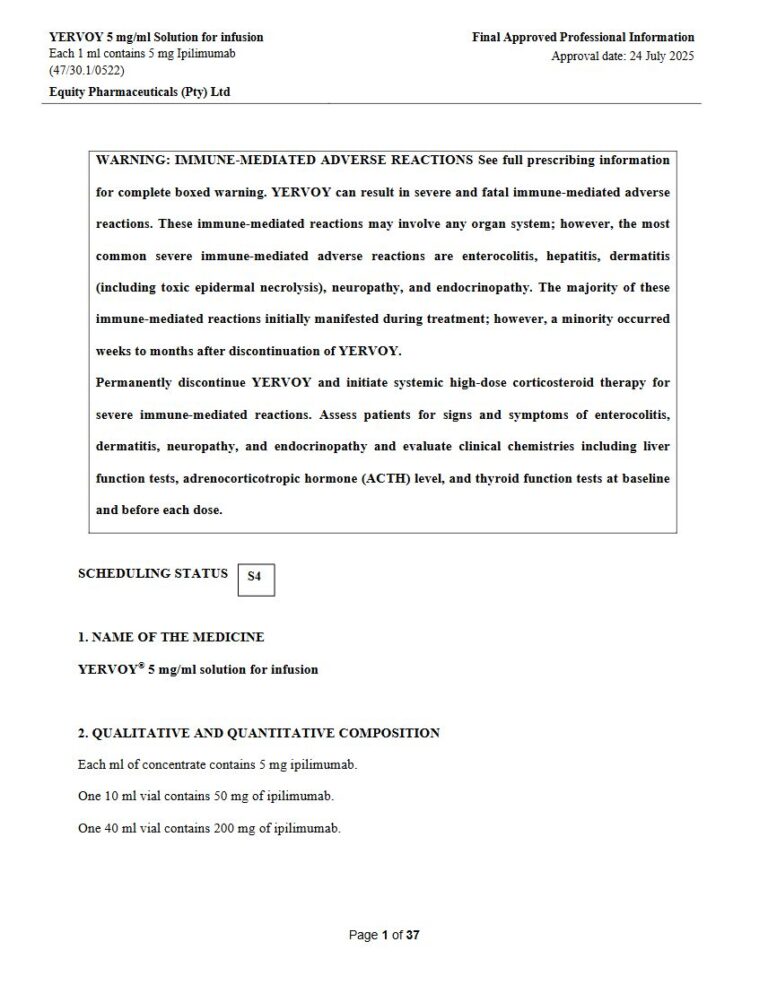
- Severe immune-mediated reactions
- Gastrointestinal perforation
- Hepatotoxicity
Important Disclaimer
The Yervoy 5mg/ml Solution for Infusion professional information leaflet below is the property of Equity Pharmaceutical and is provided on Medinsert exactly as issued, with no.. alterations or editorial changes. We make every effort to keep content current by updating documents as soon as new versions become available. Medinsert serves as a trusted access point for healthcare professionals, but does not replace official sources or clinical judgement. For more details, please read our full disclaimer. read more>>
 Healthcare Professionals Only
This content is for registered healthcare professionals
Sign in or create a free account to read the full package insert.
Free for HPCSA-registered professionals. Powered by Medinsert.
Clinical Particulars
Section 4 of the official insert — extracted exactly as issued, no alterations
4.1 Therapeutic indications
YERVOY is indicated for the treatment of previously treated unresectable or metastatic melanoma in adults.
4.2 Posology and method of administration
YERVOY should be administered under the supervision of healthcare professionals experienced in the treatment of cancer.
Posology:
Adults:
The recommended induction regimen of YERVOY is 3 mg/kg administered intravenously over a 90-minute period every 3 weeks for a total of 4 doses. Patients should receive the entire induction regimen (4 doses) as tolerated, regardless of the appearance of new lesions or growth of existing lesions. Assessment of tumour response to YERVOY should be conducted only after completion of induction therapy.
Additional treatment with YERVOY (re-treatment with four doses) may be considered for patients who develop progressive disease (PD) after prior complete or partial response (CR or PR) or after stable disease (SD) lasting longer than 3 months from the first tumour assessment.
The recommended re-treatment regimen of YERVOY is 3 mg/kg administered intravenously over a 90-minute period every 3 weeks for a total of four doses as tolerated, regardless of the appearance of new lesions or growth of existing lesions.
Liver function tests (LFTs) and thyroid function tests should be evaluated at baseline and before each dose of YERVOY. In addition, any signs or symptoms of immune-related adverse reactions, including diarrhoea and colitis, must be assessed during treatment with YERVOY (see Tables 1A, 1B, and section 4.4).
Paediatric patients:
The safety and efficacy of YERVOY in paediatric patients have not been established.
Permanent discontinuation of treatment or omission of doses: Management of immune-related adverse reactions may require withholding of a dose or permanent discontinuation of YERVOY therapy and institution of systemic high-dose corticosteroid. In some cases, addition of other immunosuppressive therapy may be considered (see section 4.4). Dose escalation or reduction is not recommended. Dosing delay or discontinuation may be required based on individual safety and tolerability.
Guidelines for permanent discontinuation or omission of scheduled doses are described in Tables 1A and 1B. Detailed guidelines for the management of immune-related adverse reactions are described in section 4.4.
4.3 Contraindications
Hypersensitivity to the active substance or to any of the excipients listed in section 6.1.
4.4 Special warnings and precautions for use
Immune-related reactions
YERVOY is associated with inflammatory adverse reactions resulting from increased or excessive immune activity (immune-related adverse reactions), likely to be related to its mechanism of action. Immune-related adverse reactions, which can be severe or life-threatening, may involve the gastrointestinal, liver, skin, nervous, endocrine or other organ systems.
While most immune-related adverse reactions occurred during the induction period, onset months after the last dose of YERVOY has also been reported. Unless an alternate aetiology has been identified, diarrhoea, increased stool frequency, bloody stool, liver function test (LFT) elevations, rash and endocrinopathy must be considered inflammatory and YERVOY-related. Early diagnosis and appropriate management are essential to minimise life-threatening complications.
Systemic high-dose corticosteroid with or without additional immunosuppressive therapy may be required for management of severe immune-related adverse reactions. YERVOY specific management guidelines for immune-related adverse reactions are described below. For suspected immune-related adverse reactions, adequate evaluation should be performed to confirm aetiology or exclude other causes. Based on the severity of the adverse reaction, YERVOY should be withheld and corticosteroids administered. If immunosuppression with corticosteroids is used to treat an adverse reaction that occurs as a consequence of combination therapy, a taper of at least 1-month duration should be initiated upon improvement. Rapid tapering may lead to worsening or recurrence of the adverse reaction. Non-corticosteroid immunosuppressive therapy should be added if there is worsening or no improvement despite corticosteroid use.
Immune-related gastrointestinal reactions
YERVOY is associated with serious immune-related gastrointestinal reactions. Fatalities due to gastrointestinal perforation have been reported (see section 4.8). Patients must be monitored for gastrointestinal signs and symptoms that may be indicative of immune-related colitis or gastrointestinal perforation. Clinical presentation may include diarrhoea, increased frequency of bowel movements, abdominal pain, or haematochezia, with or without fever. In clinical trials, immune-related colitis was associated with evidence of mucosal inflammation, with or without ulcerations, and lymphocytic and neutrophilic infiltration. Post-marketing cases of cytomegalovirus (CMV) infection/reactivation have been reported in patients with corticosteroid-refractory immune-related colitis. Stool infections work-up should be performed upon presentation of diarrhoea or colitis to exclude infectious or other alternate aetiologies.
Management recommendations for diarrhoea or colitis are based on severity of symptoms (per NCI-CTCAE v4 severity grading classification).
- Patients with mild to moderate (Grade 1 or 2) diarrhoea (an increase of up to 6 stools per day) or suspected mild to moderate colitis (e.g. abdominal pain or blood in stools) may remain on YERVOY therapy. Symptomatic treatment (e.g. loperamide, fluid replacement) and close monitoring are advised. If mild to moderate symptoms recur or persist for 5-7 days, the scheduled dose of YERVOY should be withheld and corticosteroid therapy (e.g. prednisone 1 mg/kg orally once daily or equivalent) should be initiated. If resolution to Grades 0-1 or return to baseline occurs, YERVOY may be resumed (see section 4.2).
- YERVOY must be permanently discontinued in patients with severe (Grade 3 or 4) diarrhoea or colitis (see section 4.2), and systemic high-dose intravenous corticosteroid therapy (e.g. methylprednisolone 2 mg/kg/day) should be initiated immediately. Once diarrhoea and other symptoms are controlled, corticosteroid taper should occur over a period of at least 1 month. In clinical trials, rapid tapering (over periods < 1 month) resulted in recurrence of diarrhoea or colitis in some patients. Patients must be evaluated for evidence of gastrointestinal perforation or peritonitis.
- The experience from clinical trials on the management of corticosteroid-refractory diarrhoea or colitis is limited. Addition of an alternative immunosuppressive medicine to the corticosteroid regimen should be considered in corticosteroid-refractory immune-related colitis if other causes are excluded (including Cytomegalovirus (CMV) infection/reactivation evaluated with viral PCR on biopsy, and other viral, bacterial and parasitic aetiology). In clinical trials, a single dose of infliximab 5 mg/kg was added unless contraindicated. Infliximab must not be used if gastrointestinal perforation or sepsis is suspected (see the prescribing information for infliximab).
Immune-related hepatotoxicity
YERVOY is associated with serious immune-related hepatotoxicity, including fatal hepatic failure (see section 4.8). In patients who received YERVOY 3 mg/kg monotherapy in MDX010-20, the time to onset of moderate-to-severe or fatal (Grade 2-5) immune-related hepatotoxicity ranged from 3 to 9 weeks from the start of treatment. With protocol-specified management guidelines, the time to resolution ranged from 0.7 to 2 weeks.
Hepatic transaminase and bilirubin must be evaluated before each dose of YERVOY, as early laboratory changes may be indicative of emerging immune-related hepatitis (see section 4.2). Elevations in LFTs may develop in the absence of clinical symptoms. Increases in aspartate transaminase (AST) and alanine transaminase (ALT) or total bilirubin should be evaluated to exclude other causes of hepatic injury, including infections, tumour progression, or concomitant medication, and monitored until resolution. Liver biopsies from patients who had immune-related hepatotoxicity showed evidence of acute inflammation (neutrophils, lymphocytes, and macrophages).
- For patients with Grade 2 transaminase or total bilirubin elevation, the scheduled dose of YERVOY should be withheld, and LFTs must be monitored until resolution. Upon improvement, YERVOY may be resumed (see section 4.2).
- For patients with Grade 3 or 4 transaminase or total bilirubin elevation, treatment must be permanently discontinued (see section 4.2), and systemic high-dose intravenous corticosteroid therapy (e.g. methylprednisolone 2 mg/kg daily or equivalent) should be initiated immediately. In such patients, LFTs must be monitored until normalisation. Once symptoms have resolved and LFTs show sustained improvement or return to baseline, the initiation of corticosteroid taper should be based on clinical judgment. Tapering should occur over a period of at least 1 month. Elevations in LFTs during taper may be managed with an increase in the dose of corticosteroid and a slower taper.
- For patients with significant LFT elevations that are refractory to corticosteroid therapy, addition of an alternative immunosuppressive medicine to the corticosteroid regimen may be considered. In clinical trials, mycophenolate mofetil was used in patients without response to corticosteroid therapy, or who had an LFT elevation during corticosteroid tapering that was not responsive to an increase in the dose of corticosteroids (see the prescribing information for mycophenolate mofetil).
Immune-related skin adverse reactions
YERVOY is associated with serious skin adverse reactions that may be immune-related. Rare cases of toxic epidermal necrolysis (TEN) (including Steven Johnson Syndrome) have been observed, some with fatal outcome. Rare cases of Drug Reaction with Eosinophilia and Systemic Symptoms (DRESS) have also been reported in clinical trials and during post-marketing use (see section 4.8).
DRESS presents as a rash with eosinophilia associated with one or more of the following features: fever, lymphadenopathy, facial oedema, and internal organ involvement (hepatic, renal, pulmonary). DRESS may be characterized by a long latency (two to eight weeks) between medicine exposure and disease onset. Hypersensitivity skin reactions have been reported following a switch from YERVOY to vemurafenib or PD1-inhibitors or when YERVOY was combined with one of these medicines.
YERVOY-induced rash and pruritus were predominantly mild or moderate (Grade 1 or 2) and responsive to symptomatic therapy. In patients who received YERVOY 3 mg/kg monotherapy in MDX010-20, the median time to onset of moderate-to-severe or fatal (Grade 2-5) skin adverse reactions was 3 weeks (range 0.9-16 weeks) from start of treatment. With protocol-specified management guidelines, resolution occurred in most cases (87%) after discontinuing YERVOY, with a median time from onset to resolution of 5 weeks (range 0.6 to 29 weeks).
YERVOY-induced rash and pruritus should be managed based on severity:
- Patients with a mild to moderate (Grade 1 or 2) rash may remain on YERVOY therapy with symptomatic treatment (e.g. antihistamines). For mild-to-moderate rash or pruritus that persists for 1 to 2 weeks and does not improve with topical corticosteroids, oral corticosteroid therapy should be initiated (e.g. prednisone 1 mg/kg once daily or equivalent).
- For patients with a severe (Grade 3) rash, the scheduled dose of YERVOY should be withheld. If initial symptoms improve to mild (Grade 1) or resolve, YERVOY therapy may be resumed (see section 4.2).
- YERVOY must be permanently discontinued in patients with a very severe (Grade 4) rash or severe (Grade 3) pruritus (see section 4.2), and systemic high-dose intravenous corticosteroid therapy (e.g. methylprednisolone 2 mg/kg/day) should be initiated immediately. Once rash or pruritus is controlled, initiation of corticosteroid taper should be based on clinical judgment. Tapering should occur over a period of at least 1 month.
Caution should be used when considering the use of YERVOY in a patient who has previously experienced a severe or life-threatening skin adverse reaction on prior cancer immune stimulatory therapy.
Immune-related neurological adverse reactions
YERVOY is associated with serious immune-related neurological adverse reactions. Fatal Guillain-Barru00e9 syndrome has been reported in clinical trials. Myasthenia gravis-like symptoms have also been reported (see section 4.8). Patients may present with muscle weakness. Sensory neuropathy may also occur. Post-marketing cases of transverse myelitis have been reported during treatment with YERVOY. Patients should be monitored for signs and symptoms suggestive of myelitis.
Unexplained motor neuropathy, muscle weakness, or sensory neuropathy lasting > 4 days must be evaluated and non-inflammatory causes such as disease progression, infections, metabolic syndromes, and concomitant medication should be excluded.
- For patients with moderate (Grade 2) neuropathy (motor with or without sensory) likely related to YERVOY, the scheduled dose should be withheld. If neurologic symptoms resolve to baseline, the patient may resume YERVOY (see section 4.2).
- YERVOY must be permanently discontinued in patients with severe (Grade 3 or 4) sensory neuropathy suspected to be related to YERVOY (see section 4.2). Patients must be treated according to institutional guidelines for management of sensory neuropathy, and intravenous corticosteroids (e.g. methylprednisolone 2 mg/kg/day) should be initiated immediately.
- Progressive signs of motor neuropathy must be considered immune-related and managed accordingly. YERVOY must be permanently discontinued in patients with severe (Grade 3 or 4) motor neuropathy regardless of causality (see section 4.2).
Immune-related endocrinopathy
YERVOY can cause inflammation of the endocrine system organs, manifesting as hypophysitis, hypopituitarism, adrenal insufficiency, and hypothyroidism, Type 1 diabetes mellitus and diabetic ketoacidosis (see sections 4.2 and 4.8), and patients may present with nonspecific symptoms, which may resemble other causes such as brain metastasis or underlying disease. The most common clinical presentation includes headache and fatigue. Symptoms may also include visual field defects, behavioural changes, electrolyte disturbances, and hypotension. Adrenal crisis (acute adrenal failure) as a cause of the patientu2019s symptoms must be excluded. Clinical experience with YERVOY-associated endocrinopathy is limited.
For patients who received YERVOY 3 mg/kg monotherapy in MDX010-20, time to onset of moderate to very severe (Grade 2-4) immune-related endocrinopathy ranged from 7 to nearly 20 weeks from the start of treatment. Immune-related endocrinopathy observed in clinical trials was generally controlled with immunosuppressive therapy and hormone replacement therapy.
If there are any signs of adrenal crisis such as severe dehydration, hypotension, or shock, immediate administration of intravenous corticosteroids with mineralocorticoid activity is recommended, and the patient must be evaluated for the presence of sepsis or infections. If there are signs of adrenal insufficiency but the patient is not in adrenal crisis, further investigations should be considered including laboratory and imaging assessment. Evaluation of laboratory results to assess endocrine function may be performed before corticosteroid therapy is initiated. If pituitary imaging or laboratory tests of endocrine function are abnormal, a short course of high-dose corticosteroid therapy (e.g. dexamethasone 4 mg every 6 hrs or equivalent) is recommended to treat the inflammation of the affected gland, and the scheduled dose of YERVOY should be withheld (see section 4.2). It is currently unknown if the corticosteroid treatment reverses the gland dysfunction. Appropriate hormone replacement should also be initiated. Long-term hormone replacement therapy may be necessary.
For symptomatic diabetes, YERVOY should be withheld, and insulin replacement should be initiated as needed. Monitoring of blood sugar should continue to ensure appropriate insulin replacement is utilised. YERVOY must be permanently discontinued for life-threatening diabetes. Once symptoms or laboratory abnormalities are controlled and overall patient improvement is evident, treatment with YERVOY may be resumed and initiation of corticosteroid taper should be based on clinical judgment. Tapering should occur over a period of at least 1 month.
Other immune-related adverse reactions
The following adverse reactions suspected to be immune-related have been reported in patients treated with YERVOY 3 mg/kg monotherapy in MDX010-20: uveitis, eosinophilia, lipase elevation, and glomerulonephritis. In addition, iritis, haemolytic anaemia, amylase elevations, multi-organ failure, and pneumonitis have been reported in patients treated with YERVOY 3 mg/kg + gp100 peptide vaccine in MDX010-20. Cases of Vogt-Koyanagi-Harada syndrome and serous retinal detachment have been reported post-marketing (see section 4.8). In addition, cases of severe graft-versus-host disease (GVHD), some with fatal outcome, have been reported in the post-marketing setting in patients who had undergone prior allogeneic stem cell transplant (see section 4.8). The benefit of treatment with YERVOY versus the possible risk should be considered in these patients.
If severe (Grade 3 or 4), these reactions may require immediate systemic high-dose corticosteroid therapy and discontinuation of YERVOY (see section 4.2). For YERVOY-related uveitis, iritis, serous retinal detachment or episcleritis, topical corticosteroid eye drops should be considered as medically indicated. Transient vision loss has been reported in patients with YERVOY-related ocular inflammations.
Infusion reaction
Severe infusion reactions have been reported in clinical trials of YERVOY (see section 4.8). In case of a severe or life-threatening infusion reaction, YERVOY infusion must be discontinued and appropriate medical therapy administered. Patients with mild or moderate infusion reaction may receive YERVOY with close monitoring and use of premedication according to local treatment guidelines for prophylaxis of infusion reactions.
Disease specific precautions
Immune-related pneumonitis
Infections and disease-related aetiologies should be ruled out in patients with signs and symptoms suggestive of immune-related pneumonitis and patients must be monitored for signs and symptoms of pneumonitis. If pneumonitis is suspected, evaluate with radiographic imaging and exclude other causes.
Mycobacterium tuberculosis infection
The monitoring and screening of patients for Mycobacterium tuberculosis infection and reactivation is recommended.
BCG infection
The monitoring of events of systemic BCG infection in patients with urothelial cancer, previously treated with BCG for immunotherapy is recommended.
Melanoma
Patients with ocular melanoma, primary CNS melanoma and active brain metastases were not included in the pivotal clinical trials.
Patients with autoimmune disease
Patients with a history of autoimmune disease (other than vitiligo and adequately controlled endocrine deficiencies such as hypothyroidism), including those who require systemic immunosuppressive therapy for pre-existing active autoimmune disease or for organ transplantation graft maintenance, were not evaluated in clinical trials. YERVOY is a T-cell potentiator that enables the immune response (see section 5.1) and may interfere with immunosuppressive therapy, resulting in an exacerbation of the underlying disease or increased risk of graft rejection. YERVOY should be avoided in patients with severe active autoimmune disease where further immune activation is potentially imminently life threatening.
Patients on controlled sodium diet
Each ml of this medicine contains 0.1 mmol (or 2.30 mg) sodium. To be taken into consideration when treating patients on a controlled sodium diet.
Concurrent administration with vemurafenib
The concurrent administration of YERVOY and vemurafenib is not recommended due to increased toxicity.
Sequential administration with vemurafenib
In a Phase 2 trial, the sequential treatment with vemurafenib followed by 10 mg/kg YERVOY in patients with BRAF-mutated metastatic melanoma showed a higher incidence of Grade 3+ skin adverse reactions than with YERVOY alone. Caution should be used when YERVOY is administered following prior vemurafenib.
4.5 Interactions with other medicines
YERVOY (ipilimumab) is a human monoclonal antibody that is not metabolised by cytochrome P450 enzymes (CYPs) or other metabolising enzymes. A drug-interaction study in adults of ipilimumab administered alone and in combination with chemotherapy (dacarbazine or paclitaxel/carboplatin) was conducted evaluating interaction with CYP isozymes (particularly CYP1A2, CYP2E1, CYP2C8, and CYP3A4) in patients with treatment-nau00efve advanced melanoma. No clinically relevant pharmacokinetic drug-drug interaction was observed between YERVOY and paclitaxel/carboplatin, dacarbazine or its metabolite, 5-aminoimidazole-4-carboxamide (AIC).
Other forms of interactions
Corticosteroids
The use of systemic corticosteroids at baseline, before starting YERVOY, should be avoided because of their potential interference with the pharmacodynamic activity and efficacy of YERVOY. However, systemic corticosteroids or other immunosuppressants can be used after starting YERVOY to treat immune-related adverse reactions. The use of systemic corticosteroids after starting YERVOY treatment does not appear to impair the efficacy of YERVOY.
Anticoagulants
The use of anticoagulants is known to increase the risk of gastrointestinal haemorrhage. Since gastrointestinal haemorrhage is an adverse reaction with YERVOY (see section 4.8), patients who require concomitant anticoagulant therapy should be monitored closely.
4.6 Fertility, pregnancy and lactation
Safety and efficacy in pregnancy and lactation have not been established.
Pregnancy
There are no data on the use of YERVOY in pregnant women. Animal reproduction studies have shown reproductive toxicity (see section 5.3). Human IgG1 crosses the placental barrier. The potential risk of treatment to the developing foetus is unknown. YERVOY should not be used during pregnancy. Women of childbearing potential should use highly effective contraception.
Lactation
Ipilimumab has been shown to be present at very low levels in milk from cynomolgus monkeys treated during pregnancy. It is unknown whether ipilimumab is secreted in human milk. Secretion of IgGs in human milk is generally limited and IgGs have a low oral bioavailability. Significant systemic exposure of the infant is not expected and no effects on the breastfed newborn/infant are anticipated. However, because of the potential for adverse reactions in nursing infants, YERVOY should not be used in women breastfeeding their infants.
Fertility
Studies to evaluate the effect of ipilimumab on fertility have not been performed. Thus, the effect of YERVOY on male and female fertility is unknown.
4.7 Effects on ability to drive and use machines
YERVOY has minor influence on the ability to drive and use machines. Because of potential adverse reactions such as fatigue (see section 4.8), patients should be advised to use caution when driving or operating machinery until they are certain that YERVOY does not adversely affect them.
4.8 Undesirable effects
Summary of safety profile
YERVOY has been administered to approximately 10,000 patients in a clinical program evaluating its use with various doses and tumour types. Unless otherwise specified, the data below reflect exposure to YERVOY at 3 mg/kg in clinical trials of melanoma. In the Phase 3 study MDX010-20, patients received a median of 4 doses (range 1-4).
YERVOY is most commonly associated with adverse reactions resulting from increased or excessive immune activity. Most of these, including severe reactions, resolved following initiation of appropriate medical therapy or withdrawal of YERVOY (see section 4.4 for management of immune-related adverse reactions).
In patients who received 3 mg/kg YERVOY monotherapy in MDX010-20, the most frequently reported adverse reactions (u2265 10% of patients) were diarrhoea, rash, pruritus, fatigue, nausea, vomiting, decreased appetite, and abdominal pain. The majority were mild to moderate (Grade 1 or 2). YERVOY therapy was discontinued for adverse reactions in 10% of patients.
Tabulated list of adverse reactions
Adverse reactions reported in patients with advanced melanoma who were treated with YERVOY 3 mg/kg in clinical trials (n= 767) and from post-marketing surveillance are presented. These reactions are presented by system organ class and by frequency. Frequencies are defined as: Very common (u2265 1/10); common (u2265 1/100 to < 1/10); uncommon (u2265 1/1,000 to < 1/100); rare (u2265 1/10,000 to < 1/1,000); very rare (< 1/10,000), not known (cannot be estimated from available post-marketing data). Within each frequency grouping, adverse reactions are presented in the order of decreasing seriousness.
Rates of immune-related adverse reactions in HLA-A2*0201 positive patients who received YERVOY in MDX010-20 were similar to those observed in the overall clinical program.
Adverse reactions in patients with advanced melanoma treated with YERVOY 3 mg/kg
Infections and infestations
Common: sepsis b, urinary tract infection, respiratory tract infection
Uncommon: septic shock b, pneumonia
Neoplasms benign, malignant and unspecified (including cysts and polyps)
Common: tumour pain
Uncommon: paraneoplastic syndrome
Blood and lymphatic system disorders
Common: anaemia, lymphopenia, thrombocytopenia, neutropenia
Uncommon: haemolytic anaemia b, eosinophilia
Not known: haemophagocytic lymphohistiocytosis (HLH) e
Immune system disorders
Uncommon: hypersensitivity
Very rare: anaphylactic reaction (shock)
Not known: solid organ transplant rejection e
Endocrine disorders
Common: hypopituitarism (including hypophysitis) c, hypothyroidism c
Uncommon: adrenal insufficiency c, secondary adrenocortical insufficiency d, hyperthyroidism c, hypogonadism
Rare: autoimmune thyroiditis d, thyroiditis d
Metabolism and nutrition disorders
Very common: decreased appetite
Common: dehydration, hypokalaemia, weight decreased, hyponatraemia
Uncommon: alkalosis, hypophosphataemia, tumour lysis syndrome, hypocalcaemia d
Rare: type 1 diabetes mellitus (including diabetic ketoacidosis) h
Psychiatric disorders
Common: confusional state, depression
Uncommon: mental status changes, decreased libido
Nervous system disorders
Common: peripheral sensory neuropathy, dizziness, headache, lethargy, cranial neuropathy, brain oedema, peripheral neuropathy
Uncommon: Guillain-Barru00e9 syndrome b,c, meningitis (aseptic), autoimmune central neuropathy (encephalitis) d, syncope, ataxia, tremor, myoclonus, dysarthria
Rare: myasthenia gravis d
Not known: myelitis (transverse myelitis) e
Eye disorders
Common: blurred vision, eye pain
Uncommon: uveitis c, vitreous haemorrhage, iritis c, eye oedema d, blepharitis d, reduced visual acuity, foreign body sensation in eyes, conjunctivitis
Rare: Vogt-Koyanagi-Harada syndrome e, serous retinal detachment
Cardiac disorders
Common: dysrhythmia, atrial fibrillation
Vascular disorders
Common: hypotension, flushing, hot flush
Uncommon: vasculitis, angiopathy b, peripheral ischaemia, orthostatic hypotension
Rare: temporal arteritis d
Respiratory, thoracic and mediastinal disorders
Common: dyspnoea, cough, allergic rhinitis
Uncommon: respiratory failure, acute respiratory distress syndrome b, lung infiltration, pulmonary oedema, pneumonitis
Gastrointestinal disorders
Very common: diarrhoea c, vomiting, nausea, constipation, abdominal pain
Common: gastrointestinal haemorrhage, colitis b,c, gastroesophageal reflux disease, mucosal inflammation d, gastroenteritis, stomatitis
Uncommon: gastrointestinal perforation b,c, large intestine perforation b,c, intestinal perforation b,c, peritonitis (infectious) b, diverticulitis, pancreatitis (autoimmune), enterocolitis, gastric ulcer, large intestinal ulcer, oesophagitis, ileus d, proctitis d
Rare: coeliac disease
Hepatobiliary disorders
Common: abnormal hepatic function
Uncommon: hepatic failure b,c, hepatitis, hepatomegaly, jaundice
Skin and subcutaneous tissue disorders
Very common: rash c, pruritus c
Common: dermatitis, erythema, vitiligo, urticaria, eczema d, alopecia, night sweats, dry skin
Uncommon: toxic epidermal necrolysis (including Stevens Johnson syndrome) b,c, leukocytoclastic vasculitis, skin exfoliation, hair colour changes d
Rare: erythema multiforme d, psoriasis d, Drug Reaction with Eosinophilia and Systemic Symptoms (DRESS) d
Not known: pemphigoid
Musculoskeletal and connective tissue disorders
Very common: musculoskeletal pain f
Common: arthralgia, myalgia, muscle spasms, arthritis
Uncommon: polymyalgia rheumatica, myositis d, muscular weakness d
Rare: polymyositis d
Renal and urinary disorders
Common: renal failure b
Uncommon: glomerulonephritis c, autoimmune nephritis d, renal tubular acidosis, haematuria d, cystitis noninfective g, proteinuria d
Reproductive system and breast disorders
Uncommon: amenorrhoea
General disorders and administration site conditions
Very common: fatigue, injection site reaction, pyrexia, oedema, pain
Common: chills, asthenia, influenza-like illness (symptoms) d
Uncommon: multi-organ failure b,c, systemic inflammatory response syndrome d, infusion related reaction
Investigations
Common: increased alanine aminotransferase c, increased aspartate aminotransferase c, increased blood bilirubin, increased blood alkaline phosphatase d, increased lipase c
Uncommon: increased gamma-glutamyltransferase d, increased blood creatinine, increased blood thyroid stimulating hormone, decreased blood cortisol, decreased blood corticotropin, increased blood amylase c, positive antinuclear antibody d, decreased blood testosterone
Rare: decreased blood thyroid stimulating hormone d, decreased thyroxine d, abnormal blood prolactin d
a Frequencies are based on pooled data from 9 clinical trials investigating the YERVOY 3 mg/kg dose in melanoma.
b Including fatal outcome.
c Additional information about these potentially inflammatory adverse reactions is provided in u201cDescription of selected adverse reactionsu201d and section 4.4. Data presented in those sections primarily reflect experience from a Phase 3 study, MDX010-20.
d Data outside the 9 completed clinical trials in melanoma were included in frequency determinations.
e Post-marketing event (also see section 4.4)
f Musculoskeletal pain is a composite term which includes back pain, bone pain, musculoskeletal chest pain, musculoskeletal discomfort, myalgia, neck pain, pain in extremity, and spinal pain
g Reported in clinical trials and in the post-marketing setting
h Type 1 diabetes mellitus that may be associated with diabetic ketoacidosis
Additional adverse reactions not listed above have been reported in patients who received other doses (either 3 mg/kg) of YERVOY in clinical trials of melanoma. These additional reactions occurred at a frequency of < 1% unless otherwise noted: meningism, myocarditis, pericardial effusion, cardiomyopathy, autoimmune hepatitis, erythema nodosum, autoimmune pancreatitis, hyperpituitarism, hypoparathyroidism, infectious peritonitis, episcleritis, scleritis, Raynaudu2019s phenomenon, palmar-plantar erythrodysaesthesia syndrome, cytokine release syndrome, sarcoidosis, decreased blood gonadotrophin, leukopenia, polycythaemia, lymphocytosis, ocular myositis, and neurosensory hypoacusis.
4.9 Overdose
The maximum tolerated dose of YERVOY has not been determined. In clinical trials, patients received up to 20 mg/kg without apparent toxic effects. In case of overdose, side effects will be exacerbated and exaggerated. Patients must be closely monitored for signs or symptoms of adverse reactions, and appropriate symptomatic treatment instituted.
