
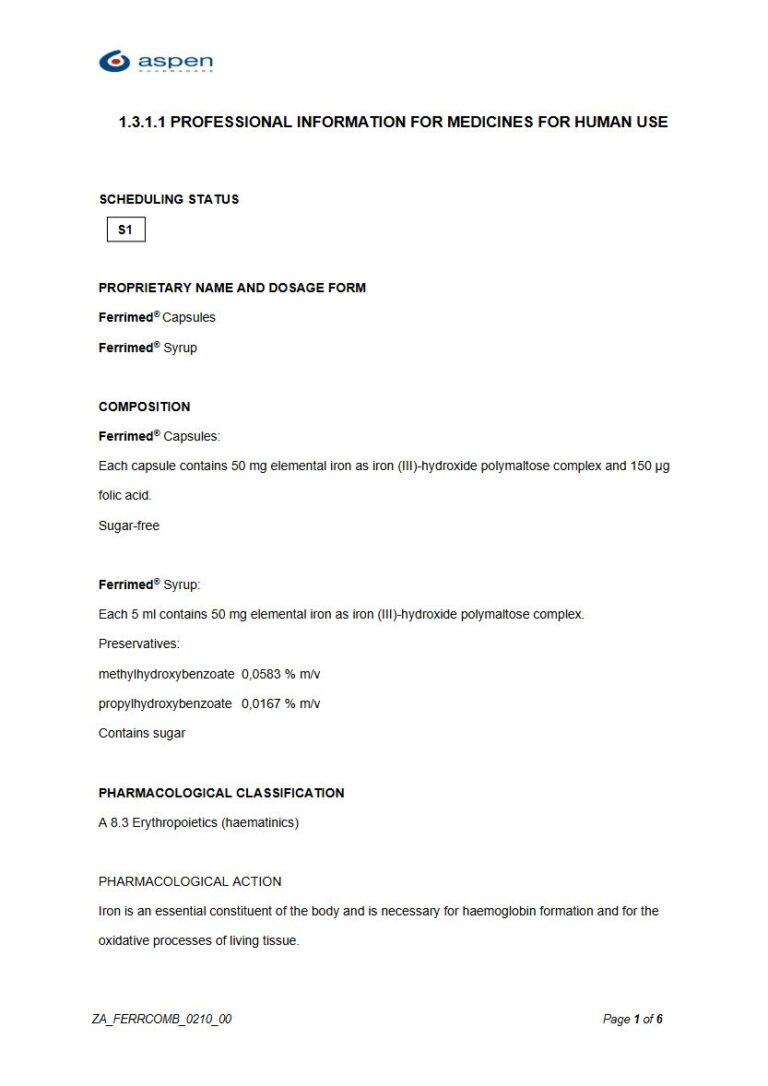
Ferrimed 50 mg Capsules
PDF Leaflet Revision Date: 3 October 2002
Clinical Summary
Quick overview from the medicine insert
Indication
Treatment of iron deficiency and iron deficiency anaemia.
Dosage (summary)
Adults: 100-200 mg elemental iron/day in divided doses with meals.
Special Populations
- Renal impairment
- Hepatic impairment
Pregnancy & Breastfeeding
Consult healthcare provider; safety not established.
Key Drug Interactions
- Antacids
- Tetracyclines
Contraindications
- Iron overload
- Hypersensitivity to iron
- Megaloblastic anaemia
Common side effects
- Gastrointestinal irritation
- Nausea
- Constipation
Counselling Points
- Take with meals
- May cause black stools
- Report severe side effects
Serious warnings
- Risk of overdose in children
- Monitor for gastrointestinal toxicity
Important Disclaimer
The Ferrimed 50 mg Capsules professional information leaflet below is the property of Pharmacare and is provided on Medinsert exactly as issued, with no.. alterations or editorial changes. We make every effort to keep content current by updating documents as soon as new versions become available. Medinsert serves as a trusted access point for healthcare professionals, but does not replace official sources or clinical judgement. For more details, please read our full disclaimer. read more>>
 Healthcare Professionals Only
This content is for registered healthcare professionals
Sign in or create a free account to read the full package insert.
Free for HPCSA-registered professionals. Powered by Medinsert.
Clinical Particulars
Section 4 of the official insert — extracted exactly as issued, no alterations
4.1 Therapeutic indications
Iron (III)-hydroxide polymaltose complex in the Ferrimed u00ae range is indicated for the treatment of iron deficiency and iron deficiency anaemia.
4.2 Posology and method of administration
Ferrimed u00ae Capsules: Therapeutic dose: Two to four capsules (100 mg to 200 mg elemental iron, and 300 u03bcg to 600 u03bcg folic acid) per day or as recommended by a medical practitioner. Supplementary dose: One to two capsules (50 mg to 100 mg elemental iron, and 150 u03bcg to 300 u03bcg folic acid) per day. The capsules must be taken in divided doses with meals.
Ferrimed u00ae Syrup Dosage Regimen
- Adults: Initially 25 mg to 50 mg elemental iron (2,5 ml to 5 ml syrup) per day increased with 25 mg to 50 mg (2,5 ml to 5 ml) increments to 200 mg (20 ml syrup) per day. The syrup should be taken in two to three divided doses per day, with meals.
- Children (6 u2013 12 years): 25 mg to 125 mg elemental iron (2,5 ml to 12,5 ml syrup) (3 mg elemental iron/kg body weight) per day. The syrup should be taken in one or two divided doses per day, with meals.
- Children (2 u2013 5 years): 15 mg to 50 mg elemental iron (1,5 ml to 5 ml syrup) (3 mg elemental iron/kg body weight) per day. The syrup should be taken in one or two divided doses per day, with meals.
- Infants (6 months u2013 2 years): Up to 6 mg elemental iron/kg body weight per day. The syrup should be taken in 3 to 4 divided doses with feeds.
- Infants (under 6 months): 10 mg to 25 mg elemental iron (1 ml to 2,5 ml syrup) per day. The syrup should be taken in 3 to 4 divided doses with feeds. The dose must take into account any supplemental iron contained in the formulation.
- Low birth weight infants or infants with low iron stores: Initially 2 mg/kg body weight per day, decreased gradually to 1 mg/kg body weight per day.
4.3 Contraindications
Cases of iron overload (haemochromatosis; haemosiderosis; chronic haemolysis or lead induced anaemia). Disturbances in iron utilisation (thalassaemia or sideroblastic anaemia). Patients showing hypersensitivity and intolerance to iron. Patients receiving repeated blood transfusions. All forms of anaemia without iron deficiency, e.g. megaloblastic anaemia stemming from Vitamin B 12 deficiency and pernicious anaemia. In cases of inflammatory conditions or malignancy, iron is deposited in the reticulo-endothelial system and iron mobilisation and utilisation do not occur until the underlying disease is treated.
4.4 Special warnings and precautions for use
Notice to diabetics: Ferrimed u00ae Capsules = 0,1 bread units per capsule, Ferrimed u00ae Syrup = 0,2 bread units per 5 ml syrup.
4.8 Undesirable effects
The oral administration of iron preparations may cause gastro-intestinal irritation and abdominal pain with nausea and vomiting. Other gastro-intestinal effects may include either diarrhoea or constipation. The faeces may be coloured black. Lassitude and headache may occur.
4.9 Overdose
Acute iron overdose can be divided into four stages. In the first phase of acute iron overdosage, which occurs up to 6 hours after oral ingestion, gastro-intestinal toxicity, notably vomiting and diarrhoea, predominates. Other effects may include cardiovascular disorders such as hypotension and tachycardia; metabolic changes including acidosis and hyperglycaemia; as well as central nervous system depression ranging from lethargy to coma. Patients with mild to moderate poisoning do not generally progress past this first phase.
The second phase may occur at 6 to 24 hours after ingestion and is characterised by a temporary remission or clinical stabilisation.
The third phase gastro-intestinal toxicity recurs together with shock, metabolic acidosis, convulsions, coma, hepatic necrosis and jaundice, hypoglycaemia, coagulation disorders, oliguria or renal failure and pulmonary oedema.
The fourth phase may occur several weeks after ingestion and is characterised by gastro-intestinal obstruction and possibly late hepatic damage.
In treating acute iron poisoning, speed is essential to block absorption of iron from the alimentary tract. Emesis or lavage should be considered and serum-iron concentrations may be an aid to estimating the severity of the poisoning. Chelation therapy with desferrioxamine, according to the instructions on the package insert, may be necessary. Treatment is symptomatic and supportive.
