
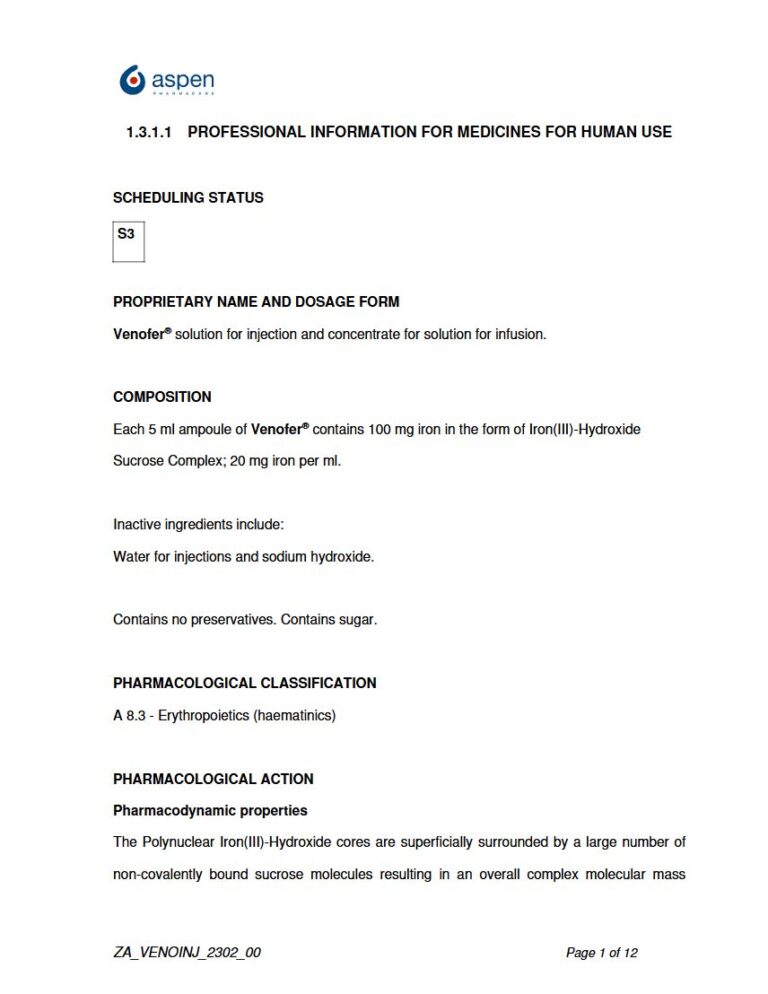
Venofer 5 ml Solution
PDF Leaflet Revision Date: 23 February 2023
Clinical Summary
Quick overview from the medicine insert
Indication
Severe iron deficiency in adults not tolerating or responding to oral iron.
Dosage (summary)
Individualized based on total iron deficit; max 200 mg per dose, up to three times a week.
Onset of Action / Duration
Onset: 10 mins, Duration: 6 hours
Special Populations
- Renal impairment
- Hepatic impairment
Pregnancy & Breastfeeding
Use in second/third trimester only; safety in lactation not established.
Key Drug Interactions
- Oral iron preparations reduce absorption
Contraindications
- Iron overload
- Anaemia not caused by iron deficiency
- Hypersensitivity to components
- Liver damage
- Infectious hepatitis
- Acute or chronic infection
- History of allergic reactions
- First trimester of pregnancy
Common side effects
- Hypotension
- Nausea
- Vomiting
- Abdominal pain
- Injection site reactions
Counselling Points
- Monitor for allergic reactions during administration
- Avoid rapid injection to prevent hypotension
- Do not mix with other medications
Serious warnings
- Risk of severe allergic reactions
- Must be administered intravenously only
- Maximum daily dose of 200 mg
Important Disclaimer
The Venofer 5 ml Solution professional information leaflet below is the property of Pharmacare and is provided on Medinsert exactly as issued, with no.. alterations or editorial changes. We make every effort to keep content current by updating documents as soon as new versions become available. Medinsert serves as a trusted access point for healthcare professionals, but does not replace official sources or clinical judgement. For more details, please read our full disclaimer. read more>>
 Healthcare Professionals Only
This content is for registered healthcare professionals
Sign in or create a free account to read the full package insert.
Free for HPCSA-registered professionals. Powered by Medinsert.
Clinical Particulars
Section 4 of the official insert — extracted exactly as issued, no alterations
4.1 Therapeutic indications
Severe iron deficiency in adult patients not tolerating or responding to oral iron. Venofer u00ae is recommended for use only where the indication is definite and confirmed by appropriate investigations.
4.2 Posology and method of administration
Administration: Venofer u00ae must be administered by a slow intravenous injection, by an intravenous drip infusion or, in patients receiving haemodialysis, into the venous limb of the dialyser (see WARNINGS). Venofer u00ae is a strongly alkaline solution and must never be administered by the subcutaneous or intramuscular route. Paravenous leakage must be avoided because leakage of Venofer u00ae at the injection site may lead to pain, inflammation, tissue necrosis, and brown discolouration of the skin. Venofer u00ae is not suitable for intramuscular use nor for TDI (Total Dose Infusion).
TEST DOSE: Before administration of the first therapeutic dose of Venofer u00ae in a new patient, a test dose of 1 ml to 2,5 ml Venofer u00ae (20 mg to 50 mg iron) should be given by the chosen method of administration (see below). If no adverse reaction occurs within a waiting period of at least 15 minutes after administration, the remaining portion of the initial dose may be given.
Infusion: The content of one ampoule has to be diluted exclusively in 100 ml of sterile 0.9 % m/v sodium chloride solution, immediately prior to infusion (i.e. 2 ampoules in 200 ml sterile 0.9 % m/v NaCl). The first 25 mg of iron (i.e. 25 ml of solution) should be infused as a test dose over a period of 15 minutes (see above TEST DOSE). If no adverse reaction occurs during this time, then the remaining portion of the infusion should be given as follows:
- 100 mg iron (5 ml Venofer u00ae) in at least 15 minutes
- 200 mg iron (10 ml Venofer u00ae) in at least 30 minutes
Intravenous injection: As an intravenous injection Venofer u00ae must be administered slowly at a rate of 1 ml undiluted solution per minute (i.e. 5 minutes per ampoule), not exceeding 2 ampoules Venofer u00ae (200 mg iron) per injection. Before administering a slow intravenous injection, a test dose of 1 ml (20 mg of iron) should be injected slowly over a period of 1 to 2 minutes. If no adverse event occurs within 15 minutes of completing the test dose, the remaining portion of the injection may be given.
Injection into dialyser: Venofer u00ae may be administered during a haemodialysis session directly into the venous limb of the dialyser under the same procedures as those outlined for intravenous injection.
4.3 Contraindications
u2013 Iron overload or disturbances in utilisation of iron (e.g. haemochromatosis, haemosiderosis).
u2013 Anaemia not caused by iron deficiency (e. g. haemolytic anaemias).
u2013 Known hypersensitivity to iron mono-, disaccharide complexes, Venofer u00ae or any of its components
u2013 Clinical or biochemical evidence of liver damage
u2013 Infectious hepatitis
u2013 Acute or chronic infection
u2013 A history of asthma, eczema, other allergic disorders or anaphylactic reactions
u2013 The safety in lactation and children has not been established
u2013 Pregnancy first trimester.
4.4 Special warnings and precautions for use
Venofer u00ae has a pH of 11 and must therefore be given strictly by the intravenous route, and the maximum daily dose of 200 mg should not be exceeded. Parenterally administered iron preparations can cause severe allergic or anaphylactic reactions. Therefore, facilities for cardio-pulmonary resuscitation must be available. In the event of a serious anaphylactic or allergic reaction, administration of Venofer u00ae must be stopped, intramuscular or intravenous epinephrine (adrenaline) should be administered immediately and other supportive measures initiated in line with the established cardio-pulmonary resuscitation procedures of the clinic or hospital.
Mild allergic reactions should be managed by stopping the administration of Venofer u00ae and administering antihistamines. Hypotensive episodes may occur if the injection is administered too rapidly. Patients with low iron binding capacity and/or folic acid deficiency are particularly at risk of an allergic or anaphylactic reaction. In cases of inadvertent paravenous leakage, and while the needle is still inserted, rinse with a small amount of 0.9 % sodium chloride solution. Venofer u00ae should not be administered in combination with oral iron preparations. Venofer u00ae must not be mixed with other medicines for simultaneous administration. A sterile 0.9 % m/v sodium chloride solution is the only recommended diluent for an infusion. Ampoules should be visually inspected for damage before use and only those with a sediment-free solution may be used. From a microbiological point of view, the product should be used immediately after first opening the container or after dilution with sterile 0.9 % m/v sodium chloride. Residual solvents must be discarded, once the ampoule has been opened. Porphyria: Safety has not been established.
4.5 Interactions with other medicines
Venofer u00ae should not be administered concomitantly with oral iron preparations, since the absorption of oral preparations is reduced.
4.6 Fertility, pregnancy and lactation
Pregnancy: Venofer u00ae is recommended for use in the second and third trimester and not for use during the first trimester in pregnancy (see CONTRA-INDICATIONS). Venofer u00ae should only be used in pregnant women with severe iron deficiency anaemia; where there is inability to absorb or tolerate adequate amounts of oral iron.
Lactation: Safety during lactation has not been established.
4.7 Effects on ability to drive and use machines
After being given Venofer u00ae, the patient may feel dizzy, confused or light-headed. If this happens, the patient should be advised not to drive or use any tool or machines.
4.8 Undesirable effects
Very common (u2265 1/10); common (u2265 1/100, < 1/10); uncommon (u22651/1 000, < 1/100); rare (u2265 1/10 000, < 1/1000,) very rare ( u2264 1/10 000,) including isolated cases.
Cardio-vascular disorders
Uncommon: Hypotension and collapse; tachycardia and palpitations.
Gastrointestinal disorders
Uncommon: Nausea; vomiting; abdominal pain; diarrhoea.
General disorders and administration site disorders
Uncommon: Fever, shivering, flushing; chest pain and tightness. Injection site disorders such as superficial phlebitis, burning, swelling.
Rare: Anaphylactic and anaphylactoid reactions (involving arthralgia); peripheral oedema; fatigue, asthenia; malaise. Isolated cases: Reduced level of consciousness, lightheaded feeling, confusion; angio-oedema; swelling of joints, hyperhidrosis, back pain.
Musculoskeletal, connective tissue and bone disorders
Uncommon: Muscle cramps, myalgia.
Nervous system disorders
Common: Transient taste perversions (in particular metallic taste).
Uncommon: Headache; dizziness.
Rare: Paraesthesia.
Respiratory, thoracic and mediastinal disorders
Uncommon: Bronchospasm, dyspnoea.
Skin and subcutaneous tissue disorders
Uncommon: Pruritus; urticaria; rash, exanthema, erythema.
4.9 Overdose
Overdosage can cause acute iron overloading which may manifest itself as haemosiderosis. Particular caution should be exercised to avoid iron overload where anaemia, non-response to treatment, has been incorrectly diagnosed as iron deficiency anaemia. Overdosage should be treated, if required, with an iron chelating agent.
