
Monicor 60mg Tablets
PDF Leaflet Revision Date: 17 February 2026
Clinical Summary
Quick overview from the medicine insert
Indication
Prophylactic treatment of angina pectoris.
Dosage (summary)
60 mg daily in the morning; may increase to 120 mg.
Special Populations
- Elderly
- Hepatic impairment
- Renal impairment
Pregnancy & Breastfeeding
Safety during pregnancy and lactation not established.
Key Drug Interactions
- Alcohol
- Vasodilators
- Sildenafil
Contraindications
- Hypersensitivity to isosorbide-5-mononitrate
- Severe hypotension
- Angle closure glaucoma
Common side effects
- Headache
- Dizziness
- Hypotension
- Nausea
Counselling Points
- Take in the morning with water
- Do not chew or crush tablets
- Avoid alcohol
Serious warnings
- Risk of tolerance
- Severe hypotension
- Caution in recent myocardial infarction
Important Disclaimer
The Monicor 60mg Tablets professional information leaflet below is the property of Pharma Dynamics and is provided on Medinsert exactly as issued, with no.. alterations or editorial changes. We make every effort to keep content current by updating documents as soon as new versions become available. Medinsert serves as a trusted access point for healthcare professionals, but does not replace official sources or clinical judgement. For more details, please read our full disclaimer. read more>>
 Healthcare Professionals Only
This content is for registered healthcare professionals
Sign in or create a free account to read the full package insert.
Free for HPCSA-registered professionals. Powered by Medinsert.
Clinical Particulars
Section 4 of the official insert — extracted exactly as issued, no alterations
4.1 Therapeutic indications
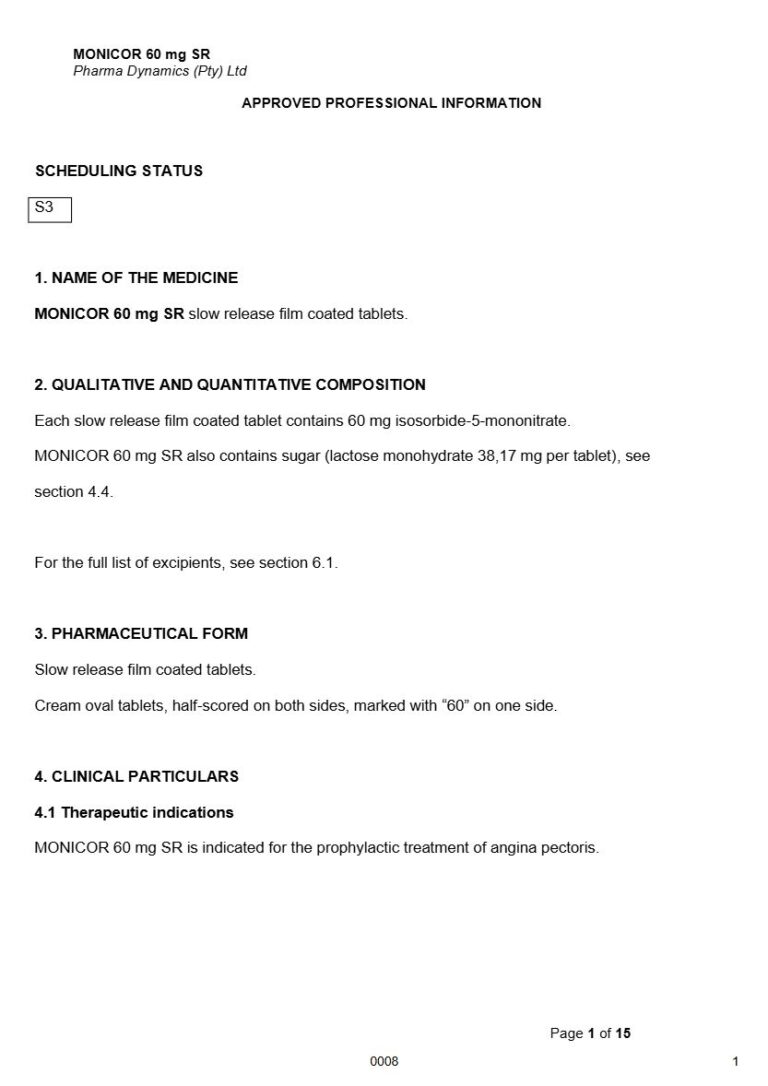
MONICOR 60 mg SR is indicated for the prophylactic treatment of angina pectoris.
4.2 Posology and method of administration
Posology
The recommended dosage is 60 mg daily (one tablet), in the morning. This dosage may be increased to 120 mg (two tablets), once daily in the morning. Treatment may be initiated with 30 mg (half a tablet) for the first two to four days, to minimize the possibility of headache. MONICOR 60 mg SR may be used effectively in monotherapy as well as in combination with chronic beta blocker therapy. NOTE: MONICOR 60 mg SR tablets are not indicated for the relief of acute anginal attacks. Sublingual or buccal nitroglycerin tablets should be used in these situations (see section 4.4).
Special populations
Elderly
There is no evidence for routine dosage adjustment in the elderly, however, special care may be needed in those with increased susceptibility to hypotension or marked hepatic or renal insufficiency.
Paediatric population
The safety and efficacy of this medicine in children has not been established.
Method of administration
Tablets are divisible. MONICOR 60 mg SR tablets may be broken in half, but should not be chewed or crushed and should be taken with half a glass of water. Missed dose: Doctors should advise patients who forget to take MONICOR 60 mg SR to take a dose as soon as possible and then continue with the normal dose. Patients should not take a double dose to compensate for the missed dose.
4.3 Contraindications
- hypersensitivity to isosorbide-5-mononitrate or to any of the ingredients of MONICOR 60 mg SR (see section 6.1)
- severe hypotension, hypovolaemia, marked anaemia, heart failure due to obstruction (including constrictive pericarditis, aortic or mitral stenosis), cardiac tamponade, or raised intracranial pressure due to head trauma or cerebral haemorrhage
- patients with angle closure glaucoma, as MONICOR 60 mg SR may increase intra-ocular pressure
- sildenafil and other phosphodiesterase type 5 inhibitors (PDE 5) must not be given with MONICOR 60 mg SR (see section 4.5).
Severe cerebrovascular insufficiency or hypotension are relative contraindications to the use of MONICOR 60 mg SR.
4.4 Special warnings and precautions for use
The lowest effective dose should be used. There is a risk of tolerance developing to modified release preparations. In such patients intermittent therapy may be more appropriate. Therapy should not be discontinued suddenly. Both dosage and frequency should be tapered gradually (see section 4.2). Symptoms of circulatory collapse may arise after the first dose, particularly in patients with labile circulation. Hypotension induced by nitrates may be accompanied by paradoxical bradycardia and increased angina. Severe postural hypotension with light-headedness and dizziness is frequently observed after the consumption of alcohol. The administration of isosorbide mononitrate causes a decrease of effective renal plasma flow (eRPF) in cirrhotic patients and should be used with caution. Caution should be observed in patients with severe cerebral arteriosclerosis and hypotension.
MONICOR 60 mg SR tablets are not indicated for the relief of acute anginal attacks. Sublingual or buccal nitroglycerin tablets should be used in these situations (see section 4.2). MONICOR 60 mg SR may increase intra-ocular pressure in patients with angle closure glaucoma, (see section 4.3). MONICOR 60 mg SR should be used with caution in patients who have a recent history of myocardial infarction and in patients suffering from hypothyroidism, hypothermia, malnutrition, and severely impaired renal or hepatic function. Oral nitrates should also be used with caution in patients with angina due to other causes, or pre-existing hyperdynamic conditions. Since oral nitrates can cause venous dilatation, they should not be used in patients with increased intracranial pressure.
Excipients
MONICOR 60 mg SR contains lactose. Patients with rare hereditary problems of galactose intolerance, total lactase deficiency or glucose-galactose malabsorption should not take this medicine.
4.5 Interaction with other medicines and other forms of interaction
The hypotensive effects of MONICOR 60 mg SR may be enhanced by alcohol, and by vasodilators and other medicines with hypotensive actions (antihypertensives, calcium channel blockers, and diuretics). Concomitant administration with sildenafil and other phosphodiesterase type 5 inhibitors (PDE 5) can potentiate the effect of MONICOR 60 mg SR leading to life threatening cardiovascular complications such as hypotension, syncope or myocardial infarction. Concomitant administration of MONICOR 60 mg SR may increase the blood level of dihydroergotamine and its hypertensive effect. Alcohol can attenuate cerebral ischaemia associated with postural hypotension. MONICOR 60 mg SR can act as a physiological antagonist to noradrenaline, acetylcholine and histamine.
4.6 Fertility, pregnancy and lactation
Pregnancy
The safety of MONICOR 60 mg SR during pregnancy has not been established.
Breastfeeding
The safety of MONICOR 60 mg SR during lactation has not been established. It is not known whether MONICOR 60 mg SR is secreted in human milk.
Fertility
There is no data on fertility with MONICOR 60 mg SR.
4.7 Effects on ability to drive and use machines
MONICOR 60 mg SR may cause drowsiness and impair your ability to drive and use machinery. Patients may develop headache or dizziness when first using the tablets. Caution is advised while performing these tasks, especially if other blood pressure lowering medications are taken at the same time.
4.8 Undesirable effects
a. Summary of the safety profile
Most of the adverse reactions are pharmacodynamically mediated and dose dependent. Headache may occur when treatment is initiated but usually disappears after 1-2 weeks of treatment. The dose can be titrated to minimize the possibility of headache, by initiating treatment with 30mg. Hypotension which may manifest as dizziness and nausea with syncope in isolated cases, has occasionally been reported. These symptoms generally disappear during continued treatment.
b. Tabulated list of adverse effects
System Organ Class
Frequency
Side effects
Blood and lymphatic system disorders
Less frequent
Methaemoglobinaemia
Immune system disorders
Frequency unknown
Allergic dermatitis, exfoliative dermatitis
Nervous system disorders
Frequent
Frequency unknown
Dizziness, restlessness Somnolence, pituitary haemorrhage
Eye disorders
Less frequent
Blurred vision
Cardiac disorders
Frequent
Less frequent
Tachycardia
Bradycardia
Vascular disorders
Frequent
Less frequent
Frequency unknown
Hypotension, syncope, headache
Severe or prolonged headache
Flushing, orthostatic hypotension, pallor, circulatory collapse (sometimes accompanied by brady-dysrhythmia, bradycardia and syncope), severe hypotension may lead to enhanced angina pectoris symptoms
Respiratory, thoracic and mediastinal disorders
Less frequent
Frequency unknown
Impairment of respiration
Hypoxia
Gastrointestinal disorders
Frequent
Less frequent
Nausea
Vomiting, diarrhoea
Skin and subcutaneous tissue disorders
Frequent
Less frequent
Flushing of the face
Cyanosis, rash, pruritus
Musculoskeletal, connective tissue and bone disorders
Less frequent
Myalgia
General disorders and administrative site conditions
Frequency unknown
Asthenia
Reporting of suspected adverse reactions
Reporting suspected adverse reactions after authorisation of the medicine is important. It allows continued monitoring of the benefit/risk balance of the medicine. Healthcare professionals are requested to report any suspected adverse drug reactions to SAHPRA via the Med Safety APP (Medsafety X SAHPRA) and eReporting platform (who-umc.org)
4.9 Overdose
Signs and symptoms:
Symptoms of overdosage are pulsing headache, excitation, flushing, cold perspiration, nausea, vomiting, vertigo, syncope, tachycardia and hypotension. A rise in intracranial pressure with confusion and neurological deficits can sometimes occur. Methaemoglobinaemia (cyanosis, hypoxaemia, change in mental status, respiratory depression, convulsions, cardiac dysrhythmias, circulatory failure and raised intracranial pressure) occurs rarely.
Management of overdose:
Treatment should include induction of emesis and the use of activated charcoal. If the patient presents with pronounced hypotension, they should be placed in the supine position with legs raised and if necessary intravenous fluid can be administered. Consider oral activated charcoal if ingestion of a potentially toxic amount has occurred within 1 hour. Observe for at least 12 hours after the overdose. Monitor blood pressure and pulse. If methaemoglobinaemia occurs seek expert advice. Treat with supplemental oxygen and methylene blue. In cases not responding to methylene blue or where methylene blue is contraindicated consider exchange transfusion or red blood cell concentrates. In case of cerebral convulsions, consider diazepam or clonazepam IV or, if therapy fails, phenobarbital, phenytoin or propofol anaesthesia. Treatment is symptomatic and supportive.
